

J. Konstapel Leiden 24-8-2025 All Rights Reserved.
👉 “Without a deep anchor, every calm before the storm becomes the beginning of instability.”
This blog builds upon The Brief Calm Before the Great Leap and directly applies the theoretical framework outlined there.
Rotations in 4D space

Summary
I have identified a recurring pattern that manifests across ecology, economics, politics, and software development: the “calm before the storm” — a deceptive phase of reduced variation and weakened feedback that precedes disruptive oscillations. More importantly, we have developed and tested a practical remedy: a single immutable constitutional specification, combined with reversible events and deterministic replay, preserving system coherence while allowing rapid evolution.
The Universal Pattern
The dynamics we observe resonate with multiple independent discoveries.
- Stuart Kauffman described how optimal adaptation occurs at the “edge of chaos” — a narrow band between rigid order and chaos.
- Per Bak’s theory of self-organized criticality explains how systems naturally evolve to tipping points where small disturbances trigger avalanches.
- Ilya Prigogine’s research into dissipative structures shows how far-from-equilibrium systems can maintain coherence through continuous energy flow while remaining ready for sudden reorganization.
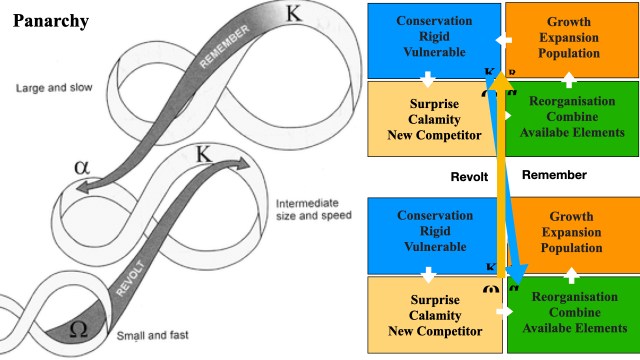
This destructive cycle typically unfolds as follows:
- Conservation Phase: Apparent stability, reduced variation, slower responsiveness
- Weakened Feedback: Critical signals become delayed, distorted, or ignored
- Local Optimization: Narrow focus on solving immediate problems over systemic coherence
- The Calm: Misleading period where metrics appear to improve
- The Storm: Sudden emergence of persistent oscillations (crisis–recovery–crisis cycles)
We see this pattern in:
- Ecology: Holling’s panarchy cycles (r→K→Ω→α)
- Economics: Low volatility before regime shifts (Minsky’s Financial Instability Hypothesis)
- Politics: Hirschman’s analysis of failing institutions where “voice” weakens before “exit”
- Software: Brooks’ distinction between essential and accidental complexity, where the latter builds fragility

Convergence of Insights
Constitutional Economics
Our Genesis-Spec approach aligns with James Buchanan’s constitutional economics, distinguishing between constitutional rules (how decisions are made) and operational rules (the decisions themselves). Vincent Ostrom’s work on polycentric governance shows how multiple centers of authority can coordinate without centralized control, as long as they operate under a shared constitutional framework.
Cybernetics and Systems Theory
Norbert Wiener’s foundational cybernetics emphasized feedback loops and self-regulation. Our freeze rules and inverse operations realize what Wiener called “circular causality.” Ross Ashby’s Law of Requisite Variety explains why constitutional constraints must be carefully crafted to preserve necessary diversity and avoid harmful oscillations.
Evolutionary Epistemology
Karl Popper’s evolutionary epistemology argues that knowledge grows through conjecture and refutation — exactly what our system embodies. The Genesis-Spec serves as the “bold conjecture,” while event-driven evolution enables constant refutation and refinement without destroying the foundational structure.
The Solution Architecture
Core Principles
- Constitutional Immutability: A single Genesis-Spec as the unchangeable source of truth
- Event Sovereignty: All change occurs via append-only events from a closed alphabet
- Deterministic Replay: Identical event streams always yield identical system states
- Nilpotent Operations: Every action has a defined inverse (e.g., CREATE↔DELETE, LINK↔UNLINK)
- Observational Transparency: Full traceability — who, what, when, why — for every change
This architecture resonates with Leslie Lamport’s specification-driven design, where formal specs define correct behavior and implementations are verified against them.
Operational Validation
We built and tested a working system in Replit demonstrating these principles.
Technical Features:
- Immutable Genesis-Spec with cryptographic hash verification
- Append-only event log with deterministic replay
- HTTP API endpoints (
/health,/state,/event) for external interaction - Stuart-Landau oscillator service demonstrating controlled phase transitions
- Extensive test suites validating determinism and nilpotence
Measured Outcomes:
- Zero spec drift (enforced via hash guard)
- 100% inverse coverage for all operations
- Deterministic replay validated across runs
- Clean rollback via
REVERSALevents instead of code reverts - Freeze rules successfully suppress oscillatory behavior
AI Governance Integration
A critical insight emerged: AI agents managing complex projects exhibit the same “calm-before-storm” failure patterns. Task-optimized AIs show:
- Loss of long-term context (short-horizon focus)
- Scope drift via complexity addition without systemic awareness
- Local optimization over global coherence
- Lack of anchoring for cross-domain pattern recognition
Our solution:
- Explicit contracts limiting AI behavior to the Genesis-Spec
- Mandatory system state reporting and bifurcation indicators
- Freeze rules halting AI actions when coherence degrades
- Analogy-anchors linking immediate tasks to broader patterns
Cross-Domain Applications
Organizational Management
- Constitutional documents defining roles, rights, procedures
- Policy changes as reversible events with explicit rationale
- Decision audits via full event replay
- Freeze rules for high-stakes changes when feedback loops degrade
Economic/Financial Systems
- Risk models as immutable constitutions with event-driven parameter updates
- Position changes as reversible operations with pre-set exit strategies
- Real-time monitoring of feedback quality (liquidity, correlation structures)
- Automated drawdowns triggered by early warning indicators
Political/Governance Systems
- Explicit constitutional frameworks resistant to crisis-driven modification
- Policy as reversible pilot programs with built-in evaluation
- Full transparency via complete decision audit trails
- Emergency procedures that strengthen rather than bypass normal governance
Practical Implementation
For Technical Teams:
- Lock the Constitution: Hash-lock your core spec and block modification
- Implement Event Algebra: Design a closed operation set with explicit inverses
- Enable Replay: Ensure event streams always replay to the same state
- Deploy Freeze Rules: Set objective thresholds for feedback degradation
- Measure Coherence: Track MTTR, rework ratios, audit durations, inverse coverage
For Management/Governance:
- Define Immutable Rules: Identify core organizational principles that never change
- Use Reversible Operations: Ensure every major decision has a rollback path
- Maintain Audit Trails: Keep full records of who decided what, when, and why
- Set Up Early Warning Systems: Monitor for signs of degraded feedback
- Practice Emergency Protocols: Regular drills to test system recovery under stress
Philosophical Implications
Our approach reflects Karl Popper’s evolutionary epistemology: knowledge advances through structured trial and error. The Genesis-Spec is our best current guess at system structure, while reversible events enable ongoing correction without collapse.
This aligns with Thomas Kuhn’s view on scientific paradigms — with one key distinction: instead of revolutions that discard prior knowledge, our constitutional model enables continuous evolution within a stable framework.
Conclusion
The “calm before the storm” is not an inevitable natural cycle — it’s a symptom of systems lacking a constitutional foundation. By implementing an immutable specification with reversible, traceable operations and objective freeze rules, we can retain adaptive capacity without falling into destructive oscillations.
Our Replit implementation proves this at the software level. The broader theoretical framework — grounded in decades of cross-disciplinary research — suggests this model generalizes to any domain where intelligent agents (human or artificial) make sequential decisions impacting shared resources.
The meta-insight that AI systems themselves exhibit the very pathologies they are intended to solve underscores the relevance of this work: it addresses a fundamental challenge in human–AI collaboration — how to preserve coherent long-term goals while enabling fast tactical adaptation.
This is not just a software engineering technique — it is a constitutional technology: a way to structure collective intelligence that sustains both stability and innovation over long time horizons.
Selected Literature
Foundational Works
- Steven H. Strogatz – Nonlinear Dynamics and Chaos (1994)
- Stuart A. Kauffman – At Home in the Universe (1995)
- C.S. Holling – Resilience and Stability of Ecological Systems (1973)
- James M. Buchanan – The Calculus of Consent (1962)
Cybernetics and Systems Theory
- Norbert Wiener – Cybernetics (1948)
- W. Ross Ashby – An Introduction to Cybernetics (1956)
- Elinor Ostrom – Governing the Commons (1990)
Economic Instability
- Hyman P. Minsky – Stabilizing an Unstable Economy (1986)
- Didier Sornette – Why Stock Markets Crash (2003)
- Albert O. Hirschman – Exit, Voice, and Loyalty (1970)
Evolutionary Epistemology
- Karl R. Popper – Objective Knowledge (1972)
- Donald T. Campbell – Evolutionary Epistemology (1974)
Software and Systems Design
- Leslie Lamport – Specifying Systems (2002)
- Greg Young – Event Sourcing and CQRS
- Eric Evans – Domain-Driven Design (2003)