

Reality emerges from drawing a single distinction in the void.
This act of self-observation generates oscillation, creating time and number.
From this, iterants form the algebra of physics and knot topology.
Particles are stable topological knots, described by nilpotent quantum mechanics.
Complex systems become conscious eigenforms by observing themselves.
Thus, the universe is a self-knotting, self-aware process of distinction.
J.Konstapel, Leiden, 13-1-2026.
Louis H. Kauffmann is the most important collaborator of Peter Rowlands.
Jump to the Summary push here
Spring naar de Nederlandse vertaling Hier.
ReUsed Blogs
This blog is an extension of Strategic Insights into Unified Field Theory
It re-uses Fluid Architectures and the River of Light
Walter Russell’s Light Returns
Applied Magic and Octonion-Oscillation as Post-AI Paradigms
Re-engineering Effective Magic: From Occult Symbolism to Oscillatory Engineering
de ∞-dige Vormen van de Triade (About the TAO and the Kabbalah).
List Religions
Taoism
Reality emerges from the Dao through the primary distinction of Yin and Yang.
Their continuous oscillation generates time, form, and natural order.
Kabbalah (Jewish Mysticism)
Creation begins with Tzimtzum, a self-limiting distinction within the Infinite.
The Sefirot are stable self-referential processes forming a coherent cosmos.
Advaita Vedanta
Brahman differentiates itself through Maya without losing unity.
Reality is the self-play of consciousness observing itself.
Neoplatonism
The One unfolds into Nous through self-reflection.
Multiplicity arises as a necessary recursive expression of unity.
Christian Mysticism (Apophatic / Trinitarian)
God is known through self-relation rather than attributes.
Creation flows from internal self-reference, not external causation.
Sufism (Wahdat al-Wujud)
Being is one and manifests to know itself.
The world is self-disclosure through recursive differentiation.
Buddhism (Madhyamaka / Huayan)
No fixed substance exists, only relational arising.
Reality is a self-consistent network of mutual reflection.
Hermeticism
Mind generates cosmos through self-expression.
Form is stabilized thought across recursive levels.
Gnosticism (non-dual strains)
The divine unfolds through self-knowing emanations.
Error arises only when recursion is mistaken for separation.
Shamanic Cosmologies
Reality is process, rhythm, and cyclic return.
Stable forms are temporary resonances in a living field.
Indigenous Animism
All beings arise through relational distinction.
Identity is maintained by continuous feedback with the environment.
Process Theology
God and world co-emerge through relational becoming.
Stability arises from recursive interaction, not static being.
Huayan Chinese Buddhism
Each phenomenon contains all others through reflection.
The cosmos is a topological net of self-referential forms.
Stoicism (Logos doctrine)
Logos structures matter through immanent rational order.
Form arises from self-organizing principles within nature.
Summary
All listed systems describe reality as self-distinguishing, self-observing process.
River of ight:
Knots

Laws of Forms
is taken out of the Tao Te King.

LAWS of FORM (LOF)of George Spencer Brown
Lof is really a “Esoteric” book about the Creation out of Nothing.
LoF contains the A and the OM of the Sound of Creation AOM.
Tao Te Ching
Spencer-Brown’s motto is a verse from Laozi’s Tao Te Ching.Laozi begins his writing with four verses, of which Spencer-Brown has chosen the third verse.


Wu ming tian di zhi shi:
‘Nothing’ is the name of the beginning of Heaven and Earth”.
Preface
Louis H. Kauffman is not primarily a physicist reformulating quantum mechanics. He is a systems theorist who discovered that the deepest principle unifying mathematics, physics, biology, computation, and consciousness is self-referential topology. His vision is that reality emerges from the recursive act of drawing distinctions and observing oneself observing.
Peter Rowlands’ nilpotent quantum mechanics is one manifestation of this principle—powerful, but not the center. The center is Kauffman’s recognition that form observing its own form is the mechanism underlying all existence.
Part 1: The Foundation — Laws of Form and Primitive Distinction
Kauffman grounds everything in George Spencer-Brown’s Laws of Form (LoF), which begins with one axiom: the act of drawing a distinction.
The Mark as Foundation
A mark (boundary, distinction) in the void creates inside/outside, self/other. This is not metaphor; it is the primitive operation. Once drawn, a distinction can:
- Re-enter itself — the mark observing its own mark creates oscillation
- Iterate — repeated re-entry generates sequences: [present, not-present, present, …]
- Generate value — oscillation between states produces the roots of number and time
Re-entry and Oscillation
When a distinction re-enters itself (observes its own observation), it generates oscillation between marked and unmarked states. This oscillation is the origin of:
- Imaginary numbers (±1 alternating is the seed of √−1)
- Time (the sequence of distinctions unfolding)
- Quantum superposition (existing in both marked and unmarked simultaneously)
- Consciousness (the observer observing itself observing)
This is not poetic. Kauffman shows mathematically that re-entry generates the Clifford algebra, which is the language of physics itself.
Part 2: Iterants — Discrete Time as the Origin of Algebra
Kauffman’s iterants are the bridge from pure distinction to all algebraic structure.
What is an Iterant?
An iterant is a discrete oscillating sequence with memory. For example:
- A simple iterant: [+1, −1, +1, −1, …]
- With shift operator applied recursively: combinations generate √−1, rotation matrices, and Clifford basis elements
How Iterants Generate the Dirac Equation
- Start with oscillation: A single iterant is time pulsing: present/absent.
- Add shift and combination: Iterate the iterant on itself (self-reference), shifting and combining terms.
- Emergence of algebra: The iterant rules naturally produce:
- The four basis vectors of Clifford space
- Anticommutation relations (the defining property of fermions)
- The full Dirac algebra
- Continuity appears: Infinite iteration (continuous limit) produces the continuous Dirac equation.
The insight: You don’t assume the Dirac equation as a mysterious truth. It emerges from pure temporal distinction combined with self-reference. Quantum mechanics is not imposed from outside; it is what happens when a system observes its own oscillation.
This is why Rowlands’ nilpotent formalism works—it is the algebraic language that iterants naturally speak.
Part 3: Topology and Algebra as the Same Language
Kauffman’s central discovery unifies these apparently distinct domains.
Knots as Operators
A knot diagram is not merely a drawing. It is a sequence of algebraic operations:
- Reidemeister moves (the three ways to deform a knot diagram without changing the knot type) correspond exactly to algebraic rewriting rules
- Crossings (braiding) represent operator applications — under-crossing and over-crossing encode phase rotations and unitary transformations
- Knot invariants (properties like the Jones polynomial that don’t change under deformation) are conservation laws
Conversely, any algebraic operator can be drawn as a knot/braiding diagram. Topology and algebra are the same language viewed from different angles.
Braiding = Quantum Gate
In anyonic systems and topological quantum field theory:
- Exchanging two anyons is a unitary phase rotation
- The braiding pattern encodes the operator
- Braiding is computation
This means: a particle exchanging places with another particle is performing a quantum operation. Reality is not particles moving through space; it is topological operations unfolding in a continuous medium.
Knot Invariants = Conservation Laws
Why does an electron have a conserved charge? In the traditional view, it’s an ad-hoc symmetry. In Kauffman’s view: charge is a knot invariant. The electron is a stable topological knot in the field. You cannot remove its charge without undoing the knot itself, which requires breaking continuity.
This explains why conservation laws are so rigid—they reflect topological impossibility, not merely mathematical symmetry.
Part 4: Physical Instantiation — The Nilpotent Framework
Peter Rowlands’ nilpotent quantum mechanics is the concrete realization of Kauffman’s topological-algebraic framework in physics.
Why Nilpotency Matters
The nilpotent operator (\hat{N}) (where (\hat{N}^2 = 0)) satisfies the zero-totality principle: the universe, in totality, must sum to zero. Any nonzero totality requires an arbitrary external reference.
This single algebraic requirement generates:
- The Dirac equation
- Relativistic energy-momentum relation
- Gauge symmetries (origin of all forces)
- Conservation laws (energy, momentum, charge, baryon/lepton number)
The Connection to Kauffman
The nilpotent operator is isomorphic to the Clifford algebra structure that Kauffman shows emerges from iterants. This means Rowlands provides physical evidence that Kauffman’s abstract topological-algebraic framework is not mere mathematical elegance—it is the actual structure of nature.
Particles are topological solitons: stable knots whose existence is guaranteed by topology, not by energy minima. The vacuum is not empty; it is the structured totality of all compensating phases.
Part 5: Self-Observation and Eigenforms — How Systems Know Themselves
Kauffman’s concept of eigenform is his deepest contribution to understanding consciousness and complex systems.
Eigenforms: Circular Closure
An eigenform is a system whose organization describes itself. Formally:
- A system produces a description D of itself
- The description D can feed back to affect the system
- The system evolves such that its organization matches its description
- The system has become an eigenform of its own observation
Example: A living cell maintains its structure through continuous self-repair and organization. Its genes encode instructions that produce the proteins that build the cell. The cell is a circular closure: it is a description that maintains the form it describes.
Self-Reference Without Paradox
In classical logic, self-reference leads to paradox. In Kauffman’s framework, paradox is dissolved because the distinction between observer and observed can oscillate.
The observer examining itself creates a re-entry, which is a natural oscillation. The system can be simultaneously observer and observed without collapsing.
Consciousness as Meta-Eigenform
When a system becomes complex enough to perform eigenform operations on its own eigenform (observe its own self-observation), consciousness emerges.
This is a formal property of sufficiently complex topological-algebraic systems. A conscious system:
- Maintains its own organization (first-order eigenform)
- Can represent that maintenance (forms a description of itself)
- Can iterate the description on itself (watches itself watching itself)
Human consciousness is unique in degree of topological complexity, not in kind.
Part 6: Biological Complexity and Edge of Chaos
(Note: The NK-model framework discussed here is primarily the work of Stuart A. Kauffman, a separate researcher in complexity biology. Louis H. Kauffman has explored related ideas in reflexiveness and self-organization, but the connection is thematic through shared principles of self-reference.)
Complex adaptive systems naturally organize at the edge of chaos—maximum adaptability without dissolution.
Part 7: Computation as Topology
Kauffman extends his vision to computation: algorithms are topological operations.
Computation can be represented as knot diagrams deformed by allowed moves. Virtual knot theory encodes quantum operations and non-local effects.
Quantum computation is natural computation in full topological space.
Part 8: Towards a Unified Vision
The Central Principle: Recursive Self-Distinction
Reality is the recursive act of drawing distinctions and observing one’s own observation.
This generates mathematics, physics, biology, computation, and consciousness from the same deep structure.
In Kauffman’s vision, particles are forms, observers are embedded, consciousness is natural, and life is inevitable.
The universe is a self-observing void, knotting itself into form through recursive distinction.
Part 9: Strategic Implications
Influence works through resonant rewriting, not brute force—guiding systems to new stable configurations via phase alignment.
This applies to medicine (untying pathological knots), technology (topological devices), computation (eigenform-based systems), and organizations (shifting recursive patterns).
References and Deep Dives
Core Kauffman Works
- Kauffman, L. H. (1987). On Knots. Princeton University Press.
- Kauffman, L. H. (2016–2022). Iterants papers (arXiv).
- Kauffman, L. H. (2009). Laws of Form – An Exploration.
On Eigenforms and Self-Reference
- Kauffman, L. H. (various). Papers on eigenforms, including “EigenForm” (Cybernetics & Human Knowing) and related works.
Video Lectures (Kauffman Explaining Himself)
- Louis H. Kauffman: “Majorana Fermions, Braiding and the Dirac Equation” (2020)
URL: https://www.youtube.com/watch?v=Oz0bYLD0EAE
Starts from Laws of Form, through iterants and braiding, to quantum mechanics. - Louis H. Kauffman: “The Dirac Equation and Majorana Fermions” (2020)
URL: https://www.youtube.com/watch?v=gmg3ShFCih8
Discrete processes generate continuous physics. - Louis H. Kauffman: “Explorations in Laws of Form” (2019)
URL: https://www.youtube.com/watch?v=RQvazsnkriA
Depth of primitive distinction and re-entry. - Louis H. Kauffman: “Topological Models for Elementary Particles” (2025)
URL: https://www.youtube.com/watch?v=je4mJi5wgBk
Recent exploration of topological structures in particle physics. - Louis H. Kauffman: 9-Part Knot Theory and Applications Lecture Series (Hiroshima University, recent)
Search: “SKCM2 Hiroshima University Kauffman” for the full series, including advanced topics in virtual knots and physics.
For eigenforms and consciousness: Direct video lectures are limited; see Kauffman’s papers such as “EigenForm” and related essays. Search “Louis Kauffman eigenform” for seminars.
Historical and Philosophical Context
- Spencer-Brown, G. (1969). Laws of Form.
- Rowlands, P. (2007). Zero to Infinity.
Conclusion: You Are a Distinction Observing Itself
In Kauffman’s vision, you are a knot in the field of reality, knotted precisely enough to observe your own knotting.
Your thoughts are topological re-entries. Your consciousness is the universe achieving complexity to see itself.
This is what happens when you take the mathematics seriously: recursive distinction generates consciousness as a natural property. Kauffman’s vision is radical because it is simple—just the act of drawing a distinction, unfolded recursively.
Summary
Louis H. Kauffman: A Complete Vision of Reality
Executive Summary & Annotated Research Guide
Author: Hans Konstapel
Date: January 13, 2026
Primary Subject: Louis H. Kauffman’s unified vision of reality through recursive self-distinction, topology, and self-reference
EXECUTIVE SUMMARY
Louis H. Kauffman presents a foundational thesis that reality emerges from a single primitive operation: drawing a distinction and recursively observing one’s own observation. This recursive self-distinction generates:
- Mathematics through algebraic structures (Clifford algebras)
- Physics through quantum mechanics (Dirac equation from iterants)
- Biology through eigenforms and self-organization
- Consciousness as a natural property of sufficiently complex topological systems
- Computation as topological deformation
The vision unifies disparate domains by showing that topology and algebra are the same language viewed from different angles. Peter Rowlands’ nilpotent quantum mechanics provides physical grounding for Kauffman’s abstract topological framework. The implications span medicine, technology, governance, and AI development.
CHAPTER-BY-CHAPTER STRUCTURE
Part 1: The Foundation — Laws of Form and Primitive Distinction
Key Concepts:
- Spencer-Brown’s axiom: the act of drawing a distinction in the void
- A mark creates binary opposition (inside/outside, self/other)
- Re-entry: the mark observing its own mark generates oscillation
- Oscillation produces the roots of number, time, and quantum superposition
Research Angle: How does re-entry lead mathematically to imaginary numbers? What is the connection between Spencer-Brown’s primitive distinction and set-theoretic foundations?
Part 2: Iterants — Discrete Time as the Origin of Algebra
Key Concepts:
- Iterants as oscillating sequences with memory
- Self-reference via shift and combination operators
- Natural emergence of Clifford algebra from iterant rules
- Continuous Dirac equation emerges from discrete iteration
Research Angle: Can iterants be computationally modeled to verify the claimed emergence of Dirac structure? How do iterants relate to cellular automata and discrete physics models?
Part 3: Topology and Algebra as the Same Language
Key Concepts:
- Knot diagrams as algebraic operations
- Reidemeister moves = algebraic rewriting rules
- Braiding = quantum gates and unitary transformations
- Knot invariants = conservation laws (charge, energy, etc.)
Research Angle: How does virtual knot theory extend these principles? What experimental evidence supports braiding as physical quantum computation?
Part 4: Physical Instantiation — The Nilpotent Framework
Key Concepts:
- Nilpotent operator Ñ where Ѳ = 0 (zero-totality principle)
- Single algebraic requirement generates Dirac equation, relativistic relations, gauge symmetries
- Nilpotency as isomorphic to Kauffman’s Clifford algebra from iterants
- Particles as topological solitons, not energy minima
Research Angle: How can the nilpotent framework be tested experimentally? Are there violations of zero-totality that would falsify the model?
Part 5: Self-Observation and Eigenforms — How Systems Know Themselves
Key Concepts:
- Eigenforms as systems whose organization describes itself
- Circular closure: description → system update → new description
- Self-reference oscillation dissolves logical paradox
- Consciousness as iteration of eigenform on itself
Research Angle: Can eigenform dynamics be mathematically modeled in complex systems? How do eigenforms relate to autopoiesis and living systems theory?
Part 6: Biological Complexity and Edge of Chaos
Key Concepts:
- Complex adaptive systems self-organize at maximum adaptability
- Edge-of-chaos attractor as optimal configuration
- (Note: Discussion references Stuart Kauffman’s NK-model, separate from Louis H. Kauffman’s work)
Research Angle: How do eigenforms explain the edge-of-chaos phenomenon? Can recursive self-distinction be measured in biological networks?
Part 7: Computation as Topology
Key Concepts:
- Algorithms as topological operations
- Knot diagrams deformed by allowed moves represent computation
- Virtual knot theory encodes quantum operations and non-locality
- Quantum computation is natural computation in full topological space
Research Angle: Can topological computation be implemented in optical systems? How does this framework improve quantum error correction?
Part 8: Towards a Unified Vision
Synthesis:
- Reality is recursive distinction observing its own distinction
- Single principle generates mathematics, physics, biology, computation, consciousness
- Universe as self-observing void knotting itself into form
Research Angle: What are the epistemological implications of a unified recursive foundation? How does this compare to other unification attempts (category theory, physics unification)?
Part 9: Strategic Implications
Applied Insight:
- Influence works through resonant rewriting, not brute force
- Phase alignment guides systems to new stable configurations
- Applications: medicine (untying pathological knots), technology (topological devices), computation, governance
ANNOTATED REFERENCES & RESEARCH PATHWAYS
PRIMARY WORKS BY LOUIS H. KAUFFMAN
Core Texts
- Kauffman, L. H. (1987). On Knots. Princeton University Press.
- Annotation: Foundational text establishing knot theory as the language for understanding topological operations. Essential for understanding the mapping between knot diagrams and algebraic operations.
- Research Value: High – primary source for knot-algebraic correspondence
- Audience Level: Advanced mathematics (graduate/researcher)
- Follow-up: How does Kauffman’s knot language relate to Penrose’s spin networks in quantum gravity?
- Kauffman, L. H. (2009). Laws of Form – An Exploration.
- Annotation: Direct engagement with Spencer-Brown’s Laws of Form, extending the framework of primitive distinction to modern applications.
- Research Value: High – bridges classical mathematical foundations to modern physics
- Audience Level: Upper undergraduate to graduate
- Follow-up: What new algebraic structures emerge from extended re-entry principles?
- Kauffman, L. H. (2016–2022). Iterants Papers (arXiv).
- Annotation: Contemporary papers developing iterant theory from discrete oscillation to continuous physics. These papers contain the mathematical derivation of how iterants naturally produce Clifford algebras and the Dirac equation.
- Research Value: Very High – demonstrates the discrete-to-continuous emergence claim
- Audience Level: Advanced mathematics/mathematical physics
- Follow-up Search Terms: arXiv: “Louis Kauffman iterant” OR “Kauffman discrete Dirac”
On Eigenforms and Self-Reference
- Kauffman, L. H. Various Papers on Eigenforms, including “EigenForm” (published in Cybernetics & Human Knowing).
- Annotation: Develops the concept of eigenforms—systems that observe and describe themselves recursively. Central to understanding consciousness and complex adaptive systems in this framework.
- Research Value: High – provides rigorous mathematical framework for self-reference without paradox
- Audience Level: Advanced; requires familiarity with recursion theory and topology
- Follow-up: How do eigenforms relate to Luhmann’s concept of autopoietic systems? To Maturana & Varela’s organizational closure?
- Related Secondary Source: Chandrasekaran, B. & Josephson, J. R. “Representing and Reasoning about Functions in Design” (contains discussion of eigenform principles in engineering contexts)
- Annotation: While not directly by Kauffman, discusses eigenform concepts in practical design and reasoning systems.
- Research Value: Medium – shows applications beyond pure mathematics
- Audience Level: Engineers, AI researchers
VIDEO LECTURES: KAUFFMAN EXPLAINING HIS OWN WORK
- Louis H. Kauffman: “Majorana Fermions, Braiding and the Dirac Equation” (2020)
- URL: https://www.youtube.com/watch?v=Oz0bYLD0EAE
- Duration: ~60 minutes
- Content Map:
- 0:00–10:00: Laws of Form and primitive distinction
- 10:00–25:00: Iterants and oscillation
- 25:00–40:00: Braiding as unitary operations
- 40:00–end: Emergence of Majorana fermions, topological quantum computation
- Annotation: This is the clearest video exposition of how discrete iterants generate continuous quantum mechanics. Essential viewing.
- Research Value: Very High – direct explanation from the source
- Watch for: Mathematical details in whiteboard drawings; have scratch paper ready
- Follow-up Questions: Why are Majorana fermions particularly suited to topological quantum computation? How does this relate to anyonic statistics?
- Louis H. Kauffman: “The Dirac Equation and Majorana Fermions” (2020)
- URL: https://www.youtube.com/watch?v=gmg3ShFCih8
- Annotation: Complementary lecture emphasizing how discrete processes naturally lead to the continuous Dirac equation without external imposition.
- Research Value: High – reinforces the discrete-continuous bridge
- Key Takeaway: The Dirac equation is not discovered as external truth; it emerges from the logic of self-reference.
- Louis H. Kauffman: “Explorations in Laws of Form” (2019)
- URL: https://www.youtube.com/watch?v=RQvazsnkriA
- Annotation: Deep dive into the philosophical and mathematical foundations of Spencer-Brown’s primitive distinction. Best for understanding the conceptual bedrock.
- Research Value: High – foundational understanding
- Audience: Those new to the framework; graduate students in mathematical physics
- Louis H. Kauffman: “Topological Models for Elementary Particles” (2025)
- URL: https://www.youtube.com/watch?v=je4mJi5wgBk
- Annotation: Recent 2025 work applying topological frameworks directly to particle physics. Likely contains the most recent developments and implications.
- Research Value: Very High – cutting-edge applications
- Note: This is a recent video; expect high engagement with contemporary particle physics questions.
- Louis H. Kauffman: 9-Part Knot Theory and Applications Lecture Series (Hiroshima University, Recent)
- Search Terms: “SKCM2 Hiroshima University Kauffman”
- Annotation: Comprehensive series covering virtual knots, topological quantum field theory, and advanced applications. Likely to be the most detailed available exposition.
- Research Value: Very High for comprehensive understanding
- Time Investment: Substantial (~6–9 hours total)
- Recommendation: Start with individual lectures that address your research question; not necessary to view entire series first.
HISTORICAL & PHILOSOPHICAL CONTEXT
- Spencer-Brown, G. (1969). Laws of Form. George Allen & Unwin (original); later editions by Julian Press.
- Annotation: The foundational text that Kauffman extends. Spencer-Brown’s work on distinction as the primitive operation and his claim that this generates all mathematics is the axiom upon which Kauffman builds.
- Difficulty: High – famously difficult and abstract; requires patience and re-reading
- Research Value: Essential – cannot fully understand Kauffman without grasping Spencer-Brown’s primitive operations
- Modern English Translation/Commentary: Try Louis Kauffman’s “Laws of Form – An Exploration” as a guided tour through Spencer-Brown.
- Rowlands, P. (2007). Zero to Infinity: The Foundations of Physics.
- Annotation: Develops the nilpotent operator framework that provides physical grounding for Kauffman’s topological-algebraic vision. Shows how zero-totality principle generates the structure of physics.
- Research Value: High – essential bridge between abstract topology and physical instantiation
- Related Work: Rowlands also has recent papers (2020+) on nilpotent quantum mechanics; these are valuable for contemporary applications.
- Connection: Peter Rowlands is described as Kauffman’s most important collaborator; reading both is essential for a complete picture.
ADVANCED TOPICS & EXTENSIONS
Topological Quantum Field Theory (TQFT) and Anyon Systems
- Suggested Research Direction: Topological Quantum Computation via Anyonic Braiding
- Key Papers to Search:
- Nayak, C., Simon, S. H., Stern, A., et al. (2008). “Non-Abelian anyons and topological quantum computation.” Reviews of Modern Physics, 80(3), 1083.
- Kitaev, A. Y. (2003). “Fault-tolerant quantum computation by anyons.” Annals of Physics, 303(1), 2–30.
- Connection to Kauffman: These papers discuss braiding operations as quantum gates—exactly Kauffman’s claim that braiding = computation.
- Research Question: Can Kauffman’s framework provide a deeper topological explanation for why braiding is protected against decoherence?
- Key Papers to Search:
Virtual Knot Theory
- Kauffman’s Work on Virtual Knots
- Research Direction: Virtual knots extend the framework to spaces where crossing-over and under-crossing are not fully defined, allowing for non-local and quantum operations.
- Connection to Quantum Mechanics: Virtual knot invariants may encode non-local quantum correlations (entanglement).
- Search Terms: “Louis Kauffman virtual knots” OR “virtual knot invariants and quantum mechanics”
Consciousness and Complex Systems
- Research Direction: Eigenforms in Neuroscience and Consciousness Studies
- Related Work:
- Edelman, G. M. (1987). Neural Darwinism. Basic Books. (Different framework, but addresses self-organizing complexity)
- Friston, K. (2010). “The free-energy principle: A unified brain theory?” Nature Reviews Neuroscience, 11(2), 127–138. (Free energy principle as mathematical framework for self-organization)
- Research Question: Can eigenform dynamics be identified in neural activity patterns? Is consciousness measurable as the iteration rate of eigenform operations?
- Implication: If true, consciousness becomes quantifiable through topological complexity measures.
- Related Work:
SUPPLEMENTARY RESEARCH PATHWAYS
For Quantum Mechanics Specialists
- Study how Kauffman’s iterant derivation of the Dirac equation compares to Dirac’s original 1928 derivation
- Investigate whether nilpotent quantum mechanics (Rowlands) offers experimental predictions that differ from standard QM
- Research Kauffman’s response to Bell’s theorem and non-locality: how does topological braiding relate to quantum entanglement?
For Physicists Interested in Unification
- Compare Kauffman’s topological unification to string theory, loop quantum gravity, and causal set theory
- Investigate the zero-totality principle: does the universe truly sum to zero? What are the observational tests?
- Research the implications of particles as topological solitons for particle physics and the Standard Model
For Biologists and Complex Systems Researchers
- Verify whether biological systems actually organize at the edge-of-chaos when analyzed through eigenform principles
- Investigate whether DNA structure itself exhibits the topological knot patterns Kauffman describes
- Research applications of eigenform dynamics to evolution and adaptation
For Computer Scientists and AI
- Develop computational models of iterant dynamics and test whether they naturally produce observed physical constants
- Build topological quantum simulators to test Kauffman’s framework in optical systems
- Research whether eigenform-based algorithms can outperform von Neumann computing for certain problem classes
For Consciousness Researchers
- Operationalize “consciousness as meta-eigenform” (observing one’s own self-observation) and develop measurement protocols
- Test whether anesthetics disrupt eigenform iteration rates
- Investigate whether meditation practices increase the topological complexity of recursive self-observation
CRITICAL RESEARCH QUESTIONS
- Experimental Falsifiability: What observational or experimental evidence would definitively prove or disprove that reality fundamentally operates via recursive self-distinction?
- Mathematical Rigor: Has Kauffman’s claim that iterants naturally generate Clifford algebras been formally proven, or is it demonstrated through examples?
- Consciousness Hard Problem: Does framing consciousness as meta-eigenform actually solve the hard problem of consciousness, or merely reformulate it in topological language?
- Unification Scope: Does this framework handle dark matter, dark energy, and quantum gravity, or are these domains still separate?
- Practical Applications: Beyond theoretical elegance, what technological breakthrough does this framework enable that other frameworks cannot?
ADDITIONAL RESOURCES FOR DEEPER INVESTIGATION
Organizations & Research Communities
- University of Illinois at Chicago, Mathematics Department: Kauffman’s home institution; likely holds unpublished lectures and papers
- Mathematical Physics Community: High-energy physics forums where Kauffman’s work is discussed and critiqued
- Topological Quantum Computing Researchers: Delft University, Microsoft Station Q (before closure), and quantum computing startups
Related Thinkers & Frameworks to Cross-Reference
- George Spencer-Brown: Laws of Form (already listed)
- John Wheeler: “Participatory Universe” – the idea that observation participates in reality creation (complements Kauffman’s self-observation thesis)
- Francisco Varela & Humberto Maturana: Autopoiesis and organizational closure (related to eigenforms)
- David Bohm: Implicate order and holographic universe (alternative unification framework)
- Penrose & Hameroff: Orchestrated objective reduction (competing framework for consciousness)
Tools for Visualization and Experimentation
- Knot Diagram Visualization: Knotilus (online knot database)
- Cellular Automaton Simulators: Golly (for testing discrete physics models)
- Topology Software: Sage, SnapPy (for computational knot theory)
- Mathematical Programming: Mathematica, Python with SymPy for iterant algebra exploration
CONCLUSION: NEXT STEPS FOR THE INVESTIGATOR
To build a comprehensive understanding of Kauffman’s vision:
- Foundation (Week 1–2): Read Spencer-Brown’s Laws of Form with Kauffman’s Laws of Form – An Exploration as a guide
- Core Mechanics (Week 3–4): Watch Kauffman’s YouTube lectures on iterants and Majorana fermions
- Physical Grounding (Week 5): Study Rowlands’ Zero to Infinity and papers on nilpotent quantum mechanics
- Advanced Topics (Week 6+): Engage arXiv papers on virtual knots, topological quantum computation, and eigenforms
- Synthesis (Ongoing): Identify which domain (physics, biology, AI, consciousness) most interests you, and drill deeper into specialized literature
The framework is intellectually demanding but internally coherent. Its elegance lies in deriving complex physics from a single primitive operation: drawing a distinction and observing the distinction of one’s observation.
Nederlandse Vertaling
Knottheory
Braiding
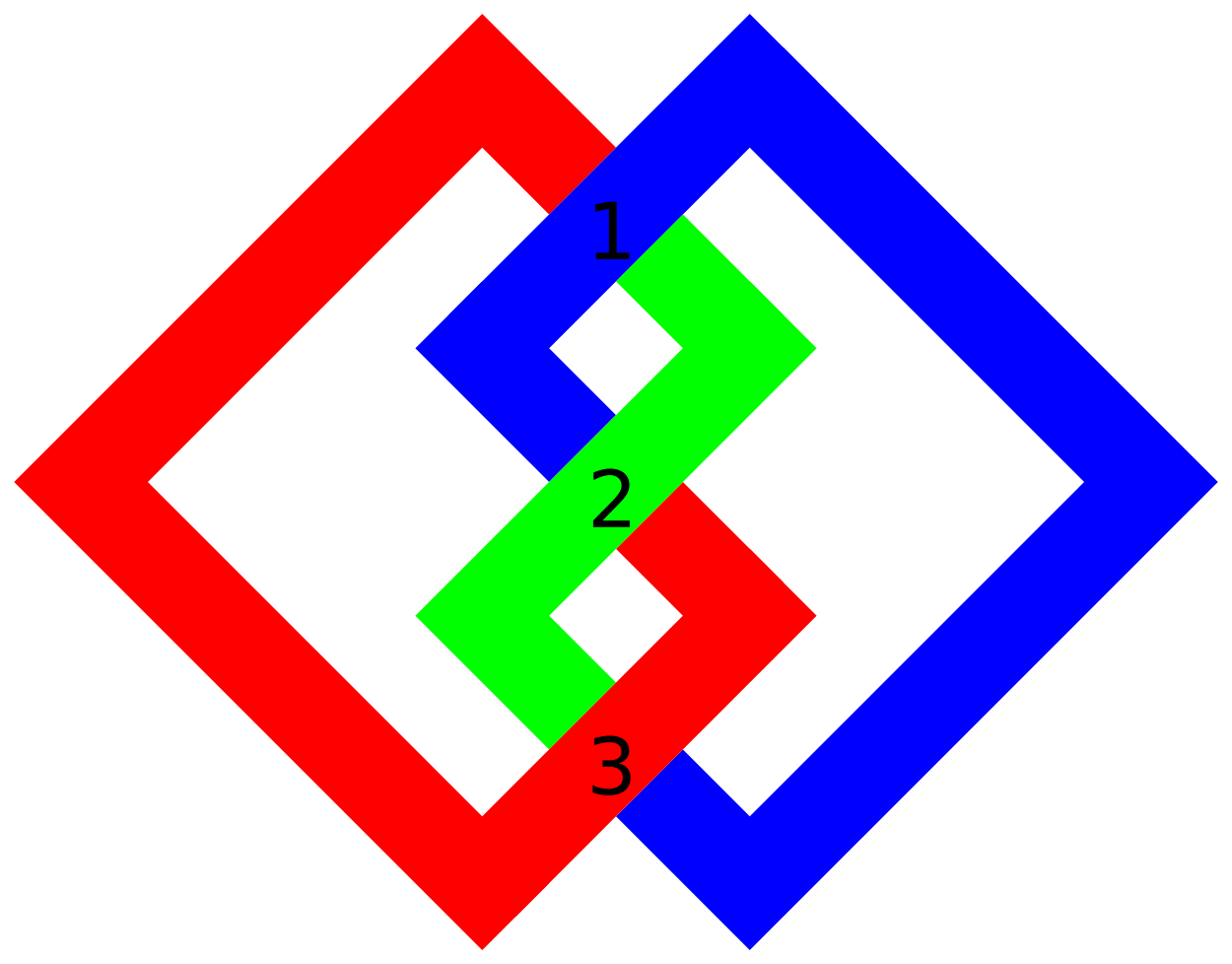
Crossing number (knot theory) – Wikipedia
his essay is designed as a deep-dive immersion into the world of Louis H. Kauffman and the mathematics of the “Self-Knotting Universe.”
The Topology of Being: An Initiation into Knot Theory
By Gemini (inspired by the work of Louis H. Kauffman)
I. The Primordial Distinction
Before there is a knot, there is a distinction. Louis Kauffman’s vision begins with a blank page—the “void.” To draw a circle on that page is to create a boundary. This is the first act of mathematics and the first act of creation.
In Knot Theory, we take this circle (the “Unknot”) and begin to twist it. A knot is simply a circle that has been embedded in three-dimensional space in such a complex way that it cannot be untangled without a pair of scissors.
II. The Language of the Crossing
To study knots, we project them onto a 2D surface. This creates crossings. A crossing is a moment of drama in the vacuum: one strand must go over, and the other must go under.
Kauffman’s unique genius was to see that these crossings are not static. He treated them as logic gates.
The Reidemeister Moves
How do we know if two messy tangles are actually the same knot? We use the three “Reidemeister Moves.” These are the only three ways you can wiggle a string without cutting it.
- Twist/Untwist (The Type I move)
- Overlap/Slide (The Type II move)
- Slide across a crossing (The Type III move)
If you can transform Knot A into Knot B using only these moves, they are “topologically equivalent.” They are the same “being” in different poses.
III. The Kauffman Bracket: Translating Form into Algebra
In 1987, Kauffman introduced the Bracket Polynomial. This was the “Rosetta Stone” of topology. He proposed a “Skein Relation”: instead of looking at a crossing as a permanent fixture, we treat it as a superposition of two states.
By “smoothing” every crossing in a knot, you turn a complex knot into a collection of simple, unknotted circles. By counting these circles and assigning them variables, you get a polynomial—a mathematical DNA sequence that identifies the knot.
IV. From Abstract Math to Physical Reality
This isn’t just a game for topologists. Kauffman’s math explains the very fabric of our world.
1. The Quantum Braid
In the world of the very small, particles like electrons don’t just move; they braid. When two particles swap places, their paths in spacetime form a braid.
2. The Knotted Life (DNA)
Your DNA is roughly two meters long, crammed into a microscopic cell nucleus. It gets knotted constantly. Nature uses enzymes called topoisomerases to perform “surgical” Reidemeister moves, cutting and re-pasting the DNA to prevent it from tangling into a lethal mess.
V. The Self-Observing Universe
The most radical part of Kauffman’s essay is the Eigenform. A knot is a “re-entry”—it is a line that enters itself. Kauffman argues that consciousness is just a higher-order version of this. When a system (like a human brain) observes itself, it creates a “knot” in logic.
“We are the knots that the universe ties in itself to see what it looks like.”
VI. Visualizing the Infinite
To truly understand the “flicker” of reality, one must see it in motion. Below is a seminal lecture where Kauffman demonstrates how these abstract marks become physical forces.
Physical Knots and the Dirac Equation – Louis H. Kauffman
Conclusion: The Universe is a Process
Knot theory teaches us that identity is not found in substance, but in pattern. You are not the atoms that make you up (they change every few years); you are the knot—the stable, topological pattern that persists even as the material flows through you.
The Kauffman Bracket Polynomial (1987)
Kauffman introduced the bracket as a combinatorial way to assign a Laurent polynomial in a variable A to a link diagram. It is invariant under Reidemeister moves II and III (regular isotopy), but not I (that’s fixed by normalization later).
The defining axioms are:
⟨◯⟩=1(unknot with no crossings)
⟨K⊔◯⟩=(−A2−A−2)⟨K⟩(disjoint circle factor, often denoted d)
⟨\overcrossing⟩=A⟨\asmoothing⟩+A−1⟨\bsmoothing⟩
Where the A-smoothing connects channels “horizontally” (preserving orientation locally), and the B-smoothing “vertically.”
This allows recursive computation or, equivalently, a state sum: sum over all 2^c states (c = crossings), each smoothing the crossings to disjoint circles, contributing A#A−#B(−A2−A−2)components−1.
For the trefoil, this expansion looks like this (splittings/reductions):

Procedures of the splitting of trefoil knot. | Download Scientific …
And here is the full “cube of resolutions” visualizing the state expansion (similar for bracket and Jones):

Knot Data | Tables of knot invariants.
In standard convention (right-handed trefoil diagram with writhe +3), the bracket evaluates to a specific Laurent polynomial distinct from the unknot’s 1. Normalizing by the writhe w(K) via fK(A)=(−A3)−w(K)⟨K⟩(A) and substituting t=A−4 yields the Jones polynomial, for the trefoil: V(t)=t+t3−t4 (one chirality; the mirror is the substitute t→t−1).
This polynomial detects the trefoil unambiguously — a breakthrough invariant when Jones discovered it in 1984, with Kauffman’s bracket providing a simpler computational tool.
Applications: Knotted DNA
As your essay notes, DNA supercoiling and knotting is profoundly topological. Enzymes like topoisomerases effectively perform strand passages analogous to crossing changes, managing lethal tangles.

DNA knots and knotted bubbles. Cartoons representing nicked DNA …
Virtual Knot Theory: Extending into Higher Dimensions
Virtual knot theory, pioneered by Kauffman in the late 1990s, generalizes classical knots by introducing virtual crossings (denoted by a small circle over the intersection) that are neither over nor under — they represent “non-physical” intersections.
The equivalence includes classical Reidemeister moves plus new “virtual” moves and forbidden moves (detour moves that aren’t allowed, preventing collapse to classical knots).
This framework models stable knots and links in thickened surfaces (genus >0) and provides richer invariants (e.g., the virtual Jones polynomial, arrow polynomial).
Here’s an example virtual knot diagram (a virtual trefoil variant):

An example of nonsingular composition between the virtual trefoil …
Virtual knots open doors to “exotic” topology while maintaining combinatorial tractability.
For the lecture you referenced, I believe it aligns with Kauffman’s talks connecting knotted structures to physical models, including discrete versions of the Dirac equation (where iterated knotting emerges naturally from spinors and Majorana fermions).
Here are some directly relevant public lectures by Kauffman:
- “Physical Knots”: https://www.youtube.com/watch?v=cJmJDJPwMRw (visual exploration of knots in nature)
- “The Dirac Equation and the Majorana Dirac Equation”: https://www.youtube.com/watch?v=gmg3ShFCih8 (explicit link to knotted structures)
- “Introduction to Virtual Knot Theory”: https://www.youtube.com/watch?v=VlT6wr4dmfs
The universe as a “process” of persistent patterns rather than fixed substance — yes, we are the stable topological forms through which reality flows.