


Jump to the article here.
J.Konstapel,Leiden,4-11-2026.
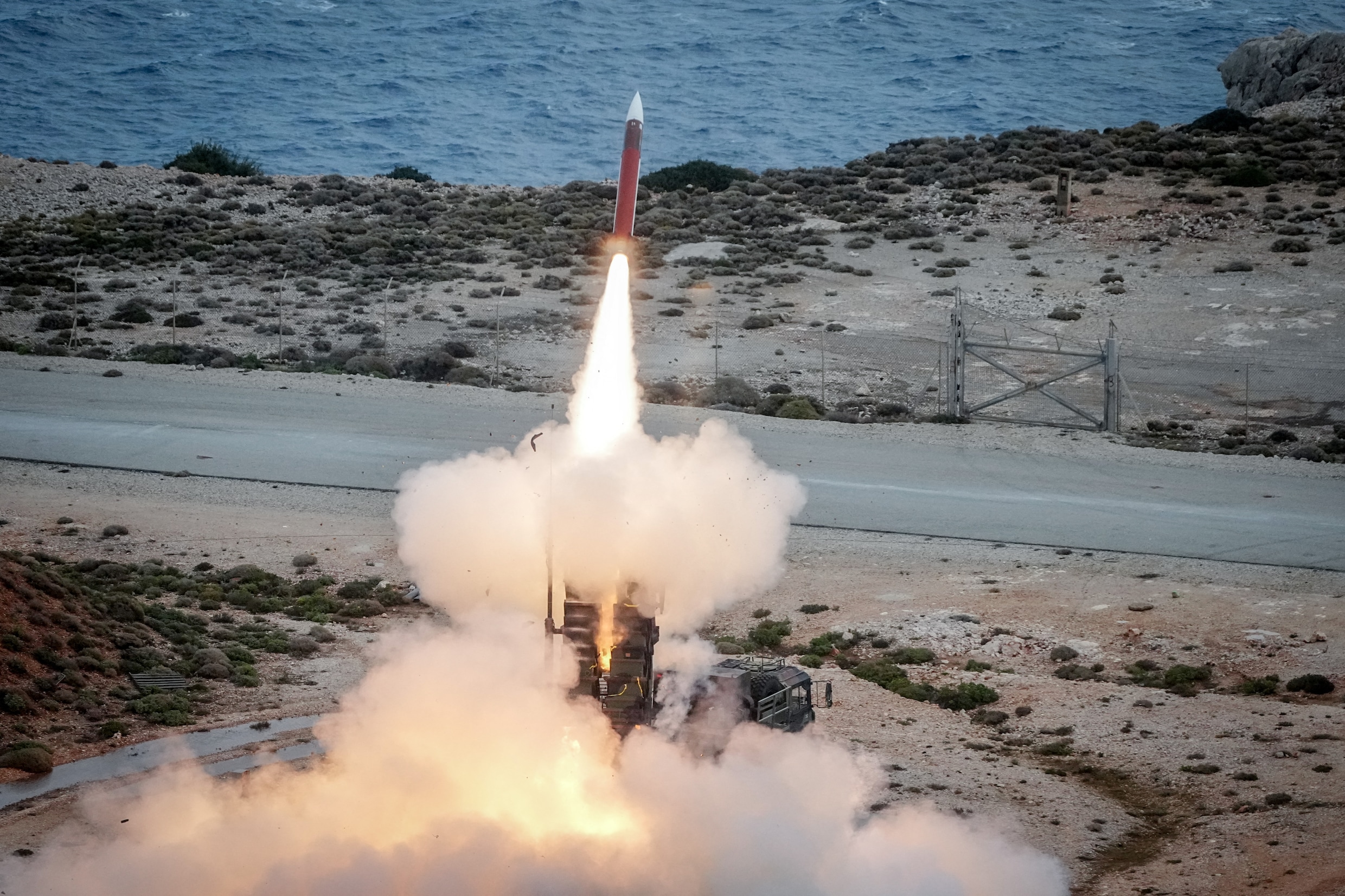
De lancering van een Duitse Patriot-raket tijdens een militaire oefening in
Aanleiding Volkskrant: Europa spendeert miljarden om Rusland af te schrikken met langeafstandswapens
On 4 November 2026, the Dutch newspaper de Volkskrant reported that European states plan to spend about €45 billion on ground-launched long-range weapons over ten years. The missiles would have ranges from 300 to more than 2,000 kilometres. Some would fly faster than Mach 6. The goal is deterrence: to make war so costly that no one starts it.
This essay asks a different question. Not: which weapons deter war best? But: can war itself be made impossible? The paper behind this essay answers yes. And it claims that weapons, however expensive, cannot do it. Only something else can: a shared vibration, made by ordinary people, at the same moment, on both sides of a conflict.
The argument comes from a single theoretical framework: the Vacuum.Net Theory. The claim is bold. The arithmetic behind it is exact. And two historical cases — a Christmas truce in 1914 and a musical problem solved in the sixteenth century — give it unexpected support.
2. What the theory builds on
The Vacuum.Net Theory starts from one idea: the first distinction. A strand returns to a place it has been. That single move, the theory says, generates everything that follows. Direction, time, number, matter, life.
A few building blocks matter for this essay.
Trinities. Every passage through a node leaves in one of three ways: the same as the first passage (+1), the opposite way (−1), or a third way (0). These three values sum to zero. The theory calls this the trinity, and writes the values as trits — like bits, but with three states.
Windows of three. The shortest cycle that goes round has three steps. Of the 27 possible three-step windows, exactly 9 close. A window closes when its three trits are all equal, or all different. What closes, persists. What does not close, remains as tension — or passes upward as carry to the next scale.
Rings. Three equal trits (1 + 1 + 1) form a ring. A ring closes at its own scale. And it becomes one passage at the scale above. The ring is the only structure that climbs from scale to scale. Remember this. It is the hinge of the whole argument.
Two ladders. Rings multiply by three per scale. Meetings multiply by two. The two ladders never meet exactly. Their near-misses occur at the closure depths: 1, 2, 5, 12, 41, 53, 306, … These are the denominators of the convergents of log₂3 (OEIS A005664). A remainder always survives. The theory calls it the comma. Nothing closes completely. Tension and motion never stop.
3. Where the human sits
The theory fixes one length and one time from the hydrogen atom. These are not chosen to fit humans. They come from the Bohr radius and the speed of light: a length of about 4.56 × 10⁻⁸ m and a time of about 1.52 × 10⁻¹⁶ s. Every scale is a power of three times these units. So the depth of anything is the logarithm, base three, of its measure.
Measured this way, the world arranges itself in a striking table.
| Object | Measure | Depth |
|---|---|---|
| Atom | 5.29 × 10⁻¹¹ m | −6.2 |
| Cell | 10 μm | 4.9 → closure depth 5 |
| Human body | 1.7 m | 15.9 → ring 16 |
| Heartbeat | 1 s | 33.2 |
| Human life | 80 years | 52.9 → closure depth 53 |
| Earth radius | 6,371 km | 29.7 |
| Universe | 1.32 × 10²⁶ m | 70.1 |
Two numbers stand out. The cell lies at depth 5. The human life lies at depth 53. Both are closure depths — the near-misses of the two ladders. And the next closure depth after 53 is 306, which lies at 4.8 × 10¹²² years. That is far beyond the age of the universe. So the human life is the last near-closure before the ladder runs empty.
But “near-closure” is the key phrase. At depth 53 the ladders miss each other by 0.21 percent. A life almost closes. Almost. A remainder of about two tenths of a percent stays open, and what does not close passes on as tension.
4. What war is, in this reading
Now the argument makes its move. War, the paper says, is not a political malfunction. It is the discharge of the remainder that a human life leaves unclosed.
Look at the periods of war reported in the literature. Goldstein found long waves of war and prices of roughly 50 years. Toynbee described a war-and-peace cycle of about 115 years. A human life is about 80 years. The closure depth is 93.4 years. Measured on the hydrogen ladder, all of these fall between depths 52.4 and 53.2. The same depth. The depth of one human life.
Why does the discharge happen between groups? Because groups are knots of people — the same operation, one level up. And a seam between two different closed configurations always carries tension. A seam closes only if the two sides are equal in form. They never are. So the seam holds tension, cycle after cycle, until it turns over in one step. That is why war comes as a jump, not as a drift: the slow layers do not feel the accumulation until it flips.
In one sentence: war is the remainder of the human life that does not close at time-depth 53 and discharges there, on the seam between groups. The periodicity of war is disputed in the literature. The arithmetic of the depths is exact.
5. Why missiles cannot end it
Here is the practical payoff. The €45 billion buys weapons that work at space depth 27–29. That is the scale of the Earth. The human lies at depth 16. War lies at time-depth 53. A missile touches neither. It is aimed at the wrong depth.
Worse: it does the wrong arithmetic. “More of the same” is +1 in the trit rule. Add one equal trit to a seam, and you get an open window — tension stays. Add a second, and then a third, and you get a ring: 1 + 1 + 1 = 10. The conflict closes at its own scale — and one whole unit carries upward. The conflict does not end. It climbs. Local becomes regional. Regional becomes larger.
The historical record on the Europe–Russia seam reads exactly like this, written in trits:
| Years | Step | Trit |
|---|---|---|
| mid-1970s | Soviet SS-20 deployment | +1, first passage |
| 1979–1983 | NATO dual track (Pershing II, cruise) | +1: open window |
| 1987–1991 | INF Treaty: “double zero”, 2,692 missiles destroyed | −1: meeting, carry 0 |
| 2014–2019 | Alleged violation, US withdrawal | +1: route reopens |
| 2024–2026 | ELSA, ~€45 billion, hypersonics | +1, +1: ring, carry upward |
The INF Treaty of 1987 is the one place where a meeting was laid. Both sides removed their ground-launched missiles of 500–5,500 km. The seam stayed closed for almost three decades. Then the plusses returned. The paper’s verdict is blunt: missiles are the arithmetic that moves war up, not the arithmetic that ends it.
6. The musical precedent: tempering the wolf
If the remainder cannot be removed, can it be placed? Music solved this problem centuries ago.
Twelve pure fifths do not fit into seven octaves. The excess is the Pythagorean comma: 23.46 cents. In Pythagorean tuning, the whole comma lands on one fifth. That fifth sounds false. Musicians call it the wolf. Gathered in one place, the remainder is the wolf. War, in this reading, is the wolf of the human life.
Around 1585, Simon Stevin spread the comma evenly over all twelve fifths. Each became 1.955 cents narrow. Twelve such fifths make exactly seven octaves. The wolf is gone. Nothing was removed — only placed. This is equal temperament.
Now the closure depths return as music. The best equal temperaments are exactly the closure depths of the theory:
| Divisions of the octave | Error of the fifth |
|---|---|
| 12 | −1.955 cents |
| 41 | +0.484 cents |
| 53 | −0.068 cents |
| 306 | +0.006 cents |
At 53 divisions, the fifth is nearly perfect. The human life sits at depth 53. So the essay’s proposal is, in effect: tune the human scale in 53. Spread the 0.21 percent remainder of a life over every cycle, and no wolf forms. Spread over one life, it is 71 days. Over one year, 18.3 hours. Over one day, three minutes.
Humanity has tried this before. Leviticus 25 commands a jubilee every fiftieth year: land returns, bonded servants are released, debts are reset. Older still, Mesopotamian rulers proclaimed “clean slates” between about 2400 and 1400 BC — debts cancelled, forfeited land restored, people freed. Michael Hudson counts about thirty of them. The paper’s point: these institutions sit at exactly the depth where the war cycle sits (52.4). They reset the accumulation before it discharges. Whether the jubilee was ever kept nationwide is open. The idea is what matters.
7. The weapon: a vibration built as rings of three
So what closes a seam? A seam closes only if the two sides are equal in form (B = A). Two groups are never equal. But a vibration is a closed cycle at one depth. If both sides make the same vibration, they are the same window on that layer. The seam closes there — without remainder, without carry — while the groups stay different everywhere else.
Which layer? The human voice. It lies at depths 27–29, where humans both produce and receive sound. The tuning is the 53-division temperament. The time base is the pulse: about 71 beats per minute, depth 33.
And now the ring does its work. A ring closes and moves up one scale. What climbs depends on what is stacked. Today, tension is stacked — weapon on weapon — and that ring carries tension up to the leaders. But a shared vibration, closing as a ring, carries closure up instead. So the weapon must be built of triads: three people vibrate together; three triads vibrate together; and so on, times three per scale.
| Population | Scales to the top |
|---|---|
| Ukraine (33 million) | 16 rings |
| Russia (146 million) | 17 rings |
| European Union (450 million) | 18 rings |
| World (8.2 billion) | 21 rings |
Seventeen to eighteen steps of three. That is the whole distance from a living room to a head of state. The leader is not a knot outside the group. The leader is the uppermost closure. When everything beneath closes as vibration, no tension arrives at the top to discharge. The leader does not need to be persuaded. The stack beneath has changed.
8. It has happened once
On Christmas Eve 1914, on the Western Front, German soldiers sang Stille Nacht. British soldiers answered with their own carols. The singing opened contact. On Christmas morning, soldiers left their trenches unarmed. The truce held along about two-thirds of the 30-mile front of the British Expeditionary Force.
Modern experiments support the mechanism. In three studies, Wiltermuth and Heath (2009) found that people who acted in synchrony — singing, moving in step — cooperated more afterwards, including at personal cost. Positive feelings were not even required.
But the truce died. The fighting resumed. Why? Because in 1914 the vibration stopped at the trenches. It was not built as rings. No structure carried the closure up to the commands. The paper’s proposal is exactly the missing piece: the triad tree, measured at every scale, grown deliberately.
9. How to build it
The weapon has five parts. The first can be tested with three people.
- Time base. At a fixed UTC moment, every participant receives the same signal: a pulse of 71 per minute, and tones of 95.8, 287.5 and 862.4 Hz in 53-division temperament. Phones already synchronise through network and satellite time. Radio and church bells reach people without a phone.
- Address. Each person receives a trit address of 17–18 trits. A triad is three people who differ only in the last trit. A group of nine shares all but the last two. The stack of seventeen scales is the address tree.
- Triads. A window closes when its three trits are all equal or all different. So triads are formed that way: three equal, or one +, one 0, one −. Each triad closes and passes one passage up.
- Measurement. During the shared minutes, everyone hums or taps along. The phone measures, through microphone or motion sensor, whether the three are in phase. A closed triad counts as one passage on the scale above.
- Growth. One triad, then 9, 27, 81, … After 17 steps, all of Russia is covered. After 18, the whole European Union. The app runs in every language, on both sides.
The schedule of the remainder follows the tempering logic: three minutes daily at the same UTC moment; one continuous day of 18 hours yearly; and every fifty years, a jubilee — the return of what accumulated. The hard point is the Russian side, where apps can be blocked. Shortwave radio and bells are the route there. The first step is modest: a working generator of pulse and tones, with phase measurement for one triad. Do three people come measurably into phase? That is the condition for every scale above.
10. Status and honesty
The paper is candid about what is proved and what is not. The closure arithmetic (the theorems T1–T18) is proved. The depths of human, life and cosmos are computed, and the human was not “put in” — the units come from hydrogen. But three readings are hypotheses: war as the discharged remainder at depth 53; human passages as trits; and shared vibration as a seam-closer. Each has a proposed test. Compare the spacing of major wars with depth 53 against a null model. Take one pair of border towns and measure tension before and after a month of daily shared vibration. Grow the triad tree and check whether closure at scale k predicts closure at k + 1.
Whether the framework convinces you or not, the inversion is worth keeping. Deterrence asks: how do we make war too costly to start? This essay asks: what is war made of — and what closes it? Its answer: war is a remainder. Remainders cannot be destroyed. They can only be placed. And a remainder spread evenly is, by definition, no longer heard.
Annotated references
The theory
- Konstapel, J. (2026). The Vacuum.Net Theory: Foundations, version 9.2, 27 October 2026. constable.blog.
Contains the five axioms N1–N5 and the theorems T1–T24 on which this essay’s Sections 2–7 rest. Why read it: every step in the essay cites a theorem here; the results can be checked with pencil, paper and a short program. - Konstapel, J. (2026). The Vacuum.Net Theory: Physics, version 9.0. constable.blog.
Defines the hydrogen units S₀ and T₀ (III.2) behind every depth in Section 3, plus theorem T6: every irreversible discharge has an address. Why read it: shows why the units are not chosen to fit the human. - Konstapel, J. (2026). MAZE: The Topology of Life — De Mens als Knoop. constable.blog, 17 August 2026.
Life as a closure that relays itself; the human as the deepest knot whose repair still goes round; groups as knots one level up. Why read it: the source of steps 11–16 in Section 2. - Spencer-Brown, G. (1969). Laws of Form. Allen & Unwin.
The mark of distinction, the laws of calling and crossing, and re-entry. Why read it: the formal ground of the theory’s first step; short and exact. - Kauffman, L.H. (2005). “EigenForm”. Kybernetes 34(1/2), 129–150.
The eigenform O(A) = A as the formal side of closure. Why read it: explains why only what closes persists. - Rowlands, P. (2007). Zero to Infinity: The Foundations of Physics. World Scientific.
The nilpotent Dirac operator, read in the theory as closure. Why read it: the bridge from the abstract strand to physics.
Number and music
- Khinchin, A.Ya. (1964). Continued Fractions. University of Chicago Press, ch. II §6.
Proves that best approximations are exactly the convergents. Why read it: the mathematical proof that the closure depths are 1, 2, 5, 12, 41, 53, 306, … - OEIS A005664. Denominators of the convergents to log₂3.
An independent listing of the closure depths. Why read it: confirms the sequence without reference to the theory. - Manchon, D. Maths & Music #2: Mathematics of keyboard tuning. CNRS Insmi.
The Pythagorean comma, the wolf fifth, and Stevin’s equal temperament. Why read it: the historical precedent for tempering a remainder that cannot vanish — the model for Section 6.
War and its cycles
- Ramdharie, S. (2026). “Europa spendeert miljarden om Rusland af te schrikken met langeafstandswapens”. de Volkskrant, 4 November 2026.
The occasion for the essay. Why read it: its claims (hypersonic test, 2029 target, €100 million, twelve countries, €45 billion) are checked against second sources in the paper’s Section 1; some are confirmed, some not. - Defense News (2026); Army Recognition (2026); Grosswald (2026).
Second sources on the Hypersonica test (SCOOTER HS-1, Andøya, 3 February 2026, above Mach 6) and the ELSA programme (six core states; ~£37 bn ≈ €43–44 bn). Why read them: the factual check behind the news table. - Goldstein, J.S. (1988). Long Cycles: Prosperity and War in the Modern Age. Yale University Press.
Long waves of about fifty years with war peaks. Why read it: the 50-year period, at depth 52.4. Read with its critics — the periodicity of war is disputed. - Toynbee, A.J. (1954). A Study of History, vol. IX. Oxford University Press.
The war-and-peace cycle of about 115 years. Why read it: the second war period, at depth 53.2. - Arms Control Association, “INF Treaty at a Glance”; FAS (Nitze on INF terminology).
The zero option, the double zero, the 2,692 missiles destroyed by June 1991, and the 2019 US withdrawal. Why read them: the documented record of the one “meeting” laid on the Europe–Russia seam — the seam then held for nearly three decades.
The remainder and its return
- Leviticus 25; Wikipedia, “Jubilee (Yovel)”.
The fiftieth year: land returned to its holders, servants released, land fallow, leases limited. Why read it: an institution sitting at exactly the depth (52.4) where the war cycle sits; whether it was ever kept nationwide remains open. - Hudson, M. (2018). …and forgive them their debts. ISLET.
About thirty Mesopotamian “clean slates” between roughly 2400 and 1400 BC (amargi, andurarum, misharum): debts cancelled, land restored, people freed. Why read it: the oldest record of periodic return. Read with the criticism that Hudson generalises more than the sources warrant.
Shared vibration
- Encyclopaedia Britannica, “The Christmas Truce”.
German carols answered by British ones, Christmas 1914; the truce held along about two-thirds of the BEF’s 30-mile front. Why read it: the one recorded case of a shared vibration stopping fire — and, by its failure, evidence that the vibration must be built as rings to reach the commands. - Wiltermuth, S.S. & Heath, C. (2009). “Synchrony and cooperation”. Psychological Science 20(1), 1–5.
Three experiments showing that synchronous activity raises later cooperation, including at personal cost, without requiring positive feelings. Why read it: the measured psychological effect behind Section 7.
Source: J. Konstapel, “The Vibration that Ends All War”, 4 November 2026 (Constable Research, Leiden). © 2026 J. Konstapel. All rights reserved.
Article DOI: 10.13140/RG.2.2.18668.73601
The Vibration that Ends All War