
J.Konstapel, Leiden,15-4-2025
0: Introduction
This blog is about the Future of Psychoterapy
Recently I discovered Deliberate Practice (DB) an improvement method in psychotherapy.
In this blog I try to integrate DB in Paths of Change and COP (Community of Practice).
go to Conclusion: push here.
Part 1: a General theory about Change
Part 2: How to Improve the Practice of Psychotherapy
Part 3: IHow to Innovate the practice of Psychotherapy
Part 4 : The Cognitieve Approach
Part 5 : Imagination: Exploring the Inner Landscape
Part 6 : The Light at the end of the Tunnel
Part7: Intuition: the work of Ibn Arabi
Part 8: Attention
Deming Cycle: PDCA:
DB is a variant of the Deming Cycle PLAN, DO, Evaluate (CHECK) and Improve (ACT).
Part 1: General Theory
skip general theory push here.
Every practice follows the same cycle with or against the Clock.


The power of the emotion moving between Up and Down (+5-Positive to -5 Negative) determinates the impact.

What happened?
is the question related to an event. It contains a description of the Event and a value of the related Emotion (>0,<0).
The event disturbs a proces (act) that could be planned (“Goal”).
What is a Case?
A case is a description of How an Event distrurbs a Life Course of a Person.
“In psychology, cases are made comparable by using diagnostic criteria, demographics, clinical features, and context.
Diagnostic criteria like those in the DSM-5 are used to diagnose disorders.
Demographics such as age and gender provide context.
Clinical features like symptom severity and treatment history aid comparison.
Contextual factors like life events and culture are considered.
These ensure systematic comparison for pattern identification and intervention development.”
Life Course
Expectation Failure

The psychological setpoint is the average emotional level a person tends to return to, despite temporary ups and downs.
It’s influenced by genetics, personality, and life experiences.
Though stable, it can change over time through therapy or positive habits.
It is also possible to clean/adapt the memory because humans are Electro-Magnetic organisms.
InterPersonal Theory: the E/M-BodyField:
Vagus Nerve Stimulation
Cell Memory
Every activity and sensation of of the body is sampled with a certain freuency and stored in cells and eventually translated into new (epi)-genetics.
Cellular Memory

Interpersonal Theory (IPT) uses two variables Agency and Communion to desrcribe a Personality.
It is based on the Electro-Magnetic Theory of Clerk Maxwell.

Emotions
Attract and ~Repel just like a Magnet.

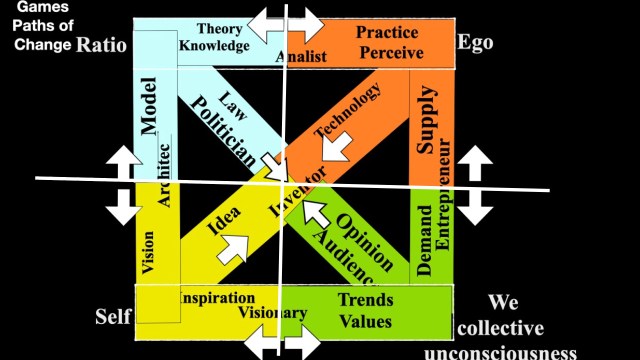
Moebius Pattern
looks like an 8.

Alan Fiske
discovered the four Universal Realtionship Patterns that match with IP, PoC.(Paths of Change), ideologies, scales of measurement and Geometries.

The 8-pattern of Panarchy:
Panarchy describes an Ecology.
4 Variables
Alpha (α): Alpha represents the rate of change or destruction in a system. It denotes the speed at which the current structure or state of the system is broken down or disrupted.
Kappa (κ): Kappa signifies the degree of stability or return to a previous state after disturbance. It represents the system’s capacity to reorganize and revert to a previous configuration.
Theta (θ): Theta denotes the degree of connectivity between different scales or levels in a system. It describes the extent to which changes at one scale or level influence others.
Omega (ω): Omega stands for the panarchic scale, referring to the extent to which a system is open to change and renewal. It describes the willingness of the system to embrace new ideas, processes, or structures.
Personality (Big Five)
Alpha (α):Equivalent to “Neuroticism” in the Big Five personality theory, representing emotional instability.
Kappa (κ): Corresponds to “Conscientiousness,” reflecting organization and responsibility.
Theta (θ):Translates to “Extraversion,” indicating sociability and assertiveness.
Omega (ω):Associated with “Openness to Experience,” signifying receptiveness to new ideas and creativity.
6 2-combinations:
Alpha-Kappa (α-κ): Exploitation (Conservation): Maintenance of stability with slow change.
Alpha-Theta (α-θ): Release (Creative destruction): Rapid change and destruction with loose connections between scales.
Alpha-Omega (α-ω): Release (Creative destruction): Rapid change and destruction with openness to renewal.
Kappa-Theta (κ-θ):Reorganization (Growth): Stable reorganization with strong connectivity between scales.
Kappa-Omega (κ-ω): Exploitation (Conservation): Maintenance of stability with openness to renewal.
Theta-Omega (θ-ω): Conservation (Reorganization): Loose connections between scales with openness to renewal.
What we miss is 5. Agreeableness. We could translate this in a 5th variable we call ooperation (C): It represents the degree of cooperative and competitive interactions within the system.
Up and Down
Remember: Reflects system stability and resilience, akin to high Conscientiousness and Openness to Experience in the Big Five, indicating readiness for change and responsibility.
Revolt: Signifies rapid change and disruption, akin to Neuroticism and low Openness to Experience in the Big Five, associated with emotional instability and resistance to change.

Part 2: Deliberate Practice
follows the Deming PDCA-cycle:


Part3: How to Innovate Psychotherapy
The classification of mental Ilness is called DSM. You can use Interpersonal Therapy or the Archetypes of Jung to explain DSM.
Trauma
The most well-known disorder in this category is Posttraumatic Stress Disorder (PTSD). PTSD can develop after exposure to a traumatic event such as a serious accident, assault, or natural disaster.
How to Innovate
When you are unable to improve and are aware of the repeating failures you are able to innovate.
In this case you have to leave the improvenent-cycle and jump Up (in abstraction) or Down to the essence.
UP: Neuro Inquistic Programming (NLP)
is a fusion of the practice of well known therapist like Gregory Bateson, Milton Erickson and Virginia Satir,
NLP is not effective because you cannot copy the context.
Milton Erisckson was an intuitive expert in hypnosis.
Talent
Psychotherapy is a interpersonal talent not a profession you can learn.
Eugene Gendlin a friend of Carl Rogers found what makes a therapy effective.
Down: Felt Sense
It is the ability of the patient to explore the inner space, Gendlin called the Felt Sense.
Key factors that influence therapy positively:
This list is made with the help of GPT-4:
GPT-4 is ignoring the felt sense because nobody writes or talks about the felt sense so it does not exist.
That why psychoterapy is stuck.
Skip this part push here
The therapeutic relationship: The bond between the therapist and client is crucial. It should be based on mutual trust, respect, and rapport. When clients feel safe and understood, they are more likely to open up and work towards recovery.expand_more
The type of therapy: Different therapies have unique characteristics. Some focus on exploring thoughts and feelings, while others focus on behavior change. The most suitable therapy depends on the individual’s problem, learning style, and preferences.
Therapist skills: Therapists need various skills, including active listening, empathy, unconditional positive regard, and asking helpful questions. They should also set boundaries, ensure client safety, and maintain confidentiality.
Client motivation: Motivation is essential for success. Clients motivated to change are more likely to work hard and benefit from treatment.
Willingness to change: Therapy often requires changes in thoughts, feelings, and behaviors. This can be challenging. Clients willing to change are more likely to succeed.
Other factors: Problem severity, therapy duration, and comorbidity can also influence therapy outcomes
Part 4: The Cognitive Approach
An Ai is a cognitive verbal talent that could be trained as a therapist. It will never becomen a talent..

Clean Language & Clean Space
Carl Rogers (Client Centered therapy) started to rephrase the words of his patients.
David Grove perfected this approach by introducing Clean Language and finally Clean Space.
- Client-Centered Therapy: Focuses on building a supportive and empathetic therapeutic relationship where clients are encouraged to explore and understand their own experiences, thoughts, and feelings. The therapist uses techniques such as reflective listening and empathy to facilitate self-discovery and personal growth.
- Clean Language: Utilizes specific, non-directive questions designed to explore the client’s inner world, particularly through the use of metaphors. The therapist guides the client to uncover their own thoughts and experiences without imposing interpretations or suggestions, allowing for a deeper understanding of their subjective reality.
Clean Space: Explores the inner world of individuals through physical space and movement. The approach involves using a physical environment, often represented by a grid or arrangement of objects, to represent different aspects of the client’s experience or inner landscape. The therapist guides the client to move through the space, interacting with different areas or objects, to gain insights and explore new perspectives on their thoughts, feelings, and experiences. Clean Space encourages clients to access their own inner resources and solutions in a non-directive and exploratory manner.
Part 5: The Imagination: Exploring The Inner Landscape
Out-off-Body Travel
Robert Monroe
Astral or spiritual dimensions: Many individuals describe entering astral or spiritual dimensions where they encounter other beings, entities, or spiritual guides. These dimensions are sometimes described as realms of light, love, and higher states of consciousness.
Transitional or liminal spaces: Some experiences involve entering transitional or liminal spaces where individuals find themselves between the physical world and other spiritual dimensions. These areas are often associated with processes of dying, reincarnation, or spiritual growth.
Mental or conceptual spaces: In some individuals report experiencing mental or conceptual spaces where thoughts, ideas, and symbols are experienced at a deeper level than in ordinary consciousness.
Multidimensional or parallel worlds: There have been cases reported where individuals have experienced multidimensional realities or parallel worlds that exist alongside our own physical world, sometimes with different laws of nature and reality.
The light: Many experiences involve entering a bright, loving, and healing light associated with a sense of peace, love, and connectedness. This light is often considered as an aspect of higher spiritual dimensions.
Seth
was the name of a Channel of Jane Roberts:
Some of the key concepts in the Seth Material include:
- Multiple realities: We live in a multiverse with an infinite number of potential realities. We can choose to focus on different realities and shape our experiences through our thoughts and beliefs.
- The divine self: We are all connected to the Source, an infinite wellspring of energy and consciousness. We are essentially divine beings with unlimited potential.
- Creative power: We are constantly creating our own reality through our thoughts, feelings, and actions. We have the power to create our lives as we want them to be.
- Self-awareness: Our true identity is not our physical form or ego. We are spiritual beings on a journey of evolution and discovery.
- Life after death: Death is not the end, but a transition to another reality. We continue to exist after death and we can create our own experiences in the afterlife.
Part 6: Using the Light
Cells Biofield and Biophotons
Every cell has its own biofield that produces biophotons (Light).
The cells in the body unite in the body-biofield that can be measured and interpreted.
Biofeedback
Yo can ask questions to the biofield and it gives you answers.
Cells are Intelligent Cooperative Organisms
The Acting with the Inner Light
conclusion
Psychotherapy is a Talent
When you look at the life of Milton H. Erickson, arguably the most successful therapist ever, you will see that his ability was not just a talent, but a skill that was honed through experience and observation. These skills were then adopted and adapted by his followers, particularly in the field of Neuro-Linguistic Programming (NLP).
Follow your Intuition
Copying a genius has an effect but the big difference is that Milton uses his Intuition to make a diagnosis.
The intuition is what Eugene Gendlin called the Felt Sense.
Approach:
- Observing verbal and nonverbal cues.
- Asking open-ended and focused questions.
- Utilizing hypnosis to access the unconscious mind.
- Gathering information about the client’s life history.
- Collaboratively creating a diagnosis with the client.
go back to Beginning push here.
Understanding
