History and Future are a Fractal Process:

J.konstapel Leiden 7-11-2024.

I have spent nearly 30 years concerned with developing the smartest software there is to predict the stock market.

Then I discovered the Svara. in 1998.

Using this blog, you can predict the future at any desired level of detail.

This blog is, for example, about the upcoming transition from the Kali Yuga to the Golden Age in multiple dimensions.

0. Introduction

If you’re interested in the predictions, click on Conclusion.

Global Brain

Notably, I had already concluded before the year 2000, using the Economic Kondratieff Cycle (P=50) and the Cultural Mikhail Bakhtin Cycle (P=1250), that a different period (“Global Brain“) was approaching and that the climate crisis corresponds to the disasters associated with the transition.

Waterman to Air.

The period was also predicted in the Precession Cycle known as Aquarius, which is an Air sign.

It will later turn out that this prediction is incorrect or needs to be interpreted differently.

1. The Four+1 Elements:

There are namely 5 elements and 24 (2x12) and 25 (5×5) lie close together.

Furthermore, the system is harmonious. To learn more, click here.

The 4+1 Elements Fire, Water, Earth, Air, and Space (Ether) are as old as human civilization.

Elements->Seasons

The elements also correspond to the seasons with Fire = Summer and the opposite Water = Winter, while Spring and Autumn are intermediary stages with the Sun as the center.

The Elements were also used to categorize the 5 ages of civilization and the corresponding Disasters.

ElementIndia (Mahabhutas)China (Wu Xing)GriekenlandJapan (Godai)Tibet
AardePrithviTu (Aarde)GeChiSa
WaterApasShui (Water)HydorSuiChu
VuurTejasHuo (Vuur)PyrKaMe
LuchtVayuMu (Hout)AerFuLung
Ether/RuimteAkashaJin (Metaal)(Niet benoemd)KuNamkhai
De vier seizoenen passen op de vier elementen met een vijfde seizoen nazomer tussen zomer en herfst.Het centrum is de Zon, waarom alles draait.
De vier elementen passen op het klimaat.

This blog is about the End of the Kali Yuga and thus also about the beginning of a new Golden Age.

The transition is a time of great turmoil comparable to a birth.

It is striking that the announcement of such a transition has occurred in almost all cultures.

De vijf elementen in China.

Explain Cyclemodel

Cyclegenerator

I discovered that all cycles in terms of arrangement resemble each other and only differ in frequency, with the frequencies having an equal ratio in their periodicity (P), namely 5x, whereby for example, the P of the Kondratieff cycle is 50 years, which people associated with the /Maya’s linked that same P to the cycle of the Pleiades.

Each cycle is a (sine) wave, which serves as the basis for a new wave, and so on. This creates harmonic effects similar to overtones and undertones in music, causing waves to either reinforce or dampen each other. As a result, with an increasing long wave, everything rises.

1+**√**5/2= =φ, the Golden Ratio

The number 5 plays an important role in natural patterns and harmonics due to its connection with biological symmetry, the golden ratio, and stability in harmonic structures.

Harmonics

Ray Tomes used the data from the Cycles Research Institute, founded by Edward Russel Dewey in the US in 1931, to demonstrate which harmonic functions were present in the data.

They were simply explained using the divisors of the prime numbers, where the number 5 plays an important role that can again be found in the Chinese Lo Shu.

They match with the Highly Composite numbers of Srinivasa Ramanujan,.
there are Er more video’s on this website

Read more in this document.

2. the Big Jump

This blog is a continuation of my blog about Constructal Law and the Creation in which I revisited the work of Andis Kaulins.

Great Year

He proved to me that ancient history has an Astrological background with the Precessional Cycle (P= 2577), the Great Year) as its foundation.

This means that each phase 5144 lasts, which, starting from the Yuga at -3,117, results in 2027 as the transition date.

Moon Cycle x Sun Cycle

In contrast to the Greek system, which associated the 12-month annual cycle with the solar cycle, resulting in a phase lasting 2160 years.

Strategy -> Predicting the Future

Because strategy was my profession, I was very skilled at predicting the future.

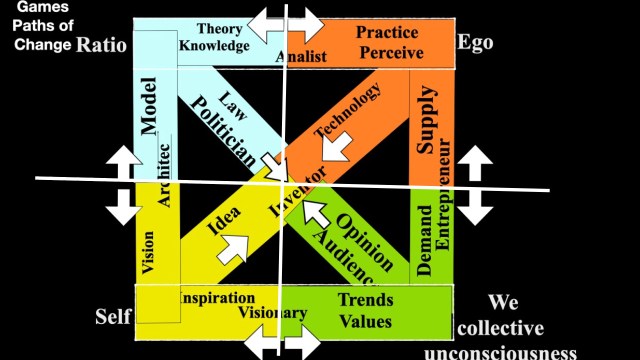
It became clear that the Kondratieff cycle provides a lot of insight, especially when I linked it to the four (actually five) worldviews of Paths of Change (PoC) by Will McWhinney.

Cross (Heart).

The four elements correspond to the four worldviews of PoC, with one worldview missing. It lies at the intersection of the other four: the Heart.

The heart is the center of two blood cycles, that of the Head (thinking) and the body (acting).

This blog is about very large transitions, such as the transition between the 5 ages of the Great Year, during which we are reportedly heading back to the Golden Age, according to some researchers, as early as 2025.

The annoying thing is that such transitions are often accompanied by major disasters like the impact of a large meteorite.

This could be part of the upcoming.

Taurid Swarm:

a different candidate is

Climate: Little Ice Age

Soon the sun will go into hibernation, which means that a minor ice age is approaching around 2025.

If that’s correct, it will get colder rather than warmer in the Netherlands.

This also happens when the AMOC (Atlantic Meridional Overturning Circulation) comes to a standstill due to the influx of cold meltwater from the North Pole.

3. The Economic Leap

Carlota Perez had come to the same realization that we are approaching a Leap.

In de blog over Constructal Law liet Geoffrey West zien dat die sprong wordt veroorzaakt door het bereiken van een singularity, die weer te maken heeft met de onmogelijkheid om alle tijd te besteden aan het repareren van Fouten in het ontwerp.

perez-cycles-final
Van Samenleving naar Samenspeling.

4. The Cultural Golden Age

Global Brain

The emergence of the Global Brain can be easily traced through the steps taken during the Industrial Revolution, from the Steam Engine via Ford and Taylor’s assembly line to the computer and the Internet network, which allowed for the unlocking of written and visualized content using the talking Wikipedia.

The next step is much more interesting because it is also about the emergence of a new religion that is not socially (Islam) oriented but is focused on the whole, on consciousness.

Consciousness has always been connected with the Holy Spirit.

5. The Precession -> Aquarius

The next step in the Precession has long been announced and is associated with the Aquarius.

The Waterman is an Air sign.

The Waterman is the first step of 12 steps where the cycle follows the Zodiac, noting that the old cycle consisted of well-visible stars used for navigation at sea.

The arrival of this phase aligns with all the old calendars, with the Maya Calendar as an example, which Andis Kaulin discovered all began on the same day.

Op die dag,  s’ochtends 25 december 3117 v.Chr, vond er een heel bijzondere zonsverduistering plaats.

Over de Precessie Cyclus

6. Wat is de Kali Yuga (de Aardse fase)

The Kali Yuga is regarded in Indian philosophy and Hindu cosmology as an age of darkness, wherein ignorance and materialism prevail.

The spiritual and moral values of society are declining sharply, and people are becoming increasingly detached from their inner and spiritual essence.

It is seen as an era in which negative traits such as greed, lies, and violence prevail.

Then comes the Satya Yuga (Golden Age): a time of purity, harmony, and spiritual awareness.

Model Bibhu Dev Misra

He predicts the end of the Kali Yuga in March 2025, which he believes could cause a global collapse by 2040 due to wars, environmental catastrophes, and comet impacts, thereby fulfilling ancient prophecies about the renewal of the earth. He also explains the scientific validation of the alignment of the Yuga cycle with Earth’s precession cycle and its implications for understanding the cyclical nature of civilizations, the fluctuation of human consciousness, and the predicted return of a savior at the end of the cycle.

In deze interpretatie van Bibhu Dev Misra is er sprake van een opgaande en neergaande cyclus die bestaat uit 2×5=10 stappen

de Purana’s

The Puranas describe the four Yugas as cyclical epochs in the cosmos:

  1. Satya Yuga (1,728,000 years): The age of truth and virtue, in which people live ethically perfect lives.
  2. Treta Yuga (1,296,000 years): Virtue declines, but people remain religious and just. Rama appears.
  3. Dvapara Yuga (864,000 years): Moral values further weaken, but religion remains important. Krishna appears.
  4. Kali Yuga (432,000 years): The age of moral decline, where virtue reaches its lowest point and materialism and conflict dominate.

Model Rudolf Steiner/Owen Barfield:

This model is derived from the theosophical models of the founder of the Theosophical movement, Helena Blavatsky.

'Of the Consciousness Soul' Diagram
De overgang volgens Rudolf Steiner en Owen Barfield.

Conclusie

Note: this text, including the image, was completely generated using a prompt from ChatGPT:

The world of technology is dynamic and constantly evolving, driven by powerful cycles of change.

Through the lens of the Precession cycle and the Kondratieff cycles, we can understand the technological development of human civilization over thousands of years.

In this chapter, we take you through the five phases of the Precession Cycle and the last five phases of the Kondratieff Cycle, illustrating how technology has evolved over time and where we currently stand.


The Precession Cycle: A 25,800 Year Overview

The Precession cycle, which spans over 25,800 years, can be divided into five major phases. Each phase reflects a different period of technological advancement and social change.

Phase 1: 0 – 5,160 years – The Origin of Civilization

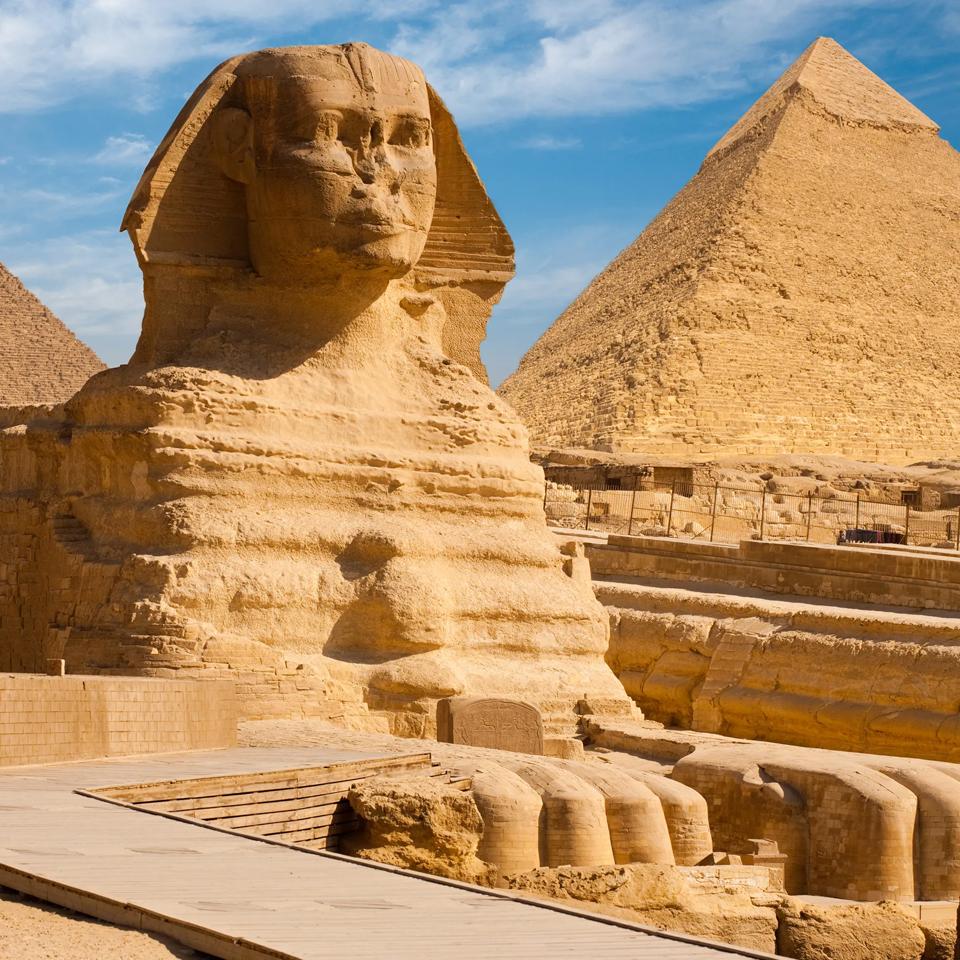
In this early phase of the Precession Cycle, around 3000 BC to 2000 AD, the foundations of human civilization were established. The invention of agriculture and writing were the first technological breakthroughs. Large monuments such as Stonehenge and the pyramids of Egypt reflect the initial phase of astronomical knowledge.

  • Characteristic Technologies:
    • Agricultural Tools
    • The Wheel
    • The Construction of Astronomical Observatories

Phase 2: 5,160 – 10,320 Years – The Establishment of Great Civilizations

Between 3000 BC and 1000 AD, human civilization continued to expand, marked by the rise of large-scale cities and complex religious systems. This period saw the development of metalworking and rice cultivation techniques.

  • Characteristic technologies:
    • Watermill
    • Early astronomical calendars
    • The invention of the writing technique

Phase 3: 10,320 – 15,480 Years – Scientific Revolution

During the period from 1,000 BC to 500 AD, the world experienced a leap in scientific and philosophical progress. Scientists such as Aristotle and Ptolemy laid the foundations for astronomy, while the emergence of steel production improved the technology and arsenal of civilizations.

  • Characteristic technologies:
    • Astronomical observations
    • Steelworking and new tools
    • Manufacturing of sailing ships for global trade

Phase 4: 15,480 – 20,640 Years – The Industrial Revolution

The Industrial Revolution from 500 to 1900 AD brought fundamental changes, from the steam engine to electricity. This period transformed the production process, transportation infrastructure, and daily life.

  • Characteristic technologies:
    • Steam engines and factories
    • Electricity: The invention of the light bulb
    • Telecommunication via the telephone

Phase 5: 20,640 – 25,800 Years – The Digital and Space Revolution

In the current era, from the 20th century to now, we see the exponential growth of digital technologies, space exploration, and artificial intelligence. We are on the verge of entering a new age of interplanetary travel and sustainable energy sources.

  • Characteristic technologies:
    • Space exploration and moon landing
    • Artificial intelligence
    • Solar energy and renewable energy sources

The Last 5 Phases of the Kondratieff Cycle

The Kondratieff cycle provides insight into the rise, flourishing, and decline of major technological innovations that drive the world economies. Each phase of the cycle lasts about 50 years and represents a period of technological change that impacts society.

Fase 1: Kondratieff V (1800 – 1850)

The industrial revolution began to bear fruit with the arrival of the steam engine, which laid the foundation for mechanization in factories and transportation.

  • Technology:
    • Steam Engine
    • Railways
    • Textile Production

Fase 2: Kondratieff VI (1850 – 1900)

The rise of electricity, the telephone, and the light bulb marked this period as one of the most groundbreaking in the history of technology.

  • Technology:
    • Electricity
    • Telephone
    • Steel Industry

Fase 3: Kondratieff VII (1900 – 1950)

The 20th century brought the world automobiles, aviation, and mass communication through radio and television.

  • Technology:
    • Automotive
    • Aerospace
    • Radio and Television

Fase 4: Kondratieff VIII (1950 – 2000)

This phase is characterized by the digital revolution, with the rise of computers, the internet, and space exploration.

  • Technology:
    • Computers
    • Internet
    • Space Exploration

Fase 5: Kondratieff IX (2000 – 2050)

The current phase revolves around the technological advancements of artificial intelligence, sustainable energy, and the colonization of Mars.

  • Technology (expected):
    • Artificial Intelligence
    • Genetic Modification
    • Sustainable Energy

Conclusion: Where Do We Stand Now?

We find ourselves at the crossroads of the fifth phase of the Precession Cycle and the kondratieff Cycle.

The technological advancements we’ve experienced in recent decades, particularly in the digital world and space exploration, are paving the way for a new era of cosmic exploration and sustainability.

The coming years are likely to be characterized by the integration of artificial intelligence, the exploration of Mars, and the transition to renewable energy sources. If technology continues to evolve in these fractal cycles, we can envision a future where space travel and intelligent technologies redefine our reality.

Return to the beginning.

Hoe Fractale StroomPatronen hun Weg Banen

J.Konstapel Leiden 11-02-2024.

Wordt het Warmer of Kouder?

In 2027 weten we zeker of Valentina Zharkova en haar obderzoeksgroep gelijk hebben.

Voorsprong vertraagt Stroom,
Vrijheid zoekt door Verstoring,
Nieuw Pad vindt zijn Weg.

Deze blog gaat weer over Constructal Law (CL) nu vooral toegepast op het Klimaat en de verdere Toekomst van de Mensheid op Aarde.

Verder introduceer ik het vergelijkbare Free Energy Principle dat weer perfect past op PoC en heel veel vergelijkbare Quaternions. zoals Panarchy.

Samenvatting: Meer weten over:

1 CL zelf druk hier

2 Het Klimaat druk hier. Tevens wordt hier ook het Free Energy Principe geïntroduceerd wat de Gaia-hypothese bewijst .

3 de Toekomst druk hier. Elon Musk heeft gelijk: De Sterren zijn de volgende stap.

4 CL en de Sociale Wetenschappen druk hier Over Social Dynamics.

5 over CL, Free Energy en snelle Besluitvorming m.b.v. OODA van John Boyd druk hier

6 Conclusie druk hier gaat over Freedom and Evolution het een na aatste boek van Adrian Bejan.

Wordt de Mensheid Saved By the Bell?

Tijdens het vervolmaken van deze blog herontdekte ik Geoffrey West net als Adrian Bejan een toegepaste natuurkundige, die de Biologie heeft ontdekt en nu kijkt naar Schaalvrije = Fractale Systemen.

Het blijkt dat de mensheid kan worden beschreven met een formule, die aangeeft, dat we iedere keer vastlopen en op het allerlaatste moment ontsnappen als we geen energie meer over hebben om onze fouten te repareren.

Die oplossing wordt altijd gevonden door een Eenzame Uitvinder en niet door de Wetenschap.

0 Inleiding

De processen in de natuur herhalen zich eindeloos met als resultaat steeds dezelfde fractale vormen.

Klimaat-> WarmteVerdeler

Het Klimaat verdeelt alle overbodige warmte netjes over de aarde en zet die warmte om in beweging op alle niveau’s.

Energie Distributie

Dat komt omdat er overal van klein tot groot dezelfde stroomsystemen zijn die energie opwekken en weer verdelen.

De stroomsystemen verbinden zich met andere systemen en vormen daarmee een grote golf, die de grote structuren vorm geeft.

1. Wat is Constructal Law?

De mens doet daar onbewust hard aan mee en baant daarmee een weg voor de volgende Golf die kan worden afgeleid met behulp van de Constructal Law (CL) van Adrian Bejan.

de Patronen van CL

Plaatjes CL:

Video CL

2. Het Klimaat

De Aarde is gedraagt zich als een “Heat Engine” net zoals een Stoommachine.

Ze zet warmte om in beweging op alle niveau’s van het weer, de rivieren tot onze bloedvaten.

De zon is de grootste warmtebron en produceert veel teveel warmte.

Ondanks alle beweging op aarde en moet er worden afgekoeld.

Daarom ontsnapt er ook weer warmte terug naar het Vacuum.

Iedere keer als er iets verandert in de energie-distributie past de aarde zich aan door nog meer te gaan bewegen.

Fractale StroomSystemen

In Ieder stroomsysteem bewegen deeltjes van 1->MxM->1

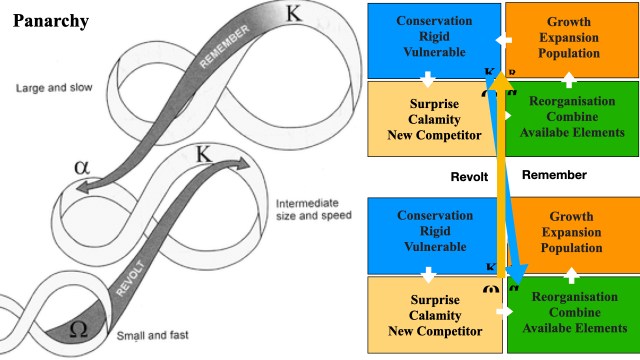
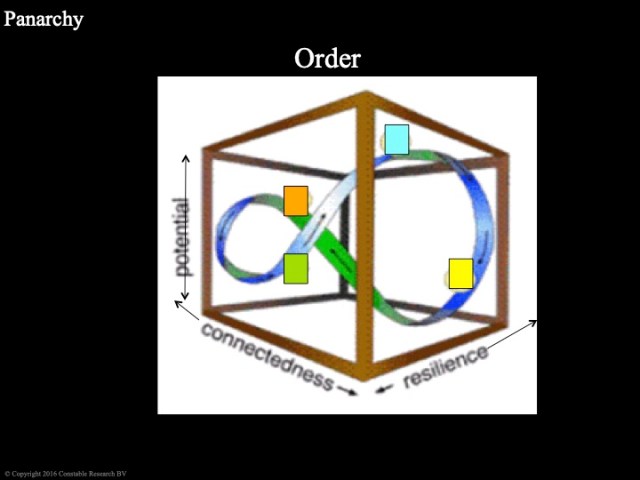
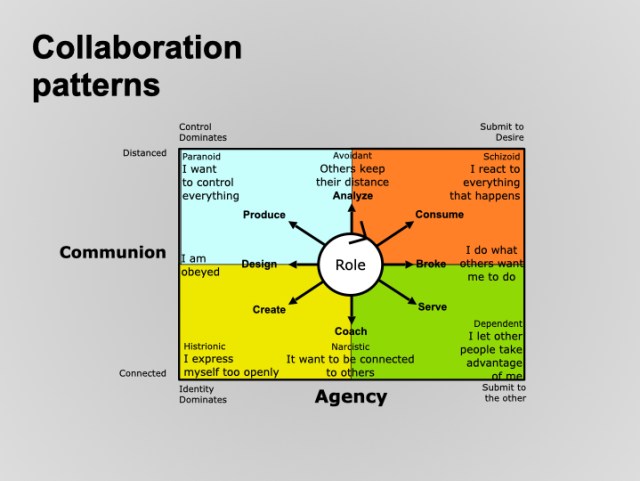
Mb.v. de Panarchie-theorie kun je m.b.v twee variabelen Agency en Communion) iedere ecologie als blokjes op- en naast elkaar stapelen en daarmee nieuwe blokjes maken.

Elk stroomsysteem maakt deel uit van een groter stroomsysteem, gevormd door en ten dienste van de wereld eromheen.

Deze blog gaat over Adrian’s Bejan’s Constructal Theory en de gevolgen van de Verstoring van Natuurlijke Energiestromen voor het Klimaat op de Aarde.

Bejan gebruikt de Thermodynamica, de wetenschap van de Dynamiek van de WarmteMachines om te bewijzen dat , de vorm en structuur van systemen in de natuur (zoals stromingen, biologische organismen en sociale structuren) zijn geoptimaliseerd voor efficiëntie.

Hij heeft dit ook toegepast op het Klimaat en komt met opmerkelijke conclusies.

Constructal theory of global circulation and climate

de drie cellen verdelen de warmte op aarde.

Het document bespreekt ook hoe de constructal theorie kan worden gebruikt om de globale circulatie en het klimaat te modelleren.

Het document laat zien dat de constructal theorie in staat is om de waargenomen waarden voor de gemiddelde temperatuur van het aardoppervlak, de convectieconductantie in horizontale richting en andere parameters die de latitudinale circulatie definiëren, te reproduceren.

Het document laat ook zien dat de constructal theorie in staat is om de waargenomen waarde voor het gemiddelde temperatuurverschil tussen dag en nacht op aarde te reproduceren.

In het klimaatmodel betekent dit concreet dat de structuren van atmosferische circulatiecellen (zoals de Hadley-, Ferrel- en Polaire cellen) zich zodanig vormen dat warmte van de evenaar naar de polen kan stromen op een manier die de warmteoverdracht optimaliseert.

Op deze manier kan het klimaat een evenwicht bereiken waarin warmte zich gelijkmatiger over het aardoppervlak verspreidt, wat helpt om temperatuurverschillen tussen de evenaar en de polen te verkleinen en de totale energieverdeling in de atmosfeer te verbeteren.

Gaia, de Aarde is een Organisme

De auteurs van het artikel hieronder bevestigen de Gaia-hypothese en stellen voor dat het klimaatsysteem van de aarde functioneert als een dynamisch en zelfvoorzienend systeem dat leefbare omstandigheden stabiliseert ondanks externe schommelingen, vergelijkbaar met biologische systemen.

Markow-deken

Ze suggereren dat de aarde deze stabiliteit bereikt via een concept genaamd de Markov-deken, die interne toestanden (zoals de metabole processen van de biosfeer) scheidt van externe toestanden (zoals zonnestraling) via tussenliggende toestanden—de zogenaamde sensorische en actieve toestanden.

De belangrijke klimaatvariabelen in dit model zijn:

Externe toestanden: Zonnestraling de klimaatdynamiek indirect beïnvloedt door het systeem via sensorische toestanden te beïnvloeden.

Sensorische toestanden: Oceaantemperaturen, die beïnvloed worden door zonnestraling, spelen een cruciale rol in het stabiliseren van het klimaat.

Actieve toestanden: Broeikasgassen en wolkendekking, die de albedo (reflectiviteit) van de aarde veranderen, helpen om de inkomende zonne-energie in balans te houden.

Interne toestanden: De metabolische processen van de biosfeer reageren op temperatuur en beïnvloeden broeikasgassen, wat een feedbacklus voltooit die het klimaat binnen leefbare grenzen houdt.

Karl Friston: the Free Energy Principle

Constructal Law: Herhalend Patroon van Klein naar Groot:

Adrian Bejan’s constructal theory biedt een nieuw kader voor het begrijpen van de evolutie van natuurlijke systemen.

Het stelt dat systemen in de loop van de tijd evolueren om de stroom van energie te vergemakkelijken, waardoor ze efficiënter worden.

Dit principe is van toepassing op alles, van de vertakking van rivieren tot de verdeling van bloedvaten in het menselijk lichaam.

Klimaat

Wanneer het wordt toegepast op het klimaatsysteem van de aarde, suggereert het dat natuurlijke processen zich hebben ontwikkeld om de stroom van energie en materie te optimaliseren.

Menselijke Interventie en de Verstoring van Natuurlijke Stromen

Menselijke activiteiten, zoals industrialisatie, ontbossing en de verbranding van fossiele brandstoffen, introduceren nieuwe energiestromen in het systeem van de aarde.

Deze activiteiten verstoren de delicate balans die zich door de millennia heen heeft ontwikkeld.

Industrialisatie: Industrieën stoten enorme hoeveelheden warmte en verontreinigende stoffen uit in het milieu, waardoor lokale en mondiale temperatuurpatronen worden veranderd. Dit verstoort de natuurlijke stroom van warmte en kan leiden tot veranderingen in weerpatronen.

Ontbossing: Bossen spelen een cruciale rol in de watercyclus en koolstofvastlegging. Door bossen te verwijderen, verstoren we de natuurlijke stroom van water en koolstof, wat leidt tot veranderingen in neerslagpatronen en een stijging van de concentraties kooldioxide in de atmosfeer.

3. De Toekomst: Engines en Brakes

De tekst bespreekt het concept van “Brakes” en “Engines” binnen de Constructal Law.

Ze vormen een cyclus waarin het nieuwe het oude deels weer opruimt en aanpast.

Volgens dit idee zijn alle stromingssystemen in de natuur opgebouwd uit onderdelen die zowel beweging bevorderen (“engines” of motoren) als beweging afremmen of weerstand bieden (“brakes” of remmen). 

Dissipatie (Verspreiding):

Deze balans tussen energie-output en dissipatie (verspreiding van energie) zorgt ervoor dat de systemen optimaal blijven functioneren.

Bijvoorbeeld, een voertuigmotor genereert kracht om te bewegen, terwijl de wrijving op de weg als een soort “rem” werkt en de energie uiteindelijk verspreidt.

Constructal Wet en Energie-efficiëntie:

Volgens de Constructal Wet ontwikkelen systemen zich om de balans tussen motoren en remmen te optimaliseren, zodat er een maximale energiestroom mogelijk is.

Deze optimalisatie betekent dat natuurlijke systemen en door de mens gemaakte technologieën evolueren naar een configuratie waarbij ze gemakkelijker kunnen bewegen en stroom kunnen geleiden, ondanks de natuurlijke weerstand.

Wet van Kleiber

is een prachtig voorbeeld van CL. Ze laat zien dat de Massa en de Energiebesteding direct van elkaar afhangen. De wet heeft zelfs betrekking op Steden en Bacterien.

Kleiber's law
Geoffrey West over de Wet van Kleiber die ook toepasbaar is op Steden.
Een stad is PoCxPoC maximaliseert sociale interactie en minimaliseert de fysieke afstand om elkaar te bezoeken wat door de communicatie-technologie theoretisch 0 is.

Toepassing in Diverse Systemen:

Dit idee geldt zowel voor levende als niet-levende systemen, zoals dieren (waar spieren fungeren als “engines” en de zwaartekracht als “brakes”), rivierstromen (waar water de energiebron is en de bodem weerstand biedt), en zelfs klimaatsystemen (waar lucht- en waterstromingen worden gereguleerd door verschillende vormen van weerstand en aandrijving).

Ontwerp en Evolutie:

Het evenwicht tussen motoren en remmen zorgt ervoor dat stromingssystemen in de natuur efficiënt blijven evolueren, omdat de Constructal Wet streeft naar het minimaliseren van energieverlies door weerstand, terwijl de energie-output gemaximaliseerd wordt. 

Dit principe verklaart waarom ontwerpen zoals vertakkingen in bomen, bloedsomloopstelsels, en rivieren allemaal op elkaar lijken: ze ontwikkelen zich volgens dezelfde fysieke principes om beweging en toegang te maximaliseren.

de Toekomst wordt gemaakt door de `Engines

Door te begrijpen welke krachten het systeem aandrijven (engines) en welke krachten de stroom afremmen (brakes), kan je inzicht krijgen in hoe een systeem zich autonoom ontwikkelt .

Voorbeeld: Toepassing op Klimaatverandering

De Aarde blijft opwarmen

In het geval van klimaatverandering kunnen we engines en brakes als volgt analyseren:

Engines: Groeiende industriële activiteit en de uitstoot van broeikasgassen zijn engines die het natuurlijke energiesysteem opwarmen en het klimaat beïnvloeden.

Brakes: De natuurlijke processen zoals oceaanopname van CO₂ en ijsreflectie (albedo) zijn brakes die de opwarming tijdelijk vertragen.

Potentiële Ontwikkeling: Naarmate brakes zoals ijsbedekking afnemen, wordt de remmende factor kleiner en zal het klimaat verder opwarmen.

Een engine is een anti-brake:

Voorbeelden van Engine-Creëert-Brake Cycli

Hier zijn enkele voorbeelden die laten zien hoe elke nieuwe engine automatisch nieuwe brakes creëert:

Agrarische Samenleving

Engine: Nieuwe landbouwtechnieken verhoogden de voedselproductie en ondersteunden bevolkingsgroei.

Brake: Overbevolking en bodemuitputting werden remmende factoren, omdat de natuurlijke grondstoffen in sommige regio’s niet konden herstellen. Dit leidde tot nieuwe technieken zoals wisselbouw om de brake van bodemuitputting te verminderen.

Industriële Revolutie

Engine: De stoommachine en andere mechanische innovaties verhoogden de productiviteit enorm.

Brake: De machineproductie zorgde voor milieuvervuiling, slechte werkomstandigheden en energieverspilling. Nieuwe engines, zoals de verbrandingsmotor en verbeterde fabrieksontwerpen, werden ontwikkeld om deze remmingen aan te pakken, maar creëerden ook weer nieuwe remmingen zoals brandstofafhankelijkheid en klimaatimpact.

Technologische Revolutie en Digitalisering

Engine: Het internet en digitale technologie versnelden communicatie en economische groei.

Brake: De toename van digitale afhankelijkheid en gegevensprivacyproblemen fungeert nu als brake op verdere ontwikkeling. Om deze remmingen tegen te gaan, worden er nieuwe engines ontwikkeld, zoals cybersecurity-oplossingen en AI-gestuurde optimalisatie, die op hun beurt echter weer nieuwe ethische en juridische remmingen met zich meebrengen.

De Aarde als Zelfregulerend Systeem

de Zon als GrootMoeder

Vanuit het perspectief van de aarde is de zon de oorspronkelijke en belangrijkste engine die vrijwel alle daaropvolgende engines en brakes mogelijk heeft gemaakt.

De interactie tussen de zonne-energie en de aardse atmosfeer, oceanen, en ecosystemen creëert een continu proces van energiestromen en terugkoppelingen. Dit zorgt ervoor dat de aarde zichzelf reguleert door cycli van warmte, koude, en ecologische aanpassingen.

Uiteindelijk betekent dit dat veel van de aardse evolutiecycli, van klimaatverandering tot biologische ontwikkeling, indirect afhankelijk zijn van de energie en cycli van de zon.

In dit licht gezien is de aarde zelf dus onderdeel van een grotere kosmische cyclus, waarbij de externe invloed van de zon en zelfs andere sterren een doorslaggevende rol speelt in hoe engines en brakes zich hier op onze planeet ontwikkelen.

De zon legt in zekere zin de grens van wat mogelijk is op aarde, en het is de bron die deze cyclus van energieoverdracht en beperking blijft aandrijven zolang het zonnestelsel bestaat.

De oneindige cyclus van engines en brakes kan worden gezien als een voortdurend proces van groei en aanpassing, waarin elk nieuw vooruitgangselement (de engine) onvermijdelijk nieuwe beperkingen en remmende factoren (de brakes) creëert.

Vanuit het perspectief van de aarde is deze cyclus een natuurlijke manier waarop systemen zich ontwikkelen en zichzelf optimaliseren binnen de context van beperkte bronnen en milieueisen.

Elke engine – of het nu natuurlijke processen zijn zoals fotosynthese, of menselijke innovaties zoals technologie – vergroot de mogelijkheden van stroming en energieoverdracht.

Maar naarmate deze engines hun invloed uitbreiden, ontstaan er remmingen, zoals resource-uitputting, vervuiling en ecologische schade, die de beweging afremmen en het systeem dwingen tot aanpassing.

Dit proces op aarde werkt als een zelfregulerend mechanisme:

4. Constructal Law en Sociale Wetenschappen

In dit boek wordt CL gebruikt om patronen in sociale structuren en gedragingen te analyseren en te voorspellen. Hierbij wordt de samenleving beschouwd als een “Levend” stroomsysteem.

Belangrijke onderwerpen in het boek zijn onder andere:

Patronen in Sociale Organisatie:

Het boek bespreekt hoe samenlevingen zich organiseren op basis van principes die het stromen optimaliseren, of het nu gaat om de stroom van informatie, mensen of goederen.

Stedelijke Planning en Migratie:

Begrippen zoals boomvormige netwerkontwerpen in steden worden onderzocht, waarbij wordt uitgelegd hoe steden groeien en hoe migratiestromen kunnen worden gezien als optimalisatie van toegankelijkheid.

Conflictbeheersing en Globalisering:

De constructal-theorie wordt toegepast om wereldwijde systemen te begrijpen, waaronder socio-politieke netwerken en economische stromen.

Evolutie van Taal en Cultuur:

Het boek gaat ook in op hoe geschreven taal en andere culturele elementen zich ontwikkelen om de informatiestroom over populaties heen te optimaliseren.

5. John Boyd’s OODA-loop

De OODA-loop van John Boyd is een strategisch model dat werd ontwikkeld door de Amerikaanse gevechtspiloot en militaire strateeg John Boyd.

OODA staat voor Observe, Orient, Decide, en Act – oftewel Observeer, Oriënteer, Beslis, en Handel in het Nederlands.

OODA volgt het Driehoekige -pad O-Perceive->Analyze->, OModel,->Value->D-ecide->Act->Perceive en mist dus de 4de factor Inzicht-Intuitie/Creatie.

John Boyd

waarom we ons vaste geloof moeten vernietigen om weer vrij te kunnen scheppen.

Het Free Energy Principle past op Constructal Law

Minimizing the Surprise of our Sensory Observations:

De van OODA mist de 12 mogelijkheden van het  ▢ van PoC en de enorme rijkdom van de gekoppelde ecologien, die soms springen (Revolt) en groeien of vallen en een Herinnering worden.

De thermodynamica van Adrian Bejan is inmiddels ingehaald door een nieuw Engine de Magie van het Global Brain die ook is gebaseerd op Free Energy.

Toeval?

Terug naar het begin druk hier

6. Conclusie

in Freedom and Evolution stelt Adrian Bejan dat evolutie niet alleen door biologische mechanismen gedreven wordt, maar ook door de fundamentele natuurwetten die beweging en efficiëntie in het universum reguleren.

Bejans langetermijnvisie op de mensheid:

  1. Voortdurende Innovatie: Menselijke beschaving zal technologieën en structuren blijven ontwikkelen om de efficiënte stroom van energie, informatie en materie te bevorderen.
  2. Globalisering en Verbondenheid: Wereldwijde netwerken zullen blijven groeien, wat vrije interactie en informatie-uitwisseling wereldwijd vergemakkelijkt.
  3. Groei van Steden: Steden en infrastructuren evolueren om de stroom van mensen en goederen te optimaliseren, met slimme steden als toekomstbeeld.
  4. Natuurlijke Duurzaamheid: De behoefte aan efficiënte systemen zal ons leiden naar duurzamere technologieën en hulpbronnenbeheer.
  5. Interplanetaire Expansie: Op de lange termijn kan de mensheid zich uitbreiden naar andere planeten, wat de ultieme vrijheid van beweging en expansie mogelijk maakt.

Op Zoek naar het Hart van de Verloren Ziel

“Deze waarheid, die boven de geest van de mens staat, is waar de mens zich aan moet onderwerpen… Dit is het licht dat de ziel verlicht, zodat zij de waarheid kan zien. Dit is geen licht dat de ogen aanschouwen, maar datgene waarmee de ziel zelf wordt verlicht.”
(Augustinus De Civitate Dei, Boek XI, Hoofdstuk 2)

Direct naar de conclusie druk hier.

Kantelpunt

Nietsche leefde precies op het kantelpunt 1889 tussen tussen de Oude en de Nieuwe tijd (Late Modernity) ingeleid door de val van de Berlijnse muur in 1989.

0. Introductie

Net als na de Franse Revolutie, toen de grote idealen van vrijheid, gelijkheid en broederschap leken te verzanden in chaos en dictatuur, volgde er na de val van de Muur een periode van grote verwachtingen en bittere teleurstellingen.

De hoop op een nieuwe wereldorde maakte plaats voor een zoektocht naar identiteit, een verlangen naar authenticiteit en een afkeer van rigide ideologieën.

De Romantiek is weer terug.

Kubler Ross model voor Rouwverwerking.

Samenvatting:

Naar de samenvatting druk hier.

1. Vrijheid, Gelijkheid en Broederschap

Het wordt tijd om weer de baricade op te gaan om de Vrijheid, Gelijkheid en Broederschap terug te halen en van een nieuw jasje te voorzien.

In deze blog laat ik zien dat we erg nog veel last hebben van oude indelingen, die de context vernietigen en het creatieve potentieel belemmeren waardoor uiteindelijk alles stil lijkt te staan.

De vier deugden van Plato geprojecteerd op de Christelijke deugden

Een slogan die de deugden van Plato zou weerspiegelen in plaats van de idealen van de Franse Revolutie, zou er zo uit kunnen zien:

“Wijsheid, Rechtvaardigheid en Harmonie”

  • Wijsheid (Sophia) vervangt Vrijheid, omdat het wijsheid is die richting geeft aan het juiste gebruik van vrijheid en de keuzes van individuen en leiders bepaalt.
  • Rechtvaardigheid (Dikaiosyne) vervangt Gelijkheid, omdat Plato’s rechtvaardigheid inhoudt dat iedereen in de samenleving eerlijk wordt behandeld en op basis van zijn capaciteiten een passende rol vervult.
  • Harmonie (Sophrosyne) vervangt Broederschap, omdat matigheid en zelfbeheersing bijdragen aan evenwicht en samenwerking binnen de samenleving, net zoals broederschap mensen verbindt.

De Muur komt Weer terug:

1889 ligt precies in het midden tussen 100 jaar verleden (1789, Bastille)) en 2089 (toekomst, Berlijn, einde Sovjetunie) ) waarin twee keer de Muur werd gebroken waarna de ratio van de taal op een veel slimmere manier kon binnenkomen namelijk via het Global Brain.

Nu wil men weer een nieuwe muur bouwen rondom Europa om de arme sloebers tegen te houden die graag het vieze slecht betaalde werk willen doen.

Leve de Robot!

In Europa prefereert men nu de witte Robot.

Pepper a humanoid robot by Aldebaran Robotics and SoftBank Mobile.
Ontwerp van een Nette Robot
'Of the Consciousness Soul' Diagram
Rudolf Steiner stelt dat de menselijke ziel zich in drie stadia ontwikkelt:
Gewaarwordingsziel: Gedomineerd door zintuiglijke waarneming en emoties.
Verstandsziel: Waarin denken en logica de overhand krijgen.
Bewustzijnsziel: Dit is het hoogste stadium, waarin de mens zich volledig bewust is van zijn eigen denken en morele autonomie ontwikkelt.

Neo-Romantiek

De Romantiek als een reactie op de Rationaliteit van de Verlichting is weer terug.

Er is een sterke nadruk op individualiteit, authenticiteit, rebellie tegen maatschappelijke conventies, en de viering van diversiteit.

Net als in de romantiek wordt de persoonlijke ervaring en emotie vaak centraal gesteld, en wordt er gezocht naar betekenis buiten de traditionele, rationele kaders van de maatschappij.

De (neo-)Romantiek speelt zich af op het Speelveld tussen Spel en Samenspel.

2. VerstoRingen:

De Ongeletterdheid neemt toe

Een curriculum dat te veel gericht is op toetsen en examens in plaats van op het ontwikkelen van kennis en vaardigheden onderdrukt de creativiteit en intrinsieke motivatie van leerlingen.

De Schuld ligt altijd Elders

Het ligt niet aan het systeem vinden de Bestuurders maar aan de kinderen ,hun ouders, de samenleving en de digitalisering.

Kijk op Children of the code.org of druk hier.

Als je het handboek van de psychiatrie, het diagnostisch en statistisch handboek voor psychische stoornissen (DSM), zou raadplegen voor iedere Nederlander dan voldoet 42 procent aan de criteria van een ‘psychische stoornis’.

Stoornis -> Norm

Een stoornis is een afwijking van een norm gesteld door Experts.

Neurodiversiteit

De journalist Steve Silberman schreef er een bestseller over “NeuroTribes: The Legacy of Autism and the Future of Neurodiversity.waarin hij laat zien welke definities er allemaal waren voor autisme totdat hij via de Oostenrijkse medicus Hans Asperger tot de essentie kwam.

Divergeren <-> Convergeren

Een vergelijkbare term is neurodivergent wat convergeren als norm stelt.

Asperger’s Syndroom

Asperger-syndroom wordt gekenmerkt door moeite met sociale interactie, weinig gebruik van non-verbale communicatie en een sterke focus op specifieke interesses en herhalend gedrag.

Wat is Normaal?

Vooral Medische Classificaties hebben enorme invloed op het levenspad van mensen waarbij “normaal” vooral van toepassing is op de mensen die passen in het bestaande systeem.

Wat is Paranormaal?

Het woord “paranormaal” verwijst naar verschijnselen of ervaringen die buiten de wetenschappelijk verklaarbare realiteit vallen.

Het bijzonder hier is dat een tekort aan verklaring resulteert in een afwijzing van de realiteit, die vaak ook is wordt geweten aan een stoornis.

Tijd is een symmetrisch concept

3. Invloed Techniek

Het aanpassen van het systeem wordt met de huidige stand van zaken in de techniek steeds makkelijker waardoor steeds meer mensen normaal worden.

Hierbij is het van groot belang, dat deze techniek vanuit een collaboratieve visie wordt ontworpen inplaats vanuit een centrale overheidsvisie.

Menselijke Maat

Wat van groot belang is om te beseffen is dat een technisch instrument (“device“) zich toont als een organisme met een persoonlijkheid.

Op weg naar de virtuele overheid.

Alfa <-> Beta

Ik ben op de middelbare school in de eerste klas blijven zitten vanwege mijn taal. Ik was goed in wiskunde.Ondanks dat was ik goed in talen leren spreken.

Ik had dus geen stoornis, die zat in het taalonderwijs en de wijze van testen.

Het ging dus vooral om het verschil tussen Syntax en Semantiek.

4.Yin & Yang

Myers Briggs (MB):

MB gebruikt vier “psychische functies”, die elkaars tegendeel zijn.

Ze worden beschreven m.b.v. twee variabelen Agency (besturen) en Communion (verbinden), die elkaars tegendeel zijn.Ze lijken op de Yang en Yin van het taoïsme.

A en C zijn continue variabelen met grenzen Hoog vs Laag en een midden (het niets of nul).

Later ontdekte ik dat ik een (Myers Briggs) (MB) INFP ben wat betekent dat ik volgens de MB-test Introvert, Empatisch, Intuitief en een Observator ben. Myers Brigss komt van Carl Jung, die het weer uit de Alchemie heeft gehaald.

MB kun je weergeven met 5 punten, waarbij Blauw Thinking,, Rood Sensing,Groen Feeling en Geel iNtuiting is. Perceiving/Judging is de Observator (In de Wereld, Boven de Wereld) en de rotatie (met de klok, tegen de klok)van de vier kleuren bepaalt Introvert (Naar Binnen) en Extravert (Naar Buiten).
De chinese ~Sheng Cyclus neemt het Midden (wit) mee in de cyclus.

IP: Interpersonal Theory

Met yin en yang, agency en communion of 0 en 1 kun je van alles maken tot de meest symmetrische symmetrie de E8 aan toe.

Zegel van Salomo

Achter de E8-symmetrie is het Hart Chakra of het Zegel van Salomo.

Het staat voor de spiegeling van de mens rondom het hart Hoofd boven, Lichaam onder.

Met de E8 symmetrie kunnen alle gebeurtenissen en wetten in de natuurkunde worden verklaard vanwege de simpele aanname dat alles om alles draait.

IP Is een persoonlijkheidstheorie bedacht door Slack Sullivan die de Electro-Magnetische (E/M) theorie van Clerk Maxwell als uitgangspunt nam.

Interpersonal Circumplex (IC)

Het IC laat zien dat er oneindig veel verschillende mensen zijn als we kijken naar hun gedrag in relaties met anders actors, waarbij een actor ook een machine of een natuurkracht kan zijn als een storm of een zonsondergang.

Er zijn in iedere taal heel veel woorden die relaties beschrijven.

IP kan ook worden voorgesteld m.b.v. het Interpersonal Circumplex. Het interpersoonlijk circumplex wordt gedefinieerd door twee orthogonale assen: een verticale as (van status, dominantie, macht, ambitieusheid, assertiviteit of controle) en een horizontale as (van aangenaamheid, mededogen, zorgzaam, solidariteit, vriendelijkheid, warmte, verbondenheid of liefde).
De combinatie van deze twee assen leidt tot een cirkelvorm, waarbij elk punt op de cirkel een specifieke combinatie van interpersoonlijke gedragingen vertegenwoordigt.

Biofield

mensen zijn Electro-Magnetische organismen.

Het menselijke E/M-veld wordt het Bioveld genoemd.

Mensen trekken elkaar aan en stoten elkaar af net als magneten.

Voor meer informatie druk hier.

PsychoPathologie:

Een stoornis is een eenzijdige (te) ontwikkeling van een van de vier functies.

Interpersonal Theory. beschrijft de persoonlijkheid m.b.v. twee variabelen Communion (Wij) en Agency die beiden lopen van hoog naar laag.(Ik). Een “stoornis” is een combinatie van extremen.

Met behulp van IP kun je de neurodiversiteit indelen:

1. Hoog Communion / Hoog Agency:

  • ADHD
    • Kenmerken: Actieve sociale interacties met impulsiviteit en hyperactiviteit, wat relaties kan bemoeilijken.
  • Bipolaire Stoornis
    • Kenmerken: Emotionele schommelingen die leiden tot intense sociale ervaringen en relaties.

2. Hoog Communion / Laag Agency:

  • Autisme Spectrum Stoornis (ASS)
    • Kenmerken: Moeite met sociale communicatie en een gevoel van hulpeloosheid in sociale situaties.
  • Sociale Angststoornis
    • Kenmerken: Intense angst in sociale situaties, wat leidt tot vermijding en isolatie.

3. Laag Communion / Hoog Agency:

  • Narcistische Persoonlijkheidsstoornis
    • Kenmerken: Overmatige focus op eigen behoeften, met vaak een gebrek aan empathie voor anderen.
  • Obsessieve-Compulsieve Stoornis (OCS)
    • Kenmerken: Behoefte aan controle en perfectionisme, wat sociale interacties kan beïnvloeden.

4. Laag Communion / Laag Agency:

  • Schizoïde Persoonlijkheidsstoornis
    • Kenmerken: Vermijden van sociale interacties, emotionele afstandelijkheid.
  • Schizofrenie
    • Kenmerken: Ernstige verstoring in realiteitswaarneming, vaak met sociale isolatie.

5. Extra Neurodiverse Stoornissen:

  • Dyslexie
    • Kenmerken: Moeite met lezen en schrijven, wat sociale uitdagingen kan opleveren.
  • Dyscalculie
    • Kenmerken: Moeite met wiskundige concepten, wat invloed kan hebben op zelfvertrouwen.
  • Tourette Syndroom
    • Kenmerken: Motorische en vocale tics, die sociale interacties kunnen bemoeilijken.

Leer& SportStijl

Met behulp van MB kun je nog veel meer bepalen bijv. een Leerstijl en zelfs een Sport-profiel.

Ik ontdekte ook dat er twee soorten wiskundigen zijn namelijk Zieners en Redeneerders.

Een goed voorbeeld is Fermat die zijn inzicht ergens in de kantlijn formuleerde en enorm veel redeneerders aan het werk zette,.

Inzicht <-> Uitzicht:

Zieners (N):

kunnen met interne plaatjes spelen.

Kijk verder naar het werk van George Lakoff,

Ieder concept heeft een prototype wat zich toont als een beeld (foto) of een beeldenreeks (film).

Bewegen

Een zelfstandig naamwoord is een foto van een werkwoord dus alles beweegt.

Zien is hetzelfde als de N van MB.Het complement is Waarnemen (Sensing).

Alle onderdelen van MB zijn elkaars complement wat betekent dat hun doorsnede de Lege Verzameling is (het Niets).

Zieners hebben het moeilijk in onze maatschappij , omdat “evidence-based” de mantra van de wetenschap is, die het monopolie op kennis heeft maar niet goed weet wat ervaring is.

Voelers (F)

De feeling van Myers Brigs zit in een plaats in het lichaam (bijv. de buik).

Het is de Felt Sense van Focusing ontdekt door Eugene Gendlin.

Ervaring (S<->F) <-> Theorie (T)

Een ervaring is een sterke Positieve of Negatieve Emotie die ontstaat als het resultaat van een Actie niet voldoet aan de Verwachting.

In Nederland met zijn Calvinistische Pruisische leercultuur wordt zo’n ervaring een fout genoemd waarbij vaak wordt vergeten dat niet de ervaring maar de theorie geimplanteerd als verwachting de oorzaak is.

Volgens de recent overleden Roger Schank kan het onderwijssysteem veel simpeler.

Analyseer de theorie door succesvolle experts te interviewen

zoek naar hun failures. Die zijn er altijd. Leer daarna de theorie door de failures te laten gebeuren in een passende context.

Educational Game

Dit kun je net als Schank inpassen in een spannend spel (simulatie).

Ik heb dit al in 1998 voorgesteld in een door het Ministerie van Onderwijs betaald onderzoeksrapport.

Roger Schank

5. Dyslexie

Moeite met Lezen en Spellen

Dyslexie is een leerstoornis die invloed heeft op het vermogen van iemand om nauwkeurig en vloeiend te lezen en te spellen.

Understanding Reading van Frank Smith betoogt dat lezen een natuurlijk proces is, vergelijkbaar met taalverwerving. Hij bekritiseert fonetisch onderwijs en benadrukt dat begrip, gebaseerd op context en bestaande kennis, centraal staat in lezen.

lezers voorspellen de betekenis van tekst op basis van context en kennis, wat helpt bij een vlotte verwerking van tekst. Je hoeft dus niet alle woorden te lezen om een tekst te snappen.

Teksten zijn soms onbegrijpelijk.

Dyslexie krijgt veel aandact omdat:

Onderwijssector: Scholen maken zich zorgen omdat dyslexie invloed heeft op leerprestaties.

Diagnose-industrie: Specialisten en testen creëren soms een gevoel van urgentie.

Maatschappelijke verwachtingen: Veel focus op lees- en schrijfvaardigheid als sleutel tot succes.

Ouders en media: Ouders maken zich zorgen en media versterken die angst soms.

Beleidsmakers: Overheden willen gelijke kansen en besteden veel aandacht aan leerstoornissen.

Dyslexie wordt versterkt door:

Dyslexie kan verergerd worden door twee hoofdproblemen: het schrift en het onderwijssysteem.

Schrift: Inconsistenties tussen spelling en uitspraak, vooral in talen zoals Engels en Nederlands, maken het leren lezen en schrijven moeilijker voor dyslectici. In meer fonetische talen zoals Italiaans is dyslexie vaak minder problematisch.

Onderwijssysteem: Traditionele onderwijsbenaderingen zijn vaak niet afgestemd op de behoeften van leerlingen met dyslexie. Gebrek aan vroege signalering, onvoldoende training bij docenten en weinig gepersonaliseerde ondersteuning maken het moeilijk voor deze leerlingen om te slagen.

Welke LeesTechniek bestaat er:

Spraak-naar-tekst software: Zet gesproken woorden om in tekst (bijv. Dragon NaturallySpeaking).

Tekst-naar-spraak software: Laat tekst voorlezen (bijv. Kurzweil 3000, VoiceOver).

Dyslexie-vriendelijke lettertypes: Speciale lettertypes die lezen makkelijker maken (bijv. OpenDyslexic).

Audioboeken en e-readers: Luister naar boeken of pas tekstweergave aan (bijv. Audible, Kindle).

Leersoftware en apps: Tools voor lezen, schrijven en spelling (bijv. Ghotit, ClaroRead).

AI-gebaseerde hulpmiddelen: Slimme tools die gepersonaliseerde feedback geven (bijv. Grammarly).

Toetsen en Testen

De aanpak van toetsen en diagnoses in het onderwijs verschilt sterk tussen Nederland en andere landen. Terwijl Nederland een sterke toetscultuur en specifieke diagnostische procedures heeft, zijn er landen zoals Finland en Zweden die meer nadruk leggen op formatieve evaluatie en inclusieve ondersteuning.

Beperkingen van Toetsen en Testen

Focus op cognitieve vaardigheden: Veel gestandaardiseerde toetsen, zoals de Cito-toets, zijn voornamelijk gericht op cognitieve vaardigheden zoals lezen, rekenen en schrijven. Dit laat weinig ruimte voor de evaluatie van andere belangrijke vaardigheden die bijdragen aan de algehele ontwikkeling van een kind.

Creativiteit: Creatieve vaardigheden, zoals artistiek en muzikaal talent, probleemoplossend vermogen en innovatief denken, worden meestal niet gemeten door traditionele toetsen. Dit kan leiden tot een vertekend beeld van een leerling’s capaciteiten en potentieel.

Sociale vaardigheden: Vaardigheden zoals communicatie, samenwerking en emotionele intelligentie zijn cruciaal voor succes in het leven en op de werkvloer, maar worden vaak niet geëvalueerd in het kader van standaardtoetsen. Deze vaardigheden zijn echter essentieel voor de algehele ontwikkeling van een kind.

Indeling Middelbaar Onderwijs en Selectie

De indeling van het middelbaar onderwijs verschilt sterk tussen landen, van de vroege selectie in Nederland en Duitsland tot de flexibele en inclusieve benadering in Finland.

Deze structuren hebben invloed op de druk die op leerlingen wordt gelegd, de sociale gelijkheid en de mogelijkheden voor verdere ontwikkeling.

Arbeidsmarkt en Techniek

Interdisciplinariteit: De moderne arbeidsmarkt vraagt steeds vaker om interdisciplinaire vaardigheden. Werknemers moeten in staat zijn om theoretische kennis toe te passen in praktische situaties en vice versa.

Dit kan betekenen dat de traditionele scheiding tussen hoog (hoofdig) (en laag (handig) theoretisch en praktisch onderwijs niet langer effectief is.

Betekenisvolle Context

Algemeen Principe: Mensen onthouden beter als ze de informatie kunnen relateren aan iets dat ze al begrijpen of waar ze al interesse in hebben.

Dit komt doordat onze hersenen informatie categoriseren en verbindingen maken om het onthouden te vergemakkelijken.

Wil hier meer over weten kijk dan bij Roger Schank of spring terug naar hier. of kijk bij Just-in-Time Leren.

Taal

volgens.de onderwijskunde leer je taal door een woord te ontleden in geluiden die lettercombinaties zijn.

Hersenonderzoek ondersteunt het dual-route model, dat stelt dat er twee leesroutes zijn:

  • Fonologische route: Wordt gebruikt om nieuwe of onbekende woorden klank voor klank te decoderen, waarbij het temporo-pariëtale gebied en de linker frontale cortex actief zijn.
  • Lexicale route: Herkent bekende woorden direct via het visuele woordvormgebied, zonder ze te ontleden.

De hersenen wisselen tussen deze routes, afhankelijk van de bekendheid met een woord.

Daarnaast worden ook motorische en auditieve gebieden geactiveerd tijdens het lezen, vooral bij het hardop lezen of het “intern” uitspreken van woorden.

Geschiedenis van de taal

Talen zijn gemaakt net als het schrift.

Mensen wisselden klanken uit en wezen met de vinger.

Dyslexie is geen stoornis maar een tekort in het schrijfsysteem wat op vele manieren kan worden opgelost bijvoorbeeld m.b.v. voorleestechnologie die nu al bestaat.

CUNEIFORM. Sumerian pictographic tablet of a property deed. Third millenium B. C

Het spijkerschrift, ontwikkeld rond 3300 v.Chr. door de Sumeriërs in Mesopotamië, is een van de oudste schrijfsystemen. De ontwikkeling van het spijkerschrift verliep in verschillende fasen:

  1. Pictografisch (ca. 3500–3000 v.Chr.): Eenvoudige afbeeldingen vertegenwoordigden objecten.
  2. Logografisch (ca. 3000–2600 v.Chr.): Symbolen stonden voor woorden en ideeën, steeds abstracter.
  3. Fonetisch (ca. 2600–2400 v.Chr.): Symbolen vertegenwoordigden klanken en lettergrepen.
  4. Syllabisch (ca. 2400–2000 v.Chr.): Elk teken stond voor een lettergreep, toepasbaar op meerdere talen.
  5. Simplificatie en verbreiding (ca. 2000–1000 v.Chr.): Het schrift werd eenvoudiger en verspreidde zich naar andere culturen.

Terug naar het begin druk hier

Bijlage 1: Cognitief Modelleren

kun je baseren op verschillende uitingen van wat we nu even het cognitieve systeem noemen.

Mijn favoriete model kreeg ik van een vriend van mijn vriend will McWhinney John Cotterill

Ik heb GPT-4 gevraagd om een aantal voorbeelden van een recent model:

ACT-R

ACT-R (Adaptive Control of Thought-Rational) is een cognitieve architectuur die menselijk denken en leren modelleert. Het werkt als volgt:

  1. Modules: Gespecialiseerde onderdelen die verschillende cognitieve functies uitvoeren (zoals geheugen, perceptie en motorische controle).
  2. Productieregels: “Als-dan”-regels die gedrag sturen op basis van binnenkomende informatie.
  3. Parallelle verwerking: Meerdere cognitieve processen worden tegelijkertijd uitgevoerd.
  4. Declaratieve en procedurele kennis: Onderscheid tussen feitenkennis (declaratief) en vaardigheden (procedureel).
  5. Leren: Het systeem leert door succesvolle strategieën te versterken en efficiënter te worden.

Global Workspace Theory

Bijlage 2: Wat Maxwell’s Wetten Ons Kunnen Leren Over Psychopathologie

In deze bijlage verkennen we hoe de wetten van Maxwell inzicht bieden in de onderliggende dynamieken van psychopathologie.

We zullen elk van de vier hoofdwetten van Maxwell omzetten naar psychologische concepten en zien hoe ze kunnen helpen bij het begrijpen van de oorzaken en symptomen van psychische aandoeningen.

1. Gauss’ Wet voor Elektrische Velden: Emotionele Overbelasting

In de natuurkunde stelt Gauss’ wet dat elektrische velden worden veroorzaakt door ladingen.

Hoe sterker de lading, hoe sterker het elektrische veld dat deze veroorzaakt.

Op psychologisch niveau kunnen we dit zien als een metafoor voor emotionele overbelasting.

Bij psychische stoornissen zoals angststoornissen of depressie kunnen mensen een overmatige emotionele lading met zich meedragen.

Deze “lading” kan angst, verdriet, of woede zijn, en creëert een veld dat hun gedachten, gedrag en interacties met anderen beïnvloedt.

Zo kan iemand met posttraumatische stressstoornis (PTSS) voortdurend in een staat van hyperalertheid verkeren omdat hun interne “emotionele lading” nog steeds een sterk veld van angst opwekt, zelfs zonder externe dreiging.

2. Gauss’ Wet voor Magnetische Velden: Polariteit in Emoties

Gauss’ wet voor magnetische velden stelt dat magnetische monopolen niet bestaan – er is altijd een noord- en zuidpool.

In psychologische termen vertaalt dit zich naar het concept van dualiteit in emoties:

menselijke emoties bestaan nooit geïsoleerd. Mensen ervaren altijd een mix van tegenstrijdige emoties, zelfs binnen psychopathologie.

Bij stoornissen zoals borderline persoonlijkheidsstoornis (BPS) is deze dualiteit bijzonder duidelijk.

Mensen met BPS ervaren vaak intense en snel wisselende emoties die variëren van extreme liefde tot intense haat voor dezelfde persoon.

Dit reflecteert de polariteit van hun emotionele leven – net zoals een magneet altijd twee polen heeftwet helpt ons te begrijpen dat psychische aandoeningen vaak worden gekenmerkt door emotionele tegenstellingen die elkaar versterken of afwisselen, wat leidt tot onvoorspelbaar gedrag en gedachten.

3. Faraday’s Wet van Inductie:

Veranderende Velden Creëren Psychologische Reacties

Faraday’s wet stelt dat veranderende magnetische velden een elektrische stroom kunnen induceren.

Psychologisch kunnen we dit zien als een metafoor voor de manier waarop externe veranderingen of triggers intense emotionele reacties kunnen opwekken bij mensen met een psychische stoornis.

Mensen met angststoornissen, zoals paniekstoornissen, ervaren vaak dat kleine veranderingen in hun omgeving of interne processen (zoals een snellere hartslag) een massale emotionele respons uitlokken, zoals een paniekaanval. Net zoals een veranderend magnetisch veld een stroom kan opwekken, kunnen schijnbaar kleine triggers bij psychische stoornissen een enorme impact hebben.

4. Ampère-Maxwell Wet:

Feedbacklussen Tussen Gedachten en Emoties

De Ampère-Maxwell wet beschrijft hoe elektrische en magnetische velden elkaar beïnvloeden en versterken.

In de psychologie kunnen we dit vertalen naar feedbacklussen tussen gedachten en emoties.

Bij psychische aandoeningen zoals depressie of obsessieve-compulsieve stoornis (OCD) zien we dat negatieve gedachten negatieve emoties veroorzaken, en die emoties versterken op hun beurt weer de negatieve gedachten.

Dit creëert een vicieuze cirkel waarin de negatieve psychologische processen zichzelf in stand houden, net zoals elektrische en magnetische velden elkaar blijven versterken.

Dit concept helpt ons te begrijpen dat veel psychische stoornissen te maken hebben met zelfversterkende negatieve feedbacklussen, waarbij gedachten en emoties elkaar continu in stand houden en versterken.

Terug naar het begin druk hier

Samenvatting

Hfdst 1, Uniek

In de periode 1789 tot heden zijn er twee muren geslecht, die van de Bastille (1789)  en die van Berlijn (2089) , die het einde van de sovjet-unie markeerde.

de romantiek als reactie op de Verlichting die het logisch redeneren (Ratio) voorop stelde, is nooit weggeweest.

Het unieke van de mens is van veel groter belang dan al de mogelijke vakjes met positieve en negatieve (stoornis) waardering waarin de wetenschap de mens kan indelen.

Hfdst 2.Storingen

De neurodiversiteit is nu de top van de verstoringspyramide terwijl de toenemende ongeletterdheid het systeem doet kraken.

Hfdst 3 Techniek

De techniek kan erg veel tekortkomingen compenseren vooral als er wordt gelet op bedienbaarheid en collaboratie. Uiteindelijk kan de Robot het vervelende werk doen als we maar genoeg electriciteit hebben om ze aan de praat te houden.

Hfdst 4 Yin en Yang

Met yin en yang, 0 en 1 of agency en communion kortom het <-> kun je alles samenstellen en is het universum een combinatorisch wonder met een automatische noodstop als het expanderen te hart gaat.

Hfdst 5 Dyslexie

Dyslexie is een goed voorbeeld van een stoornis die niet aan de mens ligt maar aan onvolwassen techniek.Het schrijven is 7000 jaar oud.

Bijlage 1 Cognitieve Modellen:

Een verzameling van de vele blogs en video’s over de stand van zaken van het onderzoek.

Bijlage 2 Waarom de mens een E/M-veld is.

Terug

Terug naar het begin druk hier

Conclusie

De 20ste Eeuw is voorbij:

Alles bestaat uit Licht.

Het begon met een zoektocht naar de achtergronden van de dyslexie waarbij ik snel uit kwam op de geschiedenis van het schrift en de taal die beiden zijn gemaakt. Door wie weet ik nog niet (aliens?)..

Daarna ontdekte ik de neurodiversiteit en de behoefte om uniek te zijn wat past op de Romantiek, die al vaak langs kwam in de vorm van Rudolf Steiner en Johann Wolfgang von Goethe.

Steiner was de privésecretaris voor de Oostenrijkse schrijver en Goethe-kenner Karl Julius Schröer.

Ik was al op de hoogte van de relatie tussen Carl Jung en Wolfgang Pauli en de relatie tussen de natuurkunde van Clerk Maxell en de Interpersonal theory, die weer past op het Taoisme.

De mens is net zo uniek als de meest symmetrische symmetrie de E8 waarachter het zegel van salomo duidelijk zichtbaar is.

De wetenschap van de verlichting heeft de mens verengd tot een Duveltje in een Doosje.

Terug naar het begin druk hier

Het Laatste Oordeel van Hannah Arendt

Leeswijzer

0. Introductie: de folosofe Hannah Arendt maakte de serie Het leven van de geest nooit af. Het laatste deel ging over Oordelen.

Tijdens het schrijven van de eerste zin overleed ze op 4 december 1975 aan een hartaanval.

1. Zelforganisatie: Deze blog is een vervolg van de vorige blog die ging over  Sociopanarchie.

2. De vlucht van Hannah Arendt naar Amerika waar ze charlotte beradt ontmoette.

3. De Filosofie van Hannah Arendt.

4Het laatste Oordeel

5. Conclusie

De Vernietigingsfabriek

Hannah Arendt was op veilige afstand in New York getuige van een nieuwe fase in de industriele revolutie de vernietigingsfabriek.

De machine zonder geweten deed wat de opdrachtgever vond, het verwijderen van alle misbaksels.

Het allerLaatste Oordeel van joHannah Arendt bleef uit omdat ze werd ingehaald door de Dood.

Smaak

Wat bedoelde ze? Is Politiek een esthetisch spel?

Smaakt het naar meer of stinkt het soms?

Dit interview vond 1 jaar voor haar plaats dood in 1975.
Ze vertelt dat ze van jongs af aan wilde begrijpen en daarom ging studeren.
Hierdoor werd ze bevriend en zelfs verliefd op beroemdheden als Heidegger en Jaspers totdat ze moest vluchten wat haar ver weg naar Amerika bracht waar ze begon te schrijven.
Door te schrijven (“te uitten”) komt het inzicht vanzelf.
Geweld is het gevolg van ambtenaren die hun werk doen en geen zin en tijd hebben om zich te keren tegen de machine die niets voelt en geen geweten heeft.,

Net als bij de kerk wordt de zonde kwijt gescholden voor een zachte prijs.

Geweld is nu verbonden aan de machines van het culturele kapitalisme dat goed doet en toch de mogelijkheid biedt om een mooie prijs te winnen.

Geweld zit nu in de bediening van de drone waarmee je thuis net kan doen alsof oorlog een spelletje is.

Johannes de Arendt

Johannes met als symbool de Arendt staande tussen de twee equinoxen,krijgt een Openbaring op het eiland Patmos over een grote crisis waarin de vier ruiters (wit, vuurrood, zwart en vaal) staan voor oorlog, shonger, ziekte en dood.

Wordt er een nieuwe god geboren uit de machine?

De cyclus van de Westerse Beschaving met een perode van 5x5x50 jaar toont in het Wit de grote spirituele sprongen.

Die komen om de 1250 jaar waarbij 750 (Mohammed) + 1250 de stap is van het Global Brain.

Zit God nu in de Machine?

0. Introductie

Het Leven van de Geest:

Gisteren kwam ik JoHannah Arendt weer tegen en ontdekte dat ze vlak voor haar dood was begonnen aan het laatste deel van een serie die ze ‘Het leven van de geest‘ noemde.

De eerste twee delen gingen over denken en willen. Het derde over Oordelen.

Ze is er nooit aan begonnen want op de dag dat ze het eerste woord “Judging” typte in 1975 ging ze dood.

Denken:

Denken is een functie van de Verwachting

Denken is een interne dioaloog van het zelf met het zelf. Denken helpt ons om te navigeren tussen opinies en overtuigingen. de afwezigheid van denken kan leiden tot morele blindheid.

Willen:

De wil is een functie van de verbeelding.

iVolgens Augustinus is de wil gevangen zit tussen verleden, heden en toekomst, wat leidt tot innerlijke conflicten en tegenstrijdigheden.

De wil is essentieel voor het menselijke vermogen om te handelen en iets nieuws in de wereld te brengen.

De wil is een functie van de verbeelding terwil het denken een functie is van de verwachting, het anticiperen op wat kan komen.

Het Oordeel

Oordelen is een functie van de Emoties, die waarderen.

Politiek: Oordelen vs Besturen:

Oordelen is het spel van de Ratio en de Emoties ook wel Politiek genoemd

1. Zelforganisatie

Deze blog is een vervolg van Sociopanarchie, waarin ik de refectie van de Quaker Kees Boeke over de Nederlandse Rechtstaat van voor 1945 nog een keer presenteer als spiegel voor de denkbeelden van Geert Wilders en zijn maten, die wellicht zonder het te beseffen dichtbij het Nationaal Socialisme is gekomen.

Waarderen van het Verschil:

Sociocratie gecombineerd met Panarchie beschouwt een Land of Stad als een Ecologie, waarin het behoud van diversiteit cruciaal is.

Wereldbeelden

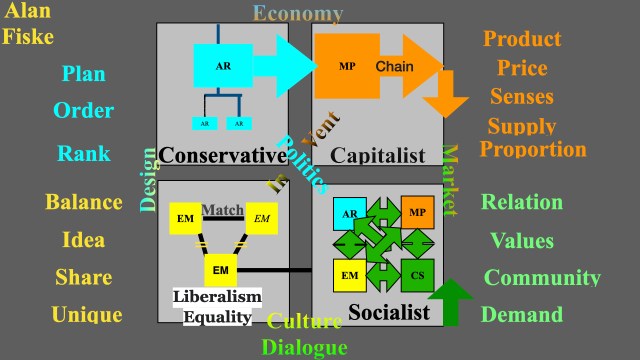
Met behulp van de vier wereldbeelden van Will McWhinney, die van Carl Jung kwamen, die hij samen met de fysicus Wolfgang Pauli uit de Alchemie haalde, die uit Egypte komt kun je gebruik makend van vier relaties van Alan Fiske alle patronen analyseren.die ook bij Hannah Arendt terugkomen.

Macht & Conflict vs Spel & Samenspel

De Patriarchale maatschappij (Blaauw/Rood) vindt dat geweld een functioneel middel is om het doel van de Autoritaire mens, de Strict Father te bereiken t.o.v de De Nurturing Mother (Geel/Groen).
Zij koestert het Leven en combineert spel en samenspel.
Geweld hoort bij een Autoritaire Staat

Waar komt het Geweld vandaan?

de legitimiteit van geweld is sterk afhankelijk van de specifieke context.

Alan Fiske legitimeert geweld binnen zijn vier relationele modellen:

Rangorde: Authority Ranking: (AR) Geweld is gerechtvaardigd om hiërarchie of autoriteit te handhaven.

Volgorde Market Pricing: Geweld beschermt eigendom of economische belangen.

Gelijk: Communal Sharing: Geweld beschermt de groep of gemeenschap

Ongelijk: Equality Matching: Geweld als vergelding om balans te herstellen.

2. De Vlucht van Hannah Arendt

Na de machtsovername door de nazi’s in 1933 kwam Arendt, als Joodse vrouw, direct in conflict met het nieuwe regime. Ze werd korte tijd gevangengezet vanwege haar activiteiten tegen het antisemitisme.

Na haar vrijlating ontvluchtte ze Duitsland en vestigde ze zich in Parijs.

Na de Duitse inval in Frankrijk in 1940 werd Arendt, als stateloze van Duitse afkomst, gevangengenomen.

Ze wist te ontsnappen en vluchtte samen met haar man in 1941 naar New York.

De Nachtmerrie van 9-11-1938:

de Joodse Charlotte Beradt een vriendin van Hannah Arendt in de VS werkte voor de beroemde psychoanalyticus en psychiater Ernst Federn en noteerde en analyseerde tussen (1933-1939) de nachtmerries van haar patienten en kennissen die voor de oorlog de concentratiekampen zagen aankomen.

3. De filosofie van Hannah Arendt:

Totalitarisme: in The Origins of Totalitarianism (1951). beschrijft ze hoe regimes gebruikmaken van ideologie en terreur om volledige controle te verwerven over het leven van mensen.

Banale kwaad: In Eichmann in Jerusalem (1963) introduceerde Arendt het controversiële concept van “de banaliteit van het kwaad.” Aan de hand van het proces tegen Adolf Eichmann stelde zij dat het kwaad niet altijd voortkomt uit sadisme of ideologische overtuiging, maar ook uit gedachteloosheid en het simpelweg volgen van bevelen zonder moreel oordeel.

n haar werk The Human Condition (1958) onderscheidt Arendt drie fundamentele menselijke activiteiten: arbeid, werk en handelen, waarbij arbeid een cyclisch proces is ten behoeve van het overleven, werk (het Ambacht) iets toevoegt wat het leven overstijgt en handelen betrekking heeft op interactie met anderen en het beginnen van iets nieuws in de publieke ruimte, wat vrijheid en pluraliteit tot uitdrukking brengt

Oordelen: Arendt maakte een onderscheid tussen handelen en oordelen. Terwijl handelen gebeurt in het publieke domein, is oordelen een meer introspectieve activiteit, waarbij individuen de gevolgen van handelingen evalueren en reflecteren op hun betekenis.

Invloeden op Hannah Arendt:

Aristoteles (384-322 v.Chr.): Arendt’s onderscheid tussen arbeid, werk en handelen; komt van zijn indeling episteme (skennis, theorie), techne (kunde, vakmanschap, ervaring) and phronesis.(Wijsheid).

De vier deugden van Plato, de leraar van aristoteles.

Liefde

Uit de analyses die ik heb gelezen en aangehoord blijkt dat Hannah een gepassioneerde vrouw was die snel oversprong naar andere geliefden waarbij Heidegger wel de grootste was.

Proefschrift Augustinus

Augustinus (354-430): Hannah Arendt’s dissertatie verkent Augustinus’ concept van liefde. Ze is met name geïnteresseerd in het concept van caritas, een liefde die voortkomt uit Gods liefde, als fundament voor een religieuze gemeenschap.

De dissertatie is opgebouwd uit drie hoofdonderdelen: Liefde als Verlangen: Onderzoek naar de aard van liefde. Schepper en Schepsel: Verkenning van de relatie tussen goddelijke en menselijke liefde. Sociaal Leven: Analyse van hoe liefde zich manifesteert in sociale interacties.

Immanuel Kant (1724-1804): Invloed op Arendt’s ideeën over oordelen en pluraliteit; oordelen vanuit verschillende perspectieven is essentieel voor politieke vrijheid.

Kants Kritik der Urteilskraft onderzoekt twee vormen van oordelen: esthetisch en teleologisch.

In het esthetisch oordeel is schoonheid een subjectief, belangeloos plezier dat toch universeel gedeeld kan worden, terwijl het sublieme ontzag of angst oproept door de grootsheid van de natuur, maar getemperd wordt door de rede.

In het teleologisch oordeel begrijpen we de natuur als doelmatig, zonder dat de natuur zelf doelen heeft.

Martin Heidegger

Martin Heidegger (1889-1976): Invloed op Arendt’s denken over het ‘zijn’ en de menselijke conditie; verlies van individualiteit in totalitaire regimes.Heidegger en Ahrendt hadden een relatie totdat ze naar de VS vluchtte.

Martin Heidegger’s filosofie draait om de fundamentele vraag naar het zijn, en zijn belangrijkste werk, Sein und Zeit (1927), staat hierin centraal.

Hierin introduceert hij het concept van Dasein, wat verwijst naar het unieke menselijke bestaan dat zich onderscheidt door zijn bewustzijn van zijn eigen sterfelijkheid en de noodzaak om betekenisvolle keuzes te maken. Heidegger stelt dat mensen “geworpen” zijn in een wereld waar ze geen controle over hebben, maar dat ze tegelijkertijd vrij zijn om hun eigen pad te kiezen.

Dit bewustzijn van hun bestaan geeft mensen de mogelijkheid tot authenticiteit—het leven op een manier die trouw is aan zichzelf, in plaats van zich te laten leiden door sociale conventies of wat hij het Men noemt.

In zijn latere werk, zoals De vraag naar de techniek, bekritiseert Heidegger de moderniteit en de invloed van technologie. Hij stelt dat de moderne mens alles, inclusief de natuur en zichzelf, ziet als een middel tot een doel, wat hij Gestell noemt. Dit kader van denken, waarin alles instrumenteel wordt gemaakt, verdoezelt volgens hem de diepere betekenissen van het zijn. Heidegger roept daarom op om voorbij dit technische wereldbeeld te kijken en een authentieke relatie met de wereld te herstellen.

Karl Jaspers (1883-1969): Karl Jaspers’ filosofie draait om het concept van grenservaringen, die intense momenten zijn die ons inzicht geven in het bestaan en de menselijke ervaring..

Onverschilligheid

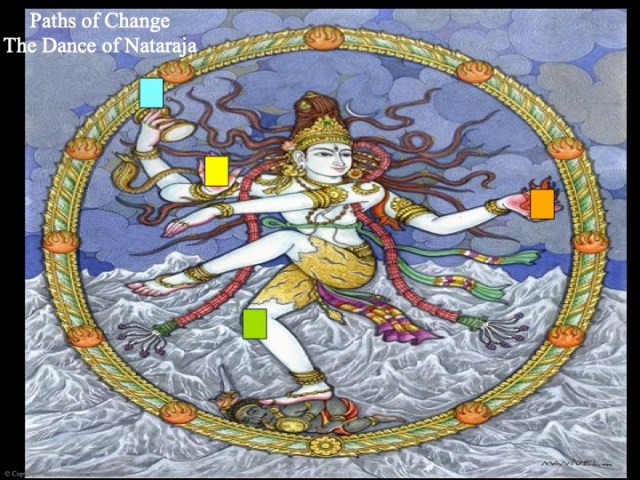
Nataraja (shiva) danst op het lichaam van een dwerg Apasmara-Purusha, de man van vergetelheid, die onverschilligheid, onwetendheid en luiheid belichaamt.De vier gebaren hebben betrekking op Ritme (blauw), Passie (Rood), Identiteit/Verbeelding (geel) en Emoties (groen)

4. Het laatste Oordeel

Politiek is een Vorm van Smaak.

nnah Arendt’s onafgemaakte boek over oordelen zou, geïnspireerd door Kant’s Kritiek van het oordeelsvermogen, hebben onderzocht hoe mensen politieke oordelen vormen door zich te verplaatsen in de perspectieven van anderen, wat zij “representatief denken” noemde. Arendt zag oordelen niet als het volgen van universele regels, maar als een proces van reflectie in dialoog met anderen, essentieel voor de politieke en publieke sfeer.

Haar originele bijdrage was de vertaling van Kant’s esthetische oordelen naar politieke oordelen, waarbij oordelen geen absolute waarheid vereisen, maar openheid voor diverse standpunten. Dit maakte haar visie relevant voor democratische politiek, waar vrijheid en pluraliteit centraal staan.

het Oordeel

Kant’s esthetische oordeelskracht houdt in dat oordelen niet worden afgedwongen door vaste regels of objectieve criteria, zoals in wetenschappelijke oordelen.

Smaak

In plaats daarvan worden ze gevormd door het subjectieve vermogen om te oordelen op basis van “smaak.” Dit heeft belangrijke consequenties voor het oordeel in de politiek en moraal volgens Arendt:

Flexibiliteit en context:

Omdat er geen vaste regels zijn, moet elk oordeel steeds opnieuw worden gemaakt in een specifieke context.

Het oordeel is afhankelijk van het vermogen om situaties te interpreteren zonder te vertrouwen op universele voorschriften.

Interpersoonlijke dimensie:

Hoewel subjectief, is het oordeel niet louter persoonlijk.

Kant en Arendt zien het als intersubjectief, wat betekent dat het oordeel moet worden gevormd met het idee dat anderen er ook mee zouden kunnen instemmen.

Dit leidt tot een dialoog tussen individuen, wat cruciaal is in de politieke sfeer.

Creativiteit en verbeelding:

Zonder vaste regels moet het individu creatieve verbeeldingskracht gebruiken om tot een oordeel te komen.

Dit bevordert onafhankelijk denken en voorkomt het volgen van rigide dogma’s of ideologieën.

Verantwoordelijkheid voor keuzes:

Omdat er geen vaste normen zijn waarop men kan terugvallen, is er een grotere verantwoordelijkheid voor het individu om op authentieke wijze te oordelen.

De kwaliteit van het oordeel hangt af van het vermogen van de persoon om de perspectieven van anderen te overwegen en niet simpelweg regels te volgen.

Ongrijpbaarheid van absolute waarheden:

Deze benadering onderstreept dat politieke en morele oordelen nooit absoluut zeker of objectief kunnen zijn.

Het vermogen om te oordelen is fluïde en aangepast aan omstandigheden, wat impliceert dat een open geest en bereidheid om standpunten te herzien essentieel zijn.

Conclusie

de naam Arendt en haar voornaam Hannah van Johanna hielden mij bezig, omdat de schrijver van het Laatste Oordeel Johannes een Arend als symbool van het “afstand nemen” had.

Hannah deed niets anders en moest schrijven om te begrijpen met als gevolg een enorme productie van essays , toespraken en boeken,

Hanah was de Muze van van Martin Heidegger en heeft meegedacht met het schrijven van zijn beroemde Zein und Zeit.

Heidegger bleef in `duitsland en kon of durde zich niet distantieren van de NAZI-doctrines wat hem later flink is kwalijk genomen.

Haar laatste “Masterpiece” is er nooit gekomen. Haar Hart hield het niet meer uit.

Ze zal worden herinnerd aan haar boek over Eichman, net zo’n mens als Heidegger, die was geboren in Meßkirch, een klein dorp in Oberschwaben, Duitsland met een cultuur van zuinigheid, hard werken en een zekere mate van conservatisme vergelijkbaar met het Hollandse Calvinisme.

Terug naar het begin.druk hier.

Hoe de Trillingen van het Licht onze Werkelijkheid Scheppen.

o. Introductie

Hoe scheppen we onze werkelijkheid?

Deze blog verkent de relatie tussen bewustzijn en natuurkunde, waarbij de invloed van quantummechanica op biologische systemen in deel 1 centraal staat.

3. Tips

Interesse in praktische tips over het focussen van de intentie? druk hier .en spring naar deel 3

2. Toepassingen

Behoefte aan atoepassingen druk dan hier. en ga naar deel 2

Deze blog is een vervolg van Indra’s Net: Het Net van Verbonden Bewustzijn.

Artikel

In de Bijlage (druk hier)is het oorspronkelijke artikel van John Williamsson opgenomen.

1. de Steutel zit in de Quantum Mechanica

Quantum Mind?

wat is het en en waar komt het vandaan volgens Roger Penrose

Bioveld?

De cellen in ons lichaam vormen een electro-magnetisch bioveld wat zich verder uistrekt dan het lichaam.

We ervaren de velden van anderen en andere organismen en ondersom.

Het bioveld bevat heel veel kennis die aan anderen wordt overgedragen en andersom.

Het lijkt er op dat de Quantum Mechanica een sleutel bevat maar die is uitermate en onnodig complex.

Dat komt vooral omdat men het simpele model van Clerk Maxwell van de quaternions nu >200 jaar geleden om politieke redenen door de toenmalige leider van het establisment Lord Kelvin werd verlaten.

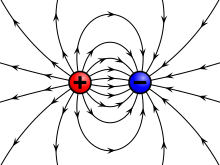
De originele tekening van Maxwell van een Electro-Magnetisch veld m.bv. ijzervijlsel gemaakt..Hier kun je duidelijk zien dat het gaat om twee cirkels die loodrecht op elkaar staan. Dat is ook het model van de Quaternions.
Clifford en en Grassmann hebben de wiskunde versimpeld terwijl Descartes in overleg met de vertegenwoordiger van de bankiers van Venetie en `Amsterdam Paolo Scarpi weloverwogen juist het omgekeerde wilde.

In deze blog probeer ik belangrijke begrippen als spin uit te leggen.

Dan zal ook blijken dat de eetenschappers soms ook niet snappen wat ze zeggen maar wel geleerd hebben om er over te praten een effect wat in de AI bijvoorbeeld bij GPT merkbaar is.

Ruiken van Trillingen

Het begrijkste hoofdstuk is hfst 2.2 over Luca Turin en gaat over hoe Ruiken de trillingen (“spin”) van een molecuul meet.

Welke Trillingen?

Het volgende hoofdstuk (1.1) gaat ove Quantum Mechanica en een alternatieve manier om die trillingen voor te stellen namelijk als om zichzelf ronddraaiend Licht wat permanent onderhevig is aan de aantrekking en afstoting van het magnetisme wat daardoor electriciteit is wat weer bewegende electronen zijn die ook weer licht zijn.

1.1 Quicycle

Deze video is complex. Het gaat eigenlijk over hoe John Williamsson de natuurkunde net als Peter Rowlands het universum opdeelt in 16 = 4×4 = (2×2)X(2×2) hokjes die allemaal een amders zicht geven op het gedrag van het licht.

igenlijk laat het ook zien hoe we de werekelijkheid opbouwen uit punten (0D) die we verbinden tot lijnen (1d) vlakken (2D)en een kubus (3D), waarbij 2**3=16.

John Williamson is helaas recent overleden.

Hij was samen met de ook overleden Martin vander Mark de bedenker van een nieuwe Natuurkunde theorie , die ze middels de Quicycle-organisattie doorgaven.

Ze waren betrokken bij het inmiddels opgeheven Philips Natlab en de deeltjesversneller CERN in Genieve en ontdekten dat de simpele waarheid werd verhuld om enorme mislukte investeringen te verhullen, een investering die men nog een aantal keren wil doen om nog harder te kunnen botsen.

>95-<105 Miljard euro!

Tot op heden is er naar chatting tussen de 90 en 105 miljard euro geinvesteerd.

Een deeltje is een vorm van licht.

CERN mag niet falen en Philips moest veel geld verdienen ten koste van alles.

Ik maakte met behulp van GPT onderstaande samenvatting van het gesprek in onderstaande video..

Hierbij heb ik deze blog over Pyschonatuurkunde gebruikt.

Aan het einde van de gegeneereerde tekst heb ik met behulp van GPT mensen gezocht die zich met hetzelfde onderwerp (de relatie Bewustzijn-Natuurkunde) bezighouden.

Daarnaast plaats ik er ook een aantal bruikbare tips om te kunnen manipuleren.

Wil je onderstaand hoofdstuk overslaan? druk dan hier.

Een samenhangende uitleg van QuiCycle.

Het Nieuwe Paradigma: Verbinding tussen Psychologie, Natuurkunde, en Bewustzijn

Dit hoofdstuk is m.b.v. GPT gegenereerd door de video “what the Universe is made off” samen te vatten en nog een paar keer samen te vatten..

deze tekst overslaan? druk dan hier.

Diverse wetenschappers, waaronder Levin, Williamson, Sheldrake en Rowlands, hebben theorieën ontwikkeld die de traditionele scheiding tussen geest en materie ter discussie stellen.

John Williamson beschrijft fundamentele deeltjes als wervelingen van het Licht.

Rupert Sheldrake introduceert morfische velden, die informatie overdragen en het gedrag van levende organismen beïnvloeden.

Peter Rowlands benadrukt de wiskundige structuur van de realiteit en stelt haar voor als rotaties van rotaties (Octonions) . Hij laat zien dat de regels van het universum zichzelf herschrijven tot een eeuwig gebalanceerd sysyteem.

Michael Levin heeft ontdekt, dat 1-celligen hun vorm ontlenen aan hun E/M-veld wat ze in meercelligen combineren tot het Bioveld.

2. Toepassingen

In dit hoofdstuk vindt je een aantal wetenschappers die bezig zijn met bewustzijn en Quatum-theorie waarbij Luca Turin (2.2) de meest interessante is omdat hij van de toepassing , parfum maken, naar de theorie is gekropen.

Matthew Fischer (2.3) is de meest invloedrijke wetenschapper die heel ver is met het bouwen van een uatum computer en nu vermoed dat de mitochondrien zo,n computer zijn.

De mitochondrien komen heel veel voor in de video’s in deze blog.

Vandaar deze ik een video over hun werking en achtergrond heb opgenomen.

2.1: Nick Lane: Biologie, Chemie

Hoe is het leven ontstaan? We zijn chemische en daarmee Electro-Magnetische wezens.

In de video “Nick Lane: The Electrical Origins of Life” legt Nick Lane uit dat elektrische processen essentieel waren voor de vorming van de eerste levensvormen. Hij bespreekt hoe elektrische gradiënten in hydrothermale bronnen de chemische reacties mogelijk maakten die leidden tot complexere moleculen en hoe mitochondriën een sleutelrol spelen in de energieproductie en evolutie van complexe cellen.

2.2: Luca Turin: Natuurkunde Biologie, Zintuigen: Alles Draait om alles Heen:

In de video bespreekt Dr. Turin zijn werk over de rol van quantummechanica in het bewustzijn. Hij stelt voor dat de spin van elektronen in biologische systemen betrokken kan zijn bij het bewustzijn. Hij bespreekt ook het werk van Dr. Roger Penrose, die gelooft dat bewustzijn het resultaat is van quantumprocessen in de hersenen.

Spin

Geur is een spin-effect maar wat is spin?

Het blijkt dat spin niets te maken heeft met draaien maar met bewegend magnetisme wat electriciteit is die haaks op elkaar staan.

De originele tekening van Maxwell, waarin hij het electro0magnetisme beschrijft. De tekening is gemaakt m.b.v. ijzervijlsel..

Het licht wordt voorgesteld als een bewegende punt.

De focus komt nu te liggen op de rol van de Mitochondria die de rol spelen van Quantum ?computers.

De rol van Nuclear Magnetic NMR en MRI.(Magnetic Resonance Imaging)

Hoe werkt de de uantum Mechanica van de Neus

Wat is Geur?

Hoe kun je het bewustzijn van Fruit Vliegjes meten?

door ze in slaap te brenen.

Wat is slaap?

2.3 Matthew Fischer

de wereld expert in Quantum Computing.

De Mens is een Quanrum Computer?

2.4: Michael Levin & Nick Lane

zijn beiden Bioloog en Natuurkundige (Biofysica) maar Michael Levin is ook computer architect waardoor hij meer kijkt naar de architectuur van het leven die anders in elkaar zit dan men tot nu toe denkt.

Zelfs de kleinste eenheden de 1-celligen vertonen intelligent gedrag wat is terug te voeren tot hun bio-veld.

2.5 Mark Thomas

3. Practische Tips

3.1 Wat is Geloof? :  Positieve emoties dragen bij een gezond lichaam.

Negatieve emoties niet.

Het Leven is een Spel:

Volgens Will McWhinney spelen we het spel dat spellen maakt.

In een spel spelen we (het zelf, geel) met anderen (groen)..

Combineren

Het leven is een combinatie van combinaties.

De vier kijken op de wereld generen 16 2-combinaties, waarvan er 4 hetzelfde zijn.
Sport was bedoeld om de Mens te Vormen.

Infinite Game:

Het spel van het leven eindigt nooit dus er zijn geen winnaars of verliezers.

Magie

Je kunt veel leren van de magie.en van Franz Bardon

Bijlage

Het onderstaande basis artikel van John G Wiliamsson “On the nature of the photon and the electron is door Gemini samengevat.

Het artikel introduceert een vernieuwende theorie die een verenigde beschrijving biedt voor zowel licht (fotonen) als materie (elektronen). Deze theorie stelt dat beide deeltjes afkomstig zijn van dezelfde onderliggende entiteit, gekarakteriseerd door haar wortel-gemiddelde-kwadratische energiedichtheid en de manier waarop deze zich gedraagt in ruimte en tijd.

Een nieuw wiskundig kader: De theorie maakt gebruik van een uniek wiskundig raamwerk, opgebouwd uit 16 basiscomponenten die ruimte, tijd en hun combinaties representeren. Dit raamwerk definieert hoe fundamentele fysische grootheden, zoals velden, impuls en energie, zich transformeren onder Lorentz-transformaties.

Licht als voortplantende velden: Licht wordt in deze theorie beschreven als voortplantende velden zonder rustmassa. Deze velden zijn oplossingen van de vergelijkingen die uit de theorie voortvloeien. Hoewel ze elke hoeveelheid energie kunnen dragen, is de overgedragen energie altijd evenredig met de frequentie van het licht.

Elektronen als recirculerende velden: In tegenstelling tot licht, worden elektronen beschreven als oplossingen met een rustmassaterm. Deze term maakt het mogelijk dat inkomende voortplantende velden samenkomen tot een recirculerende, vortex-achtige structuur. De laagst-energetische configuratie van zo’n vortex transformeert het oscillerende elektrische veld van licht in een unidirectioneel (radial in- of uitwaarts gericht) veld.

Lading en spin als gevolg: De theorie suggereert dat lading en spin geen fundamentele eigenschappen zijn, maar eerder het gevolg zijn van de manier waarop het onderliggende veld overgaat van een massaloze naar een massieve configuratie. De eenvoudigste geladen deeltjes, elektronen en positronen, worden geïdentificeerd met deze specifieke, gevouwen veldconfiguraties.

Vergelijking met bestaande theorieën: Het artikel beweert dat de nieuwe theorie de bekende Maxwell-vergelijkingen omvat en bovendien verklaringen biedt voor elementaire lading, spin en de vorming van geladen fermionen uit ongeladen bosonen.

Artikel: Het Concept van Relativistische Inversie en Zijn Betekenis voor de Menselijke Ervaring

Inleiding

In hun recente publicatie onderzoeken Martin B. van der Mark en John G. Williamson een innovatieve benadering van de relativiteitstheorie door middel van de Clifford-Dirac-algebra. Hun werk, getiteld “Relativistic Inversion, Invariance, and Inter-action,” presenteert nieuwe inzichten in de interactie tussen wiskundige structuren en fysieke realiteiten, met belangrijke implicaties voor hoe wij de wereld om ons heen waarnemen en ervaren.

Wat is de Clifford-Dirac-algebra?

Clifford-Dirac-algebra is een wiskundige structuur die ruimte-tijd en fysische verschijnselen, zoals elektromagnetisme en de beweging van deeltjes, beschrijft. Deze algebra combineert de kracht van Clifford-algebra, die gebruikt wordt om rotaties en spiegelingen in de ruimte te beschrijven, met de Dirac-algebra, die essentieel is voor het begrijpen van relativistische kwantummechanica.

De Vier Orthogonale “Ruimtes”

Een van de belangrijkste ontdekkingen in dit werk is het ontstaan van vier orthogonale (onderling onafhankelijke) “ruimtes” binnen de Clifford-Dirac-algebra:

  1. De Ruimte-tijd: De traditionele vierdimensionale ruimte-tijd waarin wij leven, bestaande uit drie ruimtelijke dimensies en één tijdsdimensie.
  2. De Elektromagnetische Ruimte: Beschrijft de verspreiding van elektromagnetische velden, zoals licht en magnetisme.
  3. De Spinruimte: Gerelateerd aan de kwantummechanische eigenschap van deeltjes die bekend staat als spin, wat de draaiing van deeltjes beschrijft.
  4. De Kwantumtoestandsruimte: Omvat andere kwantummechanische eigenschappen en symmetrieën die inherent zijn aan de Clifford-Dirac-algebra.

Interactie Tussen de Ruimtes

Deze vier “ruimtes” interageren op verschillende manieren:

  • Ruimte-tijd en Elektromagnetisme: De manier waarop licht zich door de ruimte-tijd beweegt en interacteert met objecten, wordt beschreven door de interactie tussen de ruimte-tijd en de elektromagnetische ruimte.
  • Spin en Beweging: De beweging van een deeltje door de ruimte-tijd beïnvloedt zijn spin. Deze subtiele veranderingen in spin kunnen invloed hebben op hoe we de beweging en krachten in onze omgeving waarnemen.
  • Kwantumtoestanden en Fysieke Realiteiten: De Clifford-Dirac-algebra biedt een kader voor het begrijpen van hoe kwantumtoestanden en fysische realiteiten, zoals energiebehoud en lading, met elkaar verweven zijn.

Wat Betekent Dit voor de Menselijke Ervaring?

Hoewel deze theorie op het eerste gezicht abstract lijkt, heeft ze belangrijke implicaties voor hoe wij de wereld ervaren:

  • Subtiele Interacties in het Dagelijks Leven: Veel van wat we ervaren, zoals licht, beweging, en magnetisme, wordt beïnvloed door complexe interacties tussen deze vier ruimten. Hoewel we deze interacties niet direct waarnemen, vormen ze de basis van onze fysieke realiteit.
  • Waarneming van Tijd en Ruimte: Onze waarneming van tijd en ruimte is nauw verbonden met hoe deze orthogonale ruimten met elkaar interageren. Dit kan bijvoorbeeld verklaren waarom we de wereld als driedimensionaal ervaren, ondanks dat we in een vierdimensionale ruimte-tijd leven.
  • Begrip van Fysische Grenzen: De theorie helpt ons ook te begrijpen waarom bepaalde fysieke grenzen bestaan, zoals de lichtsnelheid, en hoe deze onze waarneming en ervaring van de wereld beïnvloeden.

Terug naar het Begin?

Biophotonen

druk hier

De Terugkeer van de Moedergodin

0. Introductie

Deze blog is een vervolg van een onderzoek naar de bron van de mensheid, die vermoedelijk van de steppen komt.

Hier herontdekte ik de Moedergodin.

Ik ontdekte ook, hoe ze consequent is verwijderd uit de Abrahammische godsdiensten en ingeruild voor een agressieve god.

Meer weten over het Matriarchaat? druk hier

In deze blog laat ik zien hoe en door wie de Moedergodin werd verwijderd waardoor wij nu een Patriarchaat hebben.

Direct naar de Samenvatting druk hier

Direct naar de Conclusie druk hier

Direct naar de Bijlage met Theorie druk hier

1.: De Amerikaanse Samenleving is Patriarchaal en Geweldadig.

Een voorbeeld van een Patriarchaat is de Amerikaanse samenleving.

In de Amerikaanse samenleving vinden de republikaanse kiezers het acceptabel, dat de Vader geweld gebruikt om de kinderen te corrigeren.

Waar komt deze opvoedings-filosofie vandaan?

Alan Fiske en George Lakoff geven antwoord op deze vraag.

Alan Fiske zocht uit waarom geweld in veel culturen en contexten als moreel en zelfs noodzakelijk wordt beschouwd.

George Lakoff analyseerde de politieke moraal, die past op het christelijke Amerikaanse gezin.

Daar zijn de Republikeinen voor de Autoritaire (strict) vader.

Geweld -> Authority Ranking

Volgens onderzoek van Alan Fiske hoort geweld bij het Autority-Ranking (AR) relatie-patroon.

De Nurturing Parent hoort bij Communal Sharing (CS).

Politiek: Wetten -> Volk Maar kan het ook Andersom?

Samen vormen ze het “spel” van de Politiek, waarbij het “Volk” door een Autoriteit (nu i.h.a. de staat) aan Wetten wordt gebonden of een Mening heeft, die in het algemeen niets verandert aan de wet c.q. de grondwet.

Mozes toont de door Jahweh gegeven 10 geboden.

4 Relaties-model Alan Fiske

De antroloog Alan Fiske ontdekte, dat er vier relatie-modellen zijn, die in iedere cultuur voorkomen. Ze passen op een Productie en een Verkoopcyclus en op de Schalen van de Meettherie.

De productie-en de consumptiecyclus draaien in tegengestelde richting.
Alan Fiske’s model past op de Schalen in Meettheorie en daardoor ook op Wiskundige Geometrie. Ieder vierluik (Quaternion) past op Paths of Change van Will McWhinney (kleuren)
Het PoC-model toegepast op de Deugden van Plato.Bemerk, dat Market Pricing volledig past op het model van de Sport en de competitie, waarbij de Prijs van het winnen een prijs is geworden die is uitgedrukt in kwantatieve waarden. Hiermee wordt de relatie tussen MP en de Euclidische Ruimte erg duidelijk.

De Moeder godin lijkt erg op de Nurturing Parent , die weer het gevolg was van het onderzoek van George Lakoff naar de wortels van de Amerikaanse politiek.

George Lakoff is de mede-ontdekker van de Embodiment theorie.

Gezin -> Samenleving

Hij analyseerde daarmee de Amerikaanse politiek en vond dat de Republikeinen de Dominante Vader en de Democraten de Zorgende Moeder als de kern van het Gezin en daarmee ook als voorbeeld van de gewenste Samenlevingen.

2.Hoe is het het Patriarchaat Ontstaan?

Garda Lerner heeft uitgezocht waar deze verandering van rol van de vrouw vandaan kwam.

Gerda Lerner: The Creation of Patriarchy

Deze samenvatting is gemaakt door Chatgpt.

Gerda Lerner’s boek “The Creation of Patriarchy” onderzoekt de ontwikkeling van patriarchale systemen en hoe deze de samenleving zijn gaan domineren.

  1. Historische Context: Lerner traceert de oorsprong van het patriarchaat naar oude beschavingen, met name de Mesopotamische, Hebreeuwse en Abrahamitische samenlevingen. Ze stelt dat het patriarchaat verankerd raakte toen samenlevingen overstapten van jagen en verzamelen naar landbouw. Deze verschuiving leidde tot de vestiging van privébezit en patrilineaire verwantschapssystemen, waarbij erfenis en afstamming via de mannelijke lijn werden getraceerd​.
  2. Rol van Wetten en Religie: De institutionalisering van de ondergeschiktheid van vrouwen werd vastgelegd in vroege wetboeken, zoals de Codex van Hammurabi. Deze wetten formaliseerden de rollen en statussen van vrouwen, vaak gebaseerd op hun seksuele banden met mannen. Respectabele vrouwen waren degenen die aan één man gebonden waren, terwijl anderen als niet-respectabel werden beschouwd en onderworpen waren aan verschillende sociale en juridische beperkingen​.
  3. Symbolische en Religieuze Veranderingen: Lerner benadrukt hoe de opkomst van monotheïstische religies, met name de Abrahamitische religies, leidde tot de achteruitgang van de aanbidding van godinnen. Vrouwelijke godheden die ooit centraal stonden in religieuze praktijken, werden vervangen door mannelijke goden. Deze verschuiving marginaliseerde niet alleen vrouwen in religieuze contexten, maar associeerde vrouwelijke seksualiteit ook met zonde en kwaad, waardoor patriarchale opvattingen verder werden verankerd​.
Een uitleg van Dr. Heide Goettner-Abendroth.

Matriarchaat

Matriarchaat is niet Patriarchaat ingevuld met vrouwen als baas.

Cultuur vs Economie

Hier spelen juist de complementaire relatiemodellen van Fiske een rol namelijk Commuitysharing (CS) enEuality Matching (EM), die samen een Cultuur vormen.

De kernkenmerken van matriarchaten volgens Dr. Heide Goettner-Abendroth samengevat zijn:

  1. Gelijkheid en Consensus: Matriarchale samenlevingen zijn gebaseerd op principes van gelijkheid en consensus. Besluitvorming gebeurt door overleg en overeenstemming, in plaats van door hiërarchische of autoritaire structuren​ (YouTube)​​ (YouTube)​.
  2. Centrale Rol van Vrouwen: Vrouwen, vooral moeders, nemen een centrale positie in binnen zowel de familie als de bredere gemeenschap. Ze spelen een belangrijke rol in het bestuur en de economie, maar hun macht is vaak gedeeld en niet absoluut​ (YouTube)​​ (YouTube)​.
  3. Matrilineaire Erfelijkheid: Eigendom en afstamming verlopen via de vrouwelijke lijn. Dit betekent dat bezittingen en familienaam doorgegeven worden van moeder op dochter, wat bijdraagt aan een stabielere en gelijkwaardigere samenleving​ (YouTube)​.
  4. Economische Structuur: De economische structuren in matriarchale samenlevingen draaien om gedeeld bezit en collectieve verantwoordelijkheid. Eigendom en middelen worden gedeeld binnen de gemeenschap, wat zorgt voor economische stabiliteit en gelijkheid​ (YouTube)​.
  5. Culturele en Spirituele Waarden: Matriarchale samenlevingen hechten veel waarde aan culturele en spirituele aspecten waarin vrouwelijke creativiteit en vruchtbaarheid gevierd worden. Rituelen en tradities zijn vaak gericht op de bescherming en zorg voor de natuur en de gemeenschap​ (YouTube)​.

3. De erfenis van Abraham:

De Abrahamitische  religies zijn nu Patriarchaal.

The Bible was written backwards:

De Bijbel is gebaseerd op de Torah, die een constructie is van meerdere schrijvers, die een logisch narratief hebben gemaakt. waarin uiteindelijk de keuze voor de strict father Jahweh vanzelfsprekend is.

Midian en Edom: De Geboorteplaats van Yahweh?

Veel geleerden suggereren dat de Yahweh-verering ontstond in de regio’s Midian en Edom, gelegen in het noordwesten van het Arabisch Schiereiland en Zuid-Jordanië. Bijbelse verhalen, zoals dat van Mozes die Yahweh ontmoette in Midian, ondersteunen deze theorie. De Kenitische hypothese stelt dat Yahweh aanvankelijk een godheid was van de Kenitische of Midianitische stammen, voordat hij de God van Israël werd.

Shasu van Yahweh: Een Egyptische Connectie

Egyptische teksten uit de Late Bronstijd vermelden een groep genaamd de Shasu, waarbij sommige teksten specifiek verwijzen naar “Shasu van YHW.” Deze teksten associëren de Shasu met de regio Edom/Seir, wat suggereert dat de verering van Yahweh een band had met deze gebieden.

Kanaänitische Invloed: Syncretisme in de Vroege Yahweh-Verering

De vroege Israëlieten namen waarschijnlijk religieuze praktijken over van hun Kanaänitische buren. De Kanaänieten vereerden een pantheon van goden, waaronder El, Baäl en Asjera. Het is aannemelijk dat de Israëlieten Yahweh aanvankelijk als een van deze goden zagen, voordat zijn verering zich onderscheidde en monotheïstisch werd.

Kuntillet Ajrud: Bewijs van Syncretische Verering

Een belangrijke archeologische vindplaats, Kuntillet Ajrud in het noordoosten van de Sinaï-woestijn, bevat inscripties die “Yahweh van Samaria en zijn Asjera” vermelden. Dit wijst op een vroege, syncretische vereringspraktijk waarbij Yahweh en Asjera samen werden vereerd.

Asjera

is de Triple Goddess (Moedergodin) , die in de door de schrijvers van de Torah is verwijderd.

Kabbalah is een geometrisch systeem. dat vermoedelijk is terug te voeren tot Tetractys van Pythagoras.

Theoretische Bijlage

Direct naar de samenvatting druk hier

Wat is Embodiment

Lackoff ontdekte dat Kennis niet in het Hoofd maar in het Lichaam zit en vooral in het Hart.

Dit wisten de Egptenaren al.

Het hart van de overledene wordt gewogen en moet “niets” wegen wat betekent, dat de boven (Hoofd) en onder (Lichaam) bloedsomloop in evenwicht zijn.
De Indiase Bramanen, haalden hun kennis van de sjamanen van de steppe. Dat zijn mensen , die we nu paranormaal zouden noemen, omdat ze vaardigheden hebben, die volgens de wetenschap niet kunnen.

Het is goed om te beseffen, dat de wetenschappers de hogepriesteers van onze tijd zijn, die de macht op slimme wijze hebben overgenomen zonder dat te beseffen.

De echte macht ligt bij de Marketeers zonder hart.

Roger Schank ontdekte dat mensen leren van hun fouten en die van anderen.

Fouten noemt hij Expectation-failures.

Fouten worden soms van generatie op generatie over gedragen,

Deze fouten worden ook paradigma’s genoemd door wetenschaps-theoretici.

Dat hebben ze van Thomas Kuhn.

Volgens zijn opvolger Paul Feyerabend zit er helemaal geen structuur in het wetenschappelijk denken.

Nassim Taleb noemt dit tinkering (knutselen).

Heuristiek

Het beste verklarende model geeft de slechtste voorspelling.

De beste voorspelling komt uit het viervoudige (Quaternion) van Carl Jung wat overal werd gebruikt om m.b.v. rietjes of dobbelstenen te verklaren.

De bron van onze beschaving ligt in Afrika bij de Yoruba.

Hoe wordt je Onkwetsbaar?

Waar komen de religies, die zich baseren op de aartsvader Abraham vandaan?

Volgens Torah komt hij uit het sumerisch Ur (der chaldeen) maar waar komt de Torah vandaan?

Er is erg veel invloed van de Sumerische cultuur inclusief de wetten. Die zijn vastgelegd in spijkerschrift.

De oudste gevonden papieren bron zijn de Dode Zeerollen.

Hieruit blijkt, dat er vele varianten zijn van dezelfde tekst vermoedelijk veroorzaakt doordat een copyist een eigen variant maakte.

Darnaast zijn er ook vele onbekende boeken, die later zijn verwijderd, zoals het Evangelie van Thomas was overduidelijk boedistische inzichten vertoont.

Samenvatting

Hfdst 1: De Americaanse samenleving is Patriarchaal en geweldadig. Dat komt door het geloof in de “Strict Father“.

Dit geloof komt uit het conservatieve christelijke geloof.

Hfdst 2: Het patriarchaat komt uit het Abrahammische geloof, dat zijn wortels heeft in Sumerie.

Hoe ziet een matriarchaat er uit?

Hfdst 3: De torah is een geconstrueerde vertelling, die als conclusie de keuze voor Jahweh heeft. In die keuze is er weloverwogen afgestapt van de Moedergodin.

De moedergodin, verbonden aan de maancyclus is een symbool van vruchtbaarheid, natuur en de levenscyclus, was prominent aanwezig in oude beschavingen.

De terugkeer van de moedergodin wordt gezien als een tegenwicht voor de door mannen gedomineerde religieuze en geweldadige tradities en kan helpen bij het herstellen van de balans tussen de mannelijke en vrouwelijke energieën in de samenleving.

Hfdst 4:In de Bijlage van deze blog wordt uitgelegd wat het alternatief is voor de Strict Father, de Nurturing Parent en hoe deze dualiteit kan worden verbonden met de twee andere archetypen van Jung, die uit oude Eyptische school van Heliopolis (n Cairo) komen, die lag in het midden van de net zo oude zijderoute, die Hongarije met china verbindt.

Conclusie

De Amerikaanse en daarmee de Westerse politici geloven, dat alleen een enome ramp hun tegenstanders anders doet denken.

Onderstaand plaatje combineert heel veel kennis.

Het toont de Boom des Levens op de plaats van het Pulserende Hart <-.->, wat hier vier kanten op kan, die allemaal elkaars complement zijn, waardoor het midden Niets voorstelt.

De strict father (bestuur) wordt aangestuurd door Ma,at, Sohia, die de wil van het volk in balans brengt, zodat de Uitvinders er iets mooiers van kunnen maken.

De uitleg van dit plaatje staat hier.

Terug naar het begin druk hier.

TriOdos: Drie Krachten in Balans

Introductie

Direct naar de Samenvatting druk hier

Direct naar de Conclusie druk hier.

Deze blog ging eigenlijk over de Triodosbank totdat ik me weer begon te interesseren voor de het principe van de driegeleding.

Al snel ontdekte ik , dat ik zelfstandig inhoudelijk precies dezelfde kant op was gegroeid.

Tijdens mijn werk bij de ABN raakte ik betrokken bij de oprichting van de Triodos bank en vooral de Antroposofie.

Vandaar dat ik me regelmatig op de hoogte stelde van de Triodos Bank en merkte, dat er geen enkel verband meer was met de oorspronkelijke doelstelling.

Nog sterker Triodos was een ouderwetse Investment bank geworden, die recent in de problemen kwam, omdat de certificathouders hun certificaten niet meer konden verzilveren, waardoor de bank nu overweegt om naar de beurs te gaan.

Wat was de bedoeling? en wat ging er mis?

Rudolf Steiner kreeg gelijk, het Geld moet getemd worden vanwege de macht van Ahriman.

In de antroposofische opvatting wordt geld gezien als een middel om menselijke activiteiten te ondersteunen en sociale verbanden (Associaties) te versterken.

Steiner stelde voor dat geld drie verschillende functies heeft die van elkaar onderscheiden moeten worden:

Die functies komwn overeen mwt de vier universele relatietypen, die de Antropoloog Alan Fiske ontdekte.

Ze passen in de Productie en de Consumptie-cyclus.

Productie- en Consumptie Cyclus

MP: Koopgeld: Dit is het geld dat gebruikt wordt voor directe aankopen van goederen en diensten. Het ondersteunt de uitwisseling van producten en zorgt ervoor dat de basisbehoeften van mensen worden vervuld.

EM: Leengeld: Dit is geld dat wordt gebruikt voor investeringen. Het moet gericht zijn op het ondersteunen van productieve initiatieven en innovatieve projecten die bijdragen aan de samenleving.

CS: Schenkingsgeld: Dit is geld dat wordt gedoneerd zonder directe materiële tegenprestatie. Het ondersteunt culturele, educatieve, en sociale initiatieven en speelt een rol in het bevorderen van gemeenschapsvorming en sociale rechtvaardigheid.

Later ontdekte ik nog een vierde soort Roofgeld (AR), wat overeenkomt met Belasting.

Volgens Steiner moet geld beheerd worden op een manier die deze functies respecteert en in balans houdt.

Hij benadrukte het belang van sociale verantwoordelijkheid bij het gebruik van geld en pleitte voor een economie waarin geldstromen transparant en ethisch verantwoord zijn. Door geld te “temmen” bedoelde Steiner dat het gebruik van geld gericht moest zijn op het bevorderen van menselijk welzijn en sociale harmonie, in plaats van enkel winstmaximalisatie.

Overheid

Ahriman speelt de Duivel in het Perzische geloof

In het zoroastrisme is Ahriman de belichaming van het kwaad, duisternis, chaos en dood. Hij staat tegenover Ahura Mazda, de oppergod die geassocieerd wordt met waarheid, licht, orde en leven.

Ahriman en Ahura Mazda worden niet gezien als scheppers, maar als rivaliserende krachten die vechten om de heerschappij over de wereld. Deze strijd is de kern van de zoroastrische kosmologie en theologie.

1+1=3

Ze vormen samen de twee-heid die de drie-een-heid voortbrengt.

Scriptie

Ik vond een scriptie van Frank Hoek die erg veel informatie bevat over zowel de Triodos bank als het triodos-pricipe., druk hier.

Deel 1: Over de het Tri Odos principe:

Deel 2 gaat over de toepassing van de drie krachten in de maatschappij.

Het principe van de drie krachten, ook bekend als “Tri Odos, is een concept dat is ontwikkeld door Rudolf Steiner, de grondlegger van de antroposofie.

Rudolf Steiner is sterk beinvloed door Wolfgang Goethe en Helen Blavatsky de schepper van de Theosofie.

Hij is een “kind” van de Romantiek, die weer een reactie was op de Verlichting, die weer een gevolg was van de Franse Revolutie, die weer het gevolg was van de Vrede van Westphalia in 1648 met als gevolg:

Erkenning van religieuze vrijheid: Vorsten kregen het recht om de religie van hun staat te bepalen.

Herschikking van Europa: De politieke kaart van Europa werd gewijzigd, met nieuwe machten die opkwamen en het Heilige Roomse Rijk dat aan macht inboette.

Grondslag voor moderne internationale betrekkingen: De Vrede van Westphalia legde de basis voor het moderne concept van soevereine staten in de internationale betrekkingen.

Kruispunt 1893

Owen Barfield

Rudolf Steiner kwam via Owen Barfield terecht in het midden van een netwerk van spirituele onderzoekers, die er van overtuigd waren, dat 1893 een kantelpunt was.

GPT

Dit is het antwoord van GPT op de vraag wat Tri odos betekent:

Deze drie krachten vormen een fundamenteel concept binnen de antroposofische kosmologie en filosofie, en ze worden vaak gebruikt om verschillende aspecten van de menselijke ontwikkeling en de kosmos te verklaren. Hier zijn ze:

Lichtkracht (of scheppende kracht): Dit staat voor de kracht van groei, ontwikkeling en evolutie. Het vertegenwoordigt het proces van verandering, ontwikkeling en transformatie in de natuur en in de mensheid. Deze kracht wordt geassocieerd met het streven naar hogere niveaus van bewustzijn en spiritualiteit.

Warmtekracht (of behoudende kracht): Deze kracht staat voor stabiliteit, behoud en structuur. Het manifesteert zich in de vorm van patronen, vormen en structuren in de natuur en in de samenleving. Het is de kracht die zorgt voor het behoud van identiteit en integriteit, en het wordt geassocieerd met het conserveren en handhaven van de bestaande orde.

Zwaartekracht (of vernietigende kracht): Dit vertegenwoordigt de kracht van afbraak, ontbinding en terugkeer naar de oorsprong. Het is de kracht die deel uitmaakt van het cyclische proces van creatie en destructie in de natuur en in de menselijke ervaring. Deze kracht is nodig voor vernieuwing en hergeboorte, omdat het oude moet worden afgebroken om ruimte te maken voor het nieuwe.

Samen vormen deze drie krachten een dynamisch evenwicht in de kosmos en in de menselijke ervaring.

LichtKracht

warmtekracht

De Drie-eenheid)

de e8 symmetrie is de hoogste symmetrie mogelijk wordt super symmetrie genoemd en vrerklaart de huidige natuurkunde,

Driehoek van Pascal

is duienden jaren oud en is zichtbaar in bijv de Sainte Chapelle in Parijs.

Het laat zien hoe de Eenheid (1) zich splitst in de 2heid (+1-1=0) die samen de 3heid vormen. Dit proces gaat eindeloos door ook al wordt er soms Opgeruimd (zwaartekracht door -1+1=0=niets te maken.

De driehoek van pascal bevat alle patronen, die bestaan of zullen komen.

.De Oerkracht(0)

heeft zijn eigen tegenkracht <.> (Yang, Yin, 0, 1)) , die we eindeloos kunnen Combineren en Evalueren tot de basis kracht (0,1,1,1,0,1,).

Overheid

Zelfontplooing

Iedere kern expandeert totdat de remmende kracht het proces omkeert en alles weer comprimeert tot de kern.

De drie krachten en de Samenleving

Die drie levensgebieden zijn de Kunst en Cultuur (het Geestesleven), de Politiek (het Rechtsleven) en de Economie (de Bedrijvigheid). .

Inzicht vs Uitzicht

Introvert vs Extravert

Deel vs Geheel

De creatieve kracht, de Wijsheid of Inzicht is de antithese van de Actie, het Uitzicht.

Starten vs Stoppen

de 4 Deugden van Plato

De vier deugden van Plato gekoppeld in een cyclus die met- en tegen de klok draait.

De Economische Theorie van Rudolf Steiner:

Franse Revolutie

Volgens Peter Blom de ex CIO van de Triodos bank zitten de drie krachten verborgen in de drie slogan’s van de Franse revolutie Vrijheid Gelijkheid en Broederschap.

Dat is niet echt waar want de revolutie vwas de bron van weer vier nieuwe politieke stromingen, Conservatisme, Kapitalisme, Socialisme en Liberalisme.

Scriptie over Triodos:

Rudolf Steiner verdeelt het sociale leven in drie gebieden:

Vrijheid: Geestesleven: Hierin is iedereen vrij om zijn eigen talenten te ontwikkelen. Dit sluit aan bij het ideaal van vrijheid uit de Franse Revolutie.

Gelijkheid: Rechtsleven: Iedereen is gelijk voor de wet en heeft een gelijke stem. Dit sluit aan bij het ideaal van gelijkheid.

Broederschap: Economisch leven: Mensen werken samen om te produceren, distribueren en consumeren. Dit sluit aan bij het ideaal van broederschap.

Deze gebieden zijn met elkaar verbonden, maar moeten wel onafhankelijk zijn. Elk gebied heeft zijn eigen bestuursvorm:

Geestesleven: Bestuur door alle betrokkenen.

Rechtsleven: Democratie.

Economisch leven: Cooperatie, Sociocratie

Problemen in de huidige economie:

In de huidige samenleving zijn de drie gebieden te veel met elkaar verstrengeld. Het economisch leven domineert de andere gebieden. Dit leidt tot problemen zoals:

  • Uitbuiting van arbeiders: Arbeid wordt gezien als een waar, terwijl het volgens Steiner geen waar is. Dit leidt tot uitbuiting van arbeiders.
  • Grondspeculatie: Grond wordt gezien als een waar, terwijl het dat volgens Steiner niet is. Dit leidt tot grondspeculatie en hoge prijzen voor huizen en landbouwgrond.

Oplossingen:

Associatie

De vier universele relatietypen van Alan Fiske passen perfect op de associaties van Rudolf Steiner, die ruwweg ook kunnen worden vertaald naar Roven,Ruilen ( EM, Equality Matiching en Associaeren (CS Communual Sharing).waarbij Roven past op de relatie Authority Ranking, Market Pricing (Ekonomie).

Er blijven naast de ~Economie nog vier andere gebieden over namelijk Markt, Cultuur, Kunst,Ondernemen en Politiek, die allemaal deel uitmaken van een Cyclus, die met met- en tegen de klok kan draaien.

Roven, Ruilen en Associeren

Steiner pleit voor een associatieve economie. In deze economie vormen mensen samenwerkingsverbanden om te produceren, distribueren en consumeren. Deze associaties zijn onafhankelijk van de staat en worden bestuurd door mensen met economische kennis.

Binnen de associatieve economie worden waren tegen waren geruild. Arbeid en grond worden niet gezien als waren, maar als productiefactoren. Dit betekent dat arbeiders en grondeigenaren een eerlijk aandeel in de winst moeten krijgen.

Steiner benadrukt dat het belangrijk is om de drie gebieden van het sociale leven te scheiden en onafhankelijk te laten functioneren. Dit is de basis voor een gezonde economie en een rechtvaardige samenleving.

Deel 2: Toepassen van de Drie krachten

Het voorkomen van een De Financiele cises

Arjen Nijeboer bespreekt in zijn artikel “De financiële crisis en de driegeleding” de oorzaken van de financiële crisis vanuit Rudolf Steiner’s sociale driegeleding. Volgens Nijeboer zijn de belangrijkste oorzaken:

Gebrek aan schenkgeld voor het geestesleven: Het geestesleven (cultuur, onderwijs, wetenschap) ontvangt geen schenkgeld, waardoor het afhankelijk en minder innovatief is.

Overheidsinterventie buiten haar terrein: De staat neemt te veel taken op zich, zoals volksgezondheid en onderwijs, wat leidt tot inefficiëntie en hoge staatsschulden.

Handel in geld en grond: Geld en grond worden als handelswaar behandeld, wat leidt tot speculatie, inflatie van vastgoedprijzen, sociale ongelijkheid en financiële instabiliteit.

Hij legt uit dat wereldwijde spaaroverschotten banken ertoe brachten risicovolle leningen te verstrekken, wat de subprime hypothekencrisis veroorzaakte. De overheid faciliteerde dit door instellingen zoals Fannie Mae en Freddie Mac.

Nijeboer benadrukt dat stijgende staatsschulden wijzen op een structureel probleem in de economische organisatie. Hij pleit voor een beperking van de staat tot haar kernfuncties en een zelfstandig geestesleven gefinancierd door schenkgeld.

Nijeboer concludeert dat het herstellen van de juiste rolverdeling tussen economie, staat en geestesleven en het beperken van handel in niet-productieve goederen zoals geld en grond, kan helpen toekomstige financiële crises te voorkomen.

vier soorten Geld

Er zijn vier soorten geld, die overeenkomen met de vier universele relatietypen van Alan Fiske:

Koopgeld (Market Pricing – MP, Kapitalisme): Gebruikt voor markttransacties waarbij waarde wordt bepaald door vraag en aanbod.

Leengeld (Equality Matching – EM, Liberalisme): Geld dat wordt geleend en terugbetaald, vaak met rente, om gelijkheid te waarborgen.

Schenkgeld (Communal Sharing – CS, Socialisme ): Geld dat zonder verwachtingen wordt gegeven om het welzijn van de gemeenschap te ondersteunen.

Roofgeld Belastinggeld (Authority Ranking – AR, Conservatisme, Communisme, ): Geld dat door een Overheid wordt verzameld voor publieke diensten en het algemene welzijn.

Banken

Tot aan het begin van vorige eeuw heeft het bankwezen zich vooral geconcentreerd op vermogende bedrijven en de vermogende burger (i.h.a. ondernemers)[5]. De banken waren handelsbanken.

Dit type bank wordt nu een Investmentbank genoemd.

Rond 1900 kwamen drie nieuwe bankvormen naar voren die zich gingen richten op de minder draagkrachtige (Giro & Postspaarbank, de Standaardbank), het collectief (Raiffeisen, de Relatiebank) en het verstrekken van consumptief krediet  (Pandjesbaas, Bank van Lening, de Consumptiebank). Deze laatste functie wordt nu vrijwel overal uitgeoefend door de Retail (Kopen op afbetaling).

De Vier krachten in een Juiste Verhouding

Over de Magie van de Onkwetsbaarheid (Anti-fragility)

Cultureel Kapitalisme

is de fusie van Market Pricing (MP) en Communal Sharing, waarbij de Goede Doelen in de Prijs worden meegenomen terwijl er eigenlijk aan de goede doelen wordt verdiend.Hierdoor is de Markt in één hand.

Een goed voorbeeld zijn de Vriendenloterij en de Postcode Loterij, die hetzelfde commerciele bedrijf zijn..

Samenvatting

Introductie

De Triodos Bank is geïnspireerd door Rudolf Steiner’s ideeën over sociale driegeleding.

De bank streefde naar een balans tussen koopgeld, leengeld en schenkgeld, maar is door de druk van het Cultureel kapitalisme vertaalt in “Duurzaamheid” of simpelweg “Groen” afgeweken van deze idealen.

Driegeleding en de Franse Revolutie

Steiner’s concept van sociale driegeleding wordt gekoppeld aan de idealen van de Franse Revolutie: vrijheid, gelijkheid en broederschap. De historische context van deze idealen en hun invloed op Steiner’s denken worden besproken.

De Drie Krachten

Dit hoofdstuk introduceert Steiner’s drie kosmische krachten: scheppende kracht, behoudende kracht en vernietigende kracht. Deze krachten vormen de basis van een dynamisch evenwicht in de natuur en menselijk handelen.

De Drie Sociale Gebieden

De verdeling van het sociale leven in geestesleven, rechtsleven en economisch leven wordt uitgelegd. Elk gebied heeft zijn eigen bestuursvorm en moet onafhankelijk functioneren voor een gezonde samenleving.

Problemen en Oplossingen

De verstrengeling van de drie sociale gebieden leidt tot problemen zoals uitbuiting en speculatie. Steiner’s oplossingen omvatten een associatieve economie en een duidelijke scheiding van de drie sociale gebieden.

Financiële Crisis

De oorzaken van de financiële crisis worden vanuit Steiner’s perspectief besproken. Gebrek aan schenkgeld en ongepaste overheidsinterventies worden als kernproblemen geïdentificeerd.

Bankwezen en Cultureel Kapitalisme

De evolutie van het bankwezen wordt gekoppeld aan cultureel kapitalisme, waarbij goede doelen commercieel worden benut.

Conclusie

Door het onderzoek naar de drie krachten en de dramatische ontwikkeling van de Triodos Bank viel alles weer op zijn plaats.

Het kapitalisme inmiddels in zijn derde verschijningsvorm is gefuseerd met het socialisme, het communisme en de Internet Commune waardoor China nu de voorloper is geworden en het Westen ongemerkt volgt door toedoen van de Marketeers rondom van Microsoft aangevuurd door Bill Fates verenigd in OpenAI.

Copilot

OpenAi copieert alles wat er maar te copieren is en zet het om in software (CO-Pilot).

Ondernemers

De Nederlandse democratie was al gemanipuleerd ten behoeve van Koning Willem I, die ons voorzag van het Pruisische Onderwijs systeem en de Gilden afschafte. Daarnaast richte hij de Nederlandse Handelsmaatschappij op, die nu nog terug te vinden is in de ABN AMRO.

De oude Elite bestaat nog steeds.

Arbeiders-> Middenklasse

In 1909 werd het staatsbedrijf de Postgiro en de Rijkspostspaarbank opgericht de eerste stap om de arbeider een bankrekening en een spaarbank te bezorgen.In 1991 fuseerde de Oostbank met Nationale Nederlanden tot de ING Groep.

De onderklasse bestaat ook nog steeds en stemt op de PVV.

Zij geloven in de sterke Leider, die alles gaat oplossen.

Boeren Cooperatie

In 1898 werden de Centrale Raiffeisen-Bank en de Centrale Boerenleenbankopgericht die in 1972 fuseerden tot de RABO-bank.In 2016b verdween de cooperatie weer net als zoveel cooperaties.

Die zijn door kapitalistische slimmerikken overgenomen, die de nieuwe elite vormen.

Community of Practice

Het Internet vormt het draagvlak voor een community, die zich enorm hebben gespecialiseerd.

De grote vraag is of en hoe de burgers dit onzichtbare spel gaan overleven.

Spelen of Gespeeld worden?

Worden ze ingepakt in de virtuele wereld? of is hun bewustzijn sterk genoeg om de verleiding van een alles is mogelijk wereld te doorstaan?.

Een onkwetbare structuur.

terug naar het begin

The Future of Psychotherapy

J.Konstapel, Leiden,15-4-2025

0: Introduction

This blog is about the Future of Psychoterapy

Recently I discovered Deliberate Practice (DB) an improvement method in psychotherapy.

In this blog I try to integrate DB in Paths of Change and COP (Community of Practice).

go to Conclusion: push here.

Part 1: a General theory about Change

Part 2: How to Improve the Practice of Psychotherapy

Part 3: IHow to Innovate the practice of Psychotherapy

Part 4 : The Cognitieve Approach

Part 5 : Imagination: Exploring the Inner Landscape

Part 6 : The Light at the end of the Tunnel

Part7: Intuition: the work of Ibn Arabi

Part 8: Attention

Deming Cycle: PDCA:

DB is a variant of the Deming Cycle PLAN, DO, Evaluate (CHECK) and Improve (ACT).

Part 1: General Theory

skip general theory push here.

Every practice follows the same cycle with or against the Clock.

the human-cycle moving with the clock starts in this picture with an Event.
The power of the emotion moving between Up and Down (+5-Positive to -5 Negative) determinates the impact.
This image has an empty alt attribute; its file name is stack-sullivan-plaatjes.020.jpeg

What happened?

is the question related to an event. It contains a description of the Event and a value of the related Emotion (>0,<0).

The event disturbs a proces (act) that could be planned (“Goal”).

What is a Case?

A case is a description of How an Event distrurbs a Life Course of a Person.

“In psychology, cases are made comparable by using diagnostic criteria, demographics, clinical features, and context.

Diagnostic criteria like those in the DSM-5 are used to diagnose disorders.

Demographics such as age and gender provide context.

Clinical features like symptom severity and treatment history aid comparison.

Contextual factors like life events and culture are considered.

These ensure systematic comparison for pattern identification and intervention development.”

Life Course

Expectation Failure

Kubler Ross reaction pattern shows the behavior after a major positive or negative Expectation failure.

The psychological setpoint is the average emotional level a person tends to return to, despite temporary ups and downs.

It’s influenced by genetics, personality, and life experiences.

Though stable, it can change over time through therapy or positive habits.

It is also possible to clean/adapt the memory because humans are Electro-Magnetic organisms.

InterPersonal Theory: the E/M-BodyField:

Vagus Nerve Stimulation

Cell Memory

Every activity and sensation of of the body is sampled with a certain freuency and stored in cells and eventually translated into new (epi)-genetics.

Cellular Memory

Interpersonal Theory (IPT) uses two variables Agency and Communion to desrcribe a Personality.

It is based on the Electro-Magnetic Theory of Clerk Maxwell.

The 3th dimension is Magnetic it attracts and repulses.

Emotions

Attract and ~Repel just like a Magnet.

The emotions are a Path of Change.
The model of Path of Change contains 4 independent Points of View. They are a combination of Agency and Communion.

Moebius Pattern

looks like an 8.

The same cycle now With and against the clock with the human in the center described by Interpersonal theory.

Alan Fiske

discovered the four Universal Realtionship Patterns that match with IP, PoC.(Paths of Change), ideologies, scales of measurement and Geometries.

The 8-pattern of Panarchy:

Panarchy describes an Ecology.

4 Variables

Alpha (α): Alpha represents the rate of change or destruction in a system. It denotes the speed at which the current structure or state of the system is broken down or disrupted.

Kappa (κ): Kappa signifies the degree of stability or return to a previous state after disturbance. It represents the system’s capacity to reorganize and revert to a previous configuration.

Theta (θ): Theta denotes the degree of connectivity between different scales or levels in a system. It describes the extent to which changes at one scale or level influence others.

Omega (ω): Omega stands for the panarchic scale, referring to the extent to which a system is open to change and renewal. It describes the willingness of the system to embrace new ideas, processes, or structures.

Personality (Big Five)

Alpha (α):Equivalent to “Neuroticism” in the Big Five personality theory, representing emotional instability.

Kappa (κ): Corresponds to “Conscientiousness,” reflecting organization and responsibility.

Theta (θ):Translates to “Extraversion,” indicating sociability and assertiveness.

Omega (ω):Associated with “Openness to Experience,” signifying receptiveness to new ideas and creativity.

6 2-combinations:

Alpha-Kappa (α-κ): Exploitation (Conservation): Maintenance of stability with slow change.

Alpha-Theta (α-θ): Release (Creative destruction): Rapid change and destruction with loose connections between scales.

Alpha-Omega (α-ω): Release (Creative destruction): Rapid change and destruction with openness to renewal.

Kappa-Theta (κ-θ):Reorganization (Growth): Stable reorganization with strong connectivity between scales.

Kappa-Omega (κ-ω): Exploitation (Conservation): Maintenance of stability with openness to renewal.

Theta-Omega (θ-ω): Conservation (Reorganization): Loose connections between scales with openness to renewal.

What we miss is 5. Agreeableness. We could translate this in a 5th variable we call ooperation (C): It represents the degree of cooperative and competitive interactions within the system.

Up and Down

Remember: Reflects system stability and resilience, akin to high Conscientiousness and Openness to Experience in the Big Five, indicating readiness for change and responsibility.

Revolt: Signifies rapid change and disruption, akin to Neuroticism and low Openness to Experience in the Big Five, associated with emotional instability and resistance to change.

Part 2: Deliberate Practice

follows the Deming PDCA-cycle:

Part3: How to Innovate Psychotherapy

The classification of mental Ilness is called DSM. You can use Interpersonal Therapy or the Archetypes of Jung to explain DSM.

Trauma

The most well-known disorder in this category is Posttraumatic Stress Disorder (PTSD). PTSD can develop after exposure to a traumatic event such as a serious accident, assault, or natural disaster.

The Kubler Ross Cycle is a bodily reaction to a major event.

How to Innovate

When you are unable to improve and are aware of the repeating failures you are able to innovate.

In this case you have to leave the improvenent-cycle and jump Up (in abstraction) or Down to the essence.

UP: Neuro Inquistic Programming (NLP)

is a fusion of the practice of well known therapist like Gregory Bateson, Milton Erickson and Virginia Satir,

NLP is not effective because you cannot copy the context.

Milton Erisckson was an intuitive expert in hypnosis.

Talent

Psychotherapy is a interpersonal talent not a profession you can learn.

Eugene Gendlin a friend of Carl Rogers found what makes a therapy effective.

Down: Felt Sense

It is the ability of the patient to explore the inner space, Gendlin called the Felt Sense.

Key factors that influence therapy positively:

This list is made with the help of GPT-4:

GPT-4 is ignoring the felt sense because nobody writes or talks about the felt sense so it does not exist.

That why psychoterapy is stuck.

Skip this part push here

The therapeutic relationship: The bond between the therapist and client is crucial. It should be based on mutual trust, respect, and rapport. When clients feel safe and understood, they are more likely to open up and work towards recovery.expand_more

The type of therapy: Different therapies have unique characteristics. Some focus on exploring thoughts and feelings, while others focus on behavior change. The most suitable therapy depends on the individual’s problem, learning style, and preferences.

Therapist skills: Therapists need various skills, including active listening, empathy, unconditional positive regard, and asking helpful questions. They should also set boundaries, ensure client safety, and maintain confidentiality.

Client motivation: Motivation is essential for success. Clients motivated to change are more likely to work hard and benefit from treatment.

Willingness to change: Therapy often requires changes in thoughts, feelings, and behaviors. This can be challenging. Clients willing to change are more likely to succeed.

Other factors: Problem severity, therapy duration, and comorbidity can also influence therapy outcomes

Part 4: The Cognitive Approach

An Ai is a cognitive verbal talent that could be trained as a therapist. It will never becomen a talent..

Design of in Dutch of an Ai that is able to create and sustain a dialoque.

Clean Language & Clean Space

Carl Rogers (Client Centered therapy) started to rephrase the words of his patients.

David Grove perfected this approach by introducing Clean Language and finally Clean Space.

  • Client-Centered Therapy: Focuses on building a supportive and empathetic therapeutic relationship where clients are encouraged to explore and understand their own experiences, thoughts, and feelings. The therapist uses techniques such as reflective listening and empathy to facilitate self-discovery and personal growth.
  • Clean Language: Utilizes specific, non-directive questions designed to explore the client’s inner world, particularly through the use of metaphors. The therapist guides the client to uncover their own thoughts and experiences without imposing interpretations or suggestions, allowing for a deeper understanding of their subjective reality.

Clean Space: Explores the inner world of individuals through physical space and movement. The approach involves using a physical environment, often represented by a grid or arrangement of objects, to represent different aspects of the client’s experience or inner landscape. The therapist guides the client to move through the space, interacting with different areas or objects, to gain insights and explore new perspectives on their thoughts, feelings, and experiences. Clean Space encourages clients to access their own inner resources and solutions in a non-directive and exploratory manner.

Part 5: The Imagination: Exploring The Inner Landscape

Out-off-Body Travel

Robert Monroe

Astral or spiritual dimensions: Many individuals describe entering astral or spiritual dimensions where they encounter other beings, entities, or spiritual guides. These dimensions are sometimes described as realms of light, love, and higher states of consciousness.

Transitional or liminal spaces: Some experiences involve entering transitional or liminal spaces where individuals find themselves between the physical world and other spiritual dimensions. These areas are often associated with processes of dying, reincarnation, or spiritual growth.

Mental or conceptual spaces: In some individuals report experiencing mental or conceptual spaces where thoughts, ideas, and symbols are experienced at a deeper level than in ordinary consciousness.

Multidimensional or parallel worlds: There have been cases reported where individuals have experienced multidimensional realities or parallel worlds that exist alongside our own physical world, sometimes with different laws of nature and reality.

The light: Many experiences involve entering a bright, loving, and healing light associated with a sense of peace, love, and connectedness. This light is often considered as an aspect of higher spiritual dimensions.

Seth

was the name of a Channel of Jane Roberts:

Some of the key concepts in the Seth Material include:

  • Multiple realities: We live in a multiverse with an infinite number of potential realities. We can choose to focus on different realities and shape our experiences through our thoughts and beliefs.
  • The divine self: We are all connected to the Source, an infinite wellspring of energy and consciousness. We are essentially divine beings with unlimited potential.
  • Creative power: We are constantly creating our own reality through our thoughts, feelings, and actions. We have the power to create our lives as we want them to be.
  • Self-awareness: Our true identity is not our physical form or ego. We are spiritual beings on a journey of evolution and discovery.
  • Life after death: Death is not the end, but a transition to another reality. We continue to exist after death and we can create our own experiences in the afterlife.

Part 6: Using the Light

Cells Biofield and Biophotons

Every cell has its own biofield that produces biophotons (Light).

The cells in the body unite in the body-biofield that can be measured and interpreted.

Biofeedback

Yo can ask questions to the biofield and it gives you answers.

Cells are Intelligent Cooperative Organisms

The Acting with the Inner Light

conclusion

Psychotherapy is a Talent

When you look at the life of Milton H. Erickson, arguably the most successful therapist ever, you will see that his ability was not just a talent, but a skill that was honed through experience and observation. These skills were then adopted and adapted by his followers, particularly in the field of Neuro-Linguistic Programming (NLP).

Follow your Intuition

Copying a genius has an effect but the big difference is that Milton uses his Intuition to make a diagnosis.

The intuition is what Eugene Gendlin called the Felt Sense.

Approach:

  • Observing verbal and nonverbal cues.
  • Asking open-ended and focused questions.
  • Utilizing hypnosis to access the unconscious mind.
  • Gathering information about the client’s life history.
  • Collaboratively creating a diagnosis with the client.

go back to Beginning push here.

Understanding

With the Clock

Intuition Not-Seeing

Attention

The Crow and the Waves of the Quantum Sea

In this blog I explore the Bridge between modern Physics and Psychology, researched by Carl Jung and Wolfgang Pauli between 1932-1958.

Table of contents 

go to Summary

Go to Conclusion

1. We live in two Mirror-Universes, the Universe of the Sun and the Universe of the Moon.

2. The Dirac Sea also called the vacuum lies in between the two mirror-universes.

3. The Dirac Delta ImPulse creates the Spectrum of every system and simulates a wave,.

4. Symmetry and Conservation Laws explain the laws of physics.The universe is Charge–Parity (Mirror)-and –Time-symmetric.

5. Many Voices, Internal Mirrors and Advaita explain the Internal universe of the human.

6. Noetic Science.focuses on the the potential of Intuition (Nous).

0. Introduction

Pauli was one of the inventors of Quantum Physics who got his Ideas out of his Dreams.

Jung was a famous psychiater who researched Alchemy to find the roots of the subconsciousness.

He was highly interested in the dreams of Pauli who was interested in the Renaissance Alchemist Robert Fludd.

Robert Fludd, The Temple of Music

In this blog I show you how the Self, the Black Crow, moves between our two Mirror-Universes that are driven by the four Tetramorphs that run the Zodiac.

Retro-Causality

Time is a symmetric concept.

It is proved that our intuition can influence the Past and know about the Future.

This can be explained by modern physics.

Matter is Frozen Light

Anti-Matter

Paul Dirac discovered negative-energy now called Anti-Matter.

He believed that this energy looked like a Deep Sea filled with Anti-matter particles.

Mirror Universes

Both positive, and negative sides are Mirror-universes.

We call them Heaven and Earth.

The Human Self lives on both sides.

Non-Duality is finally entering Physics.

In my blog about Matter and Thermodynamics I showed that everyting is made out of Light.

Light is a Vibrating Vibration <-.->.

This blog is about what is driving the vibration often called Energy ->.

In Quantum Gravity Energy is a Closed Chain (Loop) of Impulses also called Quantum Foam.

Our Universe looks like an Infinite Sea in which we are made of tiny Bubbles.

The so called Dirac Sea is a result of the discovery of negative energy that was wrongley interpreted as an annihilating force with a power of mc².

Quantum Foam

From Wave to Particle

clerk Maxwell found a simple model based on the Quaternions that explains Electro-Magnetism that fits on the results of the experiments of Michael Faraday.

the Quaternion represent Rotations in 4D-space.

The original drawing of Michael Faraday.

Interpersonal Theory

Is based on the Quaternions of Clerk Maxwell

The mirror universe of Paul Dirac is perpendicular to our universe.

1 Mirror Universes

Dr Peter Rowlands of the University of Liverpool showed that all the laws in Physics kan be explained by Octonions which are connected Quaternions.

ancient egypt — Ka and the Soul | by Ancient Egypt | Medium
We visit our Mirror Universe at Night.

Peter Eowlands suggests a Mirror universe that Paul Dirac found when he discovered negative-energy we call Anti-Matter.

Duality

The fundamental unity is 0 meaning not or nothing implying that 1= 0(0), the ultimate duality meaning that everything is an infinite chain of nothings (0(0((0(0)) which is a pattern in a pattern, etc.

Quaternions Multivariate Vectors
The model of Peter Rowlands Gharge and Mass are the same concept.
The Universe is a Rewrite System with a Nilpotent constraint (Sum = 0) that rewrites its operating (creates new laws) system when the constraint is violated.

The space defined by Rowlands et al. is an abstract mathematical framework based on the following concepts:

1. Duality:

  • There are two “mirror spaces” with opposite metrics: real and complex.
  • Quaternions and their antipartners (octonions) reside in these spaces.

2. Trivector:

  • A quaternion pair (Q1, Q2) forms a trivector.
  • The trivector represents a “hyperbolic rotation” rather than a 3D rotation as with quaternions.

3. Nilpotency:

  • The trivector is nilpotent, meaning repeated multiplication by itself eventually yields zero.
  • Nilpotency is related to the “anticommutativity” of the trivector.

4. Topology:

  • The space is based on the topology of Calabi-Yau manifolds.
  • These manifolds are compact and have a complex dimension.

5. Dynamics:

  • The trivector oscillates between the two mirror spaces via a “complex crossing.”
  • This oscillation is related to the “commutativity” of the trivector.

Aim:

The aim of Rowlands et al. is to develop a new algebra with periodicity that switches between commutativity and anticommutativity. This algebra could be used to:

  • Describe the geometry of the universe.
  • Develop a Unified Field Mechanics (UF) theory.
  • Go beyond the 4D quantum uncertainty.

Mirror

In Rowland’s theory, mirrors play a crucial role in the “complex crossing” of the trivector between two mirror spaces:

1. Two Spaces:

  • Real space: The trivector behaves as a quaternion, with classical 3D rotation properties.
  • Complex space: The trivector’s behavior changes, allowing for hyperbolic rotations and other transformations.

2. Mirrors as Boundaries:

  • Mirrors separate the two spaces mathematically.
  • The trivector can cross these mirrors, undergoing a “complex crossing.”

The Psychology of the Mirror Iniverse

The model posits the existence of two mirror spaces, real and complex, and a trivector that oscillates between them. 

This oscillation is related to the “commutativity” of the trivector, which can be interpreted as a representation of mental states and interpersonal dynamics.

The real space can be associated with the conscious mind, while the complex space can be associated with the unconscious mind. 

The trivector, which represents the “self,” oscillates between these two spaces, reflecting the dynamic nature of mental states.

Interpersonal Dynamics:

The interaction between two individuals can be modeled by the interaction of their respective trivectors. 

The commutation of the trivectors determines the nature of the relationship, with commutative relationships being harmonious and anticommutative relationships being conflictual.

From Square (Male) to Circle (Female):

A Calabi-Yau manifold is a Square (X**∞ . + Y**∞=1  ) turned into a Circle (X**2+Y**2=1).

Beaiful Simulations that show why the Kalabi Yau manifold is a variant of a Circle that turned into a Square.

2. The Dirac Sea

Dirac called the Universe a Sea which is in line with current theory that uses Fluids to explain Matter.

A particle is a disturbance that sometimes moves like a drop on its own wavefront.

Bec Velocity
Out of the Dirac Sea Matter (Positive Energy) pops up.

Energy is a Direction of Rotation of a Photon

The development of the helicon or toroidal ring began with André-Marie Ampère, who in 1823 proposed tiny magnetic “loops of charge” to explain the attractive force between current elements.[1] In that same era Carl Friedrich Gauss and Michael Faraday also uncovered foundational laws of classical electrodynamics, later collected by James Maxwell as Maxwell’s equations.

Energy->Photon

Energy is a representation of a Photon.

An anti-particle is the same energy photon rotating in the opposite direction to its magnetic field.

Anti-> Mirror

Particles and their anti-particles are mirror images of each other.

Particle/anti-particle annihilation is the two coming close together and unlocking each other’s angular momentum.

The two photons travel in opposite directions, conserving all properties.

Each particle’s spin, chirality and parity are easily explained. This presentation forms the foundations for all matter particles.

Matter -> Waves

Louis de ?Broglie could explain matter with waves.

Schrodinger put a wave into a equation that combines kinetic and potential-energy.

It could be interpreted as a Probability distribution.

A Probability Distribution is a function with a constant integral.

3. Impuls .->

A Vibration is caused by a pulse or another vibration.

The Dirac Delta Function, a line segment with an area of 1, represents a Pulse.

“It is modeled by a square with a width of x and a height of 1/x. So, x * (1/x) = 1, and x is very small (almost 0).”

Probality

A function with a constant area is a probability-distribution.

The Dirac delta function i is used in many areas of mathematics, physics, engineering, and economics. ISome of the applications of the Dirac delta function include:

  • In mathematics, it is used in the theory of distributions and to solve differential equations.
  • In physics, it is used in quantum mechanics, electromagnetism, and signal theory.
  • In engineering, it is used in control theory, signal processing, and image processing.
  • In economics, it is used in finance to model the Black-Scholes-Merton formula for option pricing.

Spectrum

The Delta Pulse combined with a Function shows the characteristic or the Spectrum, of the function.

Explosion

It is used in Geology to find the properties (Spectrum) of the subsurface.

In this case the Pulse is a Explosion (with dynamite) at a Point in the center of the field.

A calamity can also be used to measure the spectrum of a Country or a Person.

Energy => Work

When you ask an AI like GPT or Gemini “What is `Energy” it produces the old thermodynamic definition that energy is he capacity of a system to perform Work.

Work => Force(F) ->Object

where work is the product of the force applied to an object and the distance over which that force is applied.

Force->Push .->

In the Physics of the 19th century the dominant metaphor was the Pushing metaphor of the Steam machine.

In the Middle Ages is was believed that the Planets were pushed by the Arch Angels.

is Light->Force of Life?

At that time people did not believe in a Field although they believed in the power of an invisible God.

In eastern cultures people believe in an invisible force called Shi or Prana, the Force of Life.

It can be proved that Chi is Light produced by the individual cells .

This light is called Bio-Photons.

Richard Feynman’s Lectures

Feynman was a briljant physicist who was able to developed new theories when needed.

He was able to play with concepts and his lectures are famous.

Richard feijnman  describes energy as a numerical quantity that remains constant throughout various natural phenomena, highlighting its abstract nature as a mathematical principle rather than a concrete mechanism.

Energy => Number

Feynman illustrates this idea using an analogy involving indestructible blocks, emphasizing that energy is a quantity that does not change despite the transformations in nature.

4 Symmetry and Conservation Laws

The Transformations in Nature are Symmetries.

Emmy Noether found a that a Symmetry implies a Conservation principle.

Emmy Noether: Symmetry and Physical Laws

Matter <-> Anti-matter -> CPT-Symmetry

It looks like The Matter-anti-Matter Universe is symmetric in reversing Charge (+ and -) , Time and Parity (A rotation With the Clock and Agianst the Clock).

Anti-Matter is a different rotation of the Photon.

From simple symmetries to Complex Symmetries : E8

Quantum Field Theory

Impuls Networks

<->><.> chains of Impulses up-down,forwards and backwards become an Impuls-network.

The Psychology of the BioField

Emergence

The supposed geometry of space by Einstein is not a cause but an effect of the Impuls-network.

Internal Mirrors and Advaita

A human is internally represented by many personalities that are mirrors.

The paper proposes that the internal social structure of the human mind, with its sub-personalities and virtual others, can be compared to a mirrorhouse.

The interactions between these internal actors might be mathematically described by quaternion or octonion algebras, depending on the complexity of the system.

Advaita

Summary

“The Crow and the Waves of the Quantum Sea” delves into the intersection of modern physics and Interpersonal psychology.

It explores concepts like antimatter and the Dirac Sea, as well as advanced mathematical frameworks such as quaternions, octonions, and Calabi-Yau manifolds, which are used to describe the universe’s geometry and develop unified field mechanics.

The blog also discusses the psychological implications of these concepts, linking the oscillation of the “self” between different mental spaces to mathematical algorithms like quaternions and octonions.

It further explores the roles of energy, work, and force in both physics and psychology, illustrating how they are understood from various perspectives, including that of Richard Feynman.

Lastly, the blog delves into symmetries between matter and antimatter, complex symmetries like E8, and the role of impulse networks in both physical and psychological systems.

6. Institute of Noetic Science

Time is a Human made concept.

the IOntuition is able to look far in the Past and the Future bebause Time is not existent. It is an abstraction of a manmade clock.

Noetic science emerges from various disciplines, rooted in philosophy, psychology, neuroscience, and spiritual traditions. It explores the intellect and intuition’s role in understanding reality.

Founded in 1973 by astronaut Edgar Mitchell, the Institute of Noetic Sciences (IONS) spearheaded formal research into consciousness and its transformative potential.

Noetic Field Theory

The text below outlines a theory called Noetic Field Theory (NFT), which extends the concept of Eccles-Cartesian Interactive Dualism.

NFT proposes that the brain is not where consciousness resides but rather acts as a transducer or quantum computer, mediating between physical processes and the mind.

It addresses the “Hard Problem” of consciousness by suggesting that classical and quantum mechanics are insufficient, requiring a new physics framework known as Unified Field Mechanics.

NFT also discusses the potential for quantum computing technologies and telepathic effects arising from understanding the mind-body relationship.

It highlights the need for a proper theoretical framework to explain phenomena like Psi-phenomena and proposes empirical tests to validate its cosmological and mind-body interaction hypotheses.

Overall, NFT offers a comprehensive framework aiming to bridge the gap between consciousness, the mind, and physical reality.

Back to the Start

Conclusion

This blog is the result of my research in thermo Dynamics.

There I discovered a fundamental mistake, the concept of the Impulse.

We have learned to believe that everything that Moves has a beginning being a (sometimes big) Pulse.

In this research I discovered the origin of our Material World being the Light.

Mirror-Symmetry

It is a combination of .->.<-. being nothing (0, or ∅ )lreading to a Mirror-symmetry.

This principle was already known in Africa, Egypt , China and India resulting in Alchemy , the Tao and AdVaita.

The Seal of Solomon is the symbol of the Heart Chakra.

The seal shows the two Universes often situated Up and Down the Heart in the center.

The Super Symmetry E8 contains the Heart Chakra.

Inhibitor Activator

The Universe flips between existence and non-existence.

The Intuition is the Inhibitor. It creates the Nilpotent Balance.
The Kubler Ross Cycle is a bodily reaction to a major event.

The cycle of a city or a country.

Move Back to Beginning

Every Step of the Meta-Cycle is Different

0 Introduction

go to the Summary

This blog ends with a new concept Magma.

Magma is the undifferentiated, pre-logical reality that exists before our minds impose order and meaning through language and logic.

Unlike sets with clearly defined elements, magma is a fluid, ever-changing multiplicity of meanings and potentialities.

Magna looks like the Ether.also called the Vacuum.

It lies in the middle between the Universum of the Sun and the Universum of the Moon

Looking for the Primordial Idea, the ? of the ?

The ? started as a . in ”Greece and became a ¿in Rome.

Magna lies behind ?, ¿,. but it is not a singularity.

This blog was about the role of Meta Systems in design especially in Software-systems until I stopped searching for a new pattern that was not a pattern or an Idea.

A metasystem is a governing structure that provides coordination and
integration of multiple systems,

It can also be used to understand the systems it contains.

Meta Systems contain Systems or other Meta-Systems.

A System is a Composition of components.

Components are really Waves that Resonate

Boundary and Enclosure

Containing can be defined in various ways, but most definitions emphasize the idea of enclosure.

  • Simple enclosure: An object A contains object B if B is located within the boundaries of A. For example: “A box contains a ball.”
  • Part of a whole: A contains B if B is a component of A. For example: “A car contains an engine.”
  • Abstract enclosure: A contains B if B is a concept or idea that falls within A. For example: “Mathematics contains geometry.”

Inside Outside

The Object can be inside, outside or Be the Boundary

The Introduction contains links to Blogs I wrote about E8.

Skip this Introduction push here.

Part 1 is about Software Architectures.

Part2 is about Meta-systems.

The appendix contains many PDF’s about Software Architectures and Meta-systems.

Go to the Conclusion.

Part 3 Meta-Cycles

This blog is about Meta-systems and Meta-Cycles.

It is also About a strange pattern in Meta symmetries called Bott Periodicity.

This pattern shows why 8 is a Boundary in symmetries: 8=> <->4. 4 is a Square.

The Square is related to the Quaternio of Carl Jung.

Mirror

It is a model of the Human Personality and therefore of the Universe

We see ourselves in the Mirror we see.

Symmetry

Therefore the Universe is a highly symmetric structure.

Meta-systems contain other systems and other meta-systems.

That’s why a Meta-system is a Fractal.

Meta cycles are Rotations (Quaternions)

Clerk Maxwell discovered in 1840 that the Universe, the ultimate Meta-system, can be described by the Quaternions that represent a Rotation in 4D-space.

When we look at Maxwell’s theory we can see that the universe is expanding in a spiralling pattern that according to Peter Rowlands is copied.

The spiral in Chartres Cathedral.

This spiral pattern creates two parallel 4D Mirror-Universes with a total dimension of 8 which is the maximum dimension defined by . Bott Periodicity.

Octonions

The pattern of 8 is called the Octonions.

It is represented by a Sphere rolling on a Sphere.

The Super Symmetry of E8.

In The Center of E8 you can see the Heart Chakra.

How to Describe a Context

The blog below is about the Context of Mikhael Bakthin.

It is already a summary of many summaries.

Names

If you use the right, fractal, compression method and the subject is a fractal no essence is lost only the Names that classify a new expansion.

Meta = Up & Down

The meta-proces turns everything into a Map

Medieval Art is without Perspective

"If you can’t get excited to die, aim for ambivalence at the very least," advises Olivia M. Swarthout in her book, "Weird Medieval Guys: How to Live, Love, Laugh (and Die) in Dark Times."

A map is a projection of a Sphere on a Plane.

Projective Geometry

IMAGE: Leonardo's perspectograph
Leonardo da vinci used a Mapping tool to project a Sphere on a Euclidian Plane.

A projection is called a Projective Geometry.

It was invented in the Renaissance when painters discovered the Perspective because they started to look with their own Eyes and not with their opinion.

Euclidian Geometry

A plane is called a Euclidian Geometry. It was invented by the Greek.

the sum of the angles is <, > and = 180 degrees.

The map is not the territory:

We experience reality with the Senses and the Emotions related to the moving Body.

With the Imagination we make an image composed of familiar images we can point to and give a Name.

Thinking -> Thencon-> Seeing.

What is a Context?

To see the context we have to find the right Point of View.

(U & D) and Forward & Backwards -> Biofield

Interpersonal Theory was based by Harry Stack Sullivan on the Electro-Magnetic theory of Clerk Maxwell.

The model behind Interpersonal Theory
The learning cycle of Interpersonal Theory.

(U&D) & (F&B) -> Spiral

This blog was triggered by my recent blog about Vibrating Vibrators (Oscillators).

Synchronization

Oscillators always synchronize.

Part 1: The Future of Software Architecture

is a computer that acts as an Organism.

Humans are organisms that are chemical (not semantic) beings.

Chemical means Biophysical, means ElectroMagnetic Resonators.

Resonator Pattern.
A picture out of the architecture I made for Cordys.
A Flow system with a general User Interface (Yellow/Green) that uses Containers that contain data and software that visit specialized machines (Servants) with a Warehouse that contains reusable Appliances (Red, Action).
The strategy of HP until 200.

This is now a repository of intresting PDF’s about Meta-\modelling until I finished a text to explain them.

This blog is a follow-up on an earlier blog about the same subject called How to solve Wicked Problems with Meta Modelling

It is also a follow-up on Matter is a Vibrating Vibration and

Resilience & Anti-Fragility: How to Benefit from Disorder

The ulimate Meta-Model

is a Cycle of Geometries based on the Archetypes of Jung that come from Alchemy, the art of personal transmutation into a God.

In my last blog I discussed the fractal model of Light (Yellow) which is a rotation of nothing=” being pure love.

The four Geometries of Paths of Change
The path from Paths of ?change (see colors) to the Relation theory of Alan Fiske, to Measurement Scales to Geometries in one picture.

A System looks like an Organism

bacterium

the bodyplan of the bacterium is the same as the bodyplan of the human. 1 cellular organisms are based on the same fractal principle as humans are.

Game and Play

Playing is a Game of the Imagination that creates new Games.

This image has an empty alt attribute; its file name is sportengels.001-2.jpeg
Poc-model applied to a model of Sports and the Virtues of Plato,

The Meta-view of the Ecology

Fractal Panarchy Pattern in 1D.

Panarchy Pattern in 4D

Panarchy Pattrrn in 2D

Panarchy Pattern projected on PoC and Alan Fiske.

The Meta-view of History

was discoverd by Mikhhael Bahktin when he was put in the prison of the Goelag Archipel by Stalin.

We are now experiencing a return to the origin or a move into Space.

Vermilion Cliffs National Monument
Ancient “rockart.

Part 2 About Meta Systems:

Meta-Physics

was seen as the most fundamental part of philosophy until it was attacked as a language-game and a subjective construction-proces. It is now focused on the pragmatic aspects of language and knowledge and on the role of social interaction in the construction of meaning.

The most advanced philosophy moved to Cybernetics, Complexity Theory and Heuristics.

Emergence: The End of Causality

Emergence is the phenomenon where new properties and behaviors arise in complex systems that cannot be reduced to the individual components of the system. These properties emerge from the interaction between the parts, but do not exist on their own.

Key concepts to understand emergence:

  • Self-organization: Complex systems can spontaneously order and form patterns without external control.
  • Nonlinearity: Small changes in initial conditions can lead to large changes in the outcome.
  • Feedback loops: Amplify or dampen the behavior of a complex system, leading to complex patterns of behavior.

Maps in Mathematics

Maps turned into functions and functors and the “numbers” became theories. Category Theory tries to find out what functions are behind functions.

Non-Russell Set

?the basic unit of Mathematics is the Paradox

Category Theory: the Art of Composition

Abstraction

is the art of throwing away without destoying the essence being the altimate paradox between he static and the dynamic.,

Scales and Meta-systems

The four Scales above impose four different relations on a Meta-System where

(1): the Ordinal scale is related to Order and Rank , It converges to a Unity (Point) at the top.

Affine geometry studies geometric properties that are preserved by affine transformations, which include translations, rotations, scalings, and reflections. It is related to ordinal scales, which only measure the order of objects, not the absolute distances between them. Examples of affine geometry in practice include city maps, thermometer scales, and rankings of teams in a competition

(2) The Ratio scale is linked to Measuring related to a Unity, Money, the Euclidian Geometry (a Frame) and Cause and Effect which is a dominant concept because it is related to Capitalism.

Many Causes Converge sometimes in one effect.

(3) The Nominal scale lis inked to being Unique and Different and Liberalism which is a product of the French and American Revolution and Alan Fiske’s Equality Matching (EM).

EM is euivalent to to Trading without money involved.. See Anti-fragility and Panarchy.

(4) Set: Socialism and Communal Shring is related to Projective Geometry which is connecting lines (Pure Relation) where crosses of lines become Points.Point-Line-Duality : which means that points and lines can be exchanged. It also means rhat persons and their relations can be exchanged. See Interpersonal Theory.

Duality

Duality in mathematics refers to the symmetry or correspondence between different mathematical concepts or structures, such as objects and morphisms in category theory, or points and lines in projective geometry.

It often involves the interchange or reversal of certain elements while preserving important relationships or properties.

(5) The Cross being the Heart = “=“.

Meta-Levels-> Meta-Rules

Abstract concepts (games, systems, languages) are understood through meta-levels of rules and constraints.

  • Ontological analysis focuses on these meta-levels (essence and rules) rather than just the entities themselves (ontic perspective).
  • Higher meta-levels define broader constraints that determine the essence of lower levels.
  • Different “kinds of Being” can be understood through this hierarchical structure of meta-levels.
  • Applying meta-levels to phenomena (like learning) reveals their core essence and limitations.

This approach allows for a deeper understanding of a domain by progressively uncovering its underlying complexity and the constraints that shape it, even if those higher levels become more abstract and less directly controllable.

Why do higher meta-levels always involve rules?

Higher meta-levels always involve rules because they represent a level of abstraction above the concrete instances within a domain. At this higher level, the principles and structures that govern the functioning of the lower levels become visible.

These meta-rules can take various forms, such as:

  • Grammar in language: Grammatical rules dictate how words can be combined to form sentences.
  • Game rules in games: Game rules define how players can behave within the game and how the game can be won.
  • Laws in physics: The laws of physics dictate how nature works and how different elements interact with each other.

In all these cases, the meta-rules are more abstract than the concrete instances they govern.

Grammatical rules are more abstract than the words they combine, game rules are more abstract than the actions of the players, and the laws of physics are more abstract than the concrete phenomena they describe.

This abstraction is crucial because it allows us to understand the workings of complex systems without getting bogged down in the details.

By examining the meta-rules, we can recognize the underlying principles and structures that govern the system’s behavior.

The End = E8?

Currently E8 is the most effective meta-rule ever found.

How to Compress Experience of many Observers during the History of Mankind

This method only works when there are many Observers that communicate and understand each other and share the new levels from zero 0 -to-six i6 in history.

It explains why science is highly diverse and is certainly not the “truth” about our reality.

A bottum-up-top-down forward-and backward proces could help.

This image has an empty alt attribute; its file name is stack-sullivan-plaatjes.020.jpeg

From Down to Up: Experience -> E/M-field->E8

Rules, Theorems, and Categories (Meta-level 1): Derived from observations and experiences (level 0). As we identify repeated patterns, we establish rules and categories to organize and describe them.

Properties, Axioms, and Spectra (Meta-level 2): Based on the rules and categories of the first meta-level. After establishing rules and categories, we examine the properties of objects and phenomena within these categories, as well as the fundamental assumptions (axioms) guiding our understanding.

Exceptions, Anomalies, and Singularities (Meta-level 3): Emerges from understanding properties and axioms. As our understanding deepens, we become aware of exceptions and anomalies that do not fit within existing rules and patterns, leading to the discovery of new concepts or ‘singularities’.

Categorization of Content, Quality Spectra, and Singularities (Meta-level 4): Arises from identifying exceptions and anomalies. In response to these discoveries, we further categorize and explore content, focusing on qualitative aspects and variability within categories.

Isolation, Transition, and Mutation (Meta-level 5): Result of understanding categorization and quality spectra. Delving deeper into variability within categories, we isolate individual elements and examine their transitions and mutations, leading to a better understanding of fundamental building blocks of phenomena.

Monads, Facets, and Wild Being (Meta-level 6): Derived from understanding isolation, transition, and mutation. At this highest level, we focus on the ultimate reduction of phenomena (monads), while acknowledging aspects of reality that cannot be fully reduced and fall beyond our comprehension (Wild Being). Facets serve as a way to understand and categorize these irreducible aspects

Appendix

Many PDF’s about Meta-Systems

Kent Palmer about Meta Systems

This PDF was used to test the theories I developed.

It is advised to read it!

https://slideplayer.com/slide/4545224

Conclusion

An Idea is a Beginning and an End.

Spring and Autumn are in between Winter and Summer but in another order.
Winter is the endstate of Autumn and Summer is the endstate of Spring.
Spring is the beginning and the end..
0. is the beginning and the end of the Number Cycle.
The four Geometries of Paths of Change
≠ has the Potential to become ∈, >,<,= + -.!,?

Cornelius Castoriadis

tried to solve the problem of the Ontology by trying to find a pattern that is Unique by itself.

Magma

Plato called it an Idea.

Cornelius called it Magma.

Magma is the undifferentiated, pre-logical reality that exists before our minds impose order and meaning through the frames of language and logic.

Unlike sets with clearly defined elements, magma is a fluid, ever-changing multiplicity of meanings and potentialities.


The concept of “magma,” as introduced by Cornelius Castoriadis, refers to a mode of being or existence that differs from traditional categories such as sets and classes.

A magma is characterized by the property that its elements are not fully determined or distinguishable.

In other words, the structure of a magma cannot be unequivocally established, and its elements are intertwined and dynamic.

In the context of Castoriadis’ philosophy, the concept of “magma” emphasizes the complexity, dynamism, and non-fully determined nature of systems, transcending traditional categorization and determinism. It suggests an openness to change and evolution, as well as a refusal of strict categorization.

In summary, a magma is a complex and dynamic entity whose elements are interconnected, and whose structure cannot be fully determined.

there is big overlap with the work of Mikhael Bahktin.

About Infinity.

Summary

0 Introduction

This blog started as a search into meta-systems guided by the PDF of Kent Palmer in the Appendix.

As always the research got a life of tis own and ended with the pilosophy of Cornelius Castoriadis.

He tried to find what he called magna that has no parts and always resist being confined to sets.

Magna is always “new” but is also always there.

It is lies on  the tip-of-the-tongue”.

To find magna you have to bstract which is throwing away what is trivial until you find the essence.

Meta Systems contain essence until you find a new meta-system.

To me E8 also called Supersymmetry was an essence and I was able to map many old essences into E8 until I found Magna.

Part 1 Software Architectures are defined by Meta-Models.

They describe the models that can be used to define software.

Software started to automate manual labor and meta-models started as data-models implemented in databases.

Later proces-models and content-models were added.

Currently Software is moving from the Body to the Mind forgetting the Soul.

Part 2 Meta Systems

It started with the Meta-fysics of Aristoteles that was found in an Arabic Library in Constantinopel

It was translated in Greek and than Latin.

It started the Renaissance.

Russell and Witgenstein reconstructed Mathematics that was abstracted away into a Map of Theories that became symmetries until Duality was discovered again.

Now Methematics is almost automated but Philosophy is not because Humans keep looking for Magna.

Part 3 Meta-cycles

are procesmodels that represent cycles with many different cycletimes.

The shortest cycletime is related to Light that is the foundation of Matter.

We are made out of Flickering Contradictions.

go back to the Introduction

Hoe Geloof ik in een Gezond Lichaam?

De vorige blog ging over de wijze waarop het Bewustzijn via de Verbeelding de Fysieke realiteit creëert.

Dat heeft grotendeels te maken met een Aangeleerd geloof dat alles hetzelfde blijft.

Direct naar de samenvatting? druk hier

Direct naar de Conclusie

Wonderen

We geloven niet in Wonderen en daarom gebeuren ze niet.

Geloof

In deze blog wordt onderzocht Hoe we door middel van dat Geloof ons Lichaam Gezond kunnen houden.

Een Mens is een Collectief van 1-celligen

Het belangrijkste inzicht in deze Blog komt van de bioloog Michael Levin:

Hij onderzoekt de relatie tussen 1-Celligen en hun gastheer (bijv. een mens).

Mensen zijn enorme verzamelingen 1-celligen die allemaal samenwerken om een lichaam te laten gedijen.

All known cognitive agents are collective intelligences, because we are all made of parts;

biological agents in particular are not just structurally modular, but made of parts that are themselves agents in important ways.

There is no Truly Monadic, Indivisible yet Cognitive Being“.

Deze uitspraak is fundamenteel voor de verklaring van het zelfherstel van Lichaam en Geest.

Op alle niveau’s van het Universum van heel heel klein tot het allergrootste wordt er conditieloos samengewerkt.

Laat het universum zijn of haar gang gaan en alles komt altijd in de oude staat terug.

Dit is de basis-conditie van Geloven namelijk

de totale overgave aan het worden.

Het Volgende Hoofdstuk gaat over Natuurkunde

Dit hoofdstuk overslaan en spring naar naar het volgende Hoofdstuk druk hier.

Dit deel gaat over Nieuwe ontwikkelingen in de Natuurkunde.

Zero-point Field (Vacuum, Aether)

Het Vacuum is de Lege ruimte die vroeger de Aether werd genoemd.

In die lege ruimte zitten kleine gaatjes (“zwarte gaten”) die met elkaar zijn verbonden via een andere gespiegelde ruimte.

Het vacuum heeft een tempratuur van 0 graden Kelvin waardoor alle beweging stil staat.

De 1-celligen koppelen aan de gaatjes en zorgen . daardoor voor Communicatie tussen Soortgenoten en Energie.

Intelligentie

Intelligentie is Het vermijden van Blokkades in de Toekomst

Alex Wissner Gross is Fysicus.

Entropica

Hij schrreef een Computer Programma Entropica dat dit vermijden automatisch doet en het lijkt er nu op dat hij de formule heeft gevonden die alles beschrijft.

Entropie(S)

Die formule komt uit de Thermodynamica en en heeft betrekking op wat men de Entropie (S) noemt.

Die is “een maat voor de waarschijnlijkheid van een bepaalde verdeling van microtoestanden (bewegingstoestanden van elementaire bouwstenen als atomen en moleculen), binnen een geïsoleerd fysisch systeem.

Alex werkt hierbij samen met onder meer Eric Chaisson een Astrofysicus en de schrijver van the Cosmic evolution: the Rise of Complexity in Nature.

Zijn theorie lijkt erg veel op de Constructal Law van Adrean Bejan.

Bejan is een expert in de thermodynamica en “ontdekker” van de “constructal law”..

Constructal Law, een nieuwe visie op Thermodynamica

StroomSystemen Banen hun eigen Pad”.

Energy Flows produce Work/Unit Time

Chaisson argues that cosmic history can be examined from the perspective of energy flows. He sees energy as “Work per unit time” which he equates with power, and shows how energy rate density in some structures has Increased over time.

In iedere stap wordt het steeds makkelijker om de in- en uitstroom van Energie te verwerken.

Cosmic Evolution by Eric Chaisson

Combineren

De entropie bereken je met kansberekening waarbij er vaak gebruik wordt gemaakt van de combinatoriek, de wiskunde van het combineren.

Combineren van Combinaties

Je kunt een Statistische berekening ook theoretisch maken.

Dan komen we in de Waarschijnlijkheidrekening terecht die laat zien dat als je de Aantallen (de wet van de grote aantallen) maar groot genoeg worden alles op elkaar gaat lijken.

Dat is in de praktijk van het leven waar te nemen.

Driehoeken

De driehoek hierboven laat zien hoe er patronen ontstaan die zich eindeloos herhalen (fractals genoemd).

Ze worden nu de driehoek van pascal genoemd.

Ze zijn al hee lang bekend en zijn ook in oude bouwwerken verwerkt zoals de BuroBudor.

De driehoek van Pascal is hier te zien in een opstelling van “heiligen” die begint met de 1-heid aan de top die 3-1-heid wordt.

Alle diagonalen van de driehoek van pascal vertonen “mystieke” patronen.

A new Equation for Intelligence

Ted-talk van Alex Wissner Gross

The End of Space Time (toespraak Nima Arkani-Hamed):

Spring naar naar het “echte” begin druk hier.

Tijd = Verandering meer niet.

Tijd meten we met een klok die is gebaseerd op een Verdeling van de 360 graden van een terugkerend patroon zoals de rotatie van de Maan rond de Aarde of de aarde rond de Zon.

Zonder die referentiekaders bestaat er geen tijd behalve dat we ook merken dat sommige zaken Veranderen. Dat kan alleen als we een referentiepunt vinden dat zelf niet verandert.

Zo zien we op basis van de zonnecyclus een continu proces van uitdijen (groeien) en en weer uiteenvallen (compressie).

We vatten deze twee bewegingen even samen met de term Ademen.

Expansie en Compressie: Waar ligt het Midden?

Volgens de huidige theorie Expandeert het Universum waardoor men terugredenerend bedenkt dat het universum heel Klein is begonnen als een samenballing van enorm veel Massa.

Als er sprake is van ademen zal de expansie van het Universum ook weer moeten overgaan in uitvallen, Compressie.

Dat gebeurt volgens de nieuwste inzichten middels een Gat in de Ruimte, een Wormhole of een Einstein-Rosen-Bridge genoemd.

Wormhole en Multiversum

Als we terug in de tijd gaan en geloven dat het begin een hele kleine massaklomp is komen we vanzelf in de Quantummechanica terecht maar ook in een Zwart gat wat weer gekoppeld kan zijn aan een Wit gat (“Wormhole” dat uitkomt in een ander Universum.

Wat de mogelijkheid biedt om er meerdere van te bedenken, het Multiversum. Helaas heeft deze redenering geen einde behalve als we geloven dat er iets is wat hetzelfde blijft anders loopt het universum “leeg“.

Het gevolg is een Wiskundige Chaos

De wiskunde die bij deze natuurkundige overwegingen hoort ziet er zo bijzonder uit dat men nu gelooft dat er of andere aannamen golden (bijvoorbeeld een evenwicht (Som is constant of iets anders) ) of dat er een andere wiskunde moet worden gebruikt die erg veel llijkt op de combinatoriek.

Combineren en Herhalen

Het universum probeert alles uit en gaat verder met het combineren van combinaties totdat een Oude bekende toestand in een andere bekende Vorm weer terugkeert.

Analogie

Vandaar dat men vroeger aannam dat het begin van het universum een mens was die zo eenzaam was dat hij delen van zichzelf aan het werk zette om iets moois te bedenken.

The 22 letters of the Hebrew Alphabet are a combination of the Trinity, the 7 Planets and 12 Signs of the Zodiac.

Bindu

Een bindu is een puntvormig gaatje in de ruimte wat erg veel wegheeft van een zwart gaatje dat nu de massa niet naar binnen zuigt maar naar buiten en van daaruit kleine Torsi-Veldjes produceert die als Licht ons universum bevolken waarna ze ergens weer via een klein Zwart gat weer “thuis” komen.

In de Indiase cosmologie zijn ze al lang bekend en zichtbaar in alle “machines” (Yantra) zoals de Sri Yantra.

 
Thr Sri Yantra representeert de OM-klank.
Het Patroon de Sri yantra komt uit de Gulden Snede, die nu wordt gebaseerd op 3-Hoeken (de “TRINITY”).
https://hareesh.org/blog/2021/3/29/the-secret-teachings-of-the-yogins

Zwarte Gaten

Erik-Verlinde en Leonard Suskind over Zwaartekracht

Is Zwaartekracht Informatie en wat is Informatie?

Dit stukje tekst tot de samenvatting bevat 3 video’s van Prof. Erik Verlinde en Leonard Suskind over een nieuwe theorie over zwaartekracht

Dit deel kan worden overgeslagen. Wil je dat? Druk dan hier.

Iedere theorie heeft een eigen Schaal

In onderstaand plaatje van Dirk Meijer zie je een herhalend patroon wat een “fractal wordt genoemd.

Dat patronen zich herhalen op iedere schaal is eigenlijk een “wet”, een terugkerende “observatie”.

Zwaartektacht is het gevolg van een bijzondere manier van kijken namelijk middels een bepaalde schaal die groter is dan de schaal van de Quantum Mechanica, de “Nano-Schaal”.

Informatie is een Proces

Informatie is eigenlijk formeren, een proces wat Erik Verlinde ook wel benoemt met Software.

Het gaat er om welke data (verkregen door Meting of Waarneming) je in welke formule moet stoppen waarbij die formule of een patroon is wat je in de data ziet of een bekend proces wat al is vertaald in een formule.

Demiurg: Het Universum is een Machine

Volgens de gnostici, een oude religie die voor het christendom bestond, beheerst de ~Demiurg de werkelijkheid.

Ons Universum is het gevolg van een “fout” in de schepping (het breken van het pleroma) waarna de Demiurg het over nam.

De film de Matrix gaat over de Demiurg.

Matrix Kosmische Software

Er is inmiddels voldoende bewijs gevonden voor een kosmische computer en de computer taal is gevonden door Peter Rowlands en zijn groep.

Sommige Theorieën passen niet meer op de Waarnemingen

De natuurkunde bouwt voort op de oude geaccepteerde theorien totdat ze gaan knellen zoals de theorie van Einstein en de Big bang die berust op achteruit redeneren naar een begin wat er wellicht nooit was omdat alles zich herhaalt

Maxwell (1840)

De theorie van Maxwell is eigenlijk altijd passend gebleven maar werd aangepast aan het resultaat van een meting die later fout bleek te zijn.

Quaternions zijn Spiralen (3D-rotatie):

Maxwell maakte gebruik van een recente (1840) wiskundige uitvinding (de Quaternions die nu weer zijn vergeten.

De quaternions en Octionions zijn beide een Complex getal wat eigenlijk een Rotatie is terwijl een “gewoon” getal een Verplaatsing is.

De aantekeningen van Maxwell gemaakt met ijzerpoeder en een magneet.

Ballenbak

Een mooi voorbeeld wat later in de video ook aan de orde is is de Algemene gaswet waarin “deeltjes voorgesteld als “pingpongballetjes” in een afgesloten ruimte met een volume dat kan worden bemeten onder druk worden gezet of door het Volume te verkleinen of om de Temperatuur te verhogen wat de beweging van de balletjes stimuleert.

Zwaartekracht lijkt op Druk

Als je het universum voorstelt als een ballon die langzaam leegloopt of wordt opgeblazen lijkt de druk in de ballon op zwaartekracht en moet je nu gaan afvragen waar er wordt geblazen en dat kan een ander universum zijn dat via een zwart-wit-gat communiceert.

Gekoppelde universa.

Van Druk naar Beweging

Door te denken in afgesloten ruimten kun je de natuurkunde transformeren naar de thermodynamica de wetenschap van de Stoommachine waar Druk wordt omgezet in een ronddraaiende Beweging.

Stoommachine

Het vervelende van de stoomachine is dat het apparaat bestaat uit allerlei fysieke mechanische onderdelen die moeilijk te vinden zijn in een niet tastbare (virtuele) wereld die in de verbeelding van de wetenschap wordt gebruikt en dus eigenlijk niet bestaat.

Carnot

Carnot berekende dat de efficiency van de machine volledig afhankelijk is van het verschil tussen de in-en-uitgaande temperatuur, wat een maat is voor de beweging van de balletjes die Moleculen worden genoemd.

Stoommachine. Volgens Freund zijn onze emoties een stoomachine.
De algemene gaswet gaat over het gedrag van Deeltjes in een afgeloten ruimte.

Entropie: Orde vs Wanorde

Dit is een erg verwarrend concept dat soms wordt vertaald met chaos terwijl het eigenlijk een maat is voor orde.

Die orde heeft betrekking op het aantal mogelijke Combinaties wat is af te leiden m.b.v. de Combinatoriek een wiskundig vakgebied wat volgens Leibniz de basis vormt voor innovatie.

Het gaat dan om het combineren van combinaties.

Van Theorie naar Emergence

Emergence is een duidelijk Zicht op een effect dat door vele meestal min of meer gelijke “Agents” (“actoren”) tot stand wordt gebracht.

Thermodynamica als Denkraam

wormholes
Een “wormhole”. of een EPR (Einstein Podolfsky Rosen-Bridge. biedt de oplossing om Quantum mechanica en Zwaartekracht te fuseren. Hierbij hebben we ook nog een andere (anti-gekromde) De Sitter Ruimte voor nodig.
Holographic principle for three-dimensional de Sitter space
Anti-de-sitter ruimte

Quantum Origins of Gravity

Samenvatting

Wat kunnen we met ons scheppend vermogen?

Wat is Intelligentie? We manoevreren ons net op tijd uit een naderend einde.

Om dat te kunnen moeten we kunnen spelen met de Entropie van de Tijd-Ruimte waarin we leven.

Stroomsystemen banen hun eigen weg en dat doen ze steeds op dezelfde manier.

In de loop der tijd zijn de stroomsystem steeds beter geworden in het balanceren van de in-enuitgaande Stroom van Energie.

De tijd-ruimte (space-time) staat ter discussie in de natuurkunde.

net als de Zwaartekracht

Dat komt omdat het begin als heel klein en vol met materie wordt gezien waardoor het vanzelf een zwart gat wordt. Maar waar gaat dat gat heen? naar een andere ruimte?

of kunnen we gewoon omlopen naar een ander Deurtje?

Het resultaat is een gebogen ruimte in de vorm van een omgekeerde kegel waarvan wij ons op de rand bevinden.

Hologram

Aangezien alle informatie in de rand zit lijkt dit universum op een Hologram waarbij de rand fungeert als de muur waartegen golven die door de binnenkamt (de “Bulk“) gaan kunnen Weerkaatsen met steeds een andere hoek.

Holographic principle for three-dimensional de Sitter space

Collectief

1 De mens is een Collectief Bewustzijn waarin 37.2 trillioen organismen samenwerken.

Het collectief van een-celligen kan door het veranderen van de (i.h.a chemische) context zich totaal anders gedragen en zelfs totaal nieuwe meervoudige organismen produceren.

2 De coordinatie vindt plaats middels Licht waarbij het DNA de Zender en Ontvanger is.

Driehoek van Pascal

3 Er zijn vele manieren van samenwerken die kunnen worden vertaald in een digitale code., die kan worden gebrukt om patronen te vinden.

Er zitten heel veel “mystieke” patronen in de Driehoek van Pascal.

Cosmische Klok

4 Op de achtergrond tikt een Cosmische klok die alle processen synchroniseert.

5 Prof Dirk Meijer legt in een interview uit hoe alles volgens hem samenhangt.

Licht

6 Hierbij relateert hij alles aan een torodiale geometrie , de geometrie van het Licht.

7 Die geometrie is overal bij de mens terug te vinden maar ook in zijn Uitingen (dans, litteratuur,..)

8 Het placebo effect is een voorbeeld waar het geloof van de mens in zijn herstellend vermogen een rol speelt.

9 Uiteindelijk komt het neer op het formueren van een intentie en mindful (“met aandacht”) leven.

Kosmische Muziek

10 In een tweede document legt Dirk Meijer samen met Henk Kieft wat zij onder Quantum Biologie verstaan en hoe de kosmische klok Harmonische klanken produceert.

Hoe kunnen we meespelen? Door goed af te stemmen met de tijdgeest.

11 naar de Conclusie

Einde Samenvatting:

Deel 2: De Kosmische Klok maakt Muziek

Zwaartekracht en Thermodynamica

Het eerste deel ging over de zwaartekracht (Erik Verlinde,Leonard Suskind ) en de thermodynamica (Bejan, Chaisson, Alex Wissner Gross).

Dit tweede deel bestaat eigenlijk uit twee documenten geschreven door Prof Dirk Meijer.

hoe werkt de Automatische Piloot van een Mens” en de tweede

Universeel Bewustzijn en het Harmonische Universum“m gaat over Harmonie.

LichtWezens

Het belangrijkste inzicht komt van de bioloog Michael Lewin.

Hij laat zien hoe een-celligen zonder externe besturing van bijv. een DNA de structuur van hun samenwerking bepalen door een collectief E/M-veld te genereren wat in feite een samenspel van het licht is.

Het Vacuum

In mijn vorige blog werd het duidelijk dat de Werkelijkheid een constructie is van de Verbeelding die middels het Bewustzijn het Zero-point-veld (het Vacuum) aanstuurt.

We scheppen op die manier onze eigen werkelijkheid.

TAO

Het zero-point-veld is al lang bekend.

Het werd in China de Tao genoemd:

The Tao is like a well:
used but never used up.
It is like the eternal void:
filled with infinite possibilities.

It is hidden but always present.
I don’t know who gave birth to it.
It is older than God.

Wat doen de Hersenen? Samen laten Werken

Volgens John Cotterill denken we met onze spieren en lijken we erg veel op onze voorouders de bacterien die een groot deel van ons lichaam controleren.

De hersenen coördineren bijv. links<->rechts.

Collectief Bewustzijn

Eigenlijk zijn we al een Collectief Bewustzijn wat met vergelijkbaren (i.h.a. eencellige organismen) samenleeft en consequent bezig is om af te stemmen.

Daar merken we niets van omdat alles in de achtergrond plaatsvindt totdat de achtergrond zichtbaar wordt.

Context

Het blijkt dat het veranderen van de context totaal andere organismen oplevert en dat de context het ook eenvoudig mogelijk maakt om bestaande meercelligen te fuseren met onvolmaakte (eigenlijk gemanipuleerde) meercellige.

Men noemt dat nu

Cell Swarms

Uiteindelijk bestaan alle organismen uit 1-celligen. De grote vraag is wat “onderliggend” is. Dit kan worden gezocht (en wellicht gevonden) in de biomathematica.

Het DNA is een Antenne

In de communicatie speelt het DNA een grote rol.

Het fungeert als de antenne van een zender en ontvanger die zich afstemt op Gelijksoortigen.

Het Geheel bepaalt welke rol het Deel in het Geheel gaat spelen.

“how do the activities of competent, lower- level agents give rise to a multiscale holobiont that is truly more than the sum of its parts? And, given the myriad of ways that parts can be assembled and relate to each other, is it possible to define ways in which truly diverse intelligences can be recognized, compared, and understood?”

Not the DNA but the collective of cells determines wat a single cel will become to create a whole.

Ecologie

Een Ecologie is eigenlijk ook een Swarm.

Over het optimaal functioneren van een Ecologie is erg veel zinvol onderzoek gedaan onder de noemer

Panarchie.

Hierbij is gebruik gemaakt van de Complexiteit-theorie, een Opvolger van de Cybernetica.

TAME—Technological Approach to Mind:

Intelligentie kan zich richten op diverse schalen (nano <-> universum), diverse tijdpaden (snel, heel langzaam) en diverse geheugens.

Mensen kijken naar buiten maar er zijn ook die organismen die naar binnen kijken en de staat van een orgaan in hun reactie meenemen.

Er zijn ook “ruimten” die de mens niet beschouwd zoals de vorm-ruimte of de fysieke ruimte waarbij bijv. gewicht (zwaartekracht) een rol speelt.

1-cellige organismen vormen een electro-magnetisch veld wat de vorm bepaald.

van Informatie en Quantum Theory naar Bewustzijn

Het Geheugen is het Gevolg van het Afwikkelen van een Golf

Het lichaam synchroniseert met de Golven die de Aarde (de z.g. Schumann Resonance) produceert.

Deze golven dragen net als bij water “componenten (“moment opnamen“) ” met zich mee die “netjes” in de juiste Volgorde worden opgeleverd, worden aangevuld, daarna worden afgeleverd en weer worden opgeborgen.

Waar zit het Bewustzijn in de Hersenen?

Waar zit het Bewustzijn?

Licht in het Lichaam -> Biophotonen

De cellen in ons lichaam produceren Coherent Licht Biophotonen genoemd.

Licht is de bron van alles wat er is en fuseert en splitst zich met het hoogste (Planck) frequentie mogelijk.

Alle Materie bestaat uit Licht en andersom.

Materie bestaat uit Licht

Licht en dus ook materie gedraagt zich als een spiralende spiraal die naar evenwicht zoekt.
Licht Splitst en fuseert weer in twee tegengestelde deeltjes.
A new linear theory of light and matter
Licht is een spiralende spiraal.

Moebius Ring (8)

Dit is het basismodel van een Ecologie. Een mens is een ecologie waarin heel erg veel meesat eencellige organismen samenwerken.

Ecologie

Photon

Levensenergie

Chi of Prana is de “Indiase en Chinese ” naam voor Levensenergie. Chi en Prana zijn dus eigenlijk Licht met een bepaalde golflengte.

Voedsel en Kwaliteit van Leven meten m.b.v Biophotonen

Het is mogelijk om de voedsel-kwaliteit te meten door de patronen van de biophotonen te meten die het voedsel uitzendt. Dat geldt ook voor “dood” voedsel.

Metingen geven aan welke Kwaliteit van Leven de dieren en planten en eieren hebben doorgemaakt maar ook of het voedsel genetisch is gemanipuleerd.

Imuunsysteem

Biophotonen laten ook de kwaliteit van het Immuunsysteem zien wat behulpzaam is bij Covid maar nooit is gebruikt. Ik heb een Immuunsysteem APK-keuring voorgesteld aan het RIVM.

Interpersonal Theory (IP)

Interpersonal theory verklaart de mens vanuit de relatie met “anderen” die ook deel kunnen uitmaken van dezelfde persoonlijkheid.

Als anderen niet reageren zoals we dat verwachten haken we af of geraken in een conflict.

Samen Dansen

Samenleven is net als dansen.

Nataraja (Shiva) danst de wereld uit het niets. De vier hand-en been bewegingen corresponderen met de vier samenwerkingsvormen van  IP.

Als je de Muziek niet hoort en voelt die in een relatie zit kun je geen Stap meer doen.

In Elkaar, Uit Elkaar-> Ademen

De relaties kunnen worden beschreven met behulp van twee variabelen die in de psychologie Communion (“Samen“) en Agency (“Alleen“) worden genoemd.

De combinatie lijkt op Ademen.

Agency is “the pursuit of Individuality through Power and Control;  

Communion is the Participation in a large Organism through Care and Contact.

Yin en Yang

Communion en Agency kunnen ook worden getypeerd met Vrouwelijk en Mannelijk of met Yin en Yang (0 en 1).

Ze kan door combinatie worden uitgebreid tot 2++n mogelijkheden ( het “Interpersonal Circumplex“) die kunnen worden beschreven door de driehoek van Pascal of de berg Meru. Ze zijn eigenlijk een gevolg van de z.g. binomiale expansie (X+Y)++n die convergeert naar de normaal-verdeling als ze als een kansverdeling wordt gebruikt.

De Chinese versie van de driehoek van Pascal

Paradox

Yin en Yang zijn elkaars tegendeel en vormen samen een Paradox.

Interpersonal Circumplex
Flow

Synchronisatie

Walter Russell kreeg een Visioen waarin hem de werking van het Universum werd uitgelegd.

Het systeem wordt gedreven door ee Klok die wordt gevoed door de emoties (Potential) en een Puls van de Creativiteit die Productiecyclus aanstuurt.
Picture

Hoe werkt de Automatische Piloot van de Mens?

De tekst tot aan de PDF vat de PDF samen.

De PDF bevat een interview met Prof Dirk Meijer.

Prof Dirk Meijer legt in dit interview uit hoe hij denkt dat het Bewustzijn werkt hierbij maakt hij een onderscheid tussen Aandacht en Bewustzijn.

Er gebeurt van alles wat onze aandacht niet opmerkt en dat komt omdat we het moeilijk of zelfs niet bewust kunnen maken.

De neuronen in ons brein werken op een chemische manier.

Die is veel te langzaam om de snelheid van de processen te verklaren.

Alles in de natuur is gebaseerd op drie aspecten die hij Materie, Energie en Informatie noemt.

Holografisch van 3 -> 2 Dimensies:

Prof Meijer gelooft in het Holografisch Universum.

Dit maakt het mogelijk om 3 dimensies op een plat vlak (1×1) = 2 dimensies af te beelden.

Verder dan onze Horizon kunnen we niet Kijken

Dit principe kun je op iedere dimensie van toepassing verklaren met als “inzicht” dat de informatie over de “Vorm” in de Rand (“Boundary“) zit.

Die is vergelijkbaar met de “Horizon

verder dan onze horizon kunnen we niet kijken.

Fractal

Een nog belangrijker principe is Zelf-referentie ook wel fractal genoemd.

Zo Boven Zo Beneden

Het betekent dat dezelfde principes zich op iedere schaal herhalen en dat we door onszelf te kennen het Universum kennen.

Zo is het model van de Interpersonal Theory samen gevat in het concept Ademen een terugkerend principe net als het principe van de de Boom (“Vertakking“)..

Synchronisatie

Zodra mensen elkaar ontmoeten worden hun hersenen gesynchroniseerd.

Dat is niet te verklaren vanuit de zintuigen maar vanuit een onderliggend communicatie-systeem waarin licht en vele vormen van licht een grote rol speelt.

Dit proes kan vanuit de Quantum Biologie worden verklaard.

Een Torus is een Cyclus in een Cyclus

Dirk Meyer heeft zoals zoveel van zijn voorgangers ontdekt dat de Torus overal tevoorscijn komt.

Een torus ontstaat door een cirkel te Wentelen om een lijn die zich in het vlak van de cirkel bevindt. Als deze lijn de cirkel niet snijdt of raakt, is het resultaat een open torus welke ringvormig is, of vergelijkbaar met de binnenband van een fiets.

In de video aan het begin over het licht wordt de torus die het spiralende licht volgt stap getoond waarbij met behulp van een gedraaide riem de vorm (een Moebius Ring) zichtbaar wordt.

Various modalities of toroidal geometry: (A) Nested torus structure (B) Torus trajectory (red) (C) Atomic structure as double torus, (D) Filled space-time structure with singularity; (E) Torus network at the Planck scale: ultra-structure of quantum foam F: Torus model for rebirth of the Universe from a Wormhole/Black hole/White hole structure (G) Donut model of the universe, (H) Knot structure in torus as metaphor for attractor/standing wave, (I) cartoon of the twistor as a supposed space-time unit
Een Torus die bestaat uit Kubussen.

Geometrie

Torrodiale Geometrie lijkt op een Orkaan.

Menselijke Beweging en het Alfabet

Rudolf Laban Space Harmony -De letters in het Alfabet kunnen worden gerepresenteerd door een patroon dat in een Kubus past.
Kim Veltman legt uit hoe het alfabet is ontstaan. Het is een resultaat van de ontworpen taal Sanskrit waarbij Sanskrit de praktijk van het geluidmaken betekent.

de Geometrie van de Menselijke Relaties

Alan Fiske is een antropoloog die een cultuur onafhankelijk model van de menselijke relaties heeft gemaakt.

Het model past op de meet-schalen en kan daarmee worden doorvertaald naar geometrie.

Relatie-model Alan Fiske
Meetschalen geprojecteerd op relaties
The four Geometries of Paths of Change
Geometrische modellen vormen samen een cyclus. Euclidische geometrie is de geometrie van het platte vlak, terwijl de projectieve geometrie past op een bol of een ander gekromd vlak.
fusie fiske en holling (panarchie)
2D model Panarchie

Raam en Horizon

De emoties (groen) zijn een gekromde ruimte terwijl het waarnemen altijd middels een Raam plaatsvindt waarin we een euclidische platte (vlakke) ruimte veronderstellen die een Horizon heeft omdat onze wereld eigenlijk rond is.

Schap

Een dergelijke 2dim ruimte wordt een schap genoemd (in het engels scape bv landscape) maar het komt ook voor in bv Vriendschap (Friendship) waarbjij Schip weer een plank is die drijft.

brown wooden dock
We Beschouwen onze buitenwereld vanuit een 2 dimensionaal Raam.

Een schap is een Plank (een 2D-model) waarop we wat we weten netjes neerzetten en waarbij de Horizon de grens is van het nu onbereikbare. 

De Projectieve Meetkunde is ontstaan uit het Perspectief tekenen.

IMAGE: Leonardo's perspectograph
Iedere geometrie is afhankelijk van de vorm van de ruimte waarop hij van toepassing is.

Placebo-Effect

Farmaceutische Bedrijven proberen door middel van Statistische Manipulatie het z.g. Placebo-effect uit te sluiten. Dat kan niet.

Eigenlijk willen ze bewijzen dat het medicijn het zelfherstellende proces van het lichaam uitsluit wat eigenlijk onmogelijk is omdat er altijd herstel zal moeten plaatsvinden nadat bijvoorbeeld er met behulp van een Chemische interventie een kankercel is vernietigd.

Met name het slecht opruimen van dode cellen is een oorzaak voor een auto-immuun-reactie.

Dat herstel gaat vanzelf totdat de schade niet meer kan worden gerepareerd.

Hoe Herstelt het Lichaam zich?

Veerkracht (Hormesis)

Hormesis staat voor de Levenskracht die lijkt op een Veer vandaar Veerkracht (Resilience anti-fragility).

Verwarren en Ontwarren

Bij het intrekken van de boog kunnen de Draden van een levenssysteem Verward worden waardoor het niet meer soepel heen en weer kan gaan.

Er zijn heel veel Eiwitten die deze ontwarring weer kunnen opheffen.

Het herstel vindt altijd op dezelfde wijze plaats totdat er een letterlijk een Kink in de kabel zit.

Gelijksoortigheid (Simila) van Oorzaak en Genezing

Vergelijkbare ziekten hebben vergelijkbare genezingspatronen en soms helpt het om de ziekteverwekker in hele kleine hoeveelheid toe te dienen waardoor het ontknopen en herstellen weer plaats vindt.

Grote ingrepen hebben grote bijeffecten.

Chronisch Ziek

In het algemeen genezen mensen vrijwel nooit volledig na zo’n ingreep en schakelen over op een ander meestal Chronisch Ziektebeeld wat voor de Industrie aantrekkelijk is.

Geloof is “Als een Kind zijn”

Er zijn experimenten gedaan met zogenaamde toevalgeneratoren zoals dobbelstenen en software-programma’s, die een willekeurig Getal trekken om te onderzoeken of en onder welke omstandigheden mensen het toeval kunnen besturen.

Dit bleek mogelijk te zijn als men zich Speels (als een kind) opstelde.

Willen en Moeten werkt niet.

Het is vergelijkbaar met de “Eenvoudigen van Geest” in de bijbel en met Mindful.

Onderzoek naar Genezing geeft dezelfde uitkomsten.

Mindful: In het Nu zijn

Volgens de huidige inzichten in de natuurkunde is onze werkelijk v.wb. de tijd symetrisch.

Dat betekent dat het Nu een kruispunt is tussen twee golven n.l. die vanuit het Verleden en de Toekomst.

Quantum Mechanica

De werkelijkheid wordt in de Quantum Mechanica beschreven met behulp van een Statistische blik.

Onze werkelijkheid wordt beschreven met behulp van een kansverdeling die tussen o-en-1 beweegt en door de Observator wordt gerealiseerd.

Dat betekent dat de werkelijkheid zich Realiseert in de Ervaring.

Quantum Biologie

Organisatie-Geometrie

The four Geometries of Paths of Change

Dit onderwerp is al eerder behandeld.

Het komt uit mijn onderzoek naar Verandering en gaat terug naar Paths of Change van Will McWhinney wat weer teruggaat naar de Archetypes van Carl Jung en de Alchemie.

Model van Paths of Change is hier samengevat in zes z.g. Spellen die verbonden zijn aan een “archetypische” rol” zoals de Architect.

De belangrijkste rol voor deze blog is de Visionair die “Spirit” en “Collectief Bewustzijn verbindt.

Spirit is naam voor de “Heilige Geest” een “kracht” die mensen tot onmenselijke daden kan brengen maar ze ook “paranormale” krachten geeft als Levitatie en spontane Genezing ook van anderen.

Dergelijke krachten worden vaak opgeroepen bij “heftige Emoties” of een sterk “Geloof“.

Van belang hier is de relatie met de Euclidische Geometrie, de geometrie van het platte vlak of van het Grensvlak .

Paths of Change in de vorm van een ontwikkel-cyclus. Niet alle mogelijke paden worden aangewend.

De zwarte pijlen mogen best als richtingen (Omhoog, Omlaag,..) worden geïnterpreteerd.

3 Lagen

De mens opereert in 3 werelden.

Collaborative Learning contains 3 connected Cycles connected in a Cycle. The )sub-cycles) operate in a Social ContextMental Spaceand Physical Space. This model is an application of one level of Paths of Change (see Part 2 of this Blog).

Abstractie

Als je omhoog gaat (Abstractie) is er geen einde aan het aantal lagen.

Brug Geometrie <-> Sociologie

Het bijzondere vanhet Sociale Geometrie-model is dat er een direct bewijs is dat het past op een Relatie-model wat in iedere cultuur voorkomt en daarom laat zien hoe menden denken als ze uitgaan van hun relaties met anderen.

Action-Potential

Hierbij is de “groene” relatie verbonden met de emoties (het het “Actie Potentiaal” van Nico Frijda .

Die Potential veroorzaakt een “kromming” van de ruimte en een eerder beschrevenAnti-de-sitter-ruimte met een “wormhole” in het midden.

Holographic principle for three-dimensional de Sitter space

Deel 3: Harmonie

Universeel Bewustzijn en het Harmonische Universum (Dirk Meijer en Henk Kieft.

Een Life Universe heeft minstens 5 functies nodig:

vormen van zelf-leren,

opslag van informatie,

zelf-observatie,

heling en

herstel van afwijkingen, en ook

reproductie.

Evolutie middels Zes Tijdperken

De evolutie van de kosmos wordt in de pdf hier beneden afgebeeld in zes tijdperken.

De evolutie wordt voltooid in tijdperk 6, waarin het heelal “wakker wordt” vanwege verzadiging met informatie.

Overdracht kennis naar Nieuw Universum

Daarna wordt deze Finale Informatie, in een geordende vorm, overgedragen aan een volgende versie van het universum (‘rebound universes’).

De melding van zo’n volgende fase (“de 43ste stap, Sri-Yantra) kwam (volgens mij) rond 2000 langs.

Age of Aquarius

Het gaat om de Age of Aquarius.

Proces-Verbetering

Het plaatje hierboven met als titel The six epoche of evolution gaat uit van de ontwikkeling van het Universum op basis van onze indeling van de wetenschappen waarbij de “onderste” laag Natuurkunde daarna Biologie en de Neurologie dan de IT-Techniek en de fusie van Techniek en Mens.

Machine

Opvallend is dat Peter Rowlands en zijn groep de 4e stap al op de eerste stap zetten n.l. bij de schepping.

Het universum is een computer die zijn operating systeem steeds herschrijft op basis van het overschrijden van de conditie dat de som nul moet zijn. Dat staat eigenlijk voor evenwicht.

Quaternions Multivariate Vectors

Slinger

Het plaatje hieronder komt uit een onderzoek naar een toepassing van de Kosmische Slinger (of JKlok) van Walter Russell, een model wat hem in een visioen is aangeboden.

De slinger, eigenlijk een cosmische klok lijkt er veel op de computer van Rowlands.

Quaternions

De klok of machine draait steeds hetzelfde rondje met een andere stap in de ontwikkeling. Dat lijkt op een spiraal.

In theorie zijn er zeven slagen omhoog mogelijk. Naarmate men verder van de basis afraakt komt er een steeds sterkere onbalans. Deze onbalans verstrekt de kracht omlaag.

Fasen-indeling

In deze blog zijn we een paar “nieuwe” fase-indelingen tegengekomen bijv.

Biologie: Michel Lewin

De mens is een ecologie van een-celligen.

Thermodynamica : Eric Chaisson

Iedere stap wordt het makkelijker om energie in te nemen om het uit elkaar vallen tegen te Houden.

Cosmic Evolution by Eric Chaisson.

Intentie

Erg veel info die laat zien dat genezen afhankelijk is van de Intentie van de genezer en de patient.

Conclusie

De echte innovatie komt niet uit de Natuurkunde maar uit de Biologie.

Ons Lichaam is een Collectief van 1-celligen die samen een Electro-Magnetisch Veld vormen wat de Collectieve Vorm bepaalt.

Onder dit veld ligt het Nulpuntsveld wat een meer-dimensionaal communicatie-systeem vormt waarbij hele kleine zwarte-witte gaten een rol spelen.

Natuurkunde

De vorige blog (geschreven in het engels) eindigde met deze conclusie:

“Our reality is dependent on our Belief of its existence. 

Our belief arises out of our Memory that is fed by our Experiences and he companions in life we belief”

“We live in two Universes that are divided by the vacuum. 

In the Universe of the Light we are awake and in the other we are Asleep“.

The Universes are instable .

They are recreating themselves based on an Algorithm that reacts on Nilpotency.

They are constantly tuned by the Music of the Spheres of the Center.

It is constantly recreated with a Planck-frequency , keeps the sum of iets energy-up-and-downs always zero and generates a new operating-system that varies on a theme that is based on opposits.

Quantum Biologie

Lang geleden heb ik al over de Quantum-Biologie geschreven.

Inmiddels weet ik weer veel meer dankzij Michael Levin.

Collectieven van 1-celligen Vormen een Morphologische Veld

Michael Levin: laat zien dat een organisme bestaat uit een collectief van 1-celligen die vaak weer uit een collectief vormen.

De 1-celligen vormen samen een Electro-Magnetisch veld vwat bepalend is voor de vorm.

Dat was al eerder ontdekt door Michael Persinger die de uitvinder werd van de “god machine“).

Neuronen

Het lijkt erop alsof de “neuronen” in de hersenen overal aanwezig zijn tot in iedere cel. waardoor het “gepolariseerde” lichaams-netwerk zich gedraagt als een geprogrammerde computer.

Morphologisch Veld

Er is geen sprake is van “low-level programmering” middels het DNA maar van een MorphologischVeld net als Rupert Sheldrake al suggereerde .

Lading Gradient is een Subroutine

Volgens Michael Levin is Iedere cel is een batterij die gekoppeld is aan andere battrijen waardoor er een ladings gradiënt (een verdeling) ontstaat.

Die verdeling van lading (+ en -_ kan worden gezien als een verzameling 1-nen-en-nullen kortom een “statement” wat weer kan worden gezien als een subroutine van een programma dat vormen maakt.

Torsion Field

Diep onder de eencelligen zit het Nulpuntsveld dat via de Zwarte-en Witte -punt (Planck)-Gaten energie transporteert wat de “behoefte” aan z.g. “zwarte materie” meer dan volledig opvult.

Hierbij koppelen gelijksoortigen aan gelijksoortigen.

Kanker ontstaat als een Cel het collectief verlaat

Kanker ontstaat als een cel het collectief verlaat.

Dat kan worden hersteld door de gradient (de PH?) te herstellen.

Identiteit: About Boundary of the Self. Zie PDF beneden.

Wanneer wordt een collectief weer een eenheid en ontneemt het individu de ruimte om te handelen?

Een uitgebreide Samenvatting van het werk van Michael Levin.

Scale Free Cognition

Welk Geloof geeft een gezond Lichaam?

De cirkel is rond.

De energie-verdeling die de cellen samen opbouwen is verantwoordelijk voor de vorm en de vorm staat in iedere geval voor het Lichaam.

Het voorkomnen van kanker kan door dit veld op orde te houden.

Dat kan door in een Mild Magnetisch veld te verkeren.

Emoties zijn Action Potential

De Emoties zijn (groen) zijn volgens Nico Frijda een Actie Potentie.

Ze verzamelen Energie en genereren een Puls die het beweeg-systeem (Spieren) laten bewegen.

Die puls komt via de zintuigen en wordt opgebouwd middels de Verwachting die simulaties uitvoert m.b.v. de Spindels.

Cellen zijn Neuronen

In dit alles spelen de neuronen een cruciale rol.

Volgens Michael Levin zijn alle cellen nog steeds neuronen en delen dus alle cellen mee in een “Beweging” van de Emoties.

Dat verklaart waarom diepe emoties (Trauma) de cellen in de war brengt.

Positieve Emoties

Vandaar dat Positieve emoties erg bijdragen aan een gezond lichaam.

PoC Cyclus

Het plaatje tbeneden en hierboven open de cyclus van Paths of Change (PoC).

Het gaat uit van vier onafhankelijke kijken op de wereld.

Er zitten honderden toepassingen in deze blog en de onderste komt uit een verhaal over Anti-Fragility. een concept ontwikkeld door Nassim Taleb.

Het gaat eigenlijk over “onkwetsbaarheid“.

Alan Fiske’s Relatie-model.

De vier views worden hier gerelateerd aan de Relatie-theorie van Alan Fiske, een Antropoloog.

Spanningsveld

Het spanningsveld Uniek<->Samen is het Spanningsveld van het Lichaam en van de Maatschappij.

Het Leven is een Spel

Het wordt opgelost door het leven als een Spel , de Infinite -Game“( te zien en op te houden met alles gelijk te maken, de valkuil van de Franse Revolutie.

Spel-model

Sport model waarin de Deugden van Plato en de Chistelijke Deugden zijn opgenomen

Ecologie

Ons Lichaam is een Ecologie die deel uit maakt van een Ecologie.

Het Universum is

Fractaal

De cellen vormen een Ecosysteem.

Panarchie

De levenscyclus van een Ecologie heeft betrekking heeft op alle vormen van samenwerking tot het hoogste nivo.

Soft Robots

Is dit de volgende stap?

Imagination, The Eye of the Soul

Jump to the conclusion? Push here.

Does the Imagination Create Reality?

This blog is a continuation of a blog called a New Map of Consciousness.

This blog is written in Dutch.

The current blog is written in English.

Zero-point Field

In the current blog I show that consciousness is a Space that is situated outside our Space-Time probably in our Mirror-universe that lies behind the Wall of the Zero-point-field.

The Mirror-universe is made out of Anti-Matter.

The Dirac Sea is a name for the Aether or the Vacuum that is a solution of the Dirac Equation were the vacuum contains “Negative energy particles” also interpreted as Anti-Matter or by Feymann as energy moving Back in Time.

List of Chapters

The links connect to Chapters in this blog (or other blogs I have written).

Body and Mind

Body and Mind: It is easy to Fool the Mind into another Body.

Cells are often changed, many cells are Bacteria and some people remember Past Lives.

Bodyfield

The Continuity of the Body is situated In the Bodyfield.

The bodyfield is an Electo-Magnetic-field created by the Heart and the other fields created by the cells in which the DNA acts as communicator with others cells inside and outside our body.

About Quantum Biology.

Is it possible to influence Chance?

The Selection Effect (Herbert Mertz):

It is possible to influence chance until you start to cross a certain border where you Believe it is Not Possible.

You have to be Playful to influence Chance.

Quantum Mechanics and Consciousness

The Physics of Consciousness. Quantum mechanics shows that Reality is created when Consciousness creates an Experience.

Harmonics

Harmonics: Consciousness in the Universe is Tuned by a Musical Master Code based on adapted Pythagorean tuning.

The grounding mathematics with real and maginary numbers predicts a Rotatory feature that introduced the idea of Vortices and  Toroidal geometries.

The Torsion Field lies Behind the Zero-Point Field

Behind the Zero-point-field we find the Torsion field.

This blog contains many PDF’s and video’s that explain the torsion field.

Spiraling Spirals

It has a lot to do with the explanation of the group of John Rowlands that discovered that it is possible to rewrite all the formula of physics into a Nilpotent Machine that Rewrites its own Operating system when the sum of all the Potentials is>0.

The sytem can be desribed by the Octionions, a Abstraction of an Imaginary number that is a rotation.

The Universe is aRotating, Rotator, a Spiraling Spiral.

Bright-white stars in a cloud of blue. Superimposed on the scene is a red spiral.

Maps of Consciousness

This blog is a translation in English of my blog about the Maps of Consciousness.

Maps of the consciousness

Experiences of “abnormal” States of Consciousness

This blog is the result of the analysis of my own experience with “paranormal states”) combined with the experience of thousands of others that literally fell into another Universe.

These people were artists, mystics, meditators and casualties in major accidents.

Nonduality

Non-duality is the effect when you want to Fuse a concept with its opposite and don’t use old fashoned logic.

In this case the effect is the empty-set or a contradiction.

According to many people that experience a state of enlightenment the experience the whole is being One and Many.

The Map of William Blake is a very special Map that was te result of a highly talented poet, painter and philosopher who lived at the end of Romance in the UK.

Conclusion

Belief Creates Reality

Do you believe in Magic?

Do you believe in Magic when it really Works?

Do you believe in Miracles?

The book the Selection Effect is an account of his fascination with Quantum Number Generators (REGs) and of his serious attempts in succesfully influencing them.

He finds that he can indeed, but his influence evaporates as soon as the Playful element disappears from his efforts and he becomes too serious in his attempts.

Body and Mind are loosely Coupled

The Brain Communicates Through the Wormhole

, We envision a ScaleIinvariant information processing, operating through a Toroidal Wormhole mediated Information Flux.

This implies an Intrinsic Cosmic connectivity that is Mirrored in the Human Brain.

Harmonics

More info on Quantum Biosystems

Synchronization

Torsion Field

Rhe torsion field is the field that belongs to the Vacuum.

Synchronicity

Our day-time consciousness is often surprised by events that have a meaning.

It looks like somebody or something is changing the causal-structure of space-time just as this happens in a dream.

Are we living in two universes at the same time?

Non-Duality

The Map of William Blake

Blake defines the „world of Imagination as that „into which we shall all go after the Death of the Vegetated body‟.

Blake wanted to Restore the Golden Age.

He believed that an artist will experience a personal „Last Judgment‟ , a moment of Imaginative Clarity.

He believed that artists like Shakespear and Michel Angelo experienced such a moment.

Analyzing “inspired” art could show him the Golden Age.

Duality

Classical Physics is nature seen from the Eye of God.

In the world of Blake everything has an Opposite that unites in a higher Abstraction or is Impossible.

Emmanuel Swedenborg

Again a person who made use of OBE to explore the inside world.

Inner Roadmaps: With a controlled OBE you can travel Deep in the Mind

In my last blogs all written in Dutch I tried to find out more about Consciousness and detected Robert Monroe’s maps of the deeper layers we can reach with a controlled OBE (Out of the Body Experience).

I also discovered Owen Barfield the center of the UK intellectuals around 1900 who called themselves the Inklings.

Maps of SpaceTime

TimeMap of Conscious Soul of Owen Barfield and Rudolf Steiner with 1889 as Tipping Point

TimeMap of the Kondratiev Cycle with 1889 as Tipping Point and the creation of the Global Brain called the Consciouss Soul by Barfield.

Kondratiev 1700-1950 with a Frequency of 50 tears.

A pattern emerges with a frequency of 200 year.

TimeMap of Mikhael Bahktin with a period of a new Religion and a new Myth

-550-2200 frquency 250 years = 5×50.

Mikhael Bhaktin made a map of history based on genres.We are moving into a new stage of Myth based on Joseph Campbell’s Meta Myth the new Myth is Star Wars and Space Oddessey of Stanley Kubrick.

A Space Odyssey future book cover futuristic Space  3ds max
Saturn was called the Son of the Sun.

Conclusion

Belief

Herbert Mertz’s research offers an interesting clue.

Our reality is dependent on our Belief of its existence.

Our belief arises out of our Memory that is fed by our Experiences and he companions in life we belief.

Mirror-Universe

We live in two Universes that are divided by the vacuum.

In the Universe of the Light we are awake and in the other we are Asleep.

Light

Both universe have a MatterAnti-Matter-relation-ship.

This means that their fusion is the Light.

Tuning

The Universes are instable

They are recreating themselves based on an Algorythm that reacts on Nilpotency.

They are constantly tuned by the Music of the Spheres of the Center.

The universe is instable.

It is constandly recreated with a Planck-frequency , keeps the sum of iets energy-up-and-downs always zero and generates a new operating-system that varies on a theme that is based on opposits.

Every old theme comes back with a different “outside” that gives the people who only look the idea that we are changing and evolving all the time.

We are highly dependent on creative people who feel what the others experience as beautiful.

Quantum Biosystems

This PDF is part of many pdf’s you can find on Quantum-Biosystems.com

Scales in the Universe

The universe is Scale free (Fractal) which means that the structure at the Planck-scale being a small black-hole called a Bindu in ancient India is recreating itself all the time where a new tiny universe is created at the output-side of the blackhole (white-hole).

Sri Yantra

Want to go to the Beginning? Push here.

Next Blog

As you can see Dirk Meijer and his companions has created a tremendous amount of publications.

I am reading them all and wil try to summarize them as soon as possible and formulate a research-question for the next blog written in Dutch (with English links);

Hoe Geloof ik in een Gezond Lichaam?

(How do I believe in a Healthy Body).

Samen Bewegen en Bewogen worden

Direct naar de samenvatting druk hier.

Samenspel is een Hyperbolic Geometry by M.C.Escher. De horizon zit in de rand.

Deze blog is een vervolg op mijn blog over Sport waarin een PoC-model van de Sport is ontwikkeld.

Dat model wordt nu gebruikt om Samenspel te onderzoeken.

PoC betekent Paths of Change.

PoC is een metapraxis, een abstractie van de praktijk ontwikkeld aan de UCLA (University of Los Angeloes) door een groep wetenschappers o.l.v. Will McWhinney.

Samenspel is een spel met de Emoties die lijken op Golven van de zee en daarom prachtig passen in een Hyperbolische Geometrie die weer past bij het Perspectief van het onafhankelijke Standpunt.

Denken met het Lichaam: Embodiment:

George Lakoff deed onderzoek naar vertalen en ontdekte dat wij denken in metaforen.

Metaforen zijn afbeeldingen tussen twee Belevings-ruimten die als we klein zijn worden verbonden met delen van het lichaam.

De lichaams-metaforen zijn cultuur-onafhankelijk en laten bijv. zien waarom boven belangrijker is dan beneden of waarom vooruit belangrijker is dan achteruit.

Samen Bewegen en Bewogen worden:

Samen Dansen op een Ritme en samen Luisteren naar Nuziek verbindt mensen.

Samenvatting

Samenvatting overslaan druk hier.

Synchronisatie:

0. Introductie: Wat is Synchronisatie ? Gelijksoortige bewegende cyclische systemen gaan zich gelijk gedragen als ze communiceren.

Het geldt voor mensen maar ook voor vuurliegjes.

Mensen die zich samen concentreren op een onderwerp zoals een voetbalwedstrijd synchroniseren.

Synchronisatie is ook de oorzaak van ontploffende economische bubbels.

Het is een oud beproefd instrument om massa’s in een gewenste richting te bewegen. Hitler deed het, Poetin doet het en onze regering ook. Het wordt Nudgen (duwen met kleine duwtjes naar een gewenste situatie) genoemd.

Bio-Mechanica:

1 Inleiding : Bewegingswetenschap in het Engels Biomechanica. is de wetenschap die zich bezighoudt met de Motoriek van het menselijk lichaam.

2 Volgens bewegingswetenschapper Prof. Peter Beek werkt Impliciet leren veel beter dan gestructureerd leren bij het leren van Motorische vaardigheden. Het geldt ook voor het leren van andere vaardigheden maar dat wordt niet gedaan in Nederland. Wel in de VS.

Vitaliteit

3 Vitaliteit is een >4 Dimensioneel concept en een combinatie van Efficiency en Veerkracht.

Veerkracht ( samen met Verbondenheid (Communion) en Potentie (“Rijkdom”) is een variabele van het 4D Panarchie-model dat betrekking heeft op een Ecologie maar eigenlijk op ieder veranderproces.

Vandaar dat het perfect past op PoC.

Vitaliteit kwam naar voren als een voorbeeld van Anti-Fragility ,Systemen die voordeel hebben van Wanorde.

Dit concept is ontwikkeld door Nassim Taleb, die veel aandacht heeft gekregen met zijn boeken over de on-voorspelbaarheid van calamiteiten (Black Swans).

Hier vergat hij de Synchronisatie als verklaring mee te nemen.

Die synchronisatie was niet vergeten door Didier Sonnete.

Hij noemt een Black Swan een Dragon King.

Innovatie Cyclus

Ik heb dit verhaal omgezet in een simpele innovatie-cyclus.

De Emoties hebben een Hyperbolische Geometrie:

4 De geometrie van het Samen Spelen begon met de Geometrie van de Menselijke Relaties van Alan Fiske.

Het samenspel blijkt een Hyperbolische geometrie te hebben, een Geometrie die Roger Penrose aan ons Cyclische Universum geeft en door Escher werd gebruikt om mooie zelf-refererende (fractale) tekeningen te maken.

Perspectief: Horizon, Stand-Punt en Denk-Raam:

Nadat we weten dat de emoties alles rond maken kunnen we m.b.v de Projectieve meetkunde laten zien door welke

ramen” we kijken en de Horizon van ons weten beschouwen.

het Kosmische Pendulum van Walter Russell:

5 Walter Russell kreeg een visioen waarin hij zag dat het Universum op een Metronoom lijkt.

Conclusie

6. Conclusie Seth was een entiteit die werd gechanneld door Jane ~Roberts.

Seth heeft tientallen boeken gedicteerd die bij nader onderzoek de geometrie van het samenspel ondersteunen. Dat geeft hoop.

Samenspel is een spel van de emoties die zijn de uitingen van de vortexen in het lichaam die in India Chakra (“Wiel”) worden genoemd.

Volgens Seth sturen ze de werkelijkheid aan en dat gelooft Roger Penrose ook die inmiddels de Big Bang heeft ingeruild voor een cyclisch universum dat weer prachtig past op de metronoom van Walter Russell die weer prachtig past op het foton die zichzelf vernietigd om weer geboren te kunnen worden.

Licht

In den beginnen was het Licht en het is er nog steeds.

Het stuurt de creativteit die anderen de Heilige Geest noemen.

Platonic Solids
De Platonische vormen zijn het resultaat van het oplossen van de spanning die ontstaat als een bol wordt vervormd.

0 Wat is Synchronisatie?

Christiaan Huigens ontdekte dat klokken die aan dezelfde muur hangen gelijk gaan tikken. Dat geldt ook voor mensen.

Alles wat communiceert, op elkaar lijkt en cyclisch beweegt gaat zich gelijk gedragen.

In 1975 bewees Charles Peskin dat zelfs ongelijke “tikkende” (“bewegende”) systemen synchroniseren.

Onze grootse klok (“de tijdgever”) is de zon. Die bepaalt erg veel aanpassing van ons lichaam en de natuur.Grote klokken bepalen kleine klokken (“overload”).

Deze video geeft een ervaring wat het betekent als een mens wordt opgenomen in een entrainment-omgeving zoals een stadion. Belangrijk zijn de ritmes en de bewegingen.
Dit werkt nog veel beter omdat hier een bepaalde frequentie wordt gedrumd die flow induceert. Dit is hetzelfde als een medicijnman doet in combinatie met gelijksoortige bewegingen.
Hier gebeurt hetzelfde met als effect dat de dansers volledig in trance gaan. Opvallend hier is dat ze ook nog is een simulatie laten zien van het universum waarin alles rondom alles draait.
Nataraja (Shiva) danst de wereld uit het niets. De vier handbewegingen corresponderen met de vier Worldviews van PoC.

Shiva danst op de onwetendheid in de vorm van een dwerg..Let op: de “blauwe” worldview die toont de Trommel van de Wereldklok.
De rechter hand draagt het vuur van de passie.
Terwijl de benen de Weerstand van de Emoties tonen in de vorm van de Olifant.

De gele hand van de Heilige Geest beschermt.
Een geprek is een uitwisseling van trillingen die gaan synchroniseren. Die synchronisatie werkt ook andersom wat betekent dat meerdere mensen (hier twee) zich gelijk gaan gedragen wat een gevoel van grote betrokkenheid geeft. Als je verliefd bent ben je vergrendelt in elkaars fase. In het Engels Entrained.

Brein Synchronisatie

Dedynamiek van de hersenen van de zender en de ontvanger in een gesprek zien er hetzelfde uit. Dat betekent dat ze 100% gesynchroniseerd zijn.
Het zelfde gebeurt bij een grote menigte die zijn aandacht op 1 punt heeft gezet, de wedstrijd. de mensen in het stadion gaan gelijke handelingen uitvoeren dus Samen Bewegen.

Een artiest en de zaal voelen als er sprake is van fasevergrendeling. De zaal wordt een beetje warmer en de akoestiek wordt beter. Het heeft ook te maken met de bewegingen van de dirigent als er sprake is van een muziekopvoering.

Rituelen zijn gemaakt om te Synchroniseren

Mensen hebben behoefte aan een omgeving waarin regelmatig fasevergrendeling plaatsvindt zoals een kerk.

Randalph Collins Interaction Rituals de basis van zijn theorie zijn de onderzoeken van Irving Goffman

Mensen hebben behoefte aan levens-energie.

Die verzamelen ze door te koppelen aan energie-zenders/ die deze energie verzamelen als ze alleen zijn. Groepen van zenders en ontvangers komen 1x per week bij elkaar en worden gestuurd door een ritueel waarin ze synchroniseren.

1 Inleiding

Deze blog is een vervolg op mijn blog over sport.

De daar verzamelde informatie gaat over de prestatie die het lichaam in samenwerking met de geest en het hart kan verrichten maar niet over het hoe.

De biomechanica van het dansen.

Bewegingswetenschap/ Biomechanica

Het lichaam past zich aan aan het Gebruik van het Lichaam.

Het lichaam past zich aan aan het gebruik. Dat geldt ook voor de botten. Bij weinig gebruik “lossen ze op”.

Bewegings-Wetenschap:

De bewegingswetenschap houdt zich daar mee bezig en komt op onderwerpen die niet zo duidelijk zijn als we zelf bewegen maar ons in de weg zitten als we bijvoorbeeld met zijn twee-en proberen te lopen of een geestelijke (bv parkinson) of lichamelijke handicap hebben.

2 Van Expliciet naar Impliciet (Tacit) Leren:

Het grootste deel wat je leert als kind op school wordt weer vergeten.

Dat heeft te maken met de Focus tijdens het Leren.

Alles wat Moet werkt niet.

Laat het Lichaam zelf ontdekken wat het moet onthouden.

Random leren:

Random leren werkt veel beter op de lange termijn omdat men wat wordt geleerd niet vergeet (retentie).Als we naar retentie kijken werkt het huidige systeem helemaal niet. Alles wat wordt geleerd wordt vergeten.

Roger Schank omtdekte dat de emotie die gepaard gaat met het mislukken een hele hoge retentie oplevert m.b.t. de oplossingen die door echte experts of gefingeerde experts hele hoge retentie heeft. Het blijkt verder dat bepaalde denk- of doefouten altijd worden gemaakt voordat men bekwaam wordt.

Leren van de fouten.
Gestructureeerd opleiden werkt slechter dan random opleiden.

Lange termijn Visie Onderwijs

Roger Schank Institute for the Learning Sciences:

In 1998 werd ik tot mijn verbazing gevraagd door Hans Boom van het Ministerie van Onderwijs om een lange termijn visie te schrijven voor het Nederlandse Onderwijs.

k was toen net bij de ABN AMRO verdwenen waar ik me onder meer bezig mocht houden met nieuwe vormen van opleiding.  Dit deden we samen met bijvoorbeeld Arthur Andersen (AA) en Cap Gemini (CG).

AA had zijn R%D in Chicago en CG in Parijs (Innovation).

In Chicago zat ook het Institute for the Learning Sciences waar Roger Schank net de directeur van was. 
Na de opdracht van Hans Boom heb ik Roger opgezocht in Chicago. 

De theorie van Roger is simpel. Je leert van de fouten (“expectatation failures”) die je maakt of van de fouten van anderen. 
Roger bouwde Educational Games (“Simulators”) en de link was snel gelegd naar Lost Boys en een aantal andere innovatoren.
tot mijn grote verbazing gingen heel veel partijen tegenwerken zoals TNO en Wolters Kluwer. Ik vergat het non-invented-here syndroom.

Leren = Samen Exploreren = Collaborative Learning:

Volgens hen is Leren is geprogrammeerd worden (Instructie) terwijl het eigenlijk exploreren is. .

Collaborative Learning

3 Vitaliteit

Vitaliteit is een meerdimensioneel Spanningsveld :
“healthy systems must maintain a Balance of Resilience factors (small, diverse, flexible & densely connected) and Efficiency factors (big, streamlined & powerful) within a Window of Vitality representing optimal network health”.

Vitaliteit = Veerkracht & Efficiency:

Cultuur: Nieuwe spellen maken door te blijven spelen:

Paths of Change gecombieerd in” Games” zijnde een combinatie van 2 wereldbeelden in totaal 6 of 12 combinaties bij heen-en-weer + rollen.

1 Rood-Blauw -> Analytic Game, heen-en-weer Spel van de Westerse Wetenschap (Analyse) en het Bedrijfsleven (Productie volgens regels (Instructie)..

2 Groen-Geel->heen-en-weer-Spel van de Cultuur. Het spel dat nieuwe spellen maakt en Nieuwe Ideen waardeert.

3 Groen-Blauw-> Spel van de Politiek (Wet<->Samenleving.Consensus bereiken over Regels en het communiceren van deze regels aan de samenleving

4 Geel-Rood-> Spel van Innovatie (Idee<->Actie).

Panarchie beschrijft de Cyclus van een Ecologie en van een Mens:

want de mens zelf is een ecologie die bestaat uit heel veel cellen en eencelligen die samen werken om het geheel in balans te houden in de “hogere” ecologie die ook weer deel uitmsskt vsn een ecologie etc.

Panarchy-model waarin drie gekoppelde lagen worden getoond. Het kunnen er veel meer zijn.
Panarchie-model bestaat uit twee cirkels die met- en tegen de klok draaien en lijken op een Moebius-ring(8)..

Combineren Vitaliteit & Panarchie in 1 model

middels het afbeelden op PoC:

In dit plaatje wordt de theorie van Panarchie (rechtsonder) getoond als een snijpunt van twee lijnen die twee dualiteiten doorsnijden.

De dualiteten zijn gelijk vs ongelijk en Onafhankelijk vs Afhankelijk.

Het Ritme van de blauwe kant induceert de entrainment aan de rechterkant die zich toont als de top van een golf (“trend”, “bubbel” die de rode kant op de top van zijn “waarde” brengt die betrekking heeft op de “gemeten” waarde bijv. in de vorm van een koers.

Ondertussen zijn aan de “groene” kant alle hulpbronnen opgebruikt en start er een “wetgevend” proces aan de blauwe (overheid) kant die uiteindelijk de “creatieve” mensen (geel) om een idee vraagt om de “crisis” op te lossen.

Besef dat er in feite geen crisis is maar een “ervaren” crisis veroorzaakt door een verkeerd meetsysteem.

Cyclus:

1.Innovatie veroorzaakt door ongelijke (“creatieve”) geesten resulteert in verhoogde activiteit die wordt versterkt door het door het gelijke veroorzaakte synchronisatie (Bubble, Hype)

2. De waarde wordt verdeeld over het sociale netwerk totdat de waarde op is (uitputting).

Het gebruik van de innovatie wordt omgezet in kennis. die wordt omgezt in inzicht en de cyclus start opnieuw.

4D-model: Panarchie:

4D Model van een Ecologie middels Panarchy theorie gerelateerd aan PoC. Hierin zijn drie variabelen zichtbaar n.l. Verbondenheid (Communiën), Potential (Agency) en Veerkracht(Resilience).

Samenvatting Innovatie-Cyclus:

Durzame innovatie cyclus. Hetzelfde plaatje als boven maar compact en geprojecteerd in de stad van Plato. In het centrum de Levensboom. In het plaatje de 4 processen die van belang zijn waarbij rechts Ma-at als godin van de Maat.

Laat de maatschappij de waarde van de Industrie beoordelen door de producten te gebruiken.

Het gebruik rwordt omgezet in kennis (Gebruiksregels) die indien nodig weer kan worden opgestart maar veel beter

laat de mensen die anders zijn een idee formuleren hoe het beter kan en start weer opnieuw.

Ma at en Thot: De Boom des Levens

bestaat uit vele vertakkingen.

Ma at en Thot laten de Boom des Levens (Ished) in Heliopolis groeien. De boom bevat het nest van de bennu-vogel, de Phoenix (Vuurvogel). Het vuur is de Levens-energie.

4 de Geometrie van de Menselijke Relaties

The four Geometries of Paths of Change
De vier geometrien komen uit het onderzoek van de antropoloog Alan Fiske naar veel voorkomende relatiepatronen op de wereld

Ze stemmen overeen met PoC waardoor het mogelijk is om een geometrie van de sport te maken.
Digital vortex - Royalty-free Abstract Stockfoto
Gekromde lijnen in de vorm van een vortex zijn de snijdende lijnen van vele Points of View in een gekromde ruimte..

Relatiemodel Alan Fiske:

This image has an empty alt attribute; its file name is anti-fragility-plaatjes-fiske-model.jpeg
De relatie met de vier Perspectieven van PoC is aangegeven middels 4 kleuren.

De relatiemodellen zijn ook of eigenlijk (meet)schalen:

Meten is het tranformeren van een Waarneming met de Zintuigen naar de Ordening van het Denken.

Een relatie berust op een vergelijking van de meting van de verhouding tussen twee personen.

The Hierarchy of Scales
Alan Fiskes Model past op de Meet-schalen waarbij Market pricing een Ratio Schaal is die past op de Euclidische meetkunde. Dat betekent dat alles wordt gemeten met dezelfde Maatstok.

Communal Sharing staat voor de Nominal Scale is een opsomming, lijst zonder ordening.

De cyclus.is gelijk aan de Innovatie cyclus zie boven.

Meer weten over schalen druk hier.

De relaties als meetschalen van Alan Fiske. Voorbeelden van Schalen waarbij Groen een Verzameling , blauw een rangordening, geel een verschil en rood een verhouding is.

Nominale schaal -> Communal Sharing:

De onderdelen van de schaal kunnen in iedere willekeurige volgorde worden getoond (Permutatie).

De deelnemers van een CS zijn voor elkaar inzetbaar en inhoudelijk vervangbaar (“functional redundant”).

Een CS is agile (flexibel) omdat iedere structuur via andere combinaties mogelijk is. CS is de basisvorm van de community.

Wiskundig staat de nominale schaal voor het behoud van de identiteit ( s1=s2 ⇔ f(s1) = f(s2), de permutatie groep).

Sportmodel en Geometrie:

Blauw: Authority Ranking (AR) is een Rangorde waarbij de vraag moet worden beantwoord wat groter betekent. Het gaat om Hoger en Lager.

Geel: Equality Matching (EM): De objecten lijken op elkaar maar zijn niet gelijk. Een voorbeeld zijn de n-hoeken.Het gaat om Meer-en Minder.

Rood: MP: Marketpricing Wedstrijd. de Euclidische geometrie gaat om meten met een standaard-meter.Het gaat om afstand. en verhoudingen.

Groen CS: Samenspelen Community Sharing-” Projectieve Geometrie verbinden van lijnen door gedeelde punten.

Wit: Vitaliteit: Speelveld Iedereen is gelijk, het Absoluut Nulpunt.

Linguist Stephen Pinker provides a good overview of three of Fiske’s Relational Models (Dominance = AR, Communal = CS, Reciprocity = EM) in this brief video.

van Perspectief naar Projectie

Projectieve Geometrie is het gevolg van onderzoek in de renaissance naar het perspectief.

.

IMAGE: Leonardo's perspectograph
De schilder kijkt vanuit een vlakke wereld met zijn oog door een gat naar een gebogen wereld waarbij een deel van de gebogen wereld verborgen is en er 1 punt is waarbij de rechte lijn van de kijker de bol raakt.
Two projections of the same object.
De verhouding tussen twee verschillende Standpunten gericht op het zelfde Object worden beschreven met behulp van de z.g. Cross-Ratio (A,B;C,D)={\frac {AC\cdot BD}{BC\cdot AD}}

Het belangrijkste verschil tussen Euclidische en niet-Euclidische geometrie is dat de eerste een nulpunt heeft.

De (Euclidische) ruimte van de Zintuigen is Plat:

De euclidische meetkunde is de meetkunde van onze werkelijkheid. Ze is 3d maar eigenlijk plat.

We projecteren alles op een plat scherm dat wordt omgeven met een Rand.

De Ruimte van de Emoties is Gebogen (Naar binnen en naar buiten (Up-&-Down)):

De projectieve meetkunde van de emoties en van het samenspel is een gekromde ruimte waarbij de kromming alle kanten op kan gaan.

Eulidean Geometryflat space euclidean triangle
Hyperbolic Geometry space curves outwardhyperbolic triangle
Spherical Geometry and Elliptic Geometry space curves inwardspherical tringle

Hoe zien Gebogen Ruimten er uit?

Volgens Einstein is ons universum gekromd door de zwaartekracht maar het wil niet zeggen dat de ruimte overal gekromd is.

Soms is er helemaal geen massa of is de massa een lichtgolf, die het beste is voor te stellen als lijn die ons oog als ontvanger verbindt met een lichtpunt.

Dat kun je zien in de vergelijking van twee Energie formules n.l. die van Einstein (E=mc**2) en die van Max Planck E=hf waarbij f de frequentie van het licht is.

Volgens Roger Penrose is het Universum plat en kunnen we het beste voorstellen dat we leven op de binnenkant van een enorm grote bol, die daardoor vrijwel vlak lijkt.

Volgens Penrose is Het universum een eindeloze cyclus van Universums die expandeert en implodeert.

Dat stemt overeen met de hele oude Cosmologische theorie uit India.

De Ruimte van Panarchie is de Ruimte van PoC

Volgens Penrose ziet het universum het resultaat van een z.g. conformal (Hoek-behoudende) afbeelding waarbij de horizon (de rand) een vrijwel oneindige verkleining is van het geheel en het geheel op een platte ruimte lijkt.

De tekening van Escher is daar een goed voorbeeld van. Het plaatje in het centrum transformeert zonder dat de hoeken veranderen in een eindeloos kleine rand.

Een verzameling lijnen met punten, een projectieve ruimte is eigenlijk ook een verzameling hoeken en afhankelijk van de kromming wordt het plaatje steeds vager “smooth”).

De Adaptieve Cyclus:

Een video over de “adaptive cycle van panarchy.
De geschiedenis van Panarchy door de ontdekker Holling.

de Geometrie van Panarchy

De geometrie van Panarchie is de geometrie van PoC en kan worden afgebeeld op het model van Fiske.

Hier een visualisatie waarbij de “mens” wordt voogesteld als een balletje:

De vier fasen van de Panarchy Cyclus voorgesteld als een landschap met een rollende bal
De verschillende vlakke en ronde ruimtes in het model van Panarchy gezien vanuit de belevingswereld van een bal.

In een vlakke ruimte kan de bal alle kanten op terwijl de bal in een gebogen wereld vast kan komen te zitten tussen twee heuvels in een dal.

De plaatjes zijn een 2D-metafoor van een N-dimensionale wereld.

Het basis-model van Panarchie is PoC.

De vier stappen of fasen kom je overal tegen.

Levensloop-begeleiding.

Dit model komt uit een regionaal project om de ‘Leide regio Vitaal te maken.

De levensloop van de mens begint en eindigt met een Samenspel tussen zorger (Ouder) en verzorgde (Kind, Bejaarde).

de Levensloop is een Fractal:

Motorische ontwikkeling kind. Een voorbeeld van een cyclus in een cyclus. Dit kan eindeloos doorgaan zowel omhoog als omlaag naar het kleinste van het kleinste de proton.

Voor meer info druk hier.

Een Mens is een Samenspel van vele Levenslopen van vele Organismen:

Het kleinste Organisme is een Chemische reactie die zichzelf steeds weer opheft:

De kleinste loop die er bestaat.

Bestaat er een Cyclus die Rond gaat?

Warom twee cirkels die tegen elkaar in draaien (met- en tegen de klok) niet kunnen samenwerken.

het Atletiek Training model start bij de Geboorte en eindigt bij de Dood:

De Geometrie van Panarchie is die van PoC en dus van het Sportmodel:

Het enige wat je moet doen is de namen van concepten vertalen en een andere naam geven.

De samenhang blijft steeds hetzelfde tot op het kleinste nivo van natuurkunde, het Quantumgebied wat in het Sportmodel op het nivo van het Speelveld zit.

Meer info over Panarchie

2D-model Panarchie en PoC
3D Model Panarchie en Poc..

Het Basis-model van Panarchy en van PoC is een Quaternion )Vierhoek)

Quaternion is een concept van Carl Jung.

Het komt uit de Alchemie en dan weer uit de Logica van Aristoteles.

De vier “kijken” zijn onderling een contradictie.

Onderstaande quaternion over de Natuur die is gebruikt om de theorie van Panarchie vorm te geven.

Boven de beschrijving zie je onder de kleur van de Poc-zienswijze de basis-ruimte waarbij het duidelijk wordt dat het samenspel een ronde ruimte is met de bal boven en het tegendeel van het spel een ronde ruimte is met de bal in het dal.

De ene zit vast en de ander valt bijna.

Standpunt, Horizon, Denk-Raam en Draag-vlak

brown wooden dock

Een schap is een Plank (een 2D-model) waarop we wat we weten netjes neerzetten en waarbij de Horizon de grens is van het nu onbereikbare. 

Schap is Scape in het Engels en de termen Landschap en vriendschap bestaan daar ook waarbij schap soms ship wordt en ook een drijvende plank betekent.

We beschouwen onze buitenwereld door een vierkant Raam (Kader) of tekenen een model op een Vierkant papier.

Het geheel zit tegen het kader aan of zit er zelfs in. kader

Het zijn allemaal 2D vierkanten die soms worden gedragen (staan op) of liggen.

Het punt als sijpunt van lijnen komt ook voor.

Een standpunt is een manier om tegen een betoog aan te kijken,

In 2003 heb ik het Architectuur-congres over dit onderwerp een presentatie gegeven. Het ging vooral over het effect van abstraheren.

Abstraheren heeft als grote probleem dat je moeilijk terug kunt.

Je verliest daardoor de ondergrond waar we eigenlijk met onze voeten op moeten staan.

Plaatje uit de presentatie waarin de invloed van abstractie op het denken wordt getoond waardoor de Territory the Map wordt en we dus de relatie met de werkelijkheid volledig verliezen.

5 De Slinger van Walter Russell:

Het oorspronkelijke document staat hier.

De Amerikaanse Architect Walter Russell kreeg een visioen waarin hem werd uitgelegd dat het Universum een Metronoom is.

Wij tikken als mens met deze grote metronoom mee

Dat bekent dat we als we contacht krijgen met de schepper last krijgen van overload.

De metronoom van Walter Russell.
Het PoC van het model van Walter Russell. De slinger van de metronoom beweegt tussen Desire en Control en krijgt een “zet” van het Potential van de Emoties. De “slinger” vindt zijn rustpunt in de Schepper.
De slinger beweegt heen (expansie) en weer (contractie).De emoties bouwen een Actie Potentieel op wat zich als Impuls ontlaadt.
Zes gekoppelde innovatie slagen.
Van Vakman naar Robot d.m.v. Abstractie.

Door het toepassen van abstractie gaat de productie-cyclus iedere keer een stap omhoog

6 Conclusie

Volgens Seth zijn de Emoties een Oorzaak:

Toen ik deze blog overzag kwam Seth weer naar boven. Seth was een persoonlijkheid die via het medium Jane Roberts communiceerde en erg veel wist over moderne natuurkunde.

Een citaat: ““You usually think, for example, that your feelings about a given event are primarily reactions to the event itself. It seldom occurs to you that the feelings themselves might be primary, and that the particular event was somehow a response to your emotions, rather than the other way around“.

Model Emoties van Nico Frijda.Emoties zijn een Actie-potentieel.

Model van de Emoties van Nico Frijda . De emoties zijn een Action-potential.

Herhaling Modellen:

de Levensloop begint en eindigt

in de Afhankelijke (Emotionele) fase:

Geometrie

De Emoties zijn een Projectieve Ruimte.

The four Geometries of Paths of Change

Innovatie Cyclus

Vitaliteit

Sportmodel + Deugden.

Slinger van Walter Russell gaat van Kracht naar Conditie en weer terug via Samenspel terug naar de Schepper.

This image has an empty alt attribute; its file name is wr-twin-opposing-vortices-2.gif
De Vortex van Walter Russeell.
De (groene) vortex van het Hart bestaat uit vier stappen waarvan de stap van het samenspelen wordt gedeeld.
Het hart chakra bestaat uit twee onderling met een 180 graden gedraaide driehoeken.

Uitvinden, Groeien en Maat Houden.

saint basil s cathedral

Understanding Russia and Vladimir Poetin

Is Wladimir Poetin playing with the unconsciousness?

The chief of staff of Wladimir Poetin Anton Vaino claims that hie has made de Nooscope.to probe the Noosphere.

The noosphere, a term coined by Vladimir Vernadsky, refers to the “sphere of thought” that envelops the Earth.

It is seen as the third and final stage of Earth’s evolution, following the geosphere and the biosphere.

The noosphere is characterized by the increasing interconnectedness of human minds through communication, technology, and shared knowledge.

I call it Gobal Brain

TVladislav Surkov, the Puppetmaster of Wladimir Putin:

When you move in all directions without a pattern you are the only person who is pulling all the strings of the Puppets.

What is Wladimir Putin doing?

Is he gone Mad or is he acting out a careful designed Plan or is he controlled by something else?

Push this link to get a `summary with references.

I believe we are facing a fundamental Transformation that Wladimir Putin was aware of and warned for but did not believe.

He was warned for the Big changes that were happening all over the world were a new generation wants to take over control.

His only tool to stop the cry for Freedom is Terror and many of his Dictorial friends all over the world believe him.

He helps them with Weapons, Propaganda, Mindcontrol and his private Wagner army

The name is a reference to the last part of the last Opera of Richard Wagner the Ring of the Nibelungen : Götterdämmerung (push).

We are facing the last battle between Good and Bad in which not one of the opponents will win but the battle will disappear by itself because of the Destruction of both opponents. .

Old myths become reality. Are we facing the repeating of the Battle of the Titans?

What will the Battlefield of the Future look like? Is War a virtual Destruction Competition?

Global Affairs of Russia

are getting Complex because the world ischanging all the time.

The big problem after the Collaps of the Sovjet Union is that the West (US) lost its Enemy and believed that Russia should become part of the US-dominated world. Now Russia is back and is again an enemy that is proving its Power and demanding a place in a Multi-Polar World.

0 Summary with References to Chapters

1 Introduction This blog is about the history of Russia and the Role Wladimir Putin wants to play in this history.

Russia

2. Wladimir Putin is a “child” of The Russian Revolution that was aimed at creating the perfect Collective State .

Stalin became the leader by using Terror and Destruction of all his potential enemies. His method became a standard approach.

The Context of Russia

3. The Russian Steppe connects the Ancient Civilizations of the East and the West Russia was the facilitator of the trade routes,

4. Oswald Spengler’s states in his book the Rise and Fall of Western Civilization that Russia is a civilization in its Infancy.

5. Russia wants to become the Ruler of Eurasia.

Wladimir Putin

6. Wladimir Putin uses Russian Philosophy to make his point. The must Influential philosopher is Wladimir Dugin.

7. Wladimir Putin is supported by Russian Orthodox Religion Putin believes the same things orthodox Christians and Jews ans Islamites believe that the world is controlled by Satan.

8. From the beginning of the Russian revolution Propaganda was used to influence the masses Wladimir the Great (a Viking King) is Putins great example.

9. Putin sees himself as the Rescuer from Evil Enemies highly related with the German Fascists of Hitler who betrayed Stalin.

10. Putin is a Business Developer who like many Autrocratic Leaders fell for the Easy Money available.

Putin is the Capo dei Capi of the network of Utra rich Russians that were facilitated by the friends of Leonid Brezhnev, the master of corruption.

History and Future of Russia

11. The History of Russia starts with the Vikings.

12: Predicting the Future of Russia using Long term Cycles.

The Spirit of the current Time

13. Conclusion

The Great Transformation of Western Civilization

This blog is a part of a long chain of posts that are about the Great Transformation I detected when I found the Kondratiev Cycle and other much Longer Cycles. that converge to the Global Brain, The Noosphere of Vernadsky:

If you want to know more push this link.

Collective Unconscious

The Noosphere is comparable with what Carl Jung (1875-1961) called the Collective Unconscious .

The concept was invented by the Russian scientist Vladimir Vernadsky (1863-1945) and many others like Teilhard de Jardin (1881-1955).

Collective Memory of Future and Past

The Noosphere contains a shared future and a shared past (the Akasha).

It contains the memory of big Catastrophs like the Great Flood.

In her book The Third Reich of Dreams Charlotte Beradt writes about the Jewish Patients of the psychiater she worked with that dreamt about the Concentrationcamps in the future in 1933.

Is the huture visble in the past?

The Future influences the Past

Retro-causation is proved in theory and practice.

History epeats itself

Quantum Theory predicts that the The future influences the Past and Harmonic theory predicts that the past repeats itself in Cycles giving us the idea that we can look into the Future.

A New Start of the Long Cycle of the Precession

At this monent the very long cycle of the Precession (P(periodicity)=25.000 year) is at its end repeating a new Birth of Civilization.

This always happens with a huge Crisis because a new Birth of collective like a Civilization is Painful.

In my last blog is about the Ecosphere I show that the same pattern of combining Action and Inhinition is Repeating all the time on every scale.

Putin’s New Chief of Staff Claims He Invented the ‘Nooscope’ to Study the Collective Consciousness.

1 Start and Introduction

This blog is about Wladimir Poetin and Russia.

I tried to find an explanation for the immense Cruelty that is embedded in Russian History.

This cruelty is visible in history but also now in the war in Syria and Ukraine both part of ancient Civilisations.

2 The Collective System as Ideal State

It looks that the aim of the Russian Revolution was the Implementation by force of a Collective System instead of giving the Poor Workers a Better Life.

The Aim was much more important than the Method used.

Stalin ruled supported with many Informers who betrayed everybody who was not supporting him.

He also killed everbody who accused him from making Mistakes.

He created a pattern that was never inhibited because those who inhibited were Killed.

Wladimir Putin was trained in the ruthless part of Russion Society the KGB in Eastern Germany.

The Russian Revolution was a Revolution of the Intelectuals

Karl Marx believed that the systen that was created by the Industrial Revolution and taken over by the bourgeois after the French Revolution in 1879 was a system where people were seen as replacable Objects and was not in Balance creating Financial crisises all the time.

The Russian Revolution was a copy of all the revolutions that took place after the French Revolution.

The big difference was that the french revolution was a revolution of the masses caused by a natural crisis (an explosion of a Vulcano in Iceland) that caused a Food crisis in Paris where a King was having Fun while the Russian Revolution was a revoltion of the Intelectuals heavily influenced by the work of Karl Marx who believed in Cycles.

Joseph, the Man of Steel, Killed and Destroyed Everything that Blocked his Way to the Top

3. The Steppes of Eurasia connected the old Civilizations

The Steppe of Eurasia is an Ecoregion (blue) that connects the West to the East.
It was used as a Trading system (“Silk Road”) and therefore also as an Exchange of Knowledge and Inventions.

The Steppe connected the Old States and contained well known Centers of Knowledge like Heliopolis in Egypt that archived in immense Libraries the research of hundreds of Ages of Civilization.

Scyntians: The Great Warriors of the Steppe

The Scyntians are one of the oldest cultures in Europe. They are the descendants of King Targitaus Targitaus is Hercules the son of Dana and Zeus the Leader of the Greek Pantheon or Poseidon the leader of Atlantis.

The Rise and Fall of Atlantis

Atlantis was probably in the Crimea, near Evpatoria, and was washed away by a Tsunami from the eruption of a Vulcano on the Island of Santorini.

A partial view of an 16th century B.C. fresco of boxers from the island of Santorini.
 fresco of boxers from the island of Santorini.

The end of ATLan, The Battle of the Titans

The same Story is described in the Rig Veda.
A model of Atlantis.
The History of Crimea

4. Spengler: the Rise and the Fall of Western Civilisation

Homer: Atlantis was situated in the Crimea

Homer has described the same story about Atlantis with many references to places still existent.

According to Oswold Spengler Russia is at the start of its Rising. Russia’s theme is set by the Steppes where you can never reach the Horizon (Infinity) . Russia is looking for its Boundary exceeding the Limits.

The End of Time: Ragnarok

The Ragnarök (Götterdämmerung in German)is the Viking version of the Apocalyps here visible in the destruction of Berlin at the end of the Second World war now again visible in Syria and Ukraine.

In this blog you will see how the Vikings became the leaders of Russia and have never changed their habits.

Richard Wagner: Götterdämmerung.

This blog contains many Resources you can explore yourself or help you to follow my Analysis.

It is not finished although the conclusion is simple. We are moving into a complete new 25.000 year cycle with the constellation of AQuarius. It is also the end of Pisces, the time of Dualism, the “Battle between “Good” and “Bad”.

The Battle is stopped by the Water of Life of Aquarius.

Violence is Justified when you are Right

It was justified to kill the opponents of the Revolution.
Alan Fiske explains where Violence comes from.

Life of Lenin (Vladimir Ilyich Ulyanov)

Magic and Mysticism in Modern Russia

Julius Evola The Nature Initiatic Experience

Julius Evola is the inpirator of Alexandr Dugin the State Philosopher of current Russia and is also an inpirator of Donald Trump.

Astrology

The Kondratiev Cycle and the Long Cycle of the Precession

Astrology is an ancient science used to navigate on sea and the countryside.

It is also used to predict important Events like the rising of the Nile, the beginning of Spring and the start of Winter.

The Seasons are related by a yearly Cycle but other events take longer time.

The ancient scientists marked the Constellations and connected the constellations with the story of the Human life-cycle.

This story was connected with concepts that were transformed into a human being (the Gods)

St Denis rose window with God at the centre surrounded by the Zodiac

The True Light of the Holy Spirit

The first Gothic Church was created by Abbott Suger who was inspired by Dionysius (Denis) the Areopagite who was inspired by the True Light of the Holy Spirit.
The Christian Church became an Institution modeled on the Roman Empire. The Pope became a Worldly power.
When the Roman Empire was divided the Chuch was divided between many Patriarchs including the Patriarch of Rome.
The many churches started their own Theological line of thought with a big divide bewteen the role of the Father en the Holy Spirit (the Light) who became a leading power in the Greek (and Russian) Orthodox Church.

The Age of the Fish and the Long Count is ended. A new Cycle strarts with Aquarius.

It has been shown that many ancient civilizations had knowledge of what they called the “Great Year” or “Long Count Calendar.They discovered this through observational astronomy. They noticed the almost imperceptible ‘wobble’ of the Earth’s axis as it spins in space.
We are currently on the cusp of the age of Aquarius. Moving into it from the age of Pisces.
The high point of civilization in 11,500BCE is equated to the time of Plato’s Atlantis and is the date at which the Egyptian Sphinx is said to have been built.
Kas Ir Kodėl Pastatė „Göbekli Tepe“- Alternatyvus Vaizdas
Göbekli tepe the “oldest (12.000 BC) Temple found carries the symbol T of Atlantis.This civilization survived a big disaster that forced them to live in the caves of Capadocia.
The Pyramids and the Great Sphinx
The Sphinx is symbolic of the fixed types of the four elements: the body of a bull – Taurus; the feet and tail of a lion – Leo; the wings of the Eagle – Scorpio; a human head – Aquarius.
The Right (Rational) ) Hand carries a Vvessel that represents the Holy Grail (The Heart). The Fishes are flowing in the Milkey Way.
The left Hand (Creative) holds the “Norma Nilotica” it represents the yearly Nile flooding signaled by the starry Water Bearer’s downturned urn in July.

6. Russia want to dominate Eurasia

The Battle-axe culture came from the Steppes of Eurasia and transformed in Russian but also German Culture sharing the same stories and Myths.
Russia became the Torchbearer of the French Revolution and has to become the state at the end-of-time that Carl Marx envisioned. Eussia had to become the “workers” Paradise.

Russia is part of its own Sphere. It has to develop its Essence and position this essence against Western Civilization and especially the US.

About Alexander Dugin

Alexandr Dugin talks about Eurasia the Fusion of China and Russia against the West.
Russia a landbases power while the UK and the US are seabased,

6. Russian Philosophy

What happened after Karl Marx (Heidegger) and what happened before Plato (DIonysis, Apollo and Sybille)

The Slavic Soul

According to Mikhail Bhaktin Dostojevski was the most innovative writer of his time. I believe that Mikhael Bahktin is one of the most innovative philosophers of our time.

Dostojevski was just as Bahktin completely broken by the Goelag Archipel of the Man of Steal Joseph Stalin.

After the Goelag Dosttojevski did not believe in Social Progress as the aim of the Russian Revolution. The world is a place of pain and suffering.

Bahktin believed in a Cycle controlled by the Chronotope (SpaceTime) that always starts with the creation of new Folktale and Myths. We are in the phase of the creation of new Myths.

In this case the movie Starwars based on the Hero’sJourney of Joseph Campbell is a good example.

The great inspirator of Vladimir Putin but also of Mikheal Bahktin. He believes Dostojevski is the expert on the Slavic Soul. Realize that he was heavenly demoralized in the concentration camps of the Sovjets in Siberia.

Fascism

Gnosticism

Berdayev believes in the Spirit that is connected with the Human Soul. His philosophy has a lot to do with Gnosticism.

The Soul Remembers and the Mind Knows

Mysticism: Believe in a Collective Destiny

7. Religion

Russian President Vladimir Putin meets with Patriarch Kirill in February 2020.
Vladimir Putin is a religious man with a mission. He want to save the world from the Devil of US Capitalism. Strangely enough he shares this vision with the US Evangelist movement (the followers of Trump). You can compare Putin to Tsar Nicholas I, who believed that Russian orthodoxy, autocracy, and nationality provided the glue that held the empire together.  

Ratio and Wisdom

Vladimir Solovyov denied Rationalism and returned to the roots of the Christian Faith and of the Greek Orthodox Church, the Gnosis. He believed in Sophia the Greek name for te Egyptian Godess of Harmony and Love Ma’at.

8. Propaganda

In this picture yiu can see that Propaganda is a link between Rukes (Blue) and Social (the party, civilians etc).

Fight Against NAZI’s

The History of Russia

One of the propaganda projects of Stalin was to promote the hero’s in Russian history. In this case Iwan the Terrible by Eisenstein.

King Wladimir the Great

The hero of Wladimir Putin King Wladimir the Great. He, a Viking King, destroyed all the enemies of (Ukranian) Russia and made peace with the Roman Empire started trade and coverted his people with the help of violence to the Orthodox Christian Faith.
Wladimir Putin Putin and Wladimir the Great

9. Putin is the Rescuer of Russia

David Remnick and the historian Steve Kotkin discuss Vladimir Putin and how authoritarian regimes are pushed into misguided foreign wars.

10. Creator of a Capitalist State

John Sawyers was the “second in command” at the time of Tony Blair. /they talked often with Putin:
Putin’s intention was to stabilize tand Revitailize he economy using mainly oil and gas until the “Revolution” took place in Bellarus and Ukraine. Than he realized that he had to return to the “old model”.

Saviour of Russia

Corruption

How the sun of an American Communist became the first Russian Capitalist.

The Future of Russia is in Gods Hands

The west has to accept a Multipolar world in which there a more powers and not only the USA.

Multi-Polarity and Multi-Interpretatation There is no Truth:

The ideology of Wladimir Putin.

11. History of Russia

Kim Veltman Why the Civilisation of Russia comes from the Vikings of Omsk an why Omsk was called Asgard.
Rudolf Laban Space Harmony -The letters of the Alphabet are represented by (geometric) pPatterns movements and sounds. They are the Foundation of the old Cultures on earth. The old cultures give us insight in the ways the State and the cities were Organized. In their organization the Ancientpatterns play an important role.

Link to the pdf-file of the book of Kim Veltman Alphabets of Life. . More info push here

the role of the Trade routes

The Siberian Trade route that turned later into the Trans Trans-Siberian Express.Its main product was and is Tea and Knowledge.
The new railway connection between China and Europe
Instead of Russia China is using Soft power to get an Political influence in Europe.

Russia is a product of the Vikings

The history of the Vikings.
Russia is a result of the expansion of the Viking Empire that got into conflict with Atilla’s Huns that destroyed the Roman Empire and moved the seat to Constantinople that became the seat of the Eeast Othodox Catholic Church that was taken over bij the Arabs (of turkey).
The Vikings settled at Kiev and united so many tribes that they were able to defeat the Emperor of the East Roman Empire in Constantinople. The tribute for this defeat were huge trading arrangements. The king and queens of the Rus where cruel, unreliable and always busy the become rischer and more powerful.
Ukraine is e state of Peasents producing a tremendous amount of food. I has been a victim of the battle many many important big powers like Poland and the Habsburgian empire realted to german speaking gemany ans Austria. In 1917 a new power emerged the Bolsheviks with their Communist Rhetorics.

12. Predicting the Future of Russia using the Kondratiev Cycle

China has the same story as Greece, Norway, Ukraine, and India about an Ancient Civilization (probably Atlantis) here created by Emperor Fu Xi who received his knowlegde from a Turtle (The Sirius constellation) that containted a 3×3 Magic Square called the Lo Shu.

Connecting the 9 points results in a cycle called the Sheng Cycle.

The Sheng cycle can be used to generate a Kondratiev Cycle.

3×3 The Lo Shu in the Middle surrounded with the 4×3 Zodiac was found in Tibet.
Interpersonal Theory explains human interaction and Mental disorders. With this model you can understand the role of Stalin (Paranoid), Nikita Khrushchev (Histrionic) Leonid Brezhnev (Dependent) and Wladimir Putin (Schizoid) as a continuum and Leaders of their Time.

The next leader will be a Spriritual Leader (White).
1907, the year of the Russian Revolution is the top of the Kondratiev cycle of Control (blue).

1960 the year of the Sixties shows a Kondratiev Cycle of Imagination (yellow).

2020 repeats the French Revolution of 1789 with a white deeper layer meaning a move to the center.In this timeframe we will see big Conflicts

Currently we are in the Communion state of the Communion state moving in 2040 to the center of the Center (With) in which always a new World Religion appears.

Dont forget that this coincedes with a new start of the P=25000) Precession Cycle called Aquarius.

The history and Future of Europe

The Spirit of the Time

Mikhael Bahktin developed a theory about genres he related to what he called a Chronotope, a Space-Time (Einstein) that can be interpreted as the state of the collective Unconscious called the Noosphere by his friend Wladimnir Verdansky.

We are intering a new Phase of Myth. This myth is the myth of Star Wars based on the Meta-myth of Joseph Campbell.

The Five Chronotopes of Mikhail Bahktin that will move to the state of Myth comparable with the Greek Culture that started about 5000 BC.
star wars
Timespiral of the history of Europe where Russia connects Eurasia. Around 2000 the cycle has a “choice” to move with or against the clock. Where with the clock is Producing and against the clock is consuming (destructing). This is a “collective” choice.
the Consuming and Producing cycle with Social-Networks and the Human in the center.
What is happening in the Ukraine? This is a very important summary of this blog.

(1) Wladimir Putin has made a big mistake by integrating the the West being the US-way-of-life united against communism.

(2) There are two system-types (a) Landbased (Eurasia) and (b) the Sea-based being the UK-Kingdom with the US and Japan and (c) Europe being the result of the Roman-Empire fused in the Renaissance with Greek culture.

(3) The landbased countries (including Iran, Saudi Arabia) are facing Climate Change and a mostly young populatian that want to be part of US-capitalistic culturecontrolled by High Tech Companies.

A possible Geopolitic model.

The Global Brain can be made by extending AI or by Collaborating with all Forms of life.

Technology Cycle related to the Kondratiev ending with the Global Brain comparable with the Noosphere of Vernadsky.
About the Global Brain of Vernadsky.
The Interregnum is finished and the confusion has to stop by opening the eyes. Russia is violating rules rhat were never established.

The effect of the Climate on the history of Russia

13. Conclusion

Russia is the Largest State on Earth. It has enormous natural resources, particularly oil and natural gas.[26]As of 2021, it was the fifth-largest economy in Europe (nr 1 Germany).

Wladimir Putin is the president of The president of the Russian Federation.

The problem with Wladimir Putin is that the Power of Russia has gone down because of “Mistakes” of his predecessors.

Wladimir is trying to Restore his power by making friends with comparable authoritarian leaders in the World. His major offer is Weapons and Private Soldiers. He tries to Balance his budget also by selling Oil and Gas.

His biggest problem is that the world is Changing.

The position of His “biggest” enemy de Capitalistic US is taken over by his Communistic “friend” China who is turning into a capitalistic state with an Inteligent control system but his plan to do the same failed.

Now Wladimir is proving to his citizens that the cause of his failure is again a version of Nazi-Germany called Ukraine.

He is also playing with Old-fashioned tools like Religion, Magic and Psychology (“fear”).

His scientific friends have (just as Us intelligence) explored the Paranormal and are able to look into the Noosphere. They have also created tools to prolong life and rejuvenate.

What Wladimir Putin is not able of is to influence the Spirals of Time.

He is running out of time hoping for a new more powerful toolset.

The Chemical Origin of Semantic Intelligence

J.Konstapel Leiden, 20-12-2021

Want to Start with a Summary? Push here.

or go to the Conclusion push here.

This blog is a Result of the Research I did for my blog about Heuristics.

Heuristics shows that Complex problems are never solved by complex solutions

The best Explaining model is the Worst predictor and the Best predictors are Fourfold.

New Research: What do all the Organisms Share?

My re-search became a search for the relationship between the Human Cognitive system, its Evolutionary Development as an Organism and the State of Artificial Intelligence ending in an Insight that our Semantic intelligence has a Chemical origin.

For a Quick Start and a Summary push this link or start with the Introduction .

This blog starts with Physics moves over to Chemistry and Ends with (Evolutionary)Biology.

In between I discover many other Fusions with Biology like Bio-Physics and even Bio-mathematics.

Where Stuff is Made Off

Stuff (Matter) is made of Light (Photons) that moves in Spiralling Spiral motion just as Peter Rowlands explains.

What is Light?

Mass = Light.

In this very difficult talk you will see that all the different theories in Physics and all the different Forces are really the same and related to different Ways to see the same Universe

~Te essence is Duality fused into Nothing.

Martin died a few years ago. Below the comment on this talk many years later by his fellow scientists.

and a summary of all this a few years ago.

Light is two Inteacting Fields Electric and Magnetic moving through Space.

When we look with our Multi-dimensional Worlview we see every dimension (Magnitude, Point, Line, Square, Volume, .. shows Another type of Particle.

John Williamsson Explains the PDF of Martin van der Mark who died recently.
Photon spiraling in a Tube.
How to compute with light.

Thermodynamics, the Sience of Heat

Natural processes are irriversible just as we are always moving into the future until we realize that natural laws are not laws at all but Context dependent Observations that can be changed when we change the context.

The Earth

The Russian scientist Wladimir Vernadsky divided the earth in 3 spheres called the (1) the Abiotic sphere – all the non-living energy and material processes (2) the Biosphere – the life processes that live within the abiotic sphere and the Noosphere – the sphere of the human cognitive processes.

The Earth as a Water Cycle

A simulation of the Creation of Life in an atmosphere like early Earth.

Our Chemical Origin

Chemical Bodily Communicators: Hormones

Our Emotions and our Personal Chemistry is controlled by our Hormones.

The endocrine system works in large part by acting on neurons in the brain, which controls the Pituitary Gland. This system is very important for the activation and control of basic behavioral activities.

Hormones are specialized Chemical Messengers that operate with different (Minutes, Days, even Years) Frequencies on a general Bodily level using the Blood flow controlled by the Heart but also on a Cell-to-Cell and an Internal Cell level.

They show an Ancient Fractal Pattern of Uni-ellular Integration.

This pattern repeats in human-to-human Social Structures and is visible in and between our our Cities and States.

Want to know more about Uni-ellular Integration? Push this link.

A City is an Organism

A Path of Change (PoC) model of self-Actualizing City that is an Ecology that grows out of the combined effort of Four different expanding and compressing Forces (look at the four Colors) that act as a 4D Wave. The Set point constitutes the base-line of well-being.

Change Management (Paths of Change)

Paths of Change uses four independent WorldViews with a fifth center.
The model behind PoC can be found in many theories including the Learning theory of Kolb. On this picture you see two cycles that move with-and against the clock.

The Endocrine System

Picture
The body is a system that is almost in balance (Homeostasis) controlled by chemical messengers that start and inhibit other messengers that do the same with the others.

Artificial Intelligence

Artificial Intelligence is is not able to React to unknown Situations. It has to be programmed by Intelligent Humans.

The most advanced AI-tool AlphaGo-Zero needs data gathered by humans to Analyze and supposes a Game to win.

AI-systems need Humans to adapt.

Human Heuristics are much smarter than AI-systems.

Wisdom is and Heuristics are an Accumulated Reflection on Experience.

0. Introduction

In this blog I analyze the human Cognitive Architecture and its relationship with the architecture of our fellow-Organisms including the bacteria and viruses.

bacterium
Bacterium
Nerve Net vs Bilateral Brain
The Hydra has a Distributed brain, the Salamander a Centralized brain.
The marine worm Platynereis has a muscle (red) which develops in the same place and has the same genetic signature as the notochord (blue) that develops into our spinal discs. Credit: Kalliopi Monoyios
The spine is developed out of the notocord that came out of he axocord that was used to Swim.

The marine worm Platynereis has a muscle (red) which develops in the same place and has the same genetic signature as the notochord (blue) that develops into our spinal discs. 

The small worm has eyes and other sensors that makes it possible to move in a 4D-frame.

Just as the bacteria the rotators are a integral part of the total cycle.
Trichoplax adhaerens is a species of placozoa, the simplest animals at the base of the tree of life.

Unbounded vs Bounded vs Ecological Rationality

I also relate the human Cognitive architecture to the architecture of Artificial Inteligence, a result of  Bounded Rationality theory of Herbert Simon that recently was taken over by the Human Bias of Daniel Kahneman and more recently by  Ecological Rationality of Gerd Gigenrenzer also called Heuristics.

The term Ecological means Context-Dependent.

Heuristics

Heuristics are the “positive” part of the Human Bias, a problem we encounter when we are put under Stress or don’t have enough Time to Reflect.

Gerd Gigerenzer and Nassim Taleb about why Complex systems Fail and Experts are not always Experts. About Taking Risk with Insight.

Organisms

Small Systems are just as Smart as Big Systems

The Law of Kleiber shows a relationship between the Metabolism (“Chemical Energy“) of an Organism and its Mass. The law holds for the Smallest (UniCellular) and the Biggest organisms and is even applicable to much bigger Organisations like Cities. Intelligence is independent from the Size of an Organism or
Big Systems are not more Intelligent than Small Systems.

Organisms are Chemical Factories

After cooling The Earth became a “giant Chemical reactor” that was able to Catch life that was part of Colliding Meteorites.

The Way Electrons Rotate around anti-electrons (protons, Kernel) in more Complex Elements looks a lot like Organisms just as very Big Far away structures look a lot like very small Close by structures .

Our Universe is a highly Self-referencing (Fractal) structure.

Fig. 2

Life is an Autocatalytic Chemical Reaction

Life is an Autocatalytic Chemical Reaction, a Loop in which an Activator produces its own inhibitor.

Example of an Activator/Inhibitor System.
An Activator/Inhibitor-System in Practice with the Slime Mold.Interesting is (1) Reuse of just one chemical AMP Adinine Mono Phosphate) as a Trigger to start clustering , (2) Synchronization and Repeating an old Pattern (“Growing into a Plant“). AMP is the simple form of ATP part of the Krebs-cycle.

Organisms are Moving Memories

Organisms are Moving Memories exploring their environment to satisfy their need for the Energy (chemicals) they need to Survive.

An Organism is its Emotion

To stay in de right place they move to the place their E-mover (“flagellum”) sends them to.

The Bodyplan of the Bacterium with the Memory in the middle and the Brain, A receptor at the Front. The place of the Memory is also the place of the Heart of the Human.

The Heart contains the Memory of the Body

In Ancient Religion the Heart was the Seat of the Soul.

The Brain in the Head is a Sensor. Its Memory is Distributed all over the Body in the Spindles of the Muscles and the Heart.

The Bodyplan of the bacterium can be seen in all the organisms including Humans.

In between a Sensor and Mover a short term Memory is created out of the molecules we take in at the Front.

Memory is a Repeating Pattern.

We are auto-poietic auto-catalytic systems Born in the Sea.

A Human is a Higher Order Embedding of a Bacterium

The difference between the bacterium and us is called Higher Order Embedding meaning the same principle is applied to Itself, creating a Hierarchy.

Creating a Hiearchy is a proces Without an End. That’s why our Living Context was transformed into a Infinite space Above us with an infinite Power that controls it. This resulted in many Stories that turned into Myths.

If you want to start now with the blog push here or first read about Scientific Narratives.

Scientific Narratives and the Meta-Myth

This hierarchy is really a very complicated Dynamic Network that contains many sub-structures {“Semantic” “Chemical“, “Ecological“, “Social“,and other types of Networks) we have Named (Categorized) using a Principle that was in Tune with the Spirit of the Time.

This resulted in a lot of Scientific Narratives that turned into Scientific Myths that are summarized by Joseph Campbell (a follower of Carl Jung) in the Hero Quest that starts with a Call to Adventure (a Vocation).

The Quest of Mankind

Scientific Narratives claim to be based on a Truth not realising that this truth is also a Belief.

Currenty especially Physics (“Big Bang“) and Biology (Evolution) is discovering that the Myth of Creation blocks us to see how Simple Life and the Universe really is.

My first Mentor was a director of ABN (Harry Haenen). My last mentor was Will McWhinney.

My Gift of the Goddess was the Discovery of the Coming of The Golden Age.

The Age of Aquarius

The hero’s Quest is an old Cyclic model that was projected on the Zodiac.

We are now moving from Pisces to Aquarius meaning from Dualism to Holism.


The very longterm Precession cycle is moving Against the Clock of the yearly Sun Cycle meaning the we are now at the Start of New long term cycle meaning a new Call to Adventure for Mankind.

FRom Dualism to Holism

An Astronomical Age takes 26000 years.

We are ending the Age of the Fish (Pisces) and are moving into the Age of Aquarius.

Pisces is the time of Duality, the battle about Good and Bad.

the Age of Aquarius heralds the arrival of a new stage of the kondratiev cycle, the Golden Age.

Drawing of man holding large water jar with water pouring out, with scattered stars.
Aquarius opens a Vessel with Water that brings the Fish to the Milkey Way.
Left you can see the Arrows of Sagittarius that precedes Aquarius. Water is the symbol of the Aether. (and other Flow Systems).
1192px-Zodiac_(PSF).png
The cycle of the Zodiac.

What are Heuristics?

When I was re-searching for ny blog about Heuristics I found the thesis of Sheldon J. Chow, called “Heuristics, Concepts, and Cognitive Architecture: Toward Understanding How The Mind Works”

Heuristics are cognitive procedures that satisfice, and that require little cognitive resources for their recruitment and execution; they operate by exploiting informational structures, called  Perceptual Symbol Systems (PSS).

Exploiting Perceptual Symbol Systems

Concepts are highly organized collections of linguistically coded perceptual information.

Our Cognition looks lke a Video-recorder connected to our real Emotions and Bodily-processes that are retrieved when certain concepts (Anchors) or Situations are recalled.

Concepts are Simulators that embody Perceptual symbols that are collections of neurons that are activated in the perceptual centres of the Brain.

What we can Imagine Exists

Brouwer: Mathematics is a product of the Imagination. What we can Imagine exists. See also Where mathematics comes from by George Lakoff who discovered the foundation of language being embodied methaphors who are 1-1 (Isomophic) Mappings from the Outside sensed world to the Inside bodily awareness.

Mathematical Language is a “Normal” language

An Assertion (If Condition (Boolean) =True do Action A or Action B) is called a Judgement that is Witnessed by a Fact (Evaluate Condition) that turns the Assertion into an Action. When we move to Space assertions become Points.

Martin Lof Type Theory describes Mathematical Language

Martin Lof Type theory is the definition of a programming language that makes it possible to program mathematical reasoning to support mathematical Proof checking.

About Type theory, the foundation of Mathematics.
Intuitional Mathenatics became the foundation of Homotopy Type theory that became the Foundation of Mathematics by the work of Martin Lof who started a discussion about what Judgementreally is. This i a very long Video about the research of Martin Lof into the history of the term Judgement.

Perceptual states arise in the Sensory-Motor system

Perceptual states arise in the Sensory-Motor system.A subset of the state is extracted by selective Attention and stored in long-term memory.

This perceptual memory can function as a symbol entering into symbol manipulation.Collections of the perceptual symbols comprise our conceptual representations.

The structure of a perceptual symbol corresponds (at least somewhat) to the perceptual state that produced it.
A Conceptual Model of a Perceptual Symbol System being a part of the PDF below.
Figure 3. (A) An example of establishing an initial frame for car after processing a first instance. (B) The frame’s evolution after processing a second instance. (C) Constructing a simulation of the second instance from the frame in panel B. In Panels A and B, lines with arrows represent excitatory connections, and lines with circles represent inhibitory connections.
An example of establishing an initial frame for car after processing a first instance. (B) The frame’s evolution after processing a second instance. (C) Constructing a simulation of the second instance…

Relevance Theory And the Frame Problem

The Thesis contains a reference to two for me interesting and highly interrelated Philosophical Questions called the Frame and the Relevance problem which is about determining what is and is not relevant in our cognitive processing or What do we Know when we Sense a Situation.

Relevance and Wisdom

Another result of my search into heuristics was a very impressive You Tube Playlist “John Vervaeke on Wisdom and the Meaning Crisis” that contains the link between Relevance and Wisdom being the result of Insight.

The egyptian goddess of Wisdom was called Maat . She represents the Concept of Harmony.

The Feather of Maat is a Measure that has a value of almost Nothing.

Ma’at aresponsible for Harmony and Thot, the Magician change the Ished Tree. This tree contains the Past and the Future. A Tree is a Symbol of the Path between the Point (Seed) of Creation and the Now.
The Heart is the Pump of the Up (Brain) and the Down Circulation of the Body.

Both parts are in Balance when their Sum is Zero.

The Ape represents the Human.
Two four-fold cycles connected at the Connection point (green) of both Cycles.

Left a comparable model where the parts (now called tatva’s) are called chakra’s (meaning “wheels“).

Every part of this model is able to turn into a new cycle until a new “emergent” level is reached.

Summary

Short description of the content of the Chapters:

Reason: This blog is the result of the Reserch i did for my blog about Heuristics.

During this research I found a Thesis that contained a lot of Interesting links.

Thermodynamics One of these links was a presentatation about Thermodynamics (the science of Heat) I was looking for that proved that the laws of physics are not “Eternal” laws but Context Dependent Observations. The same Vision as the American Pragmatists (Charles Sanders Peirce, William James, and John Dewey)  around 1840 had.

0. Introduction An old blog about bacteria brought me back on the path of Paths of Change but with the re-introduction of the Quaternio of Carl Jung.

A Video with Gerd Gigenrenzer and Nassim Taleb about Heuristics and Risk Taking.

In this blog I compare the human Cognitive Architecture with the Architecture of Organisms.

You will see that Bacteria are Controlled by an(1) Chemical Autocatalytic Cycle that contains a (2):Head that is used as a Sensor, 3):a Heart in the Middle that operates as a Memory and (4): a Tail that functions as a Motor.

In the Middle you can find the Heart, the Seat of the Soul.

Our chemical architecture is controlled by Hormones

What are Heuristics?

This blog started as a follow-up on my blog about Heuristics.

I found a thesis explaining Heuristics with the concept of Perceptual Symbol Systems being hierarchical Semantic Models linked into a Semantic Network, (SM) being a Meta SM.

The personal Semantic network not only contains Perceptual symbols but also Emotions, Patterns, and Intuitions, being Wisdom Gathered in many generations and transmitted by the epi-genes of the mother and the father.

Is mathematics a normal language?

In the thesis I also found the Frame -Problem and Relevance theory.

Both are a result of the big problem AI-systems have to look like humans being the same problem humans face when they want to do something Relevant.

The frame problem is the problem that we not really understand what is happening in a situation.

We are highly biased by What we know (including our Inate knowledge) and the Time our “brain” needs to come into Action.

This started an inquiry in the State of the Art of AI as a competitor of Heuristics.

I found that Relevance Theory(RT) looks like Interpersonal Theory (IT).

IT explains Mental Ilness and is a model of the Human Cognitive Architecture that is fully compatible with Paths of Change (PoC).

RT is also fully compatible with the theories of Mikhael Bahktin (MB).

Wisdom is the result of Reflection on Experience.

Chapter 1: Interpersonal Theory : Humans are Dialogical beings.

They comunicate internally and externally with many voices .

We not only communicate with sounds (words) but ook with movements (Eye), chemicals and EM-fields (“Bodyfield“). .

We are many personalities that react in a diffrent way and start an Internal dialogue.

Our personalities expect that the sender is providing meaning compressed in their Points of View.

People that have only one Point of View are disconnected because every View is Independent (Making an angle of 90 degrees) from all the others.

Normal communication takes two Complemenatary views into account.

Because of this RT, IP, MB,PoC are a Quaternion(Fourfold), a concept invented by Carl Jung who found the concept in ancient Mystics and ancient Egyptian, Indian and Chinese Theory including Alchemy.

Chapter 2: What is the Architecture of the Human Mind,

What is the link between AI and the Brain.

what is Innate and what is learned ?

Experiments show that the factor Nature is much bigger than Nurture.

It looks like a lot of what we know has been learned a very Long time ago by our ancestors.

What architecture do we share with the organisms?

Chapter 3: Relevance Theory:

What is important in a conversation? It has to have just enough information, with the right quality in the right manner,

We communicate much more than we think with our body and our Tone of Voice.

Our argumentation is primary used to Convice ourselves

Chapter 4: The Frame Problem

What do humans really know when they Observe a situation.

We see what we want to see.

What is Intelligence and therefore Artificial Intelligence?

Chapter 5: General Semantics and other AI Architectures.

: How to prevent that you are manipulated by language?

Alfred Korzibski deloped a theory called General Semantics that can be used to create an AI that is able to Adapt.

A description of many Other AI-Architectures shows that they are all based on Bounded Rationality.

This means that the AI expiriences the same Bias as a human and is therefore only applicable on a defined fixed Problem-domain.

Chapter 6: From Hierarchy to Network:,

Concepts are Simulators that part of a Hierchy of Semantic Networks that looks like a Network.

This is the most Important chapter.

What is this Hierarchy of hierarchies? It contains many levels called Scales.

On every scale a The same Pattern repeats itself.

What is the principle behind life itself?

The priciple of life is Self-Replication and EnergeticStability.

We Exist because there is Change.

About Autocatalytic and Autopoietic systems.

About Chemical-Intelligence.

What are Anticipatory Systems? , To be an anticipatory system it has to contain a model of the outside world.

Life is an expanding system in which all te possibilties of a very basic simple model are created until the basic model innovates itself.

This chapter is really the end of this blog because it shows that the basic model of life is Activation and Inhibition being a Duality. The duality is compatible with Movement being Distance divided by Time.

Rodney Cotterill was 20 years ago far ahead of his Colleaques.

The last part of this blog contains many highly abstract (Bounded?) subjects that show what’s wrong with current (bio-)Science.

Gategory Theory: Is it possible to define theories as Functions?

About the Gategory Theory of Networks.

A Petri-net was a Chemical Ttheory about Reaction-networks and was reused as a tool to define Software-programs and second order Differential Equations.

Is it possible to Map more “Knowledge fields”into other Knowledge-fields?

What are Meta-Meta-systems?

Is it possible to expand a Meta System in all Directions and not only Up?

Schema theory has a lot in common with Paths of Change but moves beyond a Point of View into higher dimensions and chaotic fields of Philosophy.

Schema theory is an alternative for Category Theory where different views are compared to find out where they are different.

Is a Meta Difference a real difference?

What are concepts and where do they come from.

Chapter 7. Meta-heuristics The Thesis of Seldon J. Show is about Reasoning about Heuristics.

Meta-heuristics.has become a new field of science,

It looks a lot like a Merger of Psychology with Operations Research (Mathematics).

Chapter 8. From Biophysics to Quantum Biology and Bio Mathematics

Erwin Schrödinger one of the Inventors of Quantum Mechanics (QM) wrote a book called What is Life.

QM can be applied at the very small level of the Cell. Ik can be shown that Photo-Sysynthesis in the Plant but also the detection of chemicals by the Nose can be explained with the same principle.

This part contains many interesting video’s and PDF’s.

Chapter 9. Conclusion:

Back to the beginning.

1. Interpersonal Theory is an example of a Quaternio

This image has an empty alt attribute; its file name is ls_005.jpg
Two levels of Expansion and Compression linked to 7 essential Questions of an Individual in the Center.
Paths of Change (PoC) is a Scale Free (fractal) theory of Change developed by Will McWhinney. PoC is an example of what Carl Jung called a Quaternio (a Fourfold).

Every Combination of two Points of View generates a Question (6).

Every Dual combination of points-of-view is a Game

A Quaternio contains four concepts that all have a complementary relation.

So are the senses, looking outside connected with the imagination, looking inside connected by the process Invent or Explore.

You can also play with dualism (2), the distinction )1) Zero 0) or nothing (∅).

Relevance theory is devoped to explain the Evolution of the human Cognitive system and human intelligence. It is also used to create artificial intelligence.

Relevance theory has a lot in common with Interpersonal theory and the theories of Bahktin about the Utterance or the internal and external Dialogue we take part in.

Interpersonal theory assumes that humans expect meaningful information from other humans and from the humans that are inside. We are always in a dialogue.

It also assumes that a mental illness can be explained by a connection-problem. It is all about the Tension between Agency and Communion.
Interpersonal Circumplex. The interpersonal circumplex is defined by two orthogonal axes. In recent years, it has become conventional to identify the vertical and horizontal axes with the broad constructs of agency and communion.
Human interaction can be modelled with two orthogonal (90 degree angles)variables that were also called yin (communion) and yang Agency) or o en 1 or just yin and not yin. The four 90 degree angles support a 4 dimensional Universe of Discourse that contains rotating rotations being Spirals.
Humans learn when an Expectation is violated. This happens when an External or Internal Event takes place.

The event is evaluated by the Emotions and (when there is enough time (and interest and energy) Reflected upon by the Imagination and Abstracted (moved Up) into a Model (frame, scape)that is again Instructed and or Tested.

The Learning cycle moves with and against the Clock and also moves through the diagonal between Belief and and the Prove of Belief and Dependence and in-dependence.
This picture describes the model of Nico Frijda about the Emotions: the readiness (or unreadiness) to enter into contact or interaction with some object, and the mode of that contact or interaction. [ … ] Different motivational states or states of action readiness exist … Emotions are tendencies to establish, maintain, or disrupt a relationship with the environment.
Reflect: Finding a pattern in the many actions the senses detect.

2. Our Cognitive Architecture is shared with the Organisms

This part is about the architecture we share with all of the Organisms.

It is mainly based on earlier work of Rodney Cotterill and Will McWhinney, both diseased.

Peter Carruthers: Innate Human Cognition. What is the Architecture of the Mind?
Modular architecture of Peter Carruthers

The Self-Assembling Brain

“our genome contains the information required to create our brain. That information, however, is not a blueprint that describes the brain, but an algorithm that develops it with time and energy. In the biological brain, growth, organization, and learning happen in tandem. At each new stage of development, our brain gains new learning capabilities (common sense, logic, language, problem-solving, planning, math). And as we grow older, our capacity to learn changes”

Every Organism is a step in a very long term process we call evolution in which the outside-world is internalized and externalized in a new outside-world. The genome reproduces a body that is able to reproduce a body but also a system that is able to reproduce and adapt itself.

The Basic Architecture: We are Moving Memories

The picture shows the most simple structure of an organism being a Motor and a Receptor connected with a Short term Memory.

The bacterium is Exploring its environment by changing the rotation of its flagellum with and against the clock.

The short term memory is an autocatalytic, chemical reaction that determinates not only the Rythm of the rotation but also the Direction of the rotation of the rotor.

Rodney Cotterill’s neuro-physiological work supports the motor-environment-mind schema of complex feedback loops. The complex of feedback loops enables one to “Know what one knows.”:

The ability to know that one knows is referred to by psychologists as first-order embedding.

Higher embedding, such as that exemplified by knowing that one knows that one knows, merely depends on the ability to hold things in separate patches of neuronal activity in working memory.

This manifests itself in the creature’s intelligence, which also dictates its ability to consolidate existing schemata into new schema.” is a unique feature of mammalian brains.

Intelligence and reflection are explained as due to functioning of the web of feedback loops, both internal and external, that evolved in higher animals“.

3. Relevance Theory

The word Relevant comes from Latin relevare “to lessen, lighten, levis: light.

Relevance theory is a framework for understanding the interpretation of utterances.

It aims to explain the well recognised fact that communicators usually convey much more information with their  utterances and their Body than what is contained in their literal sense. 

Our Cognitive Architecture Supports Collaboration:

Daniel Kahneman and Amos Tversky used “cognitive biases,” to show that humans make irrational choices.

One of these biasses is called the conformation bias. Humans love to hear a confirmation of what they believe.

Lately a new “science” called Evolutionary Psychology” is trying to find out what “functions” helped the human to survive.

Historically, evolutionary pressure has resulted in cognitive systems that recognise potentially relevant stimuli and try to draw relevant conclusions.

Dan sperber and Hugo mercier argued that this type of bias, being a part of communication, is supporting collaboration.

To Attract the Attention the “uttering” has to be Relevant, making things easy, simple, light.

They also looked at the amount of Energy it takes to communicate.

Relevance theory started with the research of Robert Grice. The Gricean maximsQuantity (Just Enough), Quality (True), Relation (Relevant)), and Manner (the Right Way) describe the principles observed by people in pursuit of effective communication.

Argumentation Theory tries to show the evolutionary benifit of many cognitive biasses.

The Perceptual Symbol Systems are so rich in the type of connections that they generate free Associations that keep a group in the right direction making it possible to Nudge a group by giving them only one choice into the desired direction. This is comparable with a vector-field.

Conclusions Precede Arguments:

Argumentation theory and Rhetorics. We use arguments to convince others but also to convince ourselves.

We are able to use many different cognitive tools (modules) at the same time without knowing we do that.

We use generalizations and are not aware of the differences between the generalisations.

We love Dopamine and therefore love to act in situations were dopomine is produced (“gambling).

There are two systems active the Controlled (Dopamine) and the Control system (Observer).

Conclusions come first, arguments later.

We always pick the last we hear and find the arguments to justify our decision.

Falsification avoids bias.

We are social animals and our brain has to support cooperation.

We could benefit from deceiving but we have to keep our Status.

Gossip supports our status.

We have to Sell ourselves.

Conformation Bias helps to do that.

Humans are Curious Toolmakers .

Coding vs Decoding. Humans are Curious. We are tool makers improving our tools. the older the more knowledge and problems to retrieve out of memory. Attention is given to something that fits what we want know and is relevant. Time and Energy are always Limited.

Our Communication is mainly Implicit

Maximilisation of relevance.Balance between Energy and Cognitive-Contextual effects. Assesment is looking for relevance.

The difference between the foreground and the background of comunication or the difference between Explicit and Implicit, figurative language such as hyperbolemetaphor and irony.

4. The Frame Problem:

The frame problem is about What a “system” is able to see in a Situation and what changes what (“an Event“) and what is Changed and is Not Changed.

The frame problem was created when IT-technology moved into the area of Artificial Intelligence.

At that time every “problem” was solved by designing a new Language like LISP and PROLOG.

Logic (“rules“) put into a program was leading the way and logic was guided by Set-theory.

Although Chomsky’s Language theory was already there nobody realized that human Language is very diferent from a Progamming Language that is Context-indepentedent.

The Artifical Intelligence of the Computer does not understand what was out there and tried to catagorize the outside by also define the not-categories not realizing that they were not bounded (infinite).

Until now the AI-computer looks like a savant a highly specialized human that is in an expert in one area but incapable in the Infinite area’s outside its speciality.

It is not able to define what is relevant and does not see the difference between implicit and the explicit conversations. It is also not able to interpret the many illogical signs we send with our Body, Facial Expressions and Manner until Geroge Lakoff and his group of scientitst detected that we the human communication is embodied.

5. General Semantics and other AI-architectures

This chapter contains many AI-architectures even a model based on General Semantics at the end.

As you will see all the models are different from the model that is explaining heuristics in the Introduction.

The main reason is that the models are based on the theories of bounded rationality that existed before the time of Herbert Simon and Daniel Kahneman, both winners of the Nobel Prize in Economics , described in my blog about Heuristics.

According to Marcus Hutter Intelligence is Compression just as you can find in my blog about Heuristics. If you want to know more move directly to the Conclusion.

5.1 General Semantics

Alfred Korzibski was forced to fight in the first world war. He did not understand why humans act like cruel animals. After moving to the Us and marying he started to research human Communication and developed the theory of General Semantics.

General semantics is concerned with how events translate to perceptions, how they are further modified by the names and labels we apply to them, and how we might gain a measure of control over our own responses, cognitive, emotional, and behavioral.

General semantics had a lot of influence on cognitive-therapy including NLP.

The model of Korzybski looks a lot like the model of Interpersonal theory hat describes Mental Illness.
The model of Interpersonal based on the model of Paths of Change. Return to the Start of this blog.
General semantics explained by Korzibski himself.
Korzibski designed a model of Model of the Nervous-System

5.2 Artifical Intelligence Architectures:

When you press the link above you will find an impressive website about everything you want to know about AI-architectures. Below you find a few examples I have taken out of this website.

5.3 The LIDA Cognitive Cycle Architecture 

5.4 CYC : understanding common Sense:

CYC

5.5 AIXI Optimizing Reward:

AIXI is a AI-theory developed by Marcus Hutter. IXI is a reinforcement learning agent. It maximizes the expected total rewards received from the environment. Intuitively, it simultaneously considers every computable hypothesis (or environment). In each time step, it looks at every possible program and evaluates how many rewards that program generates depending on the next action taken.

5.6 CALO The Perfect PAL:

the DArpa CALO-project ( Cognitive Assistant that Learns and Organizes ).

5.7 ACT-R A new AI Program Language:

ACT-R is a cognitive architecture: a theory for simulating and understanding human cognition. Researchers working on ACT-R strive to understand how people organize.

5.8 AI Architecture based on General Semantics:

6. From Hierarchy to a Network of Hierarchies

6.1 Organisms are not Machines

In the Evolution of the the Organisms two things happened:

(1) the processes of life became auto-catalytic meaning that a chemical process became a repeating cycle (auto) that was sustained and became independent of other processes.

(2) the cycles got connected and created bigger cycles without breaking the katalytic mode until one of the cyclic cycles was able to look like an independent entity.

A cycle that reproduces itself is called an Autopoiesis, a Self-reproduction.

Below you can watch 4 video’s that give examples of autopoietic auto-catalytic systems and the big change in thinking they accomplished.

One of the major Scientists was Robert Rosen: See chapter 6.2.

He tried to explain Anticipatory Systems and found out that it is impossible to explain them with our current modelling language that supposes that Nature is a Machine made by a (Divine) Architect (Pthah) that got the Specifications from Ma,at (responsible for Balance, Harmony) and gave them to Khnum, the divine potter, to Make the animals (including the Humans) out of Clay.

Autopoietic Systems are Self-Reproducing.
Auto catalytic systems explain the Origin of life

We Exist because there is Change

A brilliant lecture of Mihai Nadin, the last living collaborator of Robert Rosen.

How do we account for change while being part of it? How do we account for anticipation as an expression of preparing and adapting to change?

There are Reactive and Anticipatory systems. The last category has to predict the Future.

To predict the future a system has to Contain the Future. we call an Expectation .

A good example of an anticipatory system is a Pregnant woman.

Humans learn from an Expectation Failure sometimes called a Mistake.

Collaborative Learning

Collaboration and learning are active in their own space (the physical context and the social context) and join in mental space (the internal state of a person).

The Evolution of Life

The origin of life lies deep in the Universe were stars like our Sun are created.

Life was ecreated in the labatory by simulating the situation of an early Earth. After that early life was also detected in Meteorites.

Later a lot of Suns where detected that look like our Sun so Life could be Abundant in the Universe.

The Pattern of Creation is repeating at every level of Scale.

Chemistry

Life is the result of Combining the combinations until infinity of Simple Molecules made out of Four basic molecules.
Again the many combinations of a Fourfold, Hydrogen, Oxygen, Nitrogen and Carbon (+1,-2,-3,+4) determinate the Origins of life.

The interesting point is that the Sum of theValences of the Elements of the fourfold cycle = Zero.

Because the four elements are Rotating structures the Chemistry of the Beginning of Life on Earth fits perfectly with the theory of Peter Rowlands about the Nilpotent Universe (See below).

The chemical elements are ordered by the Periodic Table of of  Dmitri Mendeleev . The document below describes how the elements facitated the birth of Life.

Prochlorococcus is thought to be the most abundant photosynthetic organism on Earth

The sea contains a Huge and very Divers amount of Small Foto-Synthetic cells. Inside the cell they look like Plants.

Video’s of an Impressive playlist.about the Origin of Life

Life was started at places where a boundary could be created.
The first step in the Evolition of Life is the creation of the multi-cellular organisms that were combinations of single cells.

This and the scond video are about choanoflagellates being a long flagellum (mover) connected to a Cell.

The cells Unite and disunite at will.
Cells”eat” bacteria but also work together(symbiosis) with bacteria to form clusters (Rosseta).

The geometry of the clusters is determinated by the type of bacteria in the symbioses.
How cells communicate.

Introduction: Anticipatory Systems

6.2 Robert Rosen: Anticipatory Sytems

Robert Rosen made a distinction between Simple and Complex Systems.

In Complex Systems the Whole is more than the Sum of its Parts meaning that there are many Relations between the Parts that are not only Causal but have another Meaning.

In Simple systems the nodes are Nouns and the links are Verbs creating a Narrative that explains its Behavior.

Simple systems are Mechanical systems.

They can be explained by the Four Causes of Aristototle that always begin with asking How (Processs, Verb) an Agent (in general a Human Craftsman (Agent, I, he, ) has assembled Material parts (Noun) ending with the Why being its Purpose.

Living System have no purpose because they are not made by an mechanical process controlled by a craftsman although many people believe this happened when the autocatalytic proces took place.

Systems that can anticipate, con­tain internal predictive models of themselves and/or their environments,

They are part of the class of Third Order Cybernetic Models.

Robert Rosen, Natural systems are explained by mapping them on a Machine-Model mapping (Encoding, Decoding) them on a Formal Model where the Causal relation turns into an Inference.
Pattern formation in Nature.Te model contains two processes called aan Activator and and an Inhibitor.
Gierer-Meinhardt-model is one of the important types of pattern formation and morphogenesis observed in development.

A citation of chapter 1 shows that the same pattern of Acitivation and Inhibition is happening in the body : ” The peripheral reflexes can act independently of the brain, but they can also be coordinated and sequenced by it. The main point to be grasped here is that the brain’s primary purpose lies in the need for inhibiting peripheral reflexes, when particularly sophisticated sequences of muscular movements have to be executed“.

6.3 Dynamic Networks

Dynamic Modularity. ?How Life expanded from a Bacterium to a Human. This a part of an impressive series of video’s.
The Evolution of the Organism can be seen as an expanding structure in time that is controlled by a Linear Bodyplan that starts with the “Head” and ends with the “Tail” in which the genes act as Switches that start a deeper level of expansion.
Brain of a Fruitfly is divided in functional area’s.

6.4 The Human Brain is an Adaptive Dymamic Network:

More about the development of the brain push here.

Mapping

Mapping looks a lot like Category Theory and Schema-theory.

The idea is to map a problem-space to a domain where the problem is already solved, solve the problem and map the Solution back.

To do that the function has to be Isomorphic meaning that structure is preserved in two ways.

Below an Example.

The first picture is the result of making use of a mapping from the Rational Model of Alan Fiske using the function of Paths of Change (see the colors) to the Scales in Measurement Theory.

The four Geometries of Paths of Change
A MApping from Alan Fiske’s theory of Human Relations to Geometry and Panarchy (Ecology) and Anti-fragility.connected by Paths of Change.
The Relational models of Alan Fiske (see below) mapped to the scales of Measurement. It looks like we “measure” our relationship with four possibel scales.
The model of Alan Fiske mapped to Path of Change (PoC)
The Four Scales (with the color of PoC)explained.

6.5 Category Theory: Systems are Functions, Metaphors are Functions:

How to combine category theory and network theory.

6.6 Kent Palmer: Meta-Systems

I found Kent Palmer a long tine ago.

He is exploring the Many Meta-Levels above Reality like Will McWhinney was exploring the 2×2-level (the Quaternio).

I have also played with the Higher than Quaternio levels and tried to keep the Four “types” based on the Duality (Agency, Communion) in tact.

A Generator of a cycling cycle related to the Chinese Sheng Cycle being a (Magic) Square with the Xenter or the Whole (White) in the middle (cross) connected to the other 4 points.

As you can see the Pentragram is a Fractal model. The Points of View point into many Orthogonal “Independent“) Directions where Up (Yellow) is Abstracting and Green is Implementing and Red and Blue are SpaceTime.

The types relate with the four JungianOrgans” of the human being Mind (blue, Thinking), Sensory-Motor (Red, Action-Sensing), Social (Green, Emotions, Feeling), Imagination (Yellow, Intuitive).

When we look at the Bacterium the Sensor and the Motor (Flagellum) are put into a Container (Cell, Boundary) and are related with a Chemical AutoCatalytic Process that is a Memory that operates in a Context that contains “active” chemicals (with an E/M-valence) and other Organisms (F.i. viruses).

The bacterium according to Rodney Cotterill.

The difference with the Four types of Carl Jung is the whole (1, Boundary) put into the Pentagram, the Five (3+2).

This problem was alreaday “solved” in Chinese Philosophy where the five was the symbol of the whole also called the Quintessence. the essential part of Matter we call Energy and also called Aether.

The Sheng Cycle is the result of connecting a 3×3 Magic Square called the Lo Shu.

Chinese (fractal) Sheng Cycle constructed with the PoC-model where White is the Whole (Boundary, Protect).

Kent became incomprehensible when he left the first the Meta-level trying to find alternatives for the Duality “abstraction or implementation”.

Below a website that explores all the 2**N-levels .

About meta-systems

6.8 What are Concepts?

I found a a thesis called Peirce, Vygotsky and Concept Formation by Chris Barnham. I is also about the Semiotics and Pragmatism of Peirce. Watch out. This is complicated stuff just as the theory of Kent Palmer.

7. Meta-Heuristics

8. From Biophysics to Quantum-Biology and Bio Mathematics

9. Conclusion

This blog started with additional research on Heuristics that resulted in research about the History of the human Cognitive architecture that brought me back to Rodney Cotteril a friend of my mentor Will McWhinney who rediscovered the Paths of Change of Carl Jung he called a Quaternio based on the Quaternions invented by William Rowan Hamilton in 1841 and used by Maxwell to define his theory of Electro Magnetism.

Later I found the Quaternions of Peter Rowlands that unites Physics and is based on “recent” mathematics he called Biomathematics for the reason that it also explains Biology and the Human.

Charge
Quaternions Multivariate Vectors
The Quaternio of Peter Rowlands is based on Octonions being an abstraction of the Quaternions that are an abstraction of the Complex numbers rhat are Rotations of Real Numbers.

Peter proved that our Universe is a Turing Machine based on a special language that is constantly Rewritten by a nilpotent condition meaning its Sum is Zero.

The last weeks I have explored Type Theory as a foundation of Computer languages and Cohomogy theory, a foundation of the fusion of Topology and Algebra.

Again everything got together even in my dreams where I discovered CoQ without knowing it existed.

The infinite levels of Learning explained by Will McWhinney, A Chapter of his never published book.

Back to the Beginning

push here.

Is the State an Ecology?

J.Konstapel, Leiden 3-9-2020.

This blog is an Extension of the last chapter of my blog about the Future of the State.

In this blog I come to the conclusion that the State makes The Rich Richer and the Poor poorer.

The main reason is that the State is an Aristocracy that looks like a Democracy.

The State is a Contradictio in terminis: It accomplishes the Opposite it wants to accomplish.

The main reason is that the managers of the state believe in controlling everything instead of Self-Organization (P-Anarchy).

As you will later see in this blog this effect is the result of Dualism which is the foundation of Current Science. This problem is solved in Complexity Science, the Subject of this Blog.

I have transformed the last chapter of this blog into a new blog. called The Geometry of Change.

This blog is not a scientific article but a collage that contains many intellectual surprises.

Four Cycles that are Agents prepare you for Chapter 1: Cycles where I show you that Life is a Cyclic process and that many other processes are cyclic.

This has to do with the many Rotating systems there are. The four colors represent the many static views on cyclic processes. Agents are the object of Complexity Theory.
When Agents are seen as the cause of an effect on another Agent they are called an Event or seen as a living being.

Observe that the agents are rotating With and Against the Clock. A combination of both is a Moebius Ring (looks like 8).

A good example of a Rotating System is the Weather System. This system rotates because the Earth and the Moon Rotate . In this picture you can see the Potential, the Sum of the entering Radiation Energy of the Sun and the Reflection on Earth. Earth rotates once in about 24 hours with respect to the Sun, Earth’s rotation is slowing slightly with time; This is due to the tidal effects the rotating Moon has on Earth’s rotation.

The climate of the earth fluctuates because of the many stages the cycles are in. We are now in a local warming period but it looks like we are moving to a new ice-age.

this Blog discusses a Design for an Alternative of he City and/or the State based on the idea that they are an Ecology. An Ecology Dies when there is not enough Diversity. The same applies to a City or a State. You are diverse when you are Different.

For more info about what an Ecology is see Chapter 3. Below you can see the Design.

The Monitor (the Observer, the X in the Middle of the Cross) takes care of the Balance in the City/ or State.Its task is to prevent that one of the Views on the World becomes Dominant. This view is probably the “Management Control View” (Blue, Smart City) ). The Control View is the view of Reductionism. Reductionism is the paradigm behind current Science.

The monitor represents the Whole which is the subject of Complexity Science. Complexity theory, emphasizes adaptation, self‐organization and embraces the idea that there is no central control or master plan.

As you can see the Monitor shares the same Structure with the Whole. This is called a Fractal. The Fractal pattern never stops . It could stop when the structure is too Small.

The Set-Point is the desired value for an essential variable that represents the Homeostasis of the City/State.

About Rotating Rotations

Cycles are everywhere. They are the result of Rotating systems.
The Kubler Ross Transition Curve. The Kubler Ross model shows how people react after a major calamity (Like the COVID Pandemia) after Denial people get Angry , move into a Depression and get an Insight after the situation moves back to the Set Point. Observe that this model is the same model as Paths of Change.
This is a Rotating Cycle Generator based on the model of PoC (Paths of Change ( see Chapter.4. In this picture you can See that every Step in the Cycle represents another State of the 5-pointed Model that represents possible Points of View. Every combination of Points of View (PoV) represents an Action. Every rotation represents an E-motion. The 5-pointed model is based on the Chinese Sheng-Cycle hat was based om the Lo-Shu a 3×3 Magic Square that has the 5 in the Middle and a sum of 15=1+2+3+4+5=3×5 .

Observe that the Wheel of Time is propagating itself by exploding at the right moment just like a motor . This explosion is the Fusion of the Aha-erlebnis, the Feeling of Discovery.

Observe that the 5th view is called Whole (white). It is the center of the system (Monitor) put into the System itself. Putting a whole in a whole is called a fractal.

The Spiritual Cycle of Walter Russell. In the middle the Singularity.
The Sheng Cycle with an inner- and outer cycle showing the fractal pattern of the five in the middle . The 5 states are related to the Sun Cycle with a special Season in the Middle of the 5 sometimes called Late Summer, Indian Summer or the Autumn of the Geese. Observe that the five seasons are not only connected in a Mother->Childchain(1>2->3->4->5->1->) but are also connected with a delay of (2) called the Mother->Grandmother-chain (1>3>5>2>4->1->).

About Ancient Civilizations

In this short introduction I show you the very rich knowledge of Ancient Civilizations that already existed > 620.00 BC. They contain the roots of the concept of the state but also of the many conflicts we are totally not aware of that are now hidden behind the walls of Religion.

The Geometrie of Creation. The geometries are used as frames to draw the letters of the Alphabet..
Rudolf Laban Space Harmony -The letters are represented by (geometric) pPatterns movements and sounds. They are the Foundation of the old Cultures on earth. The old cultures give us insight in the ways the State and the cities were Organized. In their organization the Ancient patterns play an important role.
A briljant Librarian Kim Veltman researched all the Symbol-Sytems on earth starting 620.000 BC. Sadly he died 1-4-2020.

This blog starts with a few pictures and links to related articles about Urban Ecologies and some quotes and interesting video’s about Complexity Science which is the Toolset I try to Use in this blog.

About Urban Ecologies

The models of Urban Ecologies are Control/Cybernetic Systems.

After the models I explain what Complexity Science is about using two PDF’s, 2 citations and a video of Stuart Kaufman, Nassim Taleb and Robert Sapolski.

After the video’s I present a List of Chapters with a short description of the content of the chapters and Chapter 0: Introduction which is the “real” beginning of this blog .

About Complexity Science:

Complexity Science is not about the Parts but about the Whole. The Notes are not the Music played with the notes. The Meal is not the recipe. The City is not its Citizens

The basic components of a complex adaptive systems are called agents. They are typically conceived as ‘black box’ systems, meaning that we know the rules that govern their individual behaviour, but we do not care about their internal structure.

Stuart Kaufmann: Reinventing the Sacred: The science of complexity moves beyond reductionism to something new: a unified culture where we see God in the creativity of the universe, biosphere, and humanity – changing the way we all think about the evolution of humanity, the universe, faith, and reason.

Nassim Taleb:“We have the illusion that the world functions thanks to programmed design, university research, and bureaucratic funding, but there is compelling — very compelling — evidence to show that this is an illusion.  Technology is the result of antifragility, exploited by risk-takers in the form of tinkering and trial and error.  Engineers and tinkerers develop things while history books are written by academics; we will have to refine historical interpretations of growth, innovation, and many such things. … The error of naive rationalism leads to overestimating the role and necessity of … academic knowledge, in human affairs — and degrading the uncodifiable, more Complex, intuitive, or experience-based type”.

This is an example of the PoC-cycle (see chapter 4 ) where you can see what Nassim Taleb means.He believes in Intuition, Active Experimentation and Cocncrete Experience both a Kolb Learning Style.
About Stuart Kaufmann: Intuition (Insight, Yellow) is related to Creativity and the Holy Spirit different from God the Father.

A Poc-Cycle is a Fourfold Cycle with or without a Center in the Cross in de Middle.

This picture contains a summary of all the chapters of this blog until 27 10 2020 in a Path of Change (A fractal 4-fold-Cycle). It shows that Anti-Fragility Fuses Differences and jumps to a Higher Level of the Ecology (also a 4-fold cycle (within the Circles) with a new Rythm until the Ecology relapses and stores its Seeds in a new Territory where Cooperation is possible.
Observe that the Greek word for Power is Cratos being a part of DemoCracy, Power to the People (Green, Social, Cooperation).
In this picture the arrow is from People(Social, Green) to Power (Ranking) meaning “Priority to the People“. The arrow is part of a cycle that contains >16 steps.

About Panarchy

Below you can find a picture that tries to explain Panarchy (see chapter 3). The colors are a link to PoC (chapter 4). A pandemic is the result of a jump (Revolt) from a Virus part of the Human Body-Ecology to a Social Network (and further a City).

A model of the Panarchy Cycle (See Chapter 3).The cycle contains 3 layers. Each layers contains 2 connected cycles that are 4fold (see Poc chapter 4) with a center (Total 4+1=5).Every cycle is a nirror of the other. The total cycle (Path of Change (PoC) in this picture contains (6 x 5=) 30 steps.
A Briljant talk of Robert Sapolsky about Western thinking about Complex Systems from the Fall of Rome until Today. Why extreme reductionalism leads to a Paradox.

List of Chapters:

0: Introduction.

  1. About the many Fourfold Cycles there are.

2: Latour and the Parliament of Things.

3: Is a State an Ecology?

What is an Ecology: About Panarchy.

4: Why an Ecology is a Path of Change (PoC) and the many Paths of Change (comparable Procesmodels) that are already there.

5: About the Roots of Panarchy: Cultural Theory which is a PoC.

6: The Relational Model of Alan Fiske (Which is a PoC) and its links to Geometry.

7: Combine Panarchy & PoC & Fiske and discover how Anti-Fragility works.

8: About Thermodynamics and discover why everything flows .

9: About Flow States.

10: About States and Harbours. Why connecting diversity stimulates Innovation.

11: About Entrainment. and why we go to a Church and a Soccermatch severy week to collect Emotional Energy.

12: A New (PoC-)Model for the State.

13: How to Design a State.

14: What Human Rights and Maslows Pyramid have in common.

15: Why The US is a Market Society where everything has a Price.

16: The State as the Monitor of the Political Ecology.

17: About the Acupuncture of the State. About the History of the Chinese State (until today) the Cycle (Mandate of Heaven) that controls the state and the many applications of the cycle in China including Acupuncture.

18: The End. Summary and the introduction of a new blog I will write probably about the Geometry of the State.

0. Introduction

How spontaneous synchronization works.

In this blog I am trying to find out if it is possible to use Complexity Theory to design a Fair Self Organizing Structure to replace the State.

To do that I reuse a blog about Anti-Fragility and the theory of Panarchy that is made to explain an Ecology.

In the end of this blog I will use all the acquired knowledge to design a new model for a State and a City.

1. About Cycles:

A Cycle is a Selforganizing System. We experience many Cyclic processes like Day and Night and the Seasons.

virtually everything that happens on Earth runs in cycles—our climate, the markets, political systems, societies, wars, financial ups-and-downs, etc. Our ancestors have known this for centuries.

Practically all living processes are organised in cycles. The organism is thick with biological rhythms ranging from periods of split seconds for electrical activities of brain cells to seconds such as the heart-beat and respiration, to periods which are circadian and circannual. But no one has ever been able to explain why that should be.

The answer is provided by thermodynamics. It turns out that symmetrically coupled cycles are the key to both the conservation of coherent energy and compensation (or cancelling out) of entropy within the system so that living organisation is maintained.

As one cycle of activity is running down, it is charging up a second cycle, so that the role can be reversed later. Similarly, as disorder is created in some part of the system, a kind of superorder appears in elsewhere, which can restore order to the first part” (Mae Wan Ho).

Observe that MAe Wan Ho uses a theory that explains Anti-Fragility (“Order out of Disorder“) called Thermodynamics. Mae Wan Ho wrote this text long before the concept Anti-fragility was invented. Thermodynamics comes back in Chapter 8.

Figure 2. The life cycle of the organism consists of a self-similar fractal
    structure of cycles turning within cycles
This is a diagram representing the nested cycles that span all space-time scales, the totality of which make up the life cycle of the organism. The life cycle has a self-similar fractal structure, so if you magnify each cycle, you will see that it has smaller cycles within, looking much the same as the whole. Fractal dynamics are the hallmarks of natural processes and are especially fit for the organisation of living systems.
Two Symmetrically Coupled Cycles.

The Life Cycle of the Organism consists of a self-similar fractal structure of cycles.

Jeremy England is a Professor of Physics who uses Thermo Dynamics to explain Life. He detected that a Closed System (Earth, the Ocean) connected to another closed System that produces Energy (Sun) creates random-structures that look like Life. Jeremy is an Orthodox jewish Rabbi.

About Cycles (part 2):

At a certain point in time Humans detected the cyclic processes in the Night Sky that took more than a life-time to return to their beginning. They found he Cycle of the Precession of the Equinox.

observe that a lot of the Cycles Rotate around other Cycles. A rotating rotation is a Spiral.

Prexession Cycle.
Earth's Rotation Around the Sun Through the Seasons
Sun Cycle.
Alles draait om Alles
Sufi’s simulate a rotating rotation (Spiral).

The State and the City, the Mother of the state, are not alone a Boundary in Space but are also a Cyclic System .that synchronizes with all the other Cyclic systems in its environment (Growth Cycle of Agriculture, Sun cycle, Seasons, Moon Cycle/ Menstruation Cycle, Great Cycle of the Precession, ..).

New Grange , older than Stonehenge, is a Passage Tomb situated in County Meath in Ireland. It is decorated with the Spiral of Life found in many other ancient places. The burial ground is aligned with the Winter Solstice. For more info about the Spiral of Life see chapter 2.
The First Cycle is the Cycle of the Triple Goddess and her Moon-Cycle . The year Cycle of Father the Sun , Nature, is the cycle of the Medicin Wheel. The four Animals come back as symbols of the Four Evangelists.
The Second Cycle is the Cycle of Sumer and Egypt , the Sun ,(Atum) controls the Day and the Seasons. the Stars control the night (Zodiac) and the Moon controls the Magic of Thoth . The Zodiac comes back as the Twelve Apostles. Magic is an example of entrainment.
Around 500 BC The Five Innovators of the Human Inner Space (Yellow) appeared and started the Great Transformation., This started the weekly cycle of Religion, The second transformation came with the creation of Islam, the Religion of the Collective and the Emotions(Green) .The next step is the Religion of the Body and the Senses (Red) (Osho, New Age).
The United Nations and the creation of the Human Rights gave the people at the end of the 2nd world-war hope that we would enter a long period of Peace and Prosperity. They forgot the Great and Cruel Dictator Stalin. At the the end of his empire, with the opening of the Berlin Wall people hoped we would start the Long Boom . Now China is becoming number one. Will this benefit the World?

In this blog I introduce Complexity Theory (CT) to design a new type of State, the Self Organizing State or city. CT shows that when we Stop controlling a system It will Self-organizes.

Humans contain cells, contain molecules contain atoms etc etc. The organizing principle repeats until the deepest level ,the vacuum but it also moves up until Cities States and the Earth.

Neil Theise: About Complexity Theory: A City and a State are an example of a Self-organizing System.untill we Humans start to Organize and create Traffic Jams and Depressions.
This video provides a basic introduction to the science of complex systems, focusing on Patterns in nature. The most simple rule is Copying behavior although copying behavior can be the result of Entrainment which is the result of being the same (alike) and connected to a shared Sensable (by the Brain) connection-infrastructure. A Synchronized Brain produces Theta Waves that are also produced when a Human is in Deep Trance.

This blog contains examples of a new model for the State and the City who was the Mother of the State.

looking-to-toledo1

This model is based on the model of Panarchy. Panarchy is a model of an Ecology.

If you are only interested in the model move to Chapter 12.

I hope you already believe that the State is an Ecology. If you believe this please realize that Complexity Theory tells you that you have to Trust the Self-Organizing power of the State. So stop organizing and Remove the Barriers of all the control systems.

There is a special Linkedin-Group created for people who want to discuss the future of the State.

I have started this blog September 9 2020 . It is intended as the last chapter of my already finished blog About the Future of the State.

In my blog About the Future of the State (“the initial blog“) I have given a lot of information about what is going wrong with the Constitutional State and many theories about how states work.

The biggest problem is that the Constitutional State is controlled by an Aristrocratic Elite organized as a Tribe that profits from the Power and the Taxsystem of the State.

A (powerful) Politial party looks like a Tribe.

Many International or local Conflicts are Tribal Conflicts.

The highly needed Redistribution of the Wealth from the Rich to the Poor in the economy does not take place. The rich get Richer and the `Poor get Poorer.

Thomas Piketty is in favor of high taxes for rich people but most of all of free and good Education for Everybody. One of his examples is Theodore Roosevelts New Deal.

2. Latour and the Parliament of Things:

The most interesting link in the initial blog is a Statement called How to Think as a State of the French Philosopher Bruno Latour to the WRR a Scientific advisoryBoard to the King of the Netherlands about the Future of the State.

In this statement he explains the Parliament of Things (PoT) comparable to the IoT.

In the PoT humans organisms, lakes, mountains cars and other things are represented.

PoT is a concept that questions the way we organize our State. It questions also what a representional democracy really represents. Does it represent all things that are born and die including the animals that have no language or is the system of representation a simulator that hides the Games we Play.

3. The State is an Ecology that is part of the World-System:

Latour gave me the idea that the State is an Ecology.

An Ecology is a Complex multi-layered Redistribution System that contains a wide array of interacting levels of organization spanning micro-level (e.g., cells, humans) to a planetary scale (e.g., biosphere).

If you want, replace in this definition the components of the Ecology with the components of the City or the State and see what you get. Do you miss something?.

A Complex System has distinct Properties that arise from its relationships, such as nonlinearity, emergence, spontaneous order, adaptation, and feedback loops, among others.

The Windows of the Cathedral of Chartres shows the Spiral of Time.The spiral is explained by the Glass-in-Lead Windows that contains a Story that describes a Step in the Spiral
The Spiraling Spiral in Chartres Cathedral
The Spiral of Time in Chartres Cathedral now shown as a Maze . The place you stop in the Maze looks at the corresponding Window.

An explaining theory of the State is called World System Theory (WST).In this case the state is a System (a World, the domain of Man), a Boundary in Space/Time that operates at the level of the Earth.

The five Geographic boundaries . with China in the Center.

WST can be combined with the theory of the Long-Time Cycles mostly related to Kondratiev but also to Marx, Polanyi and Schumpeter.

If you look below at the pictures and read this you will see that the kondratiev-wave is in its 5th state with the color White and the subject Whole. The wave will be at its top around 2050.

The technology in this phase is called Global Brain. Gobal Brain has a lot to do with what now is called Artificial Intelligence (AI) and AI has a lot to with the Big Brother State that is now created in China.

Global Brain could be the Brain of an Entrained Collective. see chapter 11.

Want to read more (in Dutch) about the Cycles? download the PDF below.

A Cycle contains a cycle (Overtones) and contains 5 Stages (Red (Intensity)->Blue (Order)-> Yellow (Crativity -> (Green (Social)-> White (Whole, Center )-> Red. In the pictures below the colors refer to the same Descriptions of the Stages.The stages can be explained by the theory of Paths of Change (PoC).
In this picture you see the Kondratiev cycle after every iteration of the wave of 50 year starting 1740 ending 2040.Every step can be divided in 5 steps and every step can also be divided in 5 steps creating different Cycles with different names.
The Technology Cycle related to the Kondratiev with a Periodicity of 52 yrs.Starting with the Factory of Taylor ending with the Global Brain in 2050.

]

The kondratiev Cycle is represented as a Spiral and is related to the Meta-Narrative (Chronotope) of Bahktin and PoC by their colors.

knot
The Chronotope of Bahktin (The place where the knots of narrative are tied)

Blue is the color of the Law of Rome and Red is the color of he Actions of Alexander who conquered almost the complete World at his time. Yellow is the color of Spirit seen in The rise of Art in the Renaissance and the Rise of Christianity.

Green is the color of Social related to Social conflicts like the French Revolution. White is the color of the Center (The Whole) . White is always combined with a New World Religion. It could be related to the return of the Maitrea expected in many Religions.

There have been three kinds of historical systems across human history: “mini-systems” or what anthropologists call bands, tribes, and small chiefdoms, and two types of world-systems, one that is politically unified and the other is not (single state world empires and multi-polity world economies). World-systems are larger, and are ethnically diverse. The modern world-system, a capitalist world-economy, is unique in being the first and only world-system, which emerged around 1450 to 1550, to have geographically expanded across the entire planet, by about 1900.

It is defined, as a world-economy, in having many political units tied together as an interstate system and through its division of labor based on capitalist enterprises.

The Tribes never leave their State even when the states have grown into very big structures.

In the current capitalistic system many “tribes” (for instance the Oligarchs of russia) use the income of the state they control to fight their battles. These battles are now mostly faught using highly intelligent technology and weapons.

About the book the Great Transformation of Poliany. Polanyi explains that the modern market economy and the modern nation-state should be understood not as discrete elements but as the single human invention he calls the “MarketSociety”. See Chapter 4 of PoC and look at the game of the market (Sensory(Red) <->Social (reen).
Prior to the great transformation, people based their economies on Reciprocity and Redistribution (Tax) across Personal and Communal relationships. During the great transformation land, labor and money got a price. look at Chapter 5 About the Worldviews of Alan Fiske at he Market Pricing Social Relationship.

About Panarchy:

Panarchy is a Fractal Model of an Ecology that can be represented by an adaptive cycle of four distinct phases:
growth or exploitation (r)
conservation (K)
collapse or release (omega)
reorganization (alpha).

The Theory of Panarchy is used in many of my blogs. One of them is a Blog about Anti-Fragility called How to Benefit from Disorder and a Dutch version about the same issue. I will reuse these blogs.

Anti-Fragility happens when an Ecology moves Up (Revolt) to a New Fractal level. The opposite (Going Down) is called Remember. In this state the ecology saves some of its state in a place that acts as a Memory out of which o a Copy of the old state can be regenerated. This place is called a Sacred Grove.

A Sacred Grove is often a Sacred Place in a Wood. An example is the Cathedral of Chartres that was a sacred place for the Druids of the Celts.

In the UP-state The Ecology becomes Bigger and Slower in its Cyclic Frequency.

As a consequence of the periodic, but transient phases of Destruction (omega stage) and Reorganization (alpha stage), a system’s Structure and processes can be Reorganized.

This reshuffling allows for the establishment of new system configurations and opportunities for the incorporation of exotic and entirely novel entrants into the system. The adaptive cycle explicitly introduces mutations and rearrangements.

An Ecology is a Fractal Cyclic Adaptive Innovation System.

Example of a Sacred Grove. The Tree where Joseph Smith, the founder of the Mormons got his vision.
The Climate Cycle is a Fourfold Cycle because of the Cyclic Motion of the Globe of the Earth combined with a cycle around the sun. Water is crucial for Life.This model shows that the Weather or the Climate can be used to understand the State. The State like the Economy is going through all the stages of the weather. Many scientists have used the seasons as analogs for the states of the Economy. When you follow the Arrows in the picture you will see the Panarchy Cycle going around in the Horizontal plane with and against the clock and going Up and Down in the Vertical Plane.

Panarchy is a conceptual framework created by Gunderson and Holling to account for the dual, and seemingly contradictory, characteristics of all complex systemsstability and change.

Panarchy is a contradictory system. It fuses what cannot be fused .

the 2D version of Panarchy is determinated by Potential (Wealth) and Connectedness.

A highly connected system is very fragile when the system is hit by a calamity The Climate-crisis is an example.
When a A highly connected system fails this is called the Domino-effect. The Domino is modelled by the Self-Orgnized Criticallity theory of Per Bak. This theory shows that the Probability Distribution of a calamity is not a Bell Curve but a Power Law.
Black Swans vs Dragon Kings. Coupling The Same generates Synchronization.
About Powers Laws.

Panarchy is the study of how Economic growth and Human development depend on Biological ecosystems and Social institutions, and how they interact.

It is an integrative framework, bringing together ecological, economic and social models of change and stability, to account for the complex interactions among both these different areas, and different scale levels.

No system can be understood or managed by focusing on it at a single scale. All systems exist and function at multiple scales of space, time and social organization, and the interactions across scales are fundamentally important in determining the dynamics of the system at any particular focal scale. This interacting set of hierarchically structured scales has been termed a “panarchy” (Gunderson and Holling 2003).

Panarchy shows that a Government that wants to optimize the State seen as an ecology will end up with a Decay of this state.

The only thing that helps is not to interfere and follow the cycle, as you can see in the picture below where every step moves between opposites (“tensions, “polarities “).

Want to know more about opposites : read this blog about Logic and Alchemy.

4. About Paths of Change:

Paths of Change (PoC) is a theory and a model about Change.

The model of Paths of Change is a 2D Fourfold pattern of Opposites called a Quaternion by Jung.

In this Chapter you will find many Paths (of Change) related to many Subjects in which PoC is used. Remember the PoC was known by the Hunter Gatherers.

Poc is used to design a Typology of Banks.
The model of Paths of Change (PoC) is a Theory of Change discovered by Will McWhinney. In this blog the 4 colors of PoC called a Worldview are used to make a connection to the theory. It is called PoC because every Change is a combination of a Cyclic Combination of Points of View (Worldviews). Will McWhinney called the Paths Games like the Analytical Game (Sensory/Unity vice/versa). There are 2-step Games but also 5 step Games (for instance the Drama Triangle).
A model of the Human Personality based on PoC. The Human Personality model rotates Against and With the Clock. These Rotations are called Introvert and Extravert. The model also has an Observer-state. When the Points of View repeat the Human has a Mental Ilness.
Paths of Change is a fractal theory which means that the model of PoC can be used on itself . Every Square can be divided in Four Squares that can again be divided in four Squares ad infinitum.
The Pyramid of Maslow as a PoC-Structure.
The Holmes Event Scale as a Trigger for Calamities.
The kubler Ross Transition Curve is a pattern that shows how the Four World Views of the Emotions react to a Calamity. A Calamity triggers a Spring, which is a model of the Emotions. The white line is called the Setpoint. The Setpoint is the Middle of the cycle.
How the Emotions (Social) react to a Calamity. in a cycle that rotates with the clock (generative cycle) This picture shows that the Emotions are a Fractal System.
ALthough the pattern looks like a Causal Chain the parts of the chain can be triggered by a Central Clock that triggers the parts at the same time.To make this possible the Internal Clcok has to synchronize with an external clock.
Every Point of View relates to a special type of social network.

There are old examples of the Games of PoC. For instance Chess, the Tarot, the Elements and the Dance of Shiva.

The Five Elements Map
The Chinese Five Element Cycle contains five Elements and many ways to connect the five elements (Nourishing, Controlling and Reductive). The Five Element cycle is a Four Elements Cycle with the Middle (the Center) included.
The Chinese Five Element Cycle is generated out of a 3×3 Magic Square called the Lo Shu. The World Views are the Classical Elements with the colors of Poc. The Cycle contains two Paths of Change. One in the Center and one on the Outside. There are Five Worldviews (4+1) where the 5th is the Center (called Earth, the middle of the Cross that connects the other four views. , in this pattern a view is connected to two other world views one direct and the other 2 steps further. The middle of the circle is a Pentacle.
Lo shu turtle
Lo Shu on the back of a Turtle. The Turtle is the symbol of the Starsystem Orion. The middle is 5 and the sum is 15 (3×5) = 1+2+3+4+5.
worldclock
Wheel of Time and Order in the Dream of wolfgang Pauli comparable to the vision of Ezekiel. .The Four Beings look like the Four Animals of the Zodiac and the four animals of the Medicine Wheel all related to the World Views that rotate perpendicular to eachother.
illustration of Sheng/Ke Cycle
The Chinese Sheng Cycle with Five Elements/Worldviews where the 5th worldview is the Center connected to a special Season Late Summer sometimes called Indian Summer. It is the Season in the Middle I have added Communion and Agency that can be transformed into Yang (Agency) and Yin Communion).

Observe that the Center of the Pentacle is a 180 Degrees rotated Pentacle. In this sub-Pentacle the Pattern Repeats until infinity. This shows the fractal nature of this model. Fractal (“Self Reference“) means that a Model repeats itself in the model. This principle was called As Above So Below .
The Ouroboros: Self Reference.
The Sheng Cyc;le as a generator of waves related to the Human Set Point and the directions of the Point of View (called Elements). The Emotions point down. The Senses look at the Outside world looking back. The Imagination looks up. The Mind creates the future by making a Plan or have an Expectation.
In the middle the Triangle of the Creator Stone (Saturm) surrounded by 7 Planets and the Four Animals.
This picture shows that the Moebius Ring of Panarchy is a combination of Games that combines Two Cycles that move With- and Against the Clock. With the Clock is called the generative or Producing cycle the other way araound is destructructive or Consuming Cycle.

5. About the Roots of Panarchy: Cultural Theory:

De vier fasen van de Panarchy Cyclus voorgesteld als een landschap met een rollende bal
The Four Metaphors of Cultural Theory mapped on a Mathematical Model.

The matrix pictured here, adapted from Michiel Schwarz and Michael Thompson (1990), is one presentation of a typology of worldviews called cultural theory.

It plots acceptance of social controls (on the vertical axis) and levels of social commitment (on the horizontal axis). In the quadrants, the worldviews or rationalities depicted are alternatively described as archetypes, ways of life, social solidarities, and myths or caricatures of nature.

“We postulate that these four ways of life are in conflict in every conceivable domain of social life,” write Michael Thompson and Marco Verwell (2004). “Each of the four ways of life consists of a specific way of structuring social relations and a supporting cast of particular beliefs, values, emotions, perceptions, and interests.”

“In the end, every type of social conflict is about types of organization,” writes anthropologist Mary Douglas (2006). “Why do we settle for four types? Because this model is at once parsimonious and it is comprehensive. A hundred, or a million, types of cultural bias may be out there. But for explanatory value three, four or five types of social environment are enough to generate three, four or five distinct cosmologies.”

“Each rationality will generate its own distinctive engineering aesthetic: its own definition of the good, the beautiful and the socially desirable,” write Schwarz and Thompson (1990). “Our concern, therefore, should not be with which one is right (for that would be to insist that just one rationality had access to ‘the truth’) but rather with which is appropriate to the task at hand.”

Below I present a comparable model of Alan Fiske:

6. About the Relational Model of Alan Fiske:

The Relational Models of Fiske look a lot like PoC.

The Four Views of Fiske are Four World-views Viewing at the Social Worldview (also being the Emotions).

(1): Communal Sharing: This is a Social Social group. People live together and Share things. People are treated as equivalent and undifferentiated. “What’s mine is thine; what’s thine is mine”. Fairness is important in such groups and appealing to values may be the best way to persuade. Conflict may be dealt with through mediation and others methods that seek consensus.

The Sensory view on Social Fiske calls a (2): Market=Pricing-relationship. We call this a Company. or a Community of Practice. I have repeated the picture of the Sensory view below.

As you can see a City is an expansion of the Sensory (red) view when we see a City as an Actor or Organism.

Scientists of the Santa Fe institute have found that a city behaves as an organism or a Super-organism.

(3): Equality Matching: Equality matched relationships generally collaborate around Shared goals and help one another. Relationships are reciprocal and have equal value. People treat fairly those who treat them fairly. See Tit-for-Tat as the solution of the Iterated Prisoners Dilemma.

4: Authority RankingSocial groups are arranged with a hierarchy of power. The top of the pyramid protects the lower layers.

Fiske found out that his Relational Models have a lot in common with the Scales used in Measurement Theory. We measure others the same way we measure objects and situations.

Scales are not only instruments to determine a Measurement-strategy. Scales are also ladders that bring you higher to get a better Point-of-View. This view is always blocked by the Horizon, the Point of Infinity.

The scales can be ordered in a cycle that looks like the cycle of Panarchy. The Scales and therefore the Social relations and therefore PoC and Panarchy can be related to four different Geometries.

Fiske and later Bolender found out “that there is a truly fundamental self-organizing physical process (symmetry braking) underlying social relationships that has hitherto been ignored,” They form a descending, nested series with successively fewer degrees of uniqueness (There are fewer ‘admissible’ transformations which preserve the same information).

Another explanation can be found in the spatial structure of the human body. In this context an important reference must be the work by Samuel Todes, especially his dissertation -published in 2001 by MIT Press and titled “Body and World.”.

Another explanation can be found in the Embodiment-theory of the group of George Lackof.

About Body & World.Hubert Dreyfus for a discussion of why machines cannot become human. In their discussion, they talk about the role of philosophy in clarifying what it means to be human. Hubert explains his calling and calling in general.

Humans learn about the other by copying. This faculty has been named mirror-neurons but is stil in discussion.

Another explanation is mutual entrainment, the tendency of coupled oscillators to fall into step that is widely observed in mechanical and biological systems.

Entrainment

The model of Relationship of Fiske contains the Four Worldviews on Social. This picture contains the rotation against the Clock. (Consuming, Creative). The cycle with the clock is called the Productive Cycle. Both cycles are complementary wich means that they annihilate when they are connected (“Social”) . The energy of the fusion (Bisociation) generates the Light of Insight.
The Spiritual Cycle of Walter Russell.
The Cycle of with a rotation with the clock of the Emotions caused by a Calamity. THis model is comparable to the Kubler Ross-model (see Below). Observe that a calamity acts as a Spring.
The Relationshipmodel of Fiske related to PoC.

The development of the Scales follows the proces of Panarchy. About extensive and intensive measures . an intensive quantity is one whose magnitude is independent of the size of the system. This is a definition of continuous data.
Examples of Scales.The Ratio Scale uses a Ruler. It measures a Length. an Interval Scale measures a Distance THe Ordinal Scale measures a Rank and the Nominal Scale measures A the names of a List of the same Objects. (Being Part of The cities of the Netherlands). The order of the objects is not important). The list can be permuted (put in a different order).

The mathematical theory of Projective Geometry is a spin-off of the discovery of Perspective Drawing in the Renaissance. Drawing is a combination of Sensing and Action (Sensory-Motor-cortex).

IMAGE: Leonardo's perspectograph
This is The Perspectograph of Leonardo Da Vinci. The painter looks with one Eye through a Hole.
EUCLIDEAN AND OTHER GEOMETRIES
In Euclidian Geometry parallel lines don’t cross . Non-Eulidean Space is Curved. In every space the Sum of the Angles of the Triangel are different.
Writer Fuel: How Non-Euclidean Geometry Turned Me Into a Rebel - DIY MFA
Every Perspective has his own Horizon.


There is much reason to believe that what is called Revolt in Panarchy and Design in PoC is called Anti-Fragility (AF) by Nassim Taleb

AF is the art of directing an enormous frustrated diversity (mythic, yellow) towards a common Goal (unitary, blue). This happens in revolutions in which the frustrated disadvantaged popular masses (green) want to conquer the position of the rulers (blue).

AF causes a transition between two (eco) systems in which a new higher order arises. The new order has a slower rhythm, slower, because it has lost the flexibility of the lower order and has a greater range.

The revolution has filled the bureaucracy of the old structures with those who were out of order. In essence, little changes (the iron law of the oligarchy).
The new order has found a different concept for the diversity that is under pressure. An example is the transition from the unicellular to the multicellular organism that in its unicellular state had to go against the current to gather food and now just waits for the useful resources to come along.

As long as the new plan, model is only present in the mind, the model is scale independent (“a vision or a philosophy”). As soon as one starts making the design (Blue / red / -> make), one will have to fall back on what is available or design and build a lot (the “utopia”) to shape the entire ecology.
Anti-fragility occurs when the imbalance in an Equality Matching structure (resilience) becomes too great and the structure wants to return to its equilibrium.
In such a case, there are three possibilities (1) the parts go back to the original AR (blue) and reorder (counter-revolution) (2) the parts go MP (standardization, red) and are translated into ( some) units or (3) they leave the current ecology and go to a “higher” ecology where they also end up in a new AR.
The picture shows that Resilience (Anti-Fragile) and Fragile are a category and that Agile and Anti-Agile are a category.

Here you have to ask yourself if Anti-Fragile and Resilience are not the same. The first category (Fragile, Anti-Fragile) is a Form where Fragile is a physical form (a glass, matter, solid, “earth”) and Anti-Fragile is an Idea (“air”, film, software, media).

Agile and Anti-Agile are forms of collaboration that control a process. In the first case (Anti-Agile) the process (a streamline) is fixed (standard, earth / ice). The second case (Agile) is very flexible (“water”). All paths from the source flow to the sea.
Relationship Typologies (Chapter 6) - The Cambridge Handbook of Personal  Relationships
The Model of Fiske related to Concepts out of the Social Psychology.

7. Mapping the Fractal Model of Panarchy to Poc and Fiske:

The Cycles of Panarchy are fractal . They move with their own frequency. The scales are connected and Jumps Up (Revolt) and Down (Remember). Revolt looks like a Human Revolution Evolution in Biology and Anti-Fragile (being a state where the system changes and increases its Potential by being able to produce different (re)actions.

Panarchy is controlled by 3 Variables and moves in Time. This means that Panarchy is a 4D-Control feedback system. The variables are called Potential (Up/Down), Resilience (High/Low) and Connectedness (Communion, High/Low). Resilience looks like a Spring.

8. Constructal Law

9. Flow Systems States and Estuaries:

The Ancient States Egypt and Sumer were based on an ecology mostly situated at an Estuary of of a Big River (Nile, Euphrate, Tigris) that ends in a sea.

The States got into big problems when the climate changed and raining stopped, the amount of sweet water went down in combination with the entering of salt water of the sea. This all destroyed the crops.

10.Harbours, the Silk Road and other Places of Exchange of Ideas:

Many old states were situated at an Entrance to the Sea (Harbour) to make Trade and Exchange of Ideas possible. Trade was also facilitated by being at an important node in a international trade route that crossed the Desert (The Silk Road).

The connection points were the point were Ideas, Philosophies and Theories were exchanged. The Harbors facilitated important Creative centers like Alexandria and Venice.

11.About Entrainment:

RandallCollins shows in his book Interacting Ritual Chains that Humans need the Entrainment of Special group Rituals to release Emotional Tensions. Successful rituals create symbols of group membership and pump up individuals with positive emotional energy.

RUSSIA-EASTER

12. Examples of A new Model of the State:

In this Chapter I put the models out of Chapter 1-12 in a special order in which the City or the State plays a central role.

The picture below shows a PoC-model with a pattern of a Moebius Ring.

The Moebius-ring (the number 8) is the model behind Panarchy. An ecology contains many connected 8’s. A connected Ecology could be called a Region.

The model contains the functions that can be found in a (big) city. The States grew out of Cities.

Cities look like Organisms. Organisms cooperate in super-organisms. An Ecology is a Super Organism (comparable to the Ants).

The second picture below the picture below is also a model of a (big) City . It contains the Social Networks described in Chapter 4 (About PoC) in the Center.

It also contains a Linear connected ValueChain I call a Value Cycle or a Value Network.

It also contains a Triangel with a Center that connects the many roles that could be implemented as a Monitor. A Monitor plays the role of the Observer, Consciousness. Its role is to Balance the Four Roles. In my opinion the State (or City) should play this role instead of playing the role of the Controller.

The patterns in this model you can seen at the right. They contain a Poc Cycle in a Poc Cycle containing many PoC-cycles that represent Humans.

The term Company (Red)Flow and Sensor represent Activities in the City represented as a Value Cycle. A Value Cycle is a Value Chain that is connected. Flow Systems are related to the rotation of the Earth connected to the Sun Cycle. A City is synchronized to the Day and the Sun Cycle,.

Yellow (Idea, creative)/<-<Red (Sensing, Action) is called Inventive in PoC . Very important is the link Green (Social)<->Blue (Management, Control, Unity, Rules, Systems) ) that contains the term Building Value and the link Blue/Yelow (Inspire). It is the most important process that transforms resources (Value) into a Unity (Capital, Wealth,Potential) that is able to allocate the Creative Power (Spirit). Have a look again at how entrainment is used in combinations with Rituals.

The 3rd Picture shows a bigger picture where Types of Systems are related that are 2fold (Fragile), 4Fold (look like Organisms) and N-Fold (Anti-Fragile). They change in a way we call Evolution.

The interesting part of all the pictures is that they are all created by applying the fractal of PoC on PoC etc.

If The State is an Ecology we have to create a Multi-Layer nested PoC-model or start with a simple model (“a meta-fractal?) and make it more complex by combining more parts in different ways. The lowest level of this system has to be the human. The human is a moving-Ecology of Bacteria and Viruses.

The pictures below are explained in the chapters above.

Pictures come from Chapter 4 (About PoC): Also see this.

This is a PoC-model that shows how a human reacts to a calamity.This model is compatible to the model of Kubler ross.
The same model applied to a City. This model was used in a Smart City -project (called SUS, Smart Urban Space) in the Hague. In the Center we see the Observer.
The four Worldviews are Yellow Unique/ : Playing Games, Green (Social): Cooperate, Blue: Order: Hierarchy is about Power and Red: the Sensory-Moter-part is about Conflict/Competition.
3 Connected Ecologies: : Human part of a Social Network part of a City.
PoC, Panarchy & Fiske combined with Anti-Fragility. An Ecology can be a Region but An Ecology can also be a Human (or an Organism) or lower in the levels we can define until the singularity.

13. How to Design a State:

In this chapter we use the Development Proces-Model of PoC. The Arrows make it possible to create Many Different paths of Change..

Observe that Industry , Science, Market (see Polyani) and Media are part of the Model but that the Cross is not filled This place, the role of the Observer or Monitor could be taken by the Sate or the City.

14: Human Rights and Maslows Pyramid.

The ancient States grew out of Cities that where (re)Created close to the Sea by a group of People with a Bloodline (Kin(g) ) to a Godmade Human.

The “new” states USA (1787) , France (1789, ), Got Rid of their Kings and God and Based their Constitution on the Principle of “Natural Right“,that later inspired the 1948 United Nations Universal Declaration of Human Rights.

Human Rights (HR) have a lot in common with Maslow’s Hierarchy of Needs. This means that HR have a lot in Common with PoC and therefore with Fiskes theory of Human Relations and Panarchy.

Human Rights are a product of an Utopian Movement that was motivated by many World Wars and Dictators that love to speak to their counterparts in the General Assembly of the UN.

Laws are a symbolic power enforced by the legal system that is enforced by a democracy, the power of the many that have no power against the smart weapons that are designed to give Big Brother its tools to control the minds.

A politics of human rights must transcend judges. History shows that movements relying on judges alone are weak. We need more power and the power can be found in the citizins that are also consumers. They can vote with their wealth but much netter with their Intelect.

15: The US is a Market Society: see Fiske Market Pricing Relationship.

n the past three decades, says Michael Sandel, the US has drifted from a market economy to a market society; it’s fair to say that an American’s experience of shared civic life depends on how much money they have. (Three key examples: access to education, access to justice, political influence.) In a talk and audience discussion, Sandel asks us to think honestly on this question: In our current democracy, is too much for sale?

16. The State as the Monitor of the Political Ecology:

In the following chapters I will create my preferred model of the State. To do this I will use the Building blocks that were created in the previous chapters.

About Alchemy and the Squaring of the Circle:

When thou hast made the Quadrangle Round, Then is all the Secret found”. George Ripley (d.d. 1490).

I believe the State should play the role of Monitor also called Consciousness or Observer.

The monitor is in the Middle is connecting with the different Points of View making sure that the Whole is in Balance.

The monitor is without Judgement. Its only task is to Communicate.

When you look at Paths of Change you will see the big problem that arises when everybody enforces his own Personal View on the World.

It wil lead to a Permanent Conflict in which certain parts Dominate other parts for a while claiming they are the Truth.

Every Point of View claims it has its own Right but blocks the view on the Whole for the others.

Without a view on the whole the parts become a whole leading to an explosion of Complexity.

Our body contains organs but the organs are not the controller of the Body.

Our Brain is not a computer that contains software-programs that are triggered by the sensors of the senses.

the Parts react to the signals of all the Other Parts.

The monitor collects and distributes these signals.

We are a Bodyfield that synchronizes with other fields.

The Hero Path
The Monomyth of Joseph Canpbell

When we look at the Path of the Hero (PoH, also called the monomyth) that was rediscovered by Joseph Campbell we learn that the adventure of life starts with a Calling (Event) to go on a Quest.

In this Quest we use the practises and talents we have aquired in our life.

During the Quest we meet a lot of Helpers (Community) that are motivated by the Quest. At a certain point we have to make a Choice (Priotize) where to go and find the Insight we need to go on.

This Insight is shared with the Community.

An Insight is a view of the inside. Our inside is a Body . Our Body is the Temple we live in.

The PoH is a combination of 2 triangels, the Analytic Cycle and the Value Cycle that share the connection between Vision & Practice called Invention.

The Quest proves what all the Alchemists knew when they had found the Stone that brings Eternal Life.

When the Alchemist closes the circle of the Four Worldviews the alchemist discovers that History repeats itself all the time.

When the monitor does not move all the Stages of the Cycle will appear time after time stage after stage until the cycle returns to the Moment of Conception.

a Natural Ecology stores the Seeds of its creation in a sacred Groove in the Woods, a Spiritual Ecology stores its Intelectual Seeds in the Collective Unconsciousness or in its Holy Books or in the Myths and Stories that are Retold (“Retelling = Reounting) all the time.

17: About the Acupuncture of the State.

Worldviews and Meridians.

Acupuncture is part of the Chinese Medical (TCM) Tradition and the Indian Medical Tradition called Ayurveda.

The Chinese use Five Elements (Organs) related to the WOrldviews of PoC. Ayurveda uses the same Elements now called Tatvas .

The energy nodes are called Chakra‘s or Meridians. Meridians are paths through which the Life-Energy known as qi” f(or Prana) flows. Qi is the Electro-Magnetic-field that is caused by Moving Electrons in our blood.

The Chinese/Indian-system of medicine was known all over the world including the West. In the west the art of medicine was practiced by the Guild of the Barbers and Medical Doctors trained at the University. They used a Medical Theory that was based on Analogy (the Four Humors ).

The BloodLetting Points
The Bloodletting points of the Barbers correspond with the acupuncture points.
Tattva - Wikipedia
Tatvas. Spirit black egg
Tejas – Fire red equilateral triangle
Vayu – Air blue circle
Apas – Water half circle / silver crescent Prithvi (Earth tattva) – symbolized by a yellow square.
Kim Veltman’s researched the development of World Cultures by looking at the development of Alphabets.This video is part of a long playlist. Yesterday I discovered that Kim Veltman died recently 1-4-2020. Kim shows that World Culture was already there 100.000 BC and there was a lively contact with all the cultures (also in the US) by Ship and Silk Roads.

Kim Veltman shows that the many cultures on earth use the same building blocks for already > 120.000 years. The building blocks were rearranged in different orders but on the deepest level they stayed the same. He also shows that old-myths are old histories that bring us back to the beginning. This beginning was paradise and paradise was a place where humans were confronted with many dilemma’s that have not changed because our body is not changed.

World map showing the sacred sites, energy points, major chakras and major vortexes of the world.
ABout The Acupuncture Points of the Earth.
Ayurveda versus Chinese Medicine | AcuPro Academy | Acupuncture Online  Courses
The Artashastra: The Indian Art of War and Politics. The primal task of the King is to distribute Wealth.
About Ancient Indian knowledge about Strategy given to US Strategists of the Army.

The Mandate of Heaven.

The Emperor is in Control until he Fails.

The Mandate of Heaven is a cyclic concept originating in the Zhou Dynasty from before 1000 B.C. which determines whether the emperor is sufficiently virtuous to rule.

The Zhou People worshiped a supreme deity, Tian, the name means “sky” and in English means “Heaven.”

tThe mandate is based on four principles:
1. The right to rule is granted by Heaven
2. There is only Heaven therefore there can only be one ruler
3. The right to rule is based on the virtue of the ruler
4. The right to rule is not limited to one dynasty.

The mandate is still believed by a majority of the people of China. This means that even the tribe of the Communist Party and its leader (a new type of Emperor) has to obey the rules.

The four pillars of the Mandate of Heaven demand that if the Emperor fails to fulfil his obligations to the people, then his Mandate and right to be ruler is over.

“Heaven” sends signs when the ruler’s day are done.

Disasters of nature such as floods, drought, famine and disease are signs that the Ruling Dynasty has lost Heaven’s Mandate to rule, and those happenings justify the people’s right to rebel against them under the four principles of the Mandate.

In centuries past, these signs from Heaven led to uprisings – 49 times in Chinese history – and a new Ruling Dynasty came to power, often from within the ranks of those who rebelled.

5-EL-4

Plan of the Ritual complex built by emperor Wang Mang (AD 9) as a reconstruction of the Ming Tang of antiquity. The Four Directions as Doors and in the Middle the Central Building are an implementation of the Sheng Cycle in the Central City of the State. It shows the fractal nature of the state.

In ancient China the Emperor was responsible for the Balance/Harmony of the State. To balance the State the Emperor used the Sheng Cycle implemented in the practice of Sun Tzu.

This Practise can be used in Foreign Policy with the aim of Avoiding Conflicts (Diplomacy) but also in Fighting a War (Strategy). The chinese ruler used the strategy of Tit-for-Tat (Copying the behavior of the opponent).

A very small deviance of what was seen as not normal (a Rooster laying an egg) was seen as an indication that the Balance of the State was gone. It was the signal that big disasters were at hand.

At that moment the Emperor had to Balance the State by performing rituals and by taking action for instance by replacing the Governor of a Province where the imbalance took place.

The rituals of the Emperor focused the attention of the Citizens and this energy changed the course of the state.

The Emperor was responsible for Foreign Trade. Foreign Trade was necessary to introduce new ideas and technology and to find alleys.

Acupuncture: Diagnose & Treatment.

The Center is part of Triangel (Winter (Possibility), Summer (Practice)). This Triangel is the path of Invention (idea->action) in PoC. Communion looks like Yin and Agency looks like Yang. The Sheng-Cycle is a Fractal-cycle. It is applicable at the level of the Emperor and the state and the level of the body and on all the levels you find the same “tools” to diagnose and to cure..

The generating  cycle, , is a 1->1 relationship of nourishment and Support of one element by another. In the same way that a Mother nourishes her child, so does each of the elements nourish its “Child” element.

A Mother/Child-relationship is what we would call a Causal Relation in a predestinated order that is a Cycle.

The order is the order of the Sun Cycle in which order the seasons are also called organs.

The organs have a relationship with what we call the organs in the body but they are not matter but an Energy Pattern comparable with the Energy-patterns One Mae Who talks about in this blog.

The Controlling Cycle represents relationships which prevent any given element from becoming overwhelming or too powerful in relation to the system as a whole.

In terms of our family-relationships metaphor, it is the “grandmother” that exerts this healthy control over the “grandchild” element

In the West we name the Grandmother-relation a Feed-Forward of Feed-Backward-Relation.

For an explanation of Acupuncture-read this blog. (1): Acupuncture(theory) (2) diagnosis(theory).

For years, I have watched my patients,

The diagnosis is done at the Pulse. This is the place where all the Elements (Points of View)/Organs) get together. By pressing softly at the left or the right pulse a “Pattern” is felt that feels like a wave.

The pattern of the wave is an indication of the Harmony of the Body and the places where balancing is needed. Pressing simulates an Event. The “system” reacts with a reaction to an event.

The same happens when we create a very small Electro Magnetic Field . This event stimulates the Immune-System of the Body. The E/M-field is the Force of Life (Chi).

We could implement the same system by creating a monitor that samples data that represent the World-Views.

China and India are examples of cultures that used their knowledge and experience to manage society. They believed in Cycles and Harmony. The last Emperor was taken by the Mandate of Heaven and had to surrender to the new rulers of the communist party.

This is the end of this blog. In the last chapter (18) I will summarize and introduce a new step in my research.

18. The end

Summary:

The State is at the End of its Lifecycle:

History:

It started with isolated Hunter Gatherers that lived in Paradise.


They became a Tribe that settled down in a Proto-City.

The Bronze Age

Amazon Tribes Gather To Make Resistance Plan To Protect Their AmazonThe Yaminawá people in Brazil

When the Climate Changed the Tribes moved to the Caves.

Cappadocia, Turkey
In the caves the Humans discovered Total Darkness, the Light of the Imagination and translated Pictures into Sounds.

Using mainly red pigments and sometimes black, groups of animals, hand stencils, engravings, dots, discs and geometric designs are depicted in the cave paintings.

The proto-settlements turned into cities. One of the oldest is Jericho.

archaeologists have unearthed the remains of 20 successive settlements in Jericho, dating back 11,000 years.

The cities became City-states and because of the Distribution of Labor (mostly by Slaves) they were able to feed big Armies .

The Leaders of the settled tribes turned themselves into Gods and became Kin-g.

The city-states close to the Sea and the Silk-roads became Rich and Powerful and expanded into Countries.

The kin-gs united the City-States and The State was Born.

The Kin-gs became Pope or Emperor. All the time their Magical attributes and Supporters (the Tribes) did not change until the Slaves killed the Kin’gs.

Holy Roman Emperor Charlemagne
Charlemagne united most of Western Europe for the first time since the Roman Empire, and spurred the Carolingian Renaissance. Sometimes called the ‘Father of Europe’.

File:Anonymous - Prise de la Bastille.jpg
The French Revolution ended the Power of the Kin’gs and of their Gods and created the concept of the Cooperative.

The Enlightment.

The Roots of Rationalism can be found in the Enlightment.

In the 18th century Rational Man, not God, got into the Centre.

The Scientists and Philosophers of the Enlightment were obsessed by Objectivity and Perfection.

In their view, Objectivity and Perfection can only be accomplished by controlling the subjective parts, the Emotions and the Imagination of the Human Being.

The subjective parts are part of the Body and the Body is Impulsive and Illusionary. The Warm Chaotic Sensual Body detracts the Cold Analytic Brain.

The Rationalists created the Corporations, the Mass Production System and the Mass Media. Every structure in the rational ecology is designed to perform its own Specialized task.

The Mass Media create the Demand for the Products that the Mass Production Systems have to deliver.

The Rationalists put the Brains at the Top of the Hierarchy of the Corporations and the Brain in the Operating System of the Computer.

They eliminated the Craftsman and the Laborers and replaced them with the Perfect always Obedient Objective Human, the Robot.

Rationalism is turning every local Diversity into a global Monoculture. Everything can be Quantified and Everything, even Life itself, can be Engineered (Bio-Engineering).

The Big Problems Earth is facing can be solved by new Technology and Enough Capital to Invest.

It is just a matter of Time and the totally Engineered World will be a Fact of Life. If Earth cannot be saved we will simply move into Space and find another Place to Live.

The Ecology of the State:

In this blog I try to show that we have to believe in Self-Regulation which means that the first step to create the State of the Future is to de-Regulate.

Self-regulation is A State without a Government (Anarchy) or ““an inclusive, universal system of governance in which all may participate meaningfully.” This could be a State as a Cooperative.

The theory of PanAnarchy. is “a conceptual framework to account for the dual, and seemingly contradictory, characteristics of all complex systems.”

Panarchy explains Ecologies by using a Taoistic view on the world. An ecology has a Yin and a Yang side or in terms of PoC it combines Agency (Yang, Unity, Order) and Communion (Yin, Cooperation). This order is a observed or Emergent order not an enforced order.

This order could result out of an Entrained System,

The four stages of the Adaptive Cycle are  analogous to Birth, Growth, Maturation, Death and Renewal and have Three properties that determine the dynamic characteristics of each cycle:

  • (1) Potential sets the limits to what is Possible
  • (2) Connectedness determines the degree to which a system can control its own destiny through Internal controls, as distinct from being influenced by External variables
  • (3) Resilience determines how Vulnerable a system is to unexpected disturbances.

A new Research-project.

The model below is a result of the research of Alan Fiske. See chapter 6. It relates the four geometries with four Social Relationshipsmodels of Fiske.

I have created a new blog for this chapter push here to go on.

The Geometry of the State as a Fusion of Anti-Fragility Panarchy and PoC.

This chapter is now a new blog.

de Magie van de OnKwetsbaarheid

This is the same blog in English. This Blog is written in Dutch.

Hoofdstuk Indeling:

  1. Samenvatting
  2. Aanleiding: Dit was een presentatie voor het KNVI naar aanleiding van een nieuw boek van Nassim Taleb: Antifragility.
  3. Anti-kwetsbaarheid. In het Nederlands gaat het eigenlijk over Onkwetsbaarheid.
  4. Veerkracht Veerkracht is een voorstadium van Antifragility. Het gaat over het herstellen van een oude situatie maar die hoeft niet altijd dezelfde eigenschappen te hebben.
  5. Citaten van Nassim Taleb over Anti-fragility
  6. het Omgekeerde Het Omgekeerde is een geliefde methode van Taleb om mensen los te maken van het bekende.
  7. Paths of Change PoC (Paths of Change) wordt gebruikt als (fractaal) Referentie model in deze presentatie..
  8. de Quaternio Carl Jung was de herontdekker van een oude ontwerp-techniek die ook is te vinden in de en de Griekse Logica. Het gaat over een vierluik waarin alle relaties een tegendeel zijn. Het komt eigenlijk uit de Logica van Aristoteles die het weer uit de Egyptische Magie heeft gehaald.
  9. De definitie van Anti-Fragility
  10. Black Swans en Dragon Kings Nassims vorige boek de Black Swan gaat over Calamiteiten. Een Dragon King is nog veel erger. In dat geval is er sprake van entrainment.
  11. Over Stroomsystemen en Thermo-dynamica: komt uit deze blog.
  12. Vitaliteit en Spanningsvelden: De spannningvelden achter de Antifragility worden in kaart gebracht.
  13. Ecologie en Panarchie
  14. Menselijke Uitdagingen
  15. Alan Fiske Menselijke Verhoudingen
  16. Emoties
  17. Menselijke Maat
  18. Opnieuw over Anti-Fraglity
  19. Nassim Taleb over de Anti-fragile Mens
  20. De Anti-Fragile Stad
  21. De Anti-Fragile Mens kan worden afgeleid uit MBTI (Myers Briggs Typologie) die weer van Jung komt en dus een Quaternio is.
  22. De Magier is de bespeler van het onzekere.

1. Samenvatting.

Nassim Taleb is een mooie combinatie van een geld-handelaar, wetenschapper en filosoof.

Het boek Anti-Fragility is een deel van een serie boeken die onder de titel Incerto worden uitgebracht.

Incerto is is an investigation of luck, uncertainty, probability, opacity, human error, risk, disorder, and decision-making in a world we don’t understand“.

Anti-fragility is een vervolg op het deel de Black Swan dat gaat over de voorspelbaarheid van Rampen. In het boek anti-fragility leer je gebruik te maken van onvoorspelbaarheid (“to get order out of disorder”).

2. Aanleiding.

Deze blog is het gevolg van een  presentatie over Anti-Fragility die ik op 7-9-2016 heb gegeven voor de sofware-architecten van de KNVI (Koninklijke Nederlandse Vereniging van Informatieprofessionals).

De presentatie in 2016 begon met een verhaal over mijn Smart City-project in Den Haag (“Smart Urban Space”). Dit stuk van de presentatie is hier weggelaten op de conclusie na over de Anti-Fragiele Stad. Die conclusie staat in Hfdst. 15.

Het verhaal over de Zelfontplooiende Stad staat hier.

3. Over Anti-Kwetsbaarheid

Nassim Taleb beweert dat er geen woord in het Engels bestaat voor het omgekeerde van Fragility (kwetsbaarheid). Daarom heeft hij het zelf gemaakt (Anti-Fragility, anti-kwetsbaarheid). In het Nederlands bestaat het woord wel alhoewel het net als in het Engels ook een niet-(on/anti)-woord (“een tegendeel”) is.

Het omgekeerde van Fragility is onkwetsbaarheid, een mythisch begrip, waar veel levenden naar op zoek zijn geweest maar dat alleen aan de Goden is (of was?) voorbehouden.

Taleb plaatst Anti-Fragility vooral in het scheppende perspectief. Met Anti-Fragility kun je chaos gebruiken om je eigen orde te scheppen.

Dit document bevat een zoektocht naar Anti-Fragility langs allerlei modellen die stukjes van de puzzel bevatten.

4. Over Veerkracht

Op het plaatje houden Thoth, de Uitvinder en Ma’at, de Godin van de Balans, de Levensboom (de Ished) in Evenwicht.

De vruchten van de Boom des Levens gaven Eeuwig Leven (en dus Onkwetsbaarheid) en Inzicht in het Grote Plan.

In de top van de Boom die gesitueerd was in Heliopolis  zat de Bennu Vogel, de Magische Phoenix. De Vuurvogel die uit haar eigen Vuur herboren wordt is het Symbool van Nassim Taleb voor Veerkracht, het laatste stadium voor anti-kwetsbaarheid.

De tovenaar Thoht wordt ook wel Djehuti genoemd. Hij is de bestuurder van de Djed, de levenskracht (“het Vuur van de Phoenix”, de Kundalini), waarmee hij het Rad van Avontuur in beweging  zet dat door Ma’at binnen de perken wordt gehouden.

Het mag duidelijk zijn dat Nassim Taleb op zoek is naar de bron van de Levenskracht en de beperkingen van Ma’at (Balans) wil ontlopen.

In moderne terminologie wil Nassim permanent in de “Edge of Chaos” (“de Adjacent Possible“, Kauffman) opereren. De “edge” is het gebied tussen orde en chaos waar de nieuwe ruimte wordt gevormd en de tijd zijn werk nog niet kan doen.

5. Citaten van Nassim Telab

Cursief een aantal citaten van Nassim Taleb om in de stemming te komen:

Our brain is not cut out for nonlinearities. People think that if, say, two variables are causally linked, then a steady input in one variable should always yield a result in the other one. Our emotional apparatus is designed for linear causality.

Wind extinguishes a candle and energizes fire. You want to be the fire and wish for the wind. …The mission is how to domesticate, even dominate, even conquer, the unseen, the opaque, and the inexplicable.

It takes a lot of intellect and confidence to accept that what makes sense doesn’t really make sense.

For a free person, the optimal – most opportunistic – route between two points should never be the shortest one.

Not seeing a tsunami or an economic event coming is excusable; building something fragile to them is not.

The ultimate freedom lies in not having to explain “why” you did something.

The best choice is the one that remains for no good reason while other options have 2 or more reasons.

You get pseudo-order when you seek order; you get a measure of order and control when you embrace randomness.

In fact, every step is a new beginning. 

6. Over het Omgekeerde

Dit document is een persoonlijke zoektocht naar anti-fragility, een concept bedacht door de auteur/wetenschapper/filosoof/geldhandelaar Nassim Taleb. Anti-fragility is het omgekeerde van kwetsbaarbaarheid (fragile).

Taleb is een liefhebber van het omgekeerde en van kunstige metafoor (“The general principle of antifragility, it is much better to do things you cannot explain than explain things you cannot do.”).

Nassim zet zijn lezers graag op het verkeerde been suggererend dat dat het goede been is. Door het omgekeerde te nemen laat hij de grenzen zien van het dagelijkse en opent daardoor een nieuwe wereld die grotendeels onbegrijpelijk is maar wel degelijk mogelijk (“I want to live happily in a world I don’t understand”).

De zoektocht maakt gebruik van wat ik “mapping” noem, het springen (“afbeelden“) van model naar model waarbij het basismodel, Paths of Change,  steeds meer wordt verrijkt met details die zich rondom het kernthema (on-kwetsbaarheid) ophopen.

7. Over Paths of Change

Paths of Change (PoC) beschrijft veranderprocessen en is ontwikkeld door Will McWhinney.

De methode maakt gebruik van het concept wereldbeeld (worldview), een specifieke kijk op de wereld.

PoC gebruikt vier onafhankelijke  wereldbeelden:

  • Sensory (waar-nemen / handelen/ ervaring/ rood),
  • Unitary (waar-heid /kennis /systeem /blauw ),
  • Mythic (weer (waar?)-geven  / idee/ inzicht/ geel) en
  • Social (waar-deren /waarde /groep / groen).

Een verandering is een cyclisch proces dat minimaal twee wereldbeelden doorloopt. Als voorbeeld, het wetenschappelijke veranderproces, koppelt unitary (waar-heid) aan sensory (waar-nemen) en vice-versa.

PoC is een fractaal-systeem (zelf-referentie, herhaling zelfde model). De basisvorm, de golf, herhaalt zich op ieder schaalniveau. Er zijn vele golven met een verschillende periodiciteit (frequentie).

Cycli van verschillende periodiciteit versterken of beperken elkaar. Omhoog en omlaag van gelijke waarde heffen elkaar op.

Een golf lijkt op een Sinus en bestaat uit een weg omhoog (mythic), de top (unitary), de weg omlaag (sensory) en het dal (social, depressie) waar vandaan de weg omhoog weer start.

De wiskundige Fourier heeft aangetoond dat alle functies kunnen worden beschreven als een verzameling van sinussen en cosinussen. Een cosinus is een vertraagde sinus.

Een Sinusvorm bevat twee tegenstellingen (omkeringen) n.l. richting (omhoog/omlaag) en evenwicht (top/dal).

Richting en (&) evenwicht vormen samen het geheel. Ze worden elkaars complement genoemd. Een systeem dat bestaat uit twee opponenten en complementen wordt een Quaternio genoemd

8. Over de Quaternio

Een voorbeeld van de Quaternio in het basismodel van PoC is de link waar-nemen (Sensory) vs weer-geven (Mythic). Weer of waar betekent aandacht. De kruisen in het model gaan over tegenstellingen.

Quaternions hebben een hele rijke historie in de geschiedenis van de wetenschap en zijn door de psycholoog/filosoof Carl Jung weer op de kaart gezet.

Een Quaternio biedt de mogelijkheid om met een concept te spelen door complement en opponent te onderzoeken.

Het is duidelijk dat Taleb een expert is in het spel van omkeren en confronteren. Zijn hoogste doel is om de lezer zodanig in de war te brengen dat hij zelf het Licht ziet.

Er zijn veel  vergelijkbare Quaternio’s (“vierluiken”). Die kunnen worden gebruikt om een toegespitste kijk te introduceren in een discussie. Door ze steeds te relateren (“mappen”) aan het PoC-model kun je een meer-dimensioneel plaatje schetsen.

Bovenstaand Quaternio komt uit de Grid/Group-theorie. Er worden twee variabelen gebruikt die een dualiteit zijn n.l. individu en niet-individu (groep) en vrije keuze (prescribing) en niet-“vrije keuze” (prescribed). Hierdoor vormen ze samen een Quaternio.

PoC is te beschrijven met de variabelen Communion en Agency, waarbij Agency lijkt op de Vrije Keuze-variabele maar dan andersom n.l. het effect van Agency is vrije of niet-vrije keuze en de groep-variabele lijkt op Communion (Samen vs Niet-Samen).

De Grid/Group-theorie is onder meer gebruikt bij het ontwerpen van Panarchy, een theorie over autonome processen. Panarchy wordt in Hfdst. 9 geintroduceerd.

De verbindingen tussen de wereldbeelden kunnen worden benoemd. Plan (Unity) -> Praktijk (Sensory) wordt Maken genoemd en Praktijk->Plan (Theorie, Unity) wordt Analyse genoemd.

Unity comprimeert (M->1) en Sensory expandeert (1->M).

De vier onderdelen van PoC kunnen weer worden ingedeeld volgens hetzelfde model. Dit noemt men zelf-referentie of schaal. In het plaatje wordt de persoonlijkheid opgeblazen tot een stelsel van Communities. Een Community of Practice heet een bedrijf.

De rechtsdraaiende cyclus is de Productie-cyclus. De linksdraaiende cyclus is de Consumptie-cyclus.

De kleuren in de plaatjes geven de relatie aan met PoC.

9. De definitie van Anti-Fragility

Het concept anti-fragile is bedacht door Nassim Taleb en staat in de titel van zijn boek Antifragile: Things That Gain From Disorder. Anti-fragile is de antithese van fragile (kwetsbaar). Hoe meer wanorde hoe beter het anti-fragiele systeem werkt.

Een fragiel systeem is zwak dus zou je zeggen dat een anti-fragiel systeem sterk is (Robuust). Nassim Taleb gooit er nog een paar scheppen bovenop. Als je anti-fragiel bent ben je blij als er iets goed mis gaat want dan wordt het gewin groter.

Tussen fragiel (kwetsbaar) en anti-fragiel (onkwetsbaar) definieert Taleb de concepten anti-agile (niet aanpasbaar, rigide) en agile (aanpasbaar) met robuust (resilient, veerkrachtig) als midden categorie.

Anti-Fragiel worden is eigenlijk onmenselijk vandaar dat Nassim zoveel referenties geeft naar mythische voorbeelden (Phoenix (Robuust, Veerkracht), Hydra (Anti-Fragiel), een veelkoppig monster, dat meer koppen terugkrijgt als een kop wordt afgehakt).

Anti-fragile: is het vervolg op zijn bestsellers Fooled by Randomness, en The Black Swan: The Impact of the Highly Improbable.

Black Swans zijn onvoorspelbare gebeurtenissen waar je je volgens Nassim tegen kunt wapenen door het systeem robuust te maken.

Fragiele systemen hebben maar twee standen n.l. (0): Heel (H) en (1): Kapot (K). Organismen zijn veerkrachtige systemen.  Ze hebben 2×2 standen (HH (00 =0), HK (01 = 1), KH (10 =2), KK  (11=3)-> Hh->H , HK, KH, KK->K) en zijn cyclisch (0, 1,2,3.0,1,2,3,0,…).

Anti-Fragiele systemen zijn het product van een evolutionair proces. Evolutionaire systemen hebben 2**2**n standen en tonen zich als een spiraal.

In fact, the most interesting aspect of evolution is that it only works because of its antifragility; it is in love with stressors, randomness, uncertainty, and disorder — while individual organisms are relatively fragile, the gene pool takes advantage of shocks to enhance its fitness.

Onderstaande plaatje toont de Involutie (convergentie van de Evolutie) van de Spiraal van het Universum van de Big Bang tot en met het ontstaan van de Sociale Systemen.

Als een fragiel systeem kapot gaat kan de nieuwe staat iets heel anders doen dan vroeger of helemaal niets doen. In dat geval passen de brokstukken niet meer in elkaar.

Een fragiel systeem kan door een grote verstoring anti-fragiel worden omdat de componenten anders worden geordend en ook zelf worden aangepast.

Een niet-veranderbare (anti-agile, rigide) ecologie weerstaat een verstoring.

Een veerkrachtige (robuuste) ecologie herstelt zich maar verandert niet.

Een veranderbare (agile) kwetsbare (fragile) ecologie valt na een grote verstoring uit elkaar, ordent de brokstukken op een andere manier en blijft hetzelfde doen (“functional redundancy”).

Een onkwetsbare ecologie doet iets nieuws met nieuwe brokstukken. Het is de vraag of nieuw beter is. Het is ieder geval anders.

10. Over Black Swans en Dragon Kings

In tegenstelling tot Nassim Taleb is Didier Sonnete van mening dat er naast de Black Swan nog een ander soort ramp bestaat, de Dragon King.

Black Swans ontstaan door Self-Organized Criticality, “de druppel die de emmer doet overlopen”, de eerste steen die een lawine, een kettingreactie, doet ontstaan. Een kettingreactie duidt op een systeem dat te geïntegreerd is. Alles hangt met alles samen.

Het moment waarop de lawine ontstaat is niet met zekerheid te voorspellen maar de verdeling van de grootte van lawines vertoont een z.g. powerlaw-verdeling (de 80/20-regel, Pareto-principe). Een powerlaw-netwerk heeft heel veel kleine knooppunten en een paar grote “hubs”, die als magneet fungeren voor de kleintjes.

Dragon Kings ontstaan omdat er door synchronisatie min of meer gelijke (homogene) sterk gekoppelde (coupling) objecten gaan ontstaan die zich als een geheel volgens een vast ritme gaan gedragen (kuddegedrag).

De kudde drijft het systeem tot enorme hoogte (“een hype”, “bubble”) waarna het in elkaar stort en een tsunami start die veel opgebouwde waarde vernietigd. Dit wordt positieve feedback genoemd.

Synchronisatie forceert homogeniteit. Ongelijke onderdelen gaan in het geheel op elkaar lijken. Voorbeelden zijn verliefdheid, mensenmenigten (“meutes”), vogelzwermen, bacteria, hersenen, files, het weer en economische bubbles.

11. Over Stroomsystemen en Constructal Law

Het energieverschil, het potentieel, tussen de ritmische input van de zon en de output  van de ritmisch roterende aarde (via reflectie), wordt omgezet in geordende (geconfigureerde) ritmische (cycli) beweging (stroom systemen, bijv. het weer, de waterkringloop in de zee, …).

Het ritme van de zonnecyclus veroorzaakt grootschalige synchronisatie op aarde.

Als het potentieel te laag is komt de beweging tot stilstand (uitputting). Een blokkade van een aantal stroompaden kan een infarct doen ontstaan waardoor de stroom zich ophoopt en blokkeert. Op den duur wordt de blokkade (“doorbraak”) weer opgeheven als de bron maar blijft bestaan.

Een te grote stroomlijning van de rivierdelta veroorzaakt bij een te groot aanbod overstromingen. Hierdoor gaat de stroom anders lopen (bypass). Een rivierdelta is een combinatie van vele stagnaties die plotseling door de grote druk die zich bij het knooppunt ontwikkeld een bypass veroorzaken.

Tussen stagnatie en vrije stroom bevindt zich een persistent model dat een optimalisatie is van vele variabelen (i.h.a de lengte van de stroom). Dit model, de boom,  komt steeds terug.

Constructal Law is een onderdeel van de Thermodynamica. Ze laat zien dat stroomsystemen allemaal hetzelfde fractale “boom”-patroon vertonen op ieder schaal-niveau (hersenen, longen, bloedvaten, boom, rivier, stad,…).

Het model van Paths of Change bestaat eigenlijk uit vier aan elkaar gekoppelde bomen die 90 graden zijn geroteerd.

Unity is de Boom van de Hiearchie, Sensory is de Boom van de Causaliteit, waarbij een oorzaak vele gevolgen kan hebben.  Social zijn de Wortels van de Boom en Mythic is het omgekeerde van Social. Uit het Vele komt de Eenheid voort.

In zijn totaliteit lijkt het op een centrum (de Leegte) waaruit paden voortvloeien die alle kanten op stromen. Dit model is het gevolg van een systeem zonder weerstand.

Hier toont zich de Levensboom van Thoth en Ma’at maar ook de Uhrplant van Goethe die de wetenschap van de Morphologie (de Vormkunde) in gang heeft gezet.

De essentie van Constructal Law is dat de stroomsystemen in de vorm van boomstructuren op den duur alle weerstand verwijderen zodat ze steeds beter kunnen stromen. Die weerstand wordt gevormd door de vormen die “oude” stroomsystemen hebben geproduceerd.

Dit betekent dat de cyclus sneller gaat bewegen, het boom-object kleiner wordt (maar wel deel blijft uitmaken van een groter object (dat weer deel uit maakt van een nog groter object (via de fractale wetten)))  en de vorm van het object meer gestroomlijnd wordt gegeven het medium waarin het zich bevindt (vissen (water), vogels (lucht), zoogdieren (land)).

Volgens de Constructal Law zijn de organismen maar ook de hulpmiddelen van de organismen (vliegtuigen, boten , auto’s,…) allemaal een gevolg van de rotatie (in de rotatie, in de rotatie) die het overschot aan energie van de zon heeft veroorzaakt.

12. Over Vitaliteit , een voorbeeld van een Spanningsveld

Vitaliteit is een verband tussen diversiteit (veerkracht) en efficiency (orde). Als er teveel is gestroomlijnd wordt het totale gekoppelde systeem gevoelig voor verstoring (fragiel, breekbaar (brittle)).

Door het uitvallen van een elektriciteit-centrale vallen alle centrales uit of door een virus valt een groot deel van de software uit (collapse). Andersom levert een te grote diversiteit een te lage samenhang (connectivity) op en werkt er niets meer samen (stagnatie, chaos).

Vitaliteit is een voorbeeld van een spanningsveld (Efficiency (Alles gelijk) vs Diversiteit). Als je dieper analyseert blijkt dat alle problemen ontstaan door spanningsvelden die niet in het midden, in balans, verkeren omdat ze met grote moeite in balans kunnen komen.

De ene en de andere kant zijn meer waarschijnlijk maar veroorzaken zulke grote problemen dat een ander spanningsveld ze weer oplost.

Aangezien de spanningsvelden samenhangen middels spanningsvelden is de wereld een systeem dat in wankel evenwicht verkeerd en dat uiteindelijk tot een punt in een kruis kan worden teruggebracht. Dat punt is het scharnierpunt waarom alles draait.

13. Over Panarchy, de Fusie van de God Pan en Anarchie.

De hoofdstukken 4 t/m 6 laten een aantal samenhangende onafhankelijke variabelen zien die een spanningsveld zijn n.l. (1) Verbondenheid (2) Vitaliteit (3) Orde en (4) Potentieel. Die variabelen komen ook voor in het model achter Panarchy.

Panarchy is een fusie tussen Pan, de God van de Natuur en Anarchie, een  niet van boven gestuurde organisatievorm. Panarchy gaat over Autonome processen in de Natuur.

Panarchy is een cyclisch 4-dimensionaal model (een spanningsveld tussen Vorm & Proces) van de ontwikkelingen (de stromen) die een ecologie doormaakt.

De vorm van de cyclus is het cijfer 8, de Möbius-ring. De ring is een 2-Dimensionele band in een 3-D-ruimte die geen boven- en onderkant heeft maar die suggestie wel wekt.

De ring kan worden onderverdeeld in vier fasen die overeenkomen met de cyclische ontwikkeling van een organisme van geboorte tot dood.

De fasen zijn:

(1) geboorte en groei (opbouwen potentie en verbondenheid, groen/blauw), Vanuit het diepste punt (“de depressie”) ontstaat er weer samenhang. De samenhang produceert en consumeert hulpbronnen waarbij er veel meer wordt geproduceerd dan geconsumeerd. Er is nog genoeg ruimte om te groeien en om voorraden te maken. Vanuit het overschot ontwikkelt zich een besturingssysteem (een elite) die vooral zorgdraagt voor consensus. De onderdelen staan in dienst van elkaar.

(2) conserveren (behoud huidige situatie prioriteit, veel te veel connecties, geen mogelijkheid voor nieuwe paden, systeem wordt broos en breekbaar, er ontstaan  verschillende breuklijnen, diversiteit neemt toe, blauw/geel): Het systeem verbruikt vrijwel al zijn hulpbronnen om zich in stand te houden. Er vindt geen innovatie plaats en het verleden wordt belangrijker als de toekomst.

(3) ineenstorten en uit elkaar vallen  (geel/rood): Uiteindelijk valt het geheel uiteen in brokstukken die niet echt op elkaar aansluiten. Er werkt niets meer samen en het systeem komt tot stilstand.

(4) herordenen en opnieuw beginnen (rood/groen): De brokstukken worden weer aangepast en samengevoegd en een nieuwe cyclus begint.

Iedere faseovergang wordt afgesloten met een fase-specifieke ramp omdat er steeds op een andere manier “door de bocht” wordt gegaan.

Het model van de ecologie herhaalt zich op verschillende schaalniveaus. Stromen op een hoger niveau zijn groter en stromen langzamer.

De verschillende schalen (bijvoorbeeld mens, sociaal netwerk, stad, zie verder Hfdst. 15) hebben relaties die omhoog (revolutie, geel/blauw) en omlaag (herinneren/terugval, blauw/rood) springen.

Onderstaand plaatje toont het Panarchy-model geprojecteerd op het PoC-model.

Een aantal observaties:

(1) De Mobius-Ring toont zich hier ook,

(2) Er is een symmetrie tussen Blauw/Geel en Rood/Groen. Aangezien PoC een Quaternio is, zie je hier dat de opposities via de kruislijnen Groeien en Reorganiseren lopen. Groeien gaat van Dieptepunt naar Top en Reorganiseren gaat van Stijgen naar Dalen. Beiden gaan in tegengestelde richting Neer->Op vs Op->Neer, een Golf.

(3) Er is een symmetrie tussen Blauw/Rood (Analytic Game, Maken/Analyseren) en Geel/Groen (Emergence, Inzicht in Waarde, Waarde van een Inzicht).

Het Analytische Spel (Unity <-> Sensory) is een mensenspel. In een Ecologie wordt dit niet gespeeld. Het spel ontstaat via de terugkoppeling naar een hogere orde. Dat komt omdat we bij het Ontwerpen altijd veel te abstract denken en een aantal stappen terug moeten doen om de realiteit weer te bereiken. Thoht wordt altijd weer teruggefloten door Ma’at.

Taleb: “We have the illusion that the world functions thanks to programmed design, university research, and bureaucratic funding, but there is compelling — very compelling — evidence to show that this is an illusion.  Technology is the result of antifragility, exploited by risk-takers in the form of tinkering and trial and error.  Engineers and tinkerers develop things while history books are written by academics; we will have to refine historical interpretations of growth, innovation, and many such things. … The error of naive rationalism leads to overestimating the role and necessity of … academic knowledge, in human affairs — and degrading the uncodifiable, more complex, intuitive, or experience-based type”.

Het Spel van de “Emergence” (Mythic <-> Social) laat het gebeuren. Er  wordt niet gehandeld. Soms worden ideeen gewaardeerd (“brainstorm”) maar de grote vraag is of die ideeen echte ideeen zijn. In het algemeen zijn ideeen waarnemingen.

Andersom is het altijd goed inzicht te hebben in de waarde die mensen toekennen aan een proces of een calamiteit die het gevolg is van een gebeurtenis (Black Swan, Dragon King). In het laatste geval is er sprake van een hype en dient te worden opgelet dat de “fictieve” waarde niet te hoog wordt ingeschat.

Een Ecologie is een Autonoom (Natuurlijk) Proces en geen Mensenspel. Mensen hebben weinig invloed in de Ecologie behalve dat ze net als de andere organismen gebruik kunnen maken van de Ecologie en hem daarmee ten gronde kunnen richten door alles op te maken.

(4) Er is een “nieuw” type “Path-of-Change” ontstaan, een Ecologie/Ecologie-sprong dat via Revolutie (geel-sprong omhoog-blauw) en Herinner (Remember) van Blauw-sprong-omlaag-Rood loopt.

14: Over Menselijke Uitdagingen

De mens (en zijn soortgenoten, de zoogdieren) heeft in zijn leven altijd te maken met existentiële levensproblemen.

Volgens Plutchik zijn dat er vier:

(1) Identiteit (herkennen, herhalen, accepteren, afstoten, isolatie, deelnemer, samenwerken): Als je niet kunt ontdekken wat hetzelfde is kun je nooit iets herhalen. Een persistente identiteit met bijbehorende kenmerken is een eerste vereiste om te kunnen samenwerken.

(2) Hiërarchie (aanvallen, ontsnappen): Hoe hoger hoe machtiger. Om te kunnen overleven moet het duidelijk zijn wanneer je moet vluchten en wanneer de kans groot is dat je wint.

(3) Tijdelijkheid (voortbestaan, reproductie, overdracht van kennis & ervaring (= inzicht), verschil, samenkomen, vertrekken, leven en dood, vieren, spel): Als er voor alles een einde is moet het mogelijk zijn om te reproduceren zowel lichamelijk als qua cultuur. Het slagen van een reproductie is een moment waarop men viert. Het einde van een existentie is een moment van droefenis. Reproductie herhaalt hetzelfde maar niet helemaal hetzelfde. Er is sprake van een afwijking of van verschil.

(4) Territorium (exploratie, oriëntatie, beschermen, grenzen, voorspelbaarheid, hulpbronnen, overschotten, markten): Een territorium is nodig om rust te hebben om hulpbronnen op te bouwen en te bewaken. Een territorium moet een duidelijke grens hebben en de overschotten en tekorten van een territorium moeten kunnen worden bewaard en verhandeld.

15: Alan Fiske : Over Menselijke Verhoudingen

Deze problemen kunnen worden afgebeeld naar de vier relationele elementaire sociale relaties van Alan Fiske:

(1) Identiteit->Cummunal Sharing, groen,

(2) Hierarchie->Authority Ranking, blauw,

(3) Tijdelijkheid -> Equality Matching, geel en

(4) Territorium ->Market Pricing, rood.

De sociale relaties kunnen ook worden afgebeeld naar de vier wereldbeelden van PoC.

Die vier relaties van Fiske zijn vooraf gegaan door de agonistische en hedonistische samenleving, waarbij de eerste was gebaseerd op hiërarchie en conflict (territorium, oversprong-gedrag, mannelijk) en de ander op spel/cultuur (tijdelijkheid, vriendschap, vrouwelijk) en samenwerking (identiteit).

16. Menselijke Emoties

Plutchik is vooral bekend geworden door zijn 3D-model van de menselijke emoties. Het model bestaat uit vier primaire emoties met hun tegendeel:

(1) Vertrouwen vs Afkeer, groen,

(2) Angst vs Woede, blauw,

(3) Verrassing vs Waakzaamheid, geel en

(4) Vreugde vs Droefheid, rood.

In het plaatje wordt de intensiteit weergegeven.

Het model van Plutchik is afbeeldbaar op PoC en alle andere modellen die de revue hebben gepasseerd in deze blog. Het model is op vele manieren uitgetest en wordt bijvoorbeeld gebruikt bij het ontwerpen van robots.

17. Menselijke Maat

Volgens de meettheorie is meten het maken van een afbeelding (f) van de buitenwereld (de meting, waarnemen),  het waarderen van de meting en het plaatsen van de afbeelding in een abstracte relationele wiskundige wereld (het netwerk-model, groen).

De wijze van afbeelden (de analyse, de methode, de functie f) mag geen invloed uitoefenen op het eindresultaat anders wordt het model veranderd (“bias”). Deze invloed, vertaalt in specifieke eisen wordt een schaal genoemd.

Alan Fiske ontdekte dat zijn theorie over de menselijke verhoudingen (zie Hfdst. 9) ook van toepassing is op de verhoudingen tussen de meetschalen. Mensen nemen naast objecten ook menselijke verhoudingen (een ratio) waar.

De vier schalen zijn ontstaan door “symmetry-braking“. Iedere volgende schaal beperkt de vrijheid van handelen op een formele manier.

de Geometrie van de Verandering

The four Geometries of Paths of Change

In Communal Sharing is iedere combinatie van identiteiten toegestaan, terwijl Authority Ranking een bepaalde volgorde van deze entiteiten tolereert. Daarna wordt het verschil van de entiteiten (in de zin van afstand) toegestaan en als laatste mogen de verschillen alleen nog meer een eenheid zijn (meetlat).

De Ratio Schaal (Market Pricing) is vergelijkbaar met de Euclidische Geometrie, een ruimte waarin evenwijdige lijnen elkaar niet snijden. Het is de ruimte waarin we denken te leven als we dicht bij huis blijven. In werkelijkheid, als we vanuit de ruimte naar de aarde kijken zien we dat we op een bol leven en snijden de evenwijdige lijnen elkaar weer wel.

De meest vrije geometrie is de Projectieve Geometrie, die verbonden is met Communal Sharing en de Nominale Schaal. In dit geval bestaat de werkelijkheid alleen maar uit kruisende lijnen (een netwerk), waarbij een punt een kruispunt van twee lijnen is (in de N=2 dimensionale ruimte), een lijn een verbinding van twee punten en de onderliggende werkelijkheid een bol (of een anti-bol, een zadelvlak) is.

De symmetrie tussen punt en lijn wordt dualiteit genoemd en is een algemene eigenschap in alle projectieve ruimtes.

De gekromde ruimte is de ruimte van de relativiteitstheorie van Einstein, waarin er geen vast punt is en alles relatief ten opzichte van elkaar beweegt. Alles draait om alles. Communal Sharing is Agile en is de anti-these van Market Pricing.

De Ratio Schaal en de Euclidische Geometrie hebben vrijwel geen mogelijkheid om te transformeren. Ze zitten vast in hun eigen structuur. De werkelijkheid is lineair en de enige toegestane transformatie is vermenigvuldigen.

Market Pricing, de meest gebruikte sociale relatie op aarde, is daarom de meest rigide (anti-agile) en egoistische organisatievorm die er bestaat.

De Nominale Schaal (Communal Sharing (CS)) is een opsomming (bijv. de Politieke Voorkeur van Mensen).

De onderdelen van de schaal (de voorkeuren) kunnen in iedere willekeurige volgorde worden getoond (permutatie).

De deelnemers van een CS zijn voor elkaar inzetbaar en inhoudelijk vervangbaar (“functional redundant”).

Een CS is agile (flexibel) omdat iedere structuur via andere combinaties mogelijk is. CS is de basisvorm van de community.

Wiskundig staat de nominale schaal voor het behoud van de identiteit ( s1=s2 ⇔ f(s1) = f(s2), de permutatie groep).

In de Ordinale Schaal (Authority Ranking (AR)) zijn de onderdelen geordend  (bijv. kledingmaten).

De basis-relatie is baas-ondergeschikte. Deze relatie is complementair. De baas speelt zijn rol maar de onderschikte ook.

AR is fragiel omdat de rangorde ook een uniek pad van escalatie bepaalt. Je hebt aan een zet voldoende om de rest van de keten te raken. De ramp is voorgebakken in de ordening en kan door een kleine trigger in gang worden gezet (domino).

Wiskundig staat de ordinale schaal voor het behoud van orde (( s1< s2 ⇔ f(s1) < f(s2)). Deze orde wordt beschreven door monotoon stijgende functies.

De Interval Schaal (Equality Matching (EM), vriendschap) gaat over de verschillen tussen de waarden in de Ordinale schaal.

Voorbeelden zijn de temperatuur-schalen van Celcius en Fahrenheit die geen “echte” nul hebben omdat de verschillen ook negatief kunnen zijn (onder nul).

Bij EM streeft men naar evenwicht door verschillen te beperken (balans, reciprociteit). Iedere deelnemer levert een gelijkwaardige bijdrage. Er moet een evenwicht zijn tussen geven en nemen. EM is veerkrachtig.

Wiskundig gaat het hier om het behoud van verschil (s1 − s2 = s3 − s4 ⇔ f(s1) − f(s2) = f(s3) − f(s4)). Dit behoud wordt vertaald in de lineaire functie (f(x)= ax+b, a>0), vermenigvuldigen en optellen.

In de Ratio schaal (Market Pricing (MP)) zijn de verschillen altijd gestandaardiseerd op één waardoor de getallen in de schaal als Eenheid (meter, kilogram, sec,…) worden gebruikt en de waarde nul de laagste waarde is (Kelvin).

In MP is de relatie gebaseerd op een transactie waarin de partijen gelijkwaardige objecten ruilen. De prijs van het object is meestal gebaseerd op geld.

Relaties worden door middel van de transactie afgewikkeld en van te voren door een contract gedefinieerd. Ze zijn meestal kortstondig van aard.

MP is Anti-Agile. Ze is gemaakt om niet te veranderen (gestandaardiseerd).

Wiskundig gaat het om het behoud van ratio/verhouding: s1/s2 = s3/s4 ⇔ f(s1)/f(s2) = f(s3)/ f(s4). De functie f moet daartoe de vorm f(x)=ax aannemen.

18. Opnieuw over Anti-Fragility

Er is veel reden om aan te nemen dat wat in Panarchy Revolt (Geel-sprong-vertraag-Blauw) wordt genoemd door Nassim Taleb Anti-Fragility (AF) wordt genoemd.

AF is de kunst om een enorme gefrustreerde diversiteit (mythic, geel) op een gezamenlijk doel (unitary, blauw) te richten. Dit gebeurt bij revoluties waarbij de gefrustreerde achtergestelde volksmassa (groen) de positie van de machthebbers (blauw) willen veroveren.

AF veroorzaakt een overgang tussen twee (eco-)systemen waarbij er een nieuwe hogere orde ontstaat.

De nieuwe orde heeft een lager ritme (trager) omdat ze de flexibiliteit van de lagere orde kwijt is geraakt en een grotere reikwijdte heeft.

Door de revolutie is de bureaucratie van de oude structuren opgevuld met de deelnemers die buiten de orde stonden. In wezen verandert er weinig (de ijzeren wet van de oligarchie).

De nieuwe orde heeft een ander concept gevonden voor de diversiteit die onder druk staat. Voorbeeld is de overgang van het eencellige naar het meercellige organisme dat in haar eencellige staat  tegen de stroom in moest gaan om voedsel te verzamelen en nu gewoon wacht tot de bruikbare hulpbronnen langskomen.

Zolang het nieuwe plan, model  alleen maar in de geest aanwezig is is het model schaal-onafhankelijk (“een visie of een filosofie”).

Zodra men het ontwerp gaat maken (Blauw/rood/-> maken) zal men terug moeten vallen op wat er is of nog veel moeten ontwerpen en bouwen (de “utopie”) om de complete ecologie vorm te geven.

Anti-fragility ontstaat als de onbalans in een Equality Matching-structuur (veerkracht) te groot wordt en de structuur weer naar zijn evenwicht wil terugspringen.

In zo’n geval zijn er drie mogelijkheden (1) de onderdelen gaan terug naar de oorspronkelijke AR (blauw) en worden opnieuw geordend (contra-revolutie) (2) de onderdelen gaan MP (standaardisatie, rood) doen en worden vertaald in (een aantal) eenheden of (3) ze verlaten de huidige ecologie en gaan naar een “hoger” liggende ecologie waar ze ook in een nieuwe AR terecht komen.

Het plaatje laat zien dat Veerkracht (Anti-Fragile) en Fragiel een categorie vormen en dat Agile en Anti-Agile een categorie vormen.Hierbij moet je je afvragen of Anti-Fragiel en Veerkracht niet hetzelfde zijn.

De eerste categorie (Fragiel, Anti-Fragiel) zijn een Vorm waarbij Fragiel een fysieke vorm is (een glas, materie, vast, “aarde”) en Anti-Fragiel een Idee (“lucht”, film, software, media).

Agile en Anti-Agile zijn Samenwerkingsvormen die een proces besturen. In het eerste geval (Anti-Agile) is het proces (een stroomlijn) gefixeerd (standaard, aarde/ijs). Het tweede geval (Agile) is heel flexibel (“water”). Alle paden van de bron stromen naar de zee.

19. Nassim Taleb over de Anti-Fragile-Mens

In het boek Anti-Fragility staan een groot aantal “heuristieken”.

Een paar voorbeelden:

Be less dependent on external material objects

First remove the downside before you add more things to your life to make it better: Ruim eerst je troep op voordat je aan iets nieuws begint.

Seek out novelty: Try as many things as you can and keep your risk low: Dit is vergelijkbaar met de Bijbelse Spreuk “Onderzoekt alles en behoudt het goede”.

Many Small Risks can give a Big Win; Dit is de z.g. Barbell Strategy.

Get comfortable being uncomfortable:  Stop trying to be a Machine: Comfort is Not the Human Ideal:  Laat je nooit door anderen programmeren met redenen die een risicoloos bestaan garanderen. Uiteindelijk gaat er altijd iets mis of in de buitenwereld of in de binnenwereld en zul je moeten reageren. Als je daarin niet hebt geoefend ben je een willig slachtoffer.

Maintain your mobility;  Zorg  ervoor dat je altijd in beweging blijft en dus niet om wat voor reden ergens vast komt te zitten. Als je niet op tijd kunt vertrekken kun je getroffen worden door een ramp.

If you have more than one Reason to do something, Don’t Do it:  Dit heeft te maken met twijfel, motivatie en vooral ook onduidelijkheid (“elevator pitch”). Als er meerdere redenen zijn zijn er ook meerdere acties die nu nog door elkaar heen zitten.

Stop pretending you know so much about your future and structure yourself to take advantage of opportunities in the future. More Options, Less Plan: De toekomst is niet voorspelbaar dus plannen (voorspelbare acties) gaan altijd ergens mis. Als je dan geen alternatieve paden hebt zit je vast.

Evolution does not need narratives. Taking action now is the best thing to doDe natuur verzint niets. De natuur gebeurt. Er is niets op tegen om zomaar wat te doen en is te kijken wat de uitkomst is. Uitvindingen worden niet bedacht ze zijn vaak een gevolg van een fout of een andere kijk op hetzelfde.

Nimium boni est, cui nihil est mali:  The good is mostly in the absence of the bad: The quickest way to riches is to avoid becoming poor. The most effective way to health is to purge the unhealthy. The easiest way to be happy is to remove unhappiness. The fastest way to wisdom is to not be stupid: Het slechte en het goede hebben hun eigen domein. Ingewikkelde problemen moet je niet oplossen maar ze vermijden.

20. De Anti-Fragile Stad

Met behulp van PoC kunnen meerdere lagen van een Ecologie tegelijkertijd worden gemodelleerd. Bovenstaand plaatje toont een model van de Stad in vier lagen (Openbare Ruimte, Sociale Netwerken (verdeeld in Sub-netwerken), Bedrijfsleven (Waarde-ketens/cycli) en Bestuur. Iedere laag bestaat uit vier stappen waardoor er 16 (4×4) knooppunten zijn.

In bovenstaand plaatje wordt de Anti-Fragiele Stad getoond. Het Bestuur van de Stad is het resultaat van een groei-proces (zie Hfdst. 8) dat ontstaat vanuit het waarderen van de bedrijvigheid door het Sociale Netwerk. Het Bestuur van de Stad stuurt de Innovatie via de Creatieve Sector.

21. De Anti-Fragile Mens

Bovenstaand plaatje is een PoC-afbeelding van het MBTI (Myergs Briggs)-model van de Menselijke Persoonlijkheid. MBTI is een interpretatie van de archetypen van Jung die zijn samengevat in het Quaternio.

Het model bestaat uit drie delen:

(1) Observator: Observator-In-de-wereld= Judging vs Observator-Boven-de-wereld = Perceiving.

De observator is een hogere (of lagere) (fractale) vorm van de Quaternio.

(2) Rotatie: Extravert (Met-de-klok-mee-draaien) vs Introvert (Tegen-de-klok-draaien) en

(3) Een 2-combinatie zonder herhaling van de vier “organen”

(a) Thinking (T, Unity, Denken, Blauw),

(b) Sensing (S, Sensory, Waarnemen/Actie, Rood),

(c) Feeling (F, Social, Emoties, Groen) en

(d) Intuiting (N, Mythic, Verbeelding, Geel).

Je bent Anti-Fragiel als je met de Verbeelding (Inzicht, N) een Sprong maakt naar een Ordening (Thinking, T) die boven de Mens uitstijgt (in het domein van de Observator). Hierbij heb je de keuze om in de Lucht te springen (omdat er niets kan worden gemaakt) of om aan te sluiten met wat nu is. Hierbij moet je vaak weer een paar lagen terug gaan om de aansluiting te vinden.

De kortste weg tussen Waarnemen en Anti-Fragiel is om zowel de Emoties (waarderen) als het Denken (waarheid) te negeren. Het gaat hier om “zien” met de verbeelding (“het derde oog”, inzien).

22. De Magier

Het derde oog doet me erg veel denken aan de  Magier (Thoht) die de Veerkracht van  de Creativiteit (Equality Matching, het Verschil, de Creatieve Spanning, de Levenskracht) gebruikt om het Universum een stap verder te brengen waarbij Ma’at er voor zorgt dat die stap een haalbaar stapje is.

Mijn favoriete tovenaar is Don Juan een magier uit de Toltec-traditie die in de boeken van Carlos Castaneda zijn leerling, Carlos, leert om van de Tonal (het bekende, het talige) naar de Nagual (“het onbekende”, de anti-fragiele wereld) te springen. De Nagual is een hoger dimensionaal gebied waar de tovenaar kan toveren wat hij wil.

Hierbij is het opvallend dat veel van de aanbevelingen van Nassim Taleb in de boeken van Carlos Casteneda terug te vinden zijn wanneer Don Juan Carlos uitlegt hoe hij een impeccable  “warrior” kan worden:

The attributes of a warrior are ruthless, cunning, patience and sweetness. The fifth element is not a personal one: timing. With those tools he faces every day life. Ruthless is not cruelty but a lack of self pity. Patience is waiting without rushing. Cunning is to distract the mind from the real issue, so it won’t interfere with the process. Sweetness is simply being nice. Timing is the ability of the warrior to use those four qualities at the right time. The warrior aims to be impeccable in whatever he does, but never takes himself and his actions too seriously, considering them as controlled folly. He acts with sustained effort and unbending intent in order to raise his level of energy.

A warrior lives by acting, not by thinking about acting, nor by thinking about what he will think when he has finished acting.

Thot en Maa’t

Durzame innovatie cyclus. Hetzelfde plaatje als boven maar compact en geprojecteerd in de stad van Plato. In het centrum de Levensboom. In het plaatje de 4 processen die van belang zijn waarbij rechts Ma-at als godin van de Maat. 

Laat de maatschappij de waarde van de Industrie beoordelen door de producten te gebruiken. 

Het gebruik rwordt omgezet in kennis (Gebruiksregels) die indien nodig weer kan worden opgestart maar veel beter 

laat de mensen die anders zijn een idee formuleren hoe het beter kan en start weer opnieuw.

LINKS

Over de Adaptive Cycle (zie Panarchy)

Een hele uitgebreide Engelse samenvatting van het boek Anti-Fragility

Over Polarity Management

Over het Viervoudige (Quaternio)

Waarom Neurale Netwerken op het Universum lijken

Een lange lijst van vierluiken

About Anti-Fragility (in English)

Over Magie

Over Alchemie

Over de Evolutie van de Schoonheid

Over Ma’at

Over Synchronisatie

Over Don Juan & Tales of Power

Samenvatting boeken Castaneda

About Alchemy and Logic

A human lives in two complementary universes, the Universe of the Sun and the Moon

When thou hast made the Quadrangle Round, Then is all the Secret found”. George Ripley (d. d 1490).

This blog is about Logic, Alchemy and the relationship between Logic and Alchemy.

Ripley, The alchemist knew that History Repeats itself All the Time. That’s why you know when you are full Circle or when the Square is Round.

Alchemy is the old Egyptian Art of Transformation summarized in the Latin expression Solve (break down in separate elementset Coagula (recombined coming back together (coagulating) in a new, higher form)..

Classic Logic is based on the Square of Opposition of Aristotle.

This square was discussed for more than 2000 years. Recently scientists detected that the Square is really a Cube. It misses an extra dimension.

The Square describes  the six oppositions (“dual combinations”) of possibility (“some”, Particular Affirmative), necessity (“all”, Universal Affirmative), not-possibility (“not some”, Particular Negative) and not-necessity (“not all”, Universal Negative).

Geometric Logic is a part of Modal Logic which is a part of Logic.

In Geometric Logic the Linguistic Representations of Logic are mapped to the Graphical Representations of Geometry.

Modal Logic works with the notion that propositions can be mapped to sets of possible worlds.

The idea of possible worlds is attributed to the famous mathematician Gottfried Leibniz (1646-1716), who spoke of possible worlds as ideas in the mind of God and argued that our actually created world must be the best of all possible worlds. Possible worlds play an important role in the explanation of Quantum Mechanics.

Alchemy is based on the Square of the Four Elements. The Four Elements are oppositions. The oppositions of Alchemy are related to the oppositions of the Square of Opposition of Aristotle in an orthogonal model. They form an arc of 90 degrees, which makes Alchemy the complex part (imaginary) of Logic.

In his work De Arte Combinatoria Leibniz developed a general theory of science that was based on a fusion between Alchemy and Logic.

The four Elements of Leibniz
The two Rotated Squares of Leibniz combine the square of logic of Aristotle with the square of Alchemy both based on oppositions of oppositions.

In this blog I will explain Alchemy and Logic and show that Alchemy and Geometric Logic share the same geometry, the Hexagon (the Seal of Solomon), which is a 2D-mapping of the Cube of Space of the Sefer Yetsirah.

Leibniz calculating machine
Drawing of Leibniz’s calculating machine, featured as a folding plate in Miscellanea Berolensia ad incrementum scientiarum (1710), the volume in which he first describes his invention.
Leibniz calculator

About Alchemy

One of the most complicated ancient architectures is the architecture behind Alchemy. The architecture of Alchemy is full of strange concepts and allegories.

Alchemy comes from the Arabic al-khemia meaning the Black Soil of Egypt (or the ((Egyptian) Black Art). Alchemy is the art of transformation.

Alchemy is an ancient science that was practiced all over the world. The most famous teacher was called Hermes Trismegistus in Greece and Thoth in Egypt. The old science of Hermes came back in the Renaissance.

The essence of Alchemy is called REBIS (Res Bina), Double Matter. REBIS is the end product of the alchemical magnum opus or Great Work. It is the Fusion of Spirit and Matter (the Body). Spirit is the Creative Part of the Human.

Double matter is sometimes described as the divine hermaphrodite, a being of both male and female qualities as indicated by the two heads within a single body.

The Great Work is the chemical and personal quest to create Double Matter, the Philosopher’s Stone, Spirit in Matter.

The Stone is the agent of chemical transmutation, and the key ingredient in the creation of the elixir of life, said to heal all diseases, induce longevity and even immortality.

In current Physics  transmutation is proved at room temperature in a proces called Cold Fusion.

In Physics one explanation for the fusion between Quantum Mechanics and Gravity is called the Wheeler Feynman Absorber Theory. In this theory the Future causes the Past and vice-versa. We are always in the Now, the Middle between Past & Future.

The Future and the Past are created by the Intention of the Observer, we call Measurement.

The Philosopher Stone

The aim of the Great Work is a fusion with the One (the Blazing Star, Saturn, Point) that is divided in the Two (Sun & Moon, Male & Female, Line) and the Four Planets (Square), the 12 (4×4-4) Constellations or more structures based on a power of a power (of a power….)  of 2. The Great Work moves from 2**N, …., Sixteen to Four to Two to One (or from one to two to four) in a Spiraling Spiral Motion.

The One, to which the elements must be reduced, is a little circle in the center of the squared figure (the cross). The cross is the mediator, making peace between the opposition of the planets.

The First Matter is the primordial chaos comparable to what we now call the vacuum, the state of lowest energy. This state contains all possibilities.

It can be looked on as an unorganized state of energy  that is the same for all substances and exists in an invisible state between energy and matter.

The First Matter is the One, the Point in the Middle of the Circle. In current physics a point is called a singularity or a black hole.

Alchemy is about Recombination

Alchemy is about re-combination summarized in the Latin expression Solve (break down in separate elementset Coagula (coming back together (coagulating) in a new, higher form).

Solve and Coagula
Solvite Corpora et Coagulata Spiritus (“dissolve the body and coagulate the spirit”).

Earth (Body) becomes Water (Spirit) by dissolving it in some solvent. Water becomes Air (a moist vapor) by boiling, which further heating turns into Fire (a dry vapor).

Finally Fire becomes Earth by allowing the vapors to condense on a solid material (a stone).

The circulation may repeat if it is done in a reflux condenser, such as the Pelican or kerotakis.

The Pelican is the Symbol of the Heart Chakra the connector between the Upper- and the Lower Triangle of the Body.

According to the early alchemists, the four elements—fire, water, air, and earth—come into existence via the combination of specific qualities, recognized as hot, cold, wet, and dry, being impressed on to the Prime Matter. For example, when hot and dry are impressed on the Prime Matter, we have fire.

(Hot and Cold) and (Wet and Dry) are oppositions. Their fusion is the empty set.

(Hot or Cold) and (Wet or Dry) can be combined -> (Hot, Wet), (Hot, Dry), etc.

The Cold allows substances to get together. The Hot is the power of separation.

Wet things tend to be Flexible (Fluent, Movement, Self, Not-Agency) whereas Dry things are fixed and structured (Agency, Resistance, not-Movement).

When the qualities are changed, the elements themselves are changed. Adding Water to Fire substituting wet for dry; hot and dry becomes hot and wet: steam, or Air.

As you can see in de picture below Hot & Cold and Wet and Dry are Binary Opposites (“lines”) that are voided by the central cross, the point of the Empty Set, The Void (A and not-A -> Empty).

Hot & Dry = Fire, Hot & Wet = Air, Cold & Wet = Water and Cold & Dry = Earth.

There are four types of Trinities the Passion-trinity (Dry, Wet, Warm), the Structure-trinity (Dry, Wet, Cold), the Resistance-trinity  (Warm, Cold, Dry) and the Movement-trinity (Warm, Cold, Wet).

The Square rotates. The wheel of the Square is driven by the four qualities. Wet on the rising side, Hot on the top, Dry on the descending side, and Cold on the bottom.

The start is powerless (Cold). By becoming more flexible (Wet) success and power comes (Heat).  At the top Rigidity (Dry) undermines the system and it falls back to a powerless state.

The Four Triangles
The Four Elements arise out of the Quintessence, The Fifth Element, The Symbol of The Heart Chakra, the Seal of Solomon

The four Elements all share the Triangle of the Holy Trinity. Every Trinity is seen from another perspective.

The two triangels, The Up-triangel and the Down-Triangel, are Opposites that are created out of two triangels that contain two Opposites that are fused. Humans are opposites in opposition.

Humans are FourFold

Humans are part of the Bilateria,  animals with bilateral symmetry.

Humans can be described as a fusion of two mirrored bilateral triangles, the Up-triangel related to the Top of the Body (Mind) and the Bottom-triangel of the lower Body both connected by the Heart. The two triangels and the separate triangels have to be balanced.

The principle of Balancing the two Triangles of Top & Bottom of the Body is represented by the Egyptian Goddess Ma’at who weights the Heart (the connector of Up and Down) of the Dead with her Feather (Nothing).

As you can see the Square of the Cycle of the Four Elements is visible in the picture below. The total picture shows a Hexagram with a Center (The Cross).

The points that are missing in the Square are the top- and the bottom of the two triangels which are the Whole (Up, Heaven) and the not-Whole, Emptiness, the Bottom (Hell).

The Seal of Solomon
The Seal of Solomon

A hexagon is a 2D-projection of a Cube.

The hexagon of Solomon can be transformed into the Cube of Space of the Sefer Yetsirah.

Cube of Space
Cube of Space

The Cube of Space can be transformed into the Tree of Life. The Tree of Life also called the tree of knowledge or world tree  connects heaven and underworld and all forms of creation and is portrayed in various religions and philosophies all over the world.

pilgrim mecca hajj
The Kaaba is the Cube of Space related to Saturn the Point in the Center of all Rotations. The people simulate the Rings of Saturn, the Son of the Sun.

The Spiral of Alchemy is about the Chemical Transformation of the Body by the Conceptual Transformation of the Mind.

The Tree of Life shows the levels/scales (three) and possible paths of the Opus Magnum, the alchemical journey.

About Truths for a Fact and Truths for a Reason

People have always believed in the fundamental character of binary oppositions like Hot & Cold and Wet & Dry are used in Alchemy.

In this part we move to the Field of Logic. In this case Hot/Cold and Wet/Dry transform into Necessary /Not-Necessary and Possible/not-Possible.

Chemical Wedding (Union of Opposites)
Chemical Wedding (Marriage of Opposites)

Oppositions can be divided in:

  1. Digital oppositions, contradictories, contain mutually exclusive terms (Gender (Male/Female)).
  2. Analogue oppositions, antonyms  or contraries: contain terms that are ordered on the same dimension (Temperature (Minimum->Cold/maximum->Hot)).

The doctrine of the square of opposition originated with Aristotle in the fourth century BC and has occurred in logic texts ever since.

The logical square is the result of two questions: Can two things be false together? Can two things be true together?

This gives 4 possibilities: no-no: contradiction (A/O, E/I); no-yes: subcontrariety (I/O); yes-no: contrariety (A/E); yes-yes: subalternation (A/I, E/O) better known as implication (A->B).

The four corners of the square represent the four basic forms of propositions recognized in classical logic:

  1. A propositions, or universal affirmatives take the form: All S are P.
  2. E propositions, or universal negations take the form: No S are P.
  3. I propositions, or particular affirmatives take the form: Some S are P.
  4. O propositions, or particular negations take the form: Some S are not P.

The square of opposition was debated for many reasons for more than two thousand years.

One of the discussions is about the difference between possible and necessary. In the so called Master Argument Diodorus proved that the future is as certain and defined as the past. The essence of logic (necessaty) implies the non-existence of freedom (possibility). X is possible if and only if X is necessary.

The term ‘possible’, in Aristotle’s view, is ambiguous. It has two senses known as one-sided possibility and two-sided possibility (or contingency). Being two-sided possible means being neither impossible nor necessary, and being one-sided possible simply means being not impossible.

Leibniz distinguished between necessary Truths for a Reason, which are true for a reason—i.e, their opposite is a contradiction—and contingent truths, (Truth for a Fact) such as the fact that the president of France is François Hollande. A contingent truth cannot be proved logically or mathematically; it is accidental, or historical (based on facts (events)).

About Geometric Logic and n-dimensional “Squares” of Opposition 

Modal Logic is about the fusion of necessity and possibility, contingency.

Logical Hexagon
Logical Hexagon

In Modal Logic the propositions are modelled in a logical hexagon where:

  1. A is interpreted as necessity: the two propositions must be either simultaneously true or simultaneously false. A is a Proof or Law.
  2. E is interpreted as impossibility. E is an Observation that contradicts the Proof of A.
  3. I is interpreted as possibility:  the truth of the propositions depends on the system of logic being considered . I is an Idea implied by the Proof that Contradicts E.
  4. is interpreted as ‘not necessarily’. O contradicts A.
  5. U is interpreted as non-contingency: neither logically necessary nor logically impossible, its truth or falsity can be established only by sensory observation.
  6. is interpreted as contingency: propositions that are neither true under every possible valuation (i.e. tautologies) nor false under every possible valuation (i.e. contradictions). Their truth depends on the truth of the facts that are part of the proposition. Y is a possible proven theory.

The Logical Hexagon has the same geometry as the Seal of Solomon. It contains the Square of Opposition (A,E,I,O).

The Logical Hexagon can be transformed just like the Seal of Solomon to the Cube of Space now called The Cube of Opposition.

The Logical Hexagon is used in many fields of Sciences like Musical Theory or Scientific Discovery.

The Hexagon of Opposition based on Musical Theory
The Hexagon of Opposition is used in Musical Theory

Every opposite can be defined by a string of zero’s and one’s like 1010. An opposite is 0101. This means that there are 2**4/2 = 4×4/2= 16 / 2 = 8 possible opposites. This is called the Octagon of Opposites.

The Octagon contains six reachable and two unreachable points in the Center (0000, 1111), the Empty Set (the Void, the Hole, Contradiction) or its Opposite (The Whole, Tautology).

It is clear that it must be possible to create higher dimensional models based on n-based-logics.

When n becomes very big the geometry will tend to a n-Dim circle in which every point is in opposition to the point at the other side.

The big problem with n-based logics is language. We don’t have the names to articulate the many grades of opposition that are possible.

The other problem is that a negation is not a symmetric operation (A = not-not-A) but a rotation with an angle 360/n.

The n-opposite-geometries are highly related to Simple Non-Abelian Groups (SNAGs). They play an important role in biology.

The last step is to transform the static n-opposite geometries by making n very large (infinite) to a dynamic “opposition field”.

Related Models

In current Psychology Hot & Cold are called Communion and Moist & Dry, Agency. Together they create the so called Interpersonal Circumplex.

Interpersonal Circumplex

The four stages of Learning by Jean Piaget.

The mathematical model behind the theory of Piaget is called the Klein Four Group or Identity/Negation/Reciprocity/Correlation-model.

Piaget
INRC-model of Piaget

In the Science of Ecology (Panarchy) Agency & Communion are called Connectedness and Potential. The Panarchy model looks like a Mobius Ring.

A model that describes the Four Perspectives on Security:

Quaternity

The Semiotic Square of Greimas:

Semiotic Square
Semiotic Square

The Chinese Sheng-Cycle: The Chinese Five Element Model is comparable to the Western Four Element model. It contains as a Fifth Element, the Whole-Part-relationship (Earth, Observer State). Emptiness (Nothing, the Tao) is represented by the recursive Pentangle inside.

Tetralemma (Ancient Indian Logic)

The lesson

When thou hast made the quadrangle round, then is all the secret found“.

When You have moved once through the Cycle you have seen Everything there is to See. The only way to move out of the Cycle is to jump into the wHole in the Middle.

The secret: It is impossible to move though the center because the paths that go through the center are a contradiction or a tautology (I am what I am, JHWH).

We have to move with the Cycle (making the rectangle round (a circle)), around the Singularity (the Hole of the Whole), going Up and going Down all the time.

The only way to solve this problem is to join the opposites by accepting only one thruth-value, by:

  1. Accepting everything (Wu Wei),
  2. Denying everything (Stoics) or
  3. Diminishing the amount of dimensions (“becoming Simple”, “like Children”) by moving up in abstraction (Hot & Cold -> Temperature -> Everything is Energy) to the level of zero dimensions, a point, becoming One with the First Matter (Tao, Vacuum, The Kingdom).

“If we then become children, would we thus enter the kingdom?” Jesus said unto them, “When ye make the two one, and when you make the inside like unto the outside and the outside like unto the inside, and that which is above like unto that which is below, and when ye make the male and the female one and the same, so that the male no longer be male nor the female female; then will ye enter into the kingdom.” (Gospel of Thomas, Logion 22).

LINKS

About the Geometry of Negation

About the Logic of Music

About Wu Wei

About Modal Logic

About the Cube of Opposition

About Logical Geometry

About the Square of Religion

Semiotics for Beginners

About Holonomic Alchemy

About Paths of Change

About the Sheng Cycle

How to use the Square of Opposition as a Research Tool

About the Cube of Space of  Sefer Yetzirah

About Truth of Reason and Truth of Fact

Why Humans are Toolmakers

About Chemical Transformation (Cold Fusion)

About the Ars Generalis Ultima of Ramon Lull (1305)

About the Six Domains of  the Polynomic System of Value

About the Logic of Creation

About Leibniz Calculating Machine

About Zero Dimension 

Why Innovation is Re-Combination

How to Balance the Seal of Solomon

About Interpersonal Theory 

About Panarchy

About the Hexagon of Opposition

About n-based logics

About Flow-Systems

Anti-Fragility and the Square of Opposites

An Introduction to Hexagonal Geometry


Spelen met tussenschotten, lagen en stromen.

J.Konstapel , Leiden, 9-1998.

Dit is een door mij geschreven hoofdstuk uit het boek De onvermijdelijke culturele revolutie /  |red. H. Konstapel, E. Vreedenburgh, G.J.P. Rijntjes, SMO 9-1998.

Dit artikel trekt lering uit de ervaringen die ik heb opgedaan met het besturen van softwarecomplexen.

Onder besturen versta ík dat er iemand is, die weloverwogen, op basis van kennis van zaken, sturing geeft aan een proces van ontwikkeling. Onder een softwarecomplex versta ik een grote hoeveelheid geautomatiseerde code die zeer complex is opgebouwd.

In het algemeen is dit het geval als software ouder wordt. Er is dan niemand meer, die bij het origineel betrokken is geweest en de documentatie is weg of verouderd.

Een andere complicerende factor is gekochte software, zoals WINDOWS. De nieuwe eigenaar heeft er geen idee van hoe deze software werkt. Op dit ogenblik zit al meer dan 95% van de software “onder de motorkap” in de PC.

De afhankelijkheid van deze software is bij veel gebruikers erg groot. We zijn de gevangenen geworden van de ons omringende software.

Met een beschrijving van mijn eigen ontwikkelingsgang, wil ik in vogelvlucht de ontwikkelingen in de automatisering en de besturing van automatiseringsprocessen tussen 1970 en nu in kaart brengen.

Er toont zich in die periode een exploderende diversiteit aan software en ondanks verwoede pogingen een steeds verder afnemende besturing door het individu. Op dit moment is er zelfs geen sprake meer van besturing van processen maar van autonome groei.

Vervolgens beschrijf ik gedrag van mensen in relatie tot complexe situaties en zal laten zien, dat we op dit punt niet sterk staan. Mensen zijn overlevingsmachines en geen analisten.

Daarna pak ik de evolutie-theorie op. Deze theorie lijkt bruikbaar om op termijn, nieuwe wijzen van besturen van de ontwikkeling van het softwarecomplexen te ontdekken.

Als laatste probeer ik alle vergaarde kennis te gebruiken om te laten zien hoe besturen mogelijk is door te spelen met tussenschotten, lagen en stromen.

Programmeren

Mijn eerste ervaringen met computers en computertalen deed ik op in de periode 1969 – 1980. In deze periode studeerde ik wiskunde in Leiden en deed mijn eerste werkervaring op als Operations Research Analist bij de Algemene Bank Nederland (ABN).

Deze eerste ontwikkelingsfase is te typeren met de term programmeren. Er werd veel aandacht geschonken aan het maken van programma’s en nog weinig aan ontwerpen of besturen. Dit was ook niet nodig, omdat er niet veel ontwikkelaars en programma’s waren.

Ik zag mijn eerste computer of beter een stukje van de computer, de kaartlezer, in 1969 in het Centraal Rekeninstituut van de Universiteit Leiden. Hij stond in de hal en mensen met dozen vol ponskaarten omringden hem. Het duurde een dag, voordat je zeker wist, dat alles wat je op die kaarten had ingetikt ook zonder tikfouten was. Dat betekende echter nog niet, dat het programma realiseerde wat je er van verwachtte.

Studenten Wiskunde werden getraind in ALGOL en Assembler. De laatste taal was een machinetaal gericht op computers van IBM. Assembler was het summum van onbegrijpelijkheid. Je verschoof steeds kleine stukjes data in binaire vorm van het ene geheugenplekje naar het andere plekje.

ALGOL, de moeder van alle computertalen, was bedacht om deze narigheid onzichtbaar te maken. Door een ander programma werd ALGOL omgezet in Assembler. Weer een ander programma zette Assembler om in nullen en enen (de machinecode).

Het laten werken van programma’s gaf een enorme kick. Na soms weken puzzelen en erg veel wachten op output deed hij het.

Naast de praktijk van het programmeren kregen we ook theorie over talen (Chomsky), machines (Turing) en programmeren (Dijkstra).

Langzamerhand werd duidelijk, dat we iets in handen hadden, dat de wereld zou veranderen. Het werd duidelijk dat met de computer of beter gezegd met de computertaal ideeën supersnel om te zetten zijn in acties.

Computertalen

De denkbeelden van Chomsky hebben grote invloed uitgeoefend op de computertalen. Door het combineren van woorden en patronen (de syntax) ontstaan oneindig veel mogelijkheden.

Het omgekeerde, het vinden van woorden en patronen in de resultaten, kreeg mijn aandacht. Was het mogelijk om hier een methode voor te bedenken?  Het vertalen van de ene naar de andere taal leek een kwestie van tijd te zijn. Maar tot op heden zijn we in beide gebieden nog aan het speuren naar de ultieme oplossingen.

Door veel te lezen over de geschiedenis van de filosofie (Störig, Russell) ontdekte ik, dat taal en vertalen de mens al eeuwen hebben beziggehouden.

In bijvoorbeeld de Culturele Antropologie (Levi-Strauss) wordt geprobeerd om de woorden en de patronen te vinden in culturen.

Chomsky en Turing hebben laten zien, dat er een groot verschil is tussen computertalen en mensentalen. Bij een computertaal is de betekenis (semantiek) eenduidig en kunnen woorden vertaald worden door ze stuk voor stuk te lezen en te interpreteren. Er bestaat geen twijfel over wat er moet gebeuren.

In een mensentaal moet je soms “heen-en-weer” in de tekst om de juiste betekenis te vinden. Er is hierbij sprake van contextgevoeligheid.

Ook is de plaats van een woord ten opzichte van een ander woord belangrijk voor de betekenis ervan. Bovendien kunnen dezelfde woorden verschillende betekenissen hebben.

Het verschil tussen computer- en mensentalen heeft een enorme invloed gehad op de automatisering. Steeds heeft men geprobeerd om de structuur van de computertaal aan de gebruiker op te dringen omdat dit niet lukte werd de automatisering/software steeds complexer.

De computer beschikt slechts over een beperkt aantal woorden en patronen. Hoe dichter je de computer nadert, met als minimale taal de machine code, hoe minder woorden en patronen er zijn.

De variatie in (output-)mogelijkheden neemt hierdoor toe.  Iedere ontwikkelaar van een nieuwe computertaal maakt, meestal impliciet, een keuze voor het makkelijk bereiken van een bepaald soort eindresultaat, met veel vaste woorden en patronen, of voor veel variatie in dit resultaat.

Technici houden van talen die dicht bij de computer staan. Eindgebruikers willen het omgekeerde: een taal die het meest lijkt op een mensentaal.

Zo zijn er in de loop der tijd steeds nieuwe talen ontstaan, die naast elkaar staan of op elkaar zijn gebaseerd. Zo wordt een taal soms via een laag van vertalers naar de computer gebracht. Dit vertalen kost allemaal tijd.

Hoe meer de taal kan hoe langer het duurt voordat het resultaat zichtbaar wordt. Door de steeds maar weer toenemende kracht van de computer valt het niet op dat er zeer veel werk wordt verstouwd.

Aan de ontwikkelde computertalen zijn generaties toegekend, die worden aangeduid met nummers (1e Generation Languages 1GL). De ontwikkeling van machinecode (1e generatie) via Assembler (2e generatie) naar Algol (3e generatie) lijkt te zijn geëindigd in de 4de generatie ( SQL).

Het ontwikkelen van de 5de generatie taal (Artificial Intelligence) is ondanks hoge investeringen tot op heden niet gelukt.

Computers werken niet exact

Het leukste vak tijdens mijn studie vond ik Numerieke Wiskunde. Complexe wiskundige structuren werden afgebroken in door de computer te gebruiken bouwstenen.

Zo is machtsverheffen niets anders dan een aantal keren vermenigvuldigen en zijn sinus en cosinus reeksontwikkelingen.

Veel mensen weten niet dat het meestal niet mogelijk is om een berekening exact door een computer te laten uitvoeren. Men probeert dan een benadering te vinden.

Het toepassen van benaderingen op benaderingen maakt, dat de afrondfout steeds groter wordt. Zoals gesteld zijn de meeste computergebruikers zijn zich hiervan niet bewust.De computer wordt gezien als het wonder van exactheid.

Het aan elkaar verbinden van een groot aantal benaderde berekeningen, zoals in een groot wiskundig model geeft uiteindelijk een onvoorspelbaar resultaat dat tussen grote marges van onzekerheid ligt.

De meeste onderzoekers kunnen deze marge niet tonen of willen hem niet tonen. Ze geven liever hun eindresultaat in de vorm van een getal met het liefst vele cijfers na de komma.

Leren

Als bijvak voor mijn doctoraal deed ik Onderwijskunde. Het meest interessante gedeelte was voor mij Leerpsychologie.

Gagné beschreef leren als een gradueel proces, waarbij lagere structuren, zoals stimulus en respons, zich opbouwden tot het summum van de “problem-solving”. De theorie van Gagné geeft een indeling, maar verklaart weinig.

Piaget (The psychologie of intelligence, 1986) ontwikkelde een theorie die gebaseerd is op “sprongsgewijs” leren.Mensen leren door gegevens en ervaringen op te slaan in bestaande mentale vormen (assimilatie) of door het herstructureren van deze structuren (accommodatie). Dit laatste gaat gepaard met allerlei vaak ook emotionele bijeffecten (ziekte, stress).

Accommodatie grijpt veel dieper in op de mens dan enkel op mentaal niveau. Het kan bijvoorbeeld het immuunsysteem aantasten. Deze bevindingen zag ik terug in mijn latere werkzaamheden als leidinggevende van een ontwikkelafdeling en als betrokkene bij grote veranderingsprojecten.

Echte problemen zijn onoplosbaar

Na mijn afstuderen in 1976 kwam ik in dienst van ABN op de afdeling Operations Research. Hier was men, dacht ik, bezig om “het grote exacte werk” te verrichten. De afdeling bestond uit econometristen en wiskundige ingenieurs.

Ik was, naast mijn baas de enige echte Drs. Wiskunde. Al snel ontdekte ik, dat echte automatiseringsproblemen onoplosbaar waren en je ergens moest gaan “sjoemelen” om met een oplossing te komen.

Een mooi voorbeeld is het optimaliseren van databasestructuren. Na het bestuderen van boeken en gesprekken met databaseontwerpers ontdekten we, dat er vele optimalisatie manieren waren, die ieder als dé manier werden bestempeld.

Een wiskundige analyse van het probleem liet zien, dat het vrijwel onmogelijk was om in redelijke tijd een oplossing te vinden voor het optimaliseren van database-structuren.

Hierbij kwam het probleem, dat een kleine verandering van de waarden (bijvoorbeeld het aantal banktransacties per dag) aanleiding gaf tot grote veranderingen in de oorspronkelijke structuur.

Toch bleken de database-ontwerpers niet te overtuigen van de in essentie onoplosbaarheid van deze automatiseringsproblemen. Net als bij andere existentiële vraagstukken bleek de het onoplosbare karakter ervan te leiden tot het aanhangen van een geloof.

APL en de druk om te verwezenlijken.

APL, “A Programming Language”, is een taal gemaakt voor wiskundigen. Oorspronkelijk was ze bedoeld als instrument om wiskunde onderwijs te geven. APL slaat alle gegevens op in matrices. Deze manier van opslaan is uitermate flexibel en liep ver vooruit op latere ontwikkelingen zoals de relationele database.

Met APL worden alle bewerkingen direct in het geheugen uitgevoerd. Men noemt dit een interpretor. Het directe werken met de hardware gaat ten koste van de uitvoeringssnelheid.

Talen, die in onderliggende talen worden vertaald bieden de mogelijkheid om te worden geoptimaliseerd. In het algemeen kan men dan kiezen voor optimalisatie van het ruimtegebruik of van de verwerkingssnelheid.

APL is de meest perfecte “direct link” tussen (wiskundige) hersenen en de computer. Na een langdurige inleerperiode was de programmeur in staat om de meest complexe problemen in een paar symbolen te vangen.

Er werd ook een sport van gemaakt om programma’s steeds compacter te maken. Na deze inkrimping van het aantal symbolen snapte niemand meer wat het programma beoogde, behalve de ontwikkelaar. Maar na enige tijd wist deze het ook niet meer. Pas na een langdurige studie kon de ene programmeur het onderhoud van de programma’s van een ander overnemen.

Er werd om dit probleem te voorkomen aangedrongen op het maken van documentatie in het programma of daar buiten. Door de programmeurs werd dit gezien als tijdverspilling.

Er bestond een enorme druk om steeds maar weer nieuwe ideeën te verwezenlijken. Een goede administratieve afwerking leverde geen punten op.

Na enige tijd werd ik betrokken bij het maken van delen van wiskundige modellen. Deze modellen hadden tot doel om de ontwikkeling van de rente te voorspellen op basis van tijdreeksen. Hiertoe werd een complete prognosefabriek gebouwd in APL, die met behulp van een modelgenerator (Box-Jenkins)* een grafische terminal van Tectronix* aanstuurde.

Per maand werd volautomatisch een doos met plotjes met grafieken afgeleverd en aangeboden aan de bedrijfseconomen. Het viel mij op, dat men geen aandacht schonk aan afrondfouten, die APL veroorzaakte.

Er werden door APL namelijk zeer complexe programma’s aan elkaar geknoopt. Daarnaast werd ook de statistische fout niet getoond. De klant kreeg prachtige grafieken en had een groot vertrouwen in de deskundigheid van statistici. Hoe complexer het model, hoe groter het geloof.

Bij de ontwikkeling van een Management Information System (MIS) kreeg ik steeds meer te maken met medewerkers van het computercentrum. In het MIS werden wiskundige modellen (in APL) en de administratie (in COBOL) samen gebracht.

Om de opslag te verbeteren werd gekozen voor het nieuwste van het nieuwste, een database-managementsysteem van IBM genaamd IMS.

De technici vertaalden deze term in Increasing MainStorage, omdat de software enorm veel geheugen kostte. In die tijd was het werkgeheugen van de computer een schaars goed. Programma’s werden vaak opnieuw gemaakt om zo slim mogelijk met geheugen om te springen. Deze optimalisatie is één van de belangrijkste oorzaken van het jaar 2000-probleem.

Het computercentrum zelf was een grote papierfabriek, waar lange lijsten werden afgedrukt en verstuurd naar de kantoren. Men besteedde veel tijd aan het omstandig aantonen, dat iets niet kon of dat de ander de schuld had van een fout.

Dit kwam, omdat men de werkwijze had opgesplitst in stappen en taken, die vaak langs elkaar heen werkten. Voordat er wat werd gemaakt moest er eerst worden opgeschreven wat er moest gebeuren. Dit laatste werd goedgekeurd door de gebruiker. Later werd de werking van de programma’s nog eens op papier beschreven. Als laatste werd er getest of de programma’s wel deden wat de bedoeling was.

In het algemeen was de gebruiker daarna niet tevreden met wat hij kreeg. Hij werd dan om zijn oren geslagen met de specificatie die hij had goedgekeurd en moest dan wel inbinden.

Het spel kostte veel meer tijd en mensen dan bij Operations Research. Veel later werd de aanpak bij Operations Research voorzien van de naam “Iteratief ontwikkelen”. In tegenstelling tot de werkwijze bij het computercentrum  houdt iteratief ontwikkelen in het samen met de gebruiker stapsgewijs ontwikkelen van software. Elke korte ontwikkelstap wordt pas afgesloten na overleg met de gebruiker.

Samenvatting

  • We kunnen gespecialiseerde talen naar machinetaal vertalen. Een machinetaal bestuurt een computer. Een machinetaal bevat heel weinig onderdelen en patronen. Hoe minder onderdelen en regels een taal bevat hoe meer mogelijkheden hij heeft. Gewone mensentaal voldoet niet aan de regels: zij is niet eenduidig en ze is contextgevoelig.
  • Het is mogelijk om een taal te beschrijven met behulp van een andere taal. Door iedere hogere laag geven we een richting aan het toepassingsgebied. We maken de taal rijker en daarmee de uitvoer meer voorspelbaar.
  • Een computer is niet in staat tot het exact uitrekenen van complexe wiskundige berekeningen. Er worden met behulp van numerieke wiskunde benaderingen geïntroduceerd, die een fout introduceren, die zichzelf versterkt als we berekeningen op berekeningen toepassen. Mensen weten dit niet of willen dit niet weten. Een computer staat voor hen voor exactheid.
  • Er bestaat een groot verlangen om ideeën om te zetten naar activiteit. Een computer is het middel om dit te doen. Het overzetten lukt het beste met abstracte ideeën, die wiskundig kunnen worden beschreven. Er is dan een één op één relatie tussen denken en doen. Niet-wiskundige menselijke intelligentie is (nog?) niet te vatten in een taal. Schijnbaar gaan we als we taallagen maken ergens over een grens heen, die het onmogelijk maakt om eenduidig te vertalen.
  • De problemen in de wereld laten zich in het algemeen niet vangen door een wiskundig model. Altijd moet er water in de wijn worden gedaan. Onoplosbare problemen leiden tot een groot geloof in de eigen oplossing.
  • Hoe complexer het model wordt hoe onbetrouwbaarder de uitkomsten zijn en hoe groter het geloof wordt van de klant. Als een wiskundige het heeft bedacht zal het wel kloppen.
  • De taal APL was ver vooruit op alle andere talen in zijn mogelijkheden. Het gemak, waarmee men een bepaald idee kan omzetten naar de werkelijkheid is bepalend voor de werkwijze. Mensen willen direct resultaat.
  • Per periode is er een dominant selectiecriterium dat bepaalt wat goed en fout is. In de eerste periode van automatisering is dat de schaarste aan werkgeheugen van de computer geweest.
  • Hoe meer mensen tussen de vrager naar informatie en de leverancier van deze informatie worden gezet hoe minder de resultaten aanslaan en hoe langer het ontwikkelproces duurt. Dit pleit ervoor om het “zelf te doen”.

Besturen

De hoeveelheid betrokken mensen en de omvang van de programmatuur namen in de loop der tijd toe. De afstand tussen de gebruiker en de ontwikkelaar werd groter en groter. De manager werd geroepen om orde op zaken te stellen.

De volgende fase in de geschiedenis gaat over besturen.

Het zal blijken, dat het zeer moeilijk is om de realisatie van ideeën werkelijk te beheersen.

De volgende opsomming van uiteenlopende observaties en onderzoeksresultaten hebben invloed gehad op mijn denken over en besturen van ontwikkelingsprojecten.

Planning & Beleid

In 1980 ben ik overgestapt van ABN naar de Centrale Directie van de PTT.

Hier werd ik tewerkgesteld als beleidsmedewerker bij de Centrale Afdeling Personeelsvoorziening en Loopbaanontwikkeling. De PTT was op dat moment bezig om zich op te splitsen in Geld (Giro), Post en Telecom.

De centrale afdeling was bezig met zijn “doodstrijd”. Deze strijd heeft jaren geduurd.

Om de stap van Operations Research Analist naar Beleidsmedewerker te kunnen maken volgde ik de postdoctoraal opleiding Planning en Beleid in Utrecht.

Het was de allereerste keer, dat ik theoretisch te maken kreeg met het besturen van complexe processen. Ten opzichte van Operations Research richtte ik mij nu op de mens en niet op het model.

In de opleiding liet men zien, dat het vak Planning en Beleid in een diepe crisis verkeerde. Dit was de crisis van het afbrokkelende geloof in de “maakbare samenleving”.

De bekendste onderzoeker uit die tijd was Simon, die samen met Newell het boek “Human problem solving”* (1972) had geschreven.

Een belangrijk thema in dit boek was dat de meeste problemen echt onoplosbaar zijn óf dat we onvoldoende (computer-)tijd hebben om ze op te lossen.

Mensen gaan op zoek naar het “haalbare” en relateren hun “aspiratieniveau” aan de groep, waar ze inzitten. Het is goed mogelijk, dat een oplossing slechts delen van een probleem oplost en soms elders weer grote problemen veroorzaakt. Probleem oplossen is voor een groot deel perceptie. We geloven, dat we iets hebben opgelost.

Ik zat midden tussen de beleidsmedewerkers die aan onderwerpen als Beoordeling werkten. Zij hadden hiertoe overleg met gelijkwaardige managers. Ik had niet de indruk, dat men “de vloer” bezocht.

Een korte stage bij het Postdistrict Leiden opende mij de ogen. Wat was er een verschil tussen de ideële hoogbetaalde beleidsmedewerkers en de postbeambten. Later besefte ik, dat een dergelijk contact het onmogelijk maakt om nog “beleid te maken”.

Hoe meer je weet van de werkelijkheid hoe slechter je kunt beslissen, omdat je de consequenties kent. Je hebt een abstract model en soms, letterlijk, afstand nodig om hier los van te komen.

Generaals moeten ver van het slagveld hun strategie bepalen. Soldaten zijn dan nummers en eenheden geworden. Als ze te dichtbij komen zien de generaals de mens achter het nummer en nummers kunnen niet sneuvelen, mensen wel.

Men maakt plannen als men denkt, dat de toekomst voorspelbaar is

Er was wat onderzoek gedaan naar het verband tussen het planningsproces en de toestand van de omgeving. Hierbij kwam de  term “causal texture” (F.E. Emery en F.E.Trist) naar boven.

De voorspelbaarheid van de omgeving kan oplopen van “placid” naar “turbulence”. Hoe meer onvoorspelbaar een omgeving in de toekomst is hoe beter het is om ad-hoc te reageren.

Hier werd ook een mooie term voor uitgevonden namelijk “Muddling through (voortmodderen)”. Door de enorme hoeveelheid gegevens, die de laatste tijd beschikbaar komen hebben de meeste mensen het gevoel, dat de “causal texture” constant turbulent is.

Voortmodderen is de algemene trend aan het worden. Dit voortmodderen kunnen we op een nette manier vertalen in “leren en direct reageren”. De manier, waarop mensen leren is cruciaal voor het planproces.

Vandaar, dat er ook steeds meer theorieën komen,  die de term leren bevatten, zoals  “planning by learning” en “de lerende organisatie” (P. Senge).

In mijn scriptie voor de postdoctoraal opleiding paste ik deze theorie op de automatisering toe en beschreef het iteratief ontwikkelen van software.  De toekomst is altijd onvoorspelbaar. Ze wordt gemaakt door mensen, die of denken te kunnen voorspellen of willen scheppen. “Shape your own future”!

Plannen worden uitgevoerd als iedereen de “nood”-zaak ziet.

Men deed onderzoek naar falen en slagen van grote planningsprojecten.

Een historische analyse duidde aan, dat het erg goed uitkomt als er sprake is van een ramp, zie bijvoorbeeld de Deltawerken als gevolg van de stormvloedramp van 1953.

De negatieve begrippen ramp en vijand kunnen positief vertaald worden in het begrip visie. Dit grijpt echter aan op een ander niveau. (Doods-)angst en afgunst sturen op het niveau van de emoties, terwijl een visie het intellect stuurt.

Later is me opgevallen, dat men veranderingsprocessen in het algemeen probeert te sturen met positieve denkbeelden: het voorhouden van de wortel. Het aspect pijn, de stok, laat men achterwege.

Good managers don’t make policy-decisions. They give their organizations “a sense of direction” and they are masters of developing opportunities (Wrapp, Harvard Business Review, 1967).

Plannen is verbonden aan “geloven”. Managers moeten niet zelf beslissen, maar hun medewerkers de context aanbieden om een beslissing te nemen. Er zijn mensen, die de gave van het overtuigen hebben. Het lijkt erop, dat ze dit alleen kunnen doen als ze zichtbaar en voelbaar zijn. De meeste managers zijn een naam en tonen zich niet.

Een organisatie is een samenspel van mensen. We moeten er geen individuele menselijke eigenschappen aan geven. In sommige bedrijfskundige theorieën krijgen organisaties een “eigen leven”.

Ze worden een mens en hebben een geheugen, ze leren en ze anticiperen. Voor mij is het is twijfelachtig of een verzameling mensen hetzelfde gedrag vertoont als één mens.

Een collectief heeft op hetzelfde moment over een onderwerp vele meningen. Individuen of groepen van individuen streven vaak tegenstrijdige belangen na. In grote organisaties zijn er dan ook vrijwel altijd zichtbaar of onzichtbaar concurrerende onderdelen.

Aan bedrijfskundestudenten wordt een mechanistisch beeld  van de organisatie geleerd. Het topmanagement ziet de richting, drukt op de knop en de raderen draaien. Maar de medewerkers zien geen beleid en geen visie.

De omgeving blijkt niet te reageren zoals het topmanagement dacht en de raderen staan stil. Het duurt jaren voor het management, vaak na een tijdje overspannen te zijn geweest, accepteren dat het anders moet.

Organisaties zijn in de tijd onvoorspelbare, veranderende patronen van mensen en middelen en kunnen daardoor niet mechanistisch bestuurd worden.

Plannen is een mentaal proces

Mensen veranderen door de mentale en fysieke ervaringen die ze meemaken. Deze ervaringen zijn het gereedschap, waarmee ze de toekomst ingaan. Het maken van plannen wordt enorm beïnvloed door deze ervaringen.

Voorspellingen, die negatieve consequenties geven voor het toekomstig functioneren worden “weggestopt”.

Zo ziet de toekomst er in principe altijd enigszins “rooskleurig” uit. Ernstige ziekten en faillissementen overkomen anderen.

Veel methodes proberen om deze bias te voorkomen, door het toeval in het planningsproces te introduceren.

Men gaat scenario’s maken. In de mentale modellen  van de werkelijkheid worden variaties aangebracht en aan de planners aangeboden. Men hoopt dan, dat iemand “het licht ziet”.

Als een kind speelt experimenteert het binnen een “veilige wereld”. Hierbij gebruikt het voorwerpen, die belangrijke zaken in de wereld voorstellen (een pop vader). Door de pop worden vele mogelijke (en ook onmogelijke) situaties uitgeprobeerd.

Ook volwassenen gebruiken dit soort manieren om zich voor te bereiden op nieuwe situaties.

Mensen lijken doelgericht, van zichzelf bewust, staan open voor de buitenwereld en hebben een eindig bestaan. In sommige theorieën hebben organisaties deze eigenschappen overgenomen.

De meeste organisaties leven echter veel korter dan mensen. Men heeft de hoop, dat planning het mogelijk maakt om de levensduur te verlengen. Arie de Geus (De Levende Onderneming) heeft laten uitzoeken wat “oude bedrijven” gemeen hebben.

Deze bedrijven blijken gevoelig te zijn voor hun omgeving, hebben een sterke identiteit, zijn tolerant en karig met geld.

Dit laatste punt is mij al meer opgevallen. Beperkingen verwekken creativiteit. Hoe minder budget hoe intelligenter de oplossing.

De identiteit maakt het voor individuen mogelijk om zich te ordenen. Men streeft naar een gezamenlijk doel. Indien de toekomst een dergelijk doel niet meer suggereert valt de identiteit weg.

Ontwikkelingen in de besturing van automatisering na 1984

In 1981 kwam ik terug bij  ABN. Ik promoveerde in snel tempo naar de functie van groepsleider van een automatiseringsafdeling. In 1984 werd ik gevraagd om me druk te gaan maken over het ontwikkelproces. De projecten werden complexer.

Om de processen in de automatisering te kunnen besturen werd een aantal maatregelen genomen.

Projectmanagement werd geïntroduceerd. Dit werd gebaseerd op wat men later de watervalaanpak is gaan noemen.

Er werden scherp afgescheiden fasen ingevoerd (ontwerpen, bouwen, testen en exploiteren).

Deze specifieke fasen werden voorzien van standaarden (documentindeling, opleidingen, taakbeschrijvingen).

Men ging uit van de oude planningstheorie die een maakbare wereld veronderstelde.

Niemand had in die tijd het benul hoe snel en drastisch de automatisering en de buitenwereld zou gaan veranderen.

Er werden hulpmiddelen geïntroduceerd. De ontwikkelaar ging steeds meer tijd achter zijn beeldscherm  doorbrengen. Er werd hierdoor minder tijd besteed aan overwegen.

Door de standaardisatie ging de automatisering zich voor automatisering lenen.

De eerste innovatie was de tekstverwerker, waardoor de programmeur niet meer afhankelijk was van de centrale typ- en ponskamer.

De doorlooptijd tussen idee en realisatie van het idee werd steeds korter. Bij de tekstverwerker moest men in eerste instantie nog gebruik maken van een typmachine. Later werd het beeldscherm geïntroduceerd.

Er waren minder beeldschermen dan medewerkers. Men moest inschrijven op een lijst. In de tussentijd bekeek de programmeur zijn product en op papier bracht wijzigingen aan.

In de loop der tijd werd de verhouding één op één. Vanaf toen werd er nog uitsluitend gewerkt achter het scherm. De interactie tussen computer en ontwikkelaar verving het rustig zelf nadenken.

Deze vervanging van de “contemplatie” door de interactie heeft een enorme impact op de werkwijze gehad. De mens werd langzaam maar zeker in de machine, lees de software, “gezogen”. De software nam de leiding over.

In een later stadium werd de methode vertaald in grafische hulpmiddelen. In eerste instantie vervingen die het tekenmiddel (de template). Later ging de software meedenken en taken overnemen.

De Computer Assisted Software Engineering (CASE) was geboren. De ontwikkelaars waren niet echt blij met deze ontwikkeling. Men kon zijn eigen “stijl” niet meer gebruiken.

Preventie krijgt de overhand. Dit resulteerde in vele nieuwe functies, die allemaal proberen te voorkomen dat er fouten worden gemaakt.

In 1984 werd ik verantwoordelijk voor de nieuwe afdeling Gegevensbeheer. Deze afdeling moest proberen om de samenhang in de gegevensstructuren van de bank te bewaken.

Het streven werd om een project op tijd, binnen het budget en met de gewenste functionaliteit op te leveren. Dit streven naar preventie heeft grote invloed gekregen op de werkwijze.

  • Men ontdekte, dat veel functionaliteitfouten onstonden door een beperkt ontwerpproces. Het aanpassen van een ontwerp (een idee) is veel goedkoper dan het aanpassen van een programma (een realisatie). Er kwamen dus ontwerpers, die los van de bouwers gingen werken. De overdracht van de kennis van de ontwerpers naar de bouwers werd een probleem. In de loop van een project werd altijd tijd verloren. De managers durfden meestal deze uitloop niet te vertellen aan de opdrachtgevers. Men bespaarde liever tijd  door “onnodige” zaken over te slaan. Er werd dan minder getest en gedocumenteerd.
  • Men ontdekte, dat de ontwikkelaars zich niet aan de methode hielden. Er kwamen dan ook kwaliteitscontroleurs, verbeterprogramma’s en ISO-certificaten. De ontwikkelaars vonden manieren om aan deze controle te ontkomen. Dit gaf weer munitie aan de controleurs om hun aantal te vergroten en nog meer geavanceerde middelen te ontwikkelen.
  • Men ontdekte, dat systemen elkaar in de weg zaten (overlap). Er kwamen dan ook informatieplanners en administrators, die bedrijfsdoelstellingen gingen vertalen in logische- en technische architecturen.
  • Men ontdekte, dat software veel fouten bevatte. Er kwamen dan ook testers en testplannen en testhulpmiddelen.
  • Men ontdekte nieuwe aanpakken en er kwam nieuwe technologie, die alles zou verbeteren. Hiertoe moesten velen vaak getraind worden.

Er kwamen zoveel verschillende soorten automatiseerders, dat het op het juiste moment bijeen brengen een probleem werd.

Er kwamen dan ook human resourcemanagers, skill-management-systemen en planningspakketten.

Het resultaat was, dat de bouwer omringd werd door een veelvoud van anderen, die feitelijk niets maakten.

Het ergste is nog, dat men nog steeds niet beschikt over een manier om objectief te meten wat productief is.

Hierdoor kon de ene na de andere hype de softwareontwikkeling in grote beroering brengen. Deze is nog steeds in afwachting van de “silver bullet”, die wellicht nooit gaat komen.

De database als grote integrator

De ontwikkelingsmethode werd sterk beïnvloed door de opkomst van de database. Het computercentrum transformeerde zich van lijstenfabriek naar opslagcentrum. Het gegeven werd uitgevonden.

De methode werd een object van heilige oorlog tussen de procesdenkers en gegevensdenkers. In essentie ging het bij deze oorlog om het verschil tussen het veranderende (gebeurtenis, algoritme, proces) en het blijvende (het gegeven, het geheugen).

De hoop bestond, dat gegevens zeer lang gelijk zouden blijven in hun semantiek en syntax. De semantiek en in het bijzonder het classificeren werd een belangrijk onderwerp van onderzoek.

Er werden projecten gestart om bedrijfsgegevens-modellen in kaart te brengen en bedrijfsbrede databases te bouwen. Deze databases moesten de waarden, betekenis en beschrijving van alle gegevens van het bedrijf bevatten.

Hiervoor deed de architect zijn intrede. Hij had als opdracht om ruimtelijke ordening tussen systemen te bewerkstelligen. De “vaste gegevens” theorie is niet uitgekomen. De werkelijkheid bevat weinig stabiele elementen.

Gegevens zijn een afbeelding van de blik van de medewerkers en de klanten op de werkelijkheid. Zowel deze blik, lees het paradigma, als de werkelijkheid zijn met toenemende snelheid aan het veranderen.

De waterval-aanpak veronderstelde stabiliteit in de verwachtingen en specificaties van de klant en in de  techniek. De doorlooptijd van een redelijk project was toch gauw een jaar. In die tijd veranderde de wereld sterk.

Bij de klanten was een onderscheid te maken tussen de vertegenwoordiger van de klanten en de daadwerkelijke gebruiker van de software. De laatste kwam er bij het specificeren eigenlijk weinig aan te pas.

Als men na hard zwoegen alles klaar had begon het proces van implementatie: de eerste confrontatie met de gebruiker. In de loop der tijd is die gebruiker steeds mondiger en veeleisender geworden.

De acceptatiegraad van nieuwe software is vaak klein. Dit fenomeen komt veel minder voor bij pakketsoftware. Hier wordt goed gebruik gemaakt van marketingtechnieken. Implementeren is “verkopen”.

Het uitgangspunt bij pakketsoftware is dat het niet mogelijk is om met alle individuele wensen rekening te houden.

Men dacht structuur te zien in de bestaande situatie. Alle databases gerelateerd aan een klant werden onder één noemer gebracht net als alle manieren om rente te berekenen. Er werden vele herbruikbare elementen onderscheiden.

Deze elementen werden vertaald in een nieuwe taal, de zogenaamde 4GL. Deze taal maakte het maken van een lijst zo simpel, dat de eindgebruiker het zelf kon doen.

Een andere manier om snel te ontwikkelen is de generator. Dit is een middel om kleine stukjes bestaande programma’s aan elkaar te koppelen.

Toch bleek in de loop der tijd, dat iedere groepering op den duur weer instabiel werd. Hoe groter de samengeklonterde brokken waren, hoe moeilijker het werd om ze snel aan te passen.

De “just-in-time” ontwikkeling

De logistiek leverde het concept van just-in-time. Deze manier van werken wordt gerealiseerd door voorraden op te heffen en de ontwikkeling pas te starten als het nodig is.

Dit verreist een hoog niveau van standaardisatie en een goed inzicht in het product. Dit product wordt uit elkaar gehaald en weer opgebouwd uit instelbare bouwstenen.

Binnen de grenzen van het mogelijke worden de klanten in staat gesteld om hun wensen kenbaar te maken. Ontwikkelen wordt een proces van het instellen van soms vele parameters. Met complexe software (bijv. SAP) kan men hier maanden mee bezig zijn.

Uit het logistieke concept groeide het idee van de software-fabriek. Software wordt door de opdrachtgever just-in-time samengesteld uit pasklare onderdelen. Dit vereist een goed inzicht in het eindresultaat.

Na een aantal iteraties is een goede architect in staat om dit eindresultaat te bereiken met een beperkt aantal bouwstenen. In één keer lukt het nooit.

Een goede manier is om bestaande systemen te verbeteren. Het doel moet zijn om meer functionaliteit met minder onderdelen te bereiken.

Er wordt echter betrekkelijk weinig gekeken naar het bestaande. De meeste hulpmiddelen en methodes gaan uit van nieuwbouw. Men denkt, dat men met de nieuwe technieken en hulpmiddelen sneller klaar is met een beter resultaat.

Niet iedereen wil snel klaar zijn. Deze ontwerpers construeren bibliotheken met herbruikbare bouwstenen voor een bepaald kennis-domein.

Samenvatting

  • De planningstheorie was niet voor niets in de jaren tachtig in een crisis. De wereld is niet maakbaar. Zij is door de automatisering met steeds grotere snelheid aan het veranderen. Hier bijt de slang in zijn eigen staart.
  • In de automatisering heeft men er alles aan gedaan om de lering uit deze theorie te negeren. Men heeft zonder veel succes zeer zware preventieve maatregelen genomen in de veronderstelling, dat men hiermee de wereld stil kon zetten.
  • In essentie gingen de bouwers gewoon door met bouwen maar nu omringd met een veelvoud van niet-productieve bestuurders. De onderlinge afstemming werd steeds complexer
  • Het beperkende selectiemiddel geheugenruimte werd verwisseld voor (minimale) tijd en geld. Door de constant aanwezig tijdsdruk laat men zaken, die in het laatste deel van het ontwikkeltraject thuishoren, liggen (documenteren, testen).
  • De ontwikkelaar wordt in toenemende mate verslaafd aan  directe interactie met zijn ontwikkelsoftware. Iedere kleine aanpassing aan het idee kan onmiddellijk worden uitgeprobeerd. Zo wordt men steeds meer meegezogen door het detail en wordt er steeds minder tijd besteed aan het achterover leunen en contempleren.
  • Het is mogelijk om na vele iteraties bekende softwarestructuren uit elkaar te halen en te versimpelen tot een aantal gekoppelde instelbare bouwstenen. Dit wordt in het bedrijfsleven vrijwel niet gedaan. Nieuwbouw is hier de meest gebruikte aanpak. Er ontstaan bibliotheken met herbruikbare onderdelen.

Groeien

De Personal Computer (PC) startte een ontwikkeling, waarbij het individu zijn gang kan gaan met automatiseren. De eigen verantwoordelijkheid voor de informatievoorziening wordt daarna steeds belangrijker.

Er komen zogenaamde softwarepakketten. Het netwerk koppelt iedereen aan iedereen en maakt het mogelijk, dat een individuele programmeur binnen korte tijd zijn programma op miljoenen PC’s laat draaien.

Software wordt niet meer ontworpen, maar lijkt te groeien. Deze groei lijkt soms op een kwaadaardig kankergezwel. Virussen tonen zich.

De kwaliteit van de software neemt af.

Individuele automatisering

Met de komst van de PC startte de individualisering van de automatisering. Het centrale mainframe rangschikte de ontwikkelaars rondom zich. Dit maakte centrale besturing mogelijk.

In de kantine en de “wandelgangen” vond veel afstemming plaats over samenhang tussen systemen en de richting die er gekozen moest worden.

De eindgebruiker zat “braaf” achter zijn terminal en deed wat de computer hem of haar aangaf. Door de PC werd dit allemaal anders.

Er werden PC-privé projecten opgezet om de nieuwe ontwikkeling bij gebruikers en ontwikkelaars te promoten. Medewerkers, die wel eens wat klungelden met de tekstverwerker begonnen te programmeren in BASIC. Een enorme verzameling niet samenhangende software begon te ontstaan.

De centrale ontwikkelafdelingen zagen hoe op vele plaatsen nieuwe software werd ontwikkeld door externe softwaremakers of door, door het management vrijgestelde, medewerkers. De concurrentie was begonnen.

De “amateurs” op de PC hadden meestal niet de kennis en ervaring van de centrale automatiseringsmedewerkers. Ze begonnen dus vrolijk opnieuw in alle valkuilen te vallen, die de professionelen net hadden gedicht. Gebaseerd op een totaal nieuwe onderlaag (Windows) begon het spel opnieuw.

Softwarepakketten vervangen maatwerk

Er komt een markt voor pakketten. Deze worden voornamelijk voor de externe klant ontwikkeld. Door de grote concurrentie neemt de snelheid van verandering en de hoeveelheid fouten exponentieel toe.

De werkwijze binnen het eigen bedrijf (hier het bankbedrijf) werd door de eigen ontwikkelafdeling als een uniek fenomeen gezien. De leverancier die probeerde om een pakket te maken voor het bankwezen moest dan ook van goeden huize komen.

Men vond altijd wel uitzonderingen, die niet in het pakket voor kwamen. In het ergste geval werd het pakket hier op aangepast en ontstond een niet onderhoudbaar software-complex.

Door deze krappe markt waren de prijzen van dergelijke pakketten hoog. Dit was ook een reden om ze niet te kopen. De PC doorbrak deze spiraal en schiep de gelegenheid om grote omzetten te gaan draaien.

Tot grote schrik van de automatiseerders werd niet de bank, maar ook de klant van de bank het object van de pakketbouwer. De interne ontwikkelaar was hier nog niet eens aan toe gekomen. Die was bezig om de interne processen te automatiseren.

Veel leveranciers zien deze lucratieve markt zitten. Door de felle concurrentie volgt de ene aanpassing de andere op. Het is voor de normale automatiseerder niet meer bij te houden.

Door de grote snelheid van ontwikkeling ontstaan zeer gecompliceerde, ondoorzichtige softwarecomplexen. De hoeveelheid softwarefouten neemt hierdoor enorm toe, maar omdat ze niet beter weten vinden gebruikers het normaal als de software per dag een aantal keren “hangt”.

Het beeldscherm krijgt grafische mogelijkheden.

De buitenkant wordt steeds belangrijker. Naast tekst komen er beelden. Er is weinig kennis over hoe een goed design moet worden ontwikkeld. De bruikbaarheid neemt sterk af. Het bijzondere van de PC zit in het grafische gebruikersinterface.

Om de een of andere reden is dit nooit voor het mainframe ontwikkeld. Met een enorme snelheid kunnen kleine puntjes (pixels) op het scherm worden aangestuurd.

Het wordt mogelijk om plaatjes en films te gaan presenteren met steeds toenemende kwaliteit.

Deze kwaliteit is sterk verbonden met de toenemende kracht van de chip in de computer. Het uitnutten van deze grafische potentie is een vak apart. De technici zijn vooral bezig om alle technische hoogstandjes uit te gebruiken. Dit heeft een sterk negatief effect op de bruikbaarheid.

Kennis wordt in software gestopt.

Men probeert kennis om te zetten in software. De adviseurs, de kenniswerkers, zijn aan de beurt om geautomatiseerd te worden.

Langzaamaan pakt de automatisering alle processen over. Het bedrijf verdwijnt letterlijk in de computer.

Men gaat proberen om kennis van experts te modelleren. Voor deze expertsystemen worden hele nieuwe talen en methoden ontwikkeld.

Na de bekende hype toont de realiteit zich. Het kennissysteem verovert langzaam de wereld en begint de kenniswerkers aan te pakken.

Er komen ondersteunende systemen voor dealers en accountmanagers. Deze laatste systemen zijn zo goed, dat ze direct met de klant kunnen gaan overleggen.

De evolutionaire aanpak.

De aanpak wordt evolutionair. Men gaat nu expliciet sturen op tijd en geld. Dit dwingt tot het stellen van prioriteiten.

De watervalaanpak verliest terrein. Men acht hem uitsluitend nog geschikt voor het ontwikkelen van infrastructuur. Veel bedrijven besluiten om deze infrastructuur te kopen.

De tegenhanger van de watervalaanpak wordt iteratief of evolutionair genoemd. Software wordt het liefst samen met de eindgebruiker in stappen (iteraties) ontwikkeld en ingevoerd. Men accepteert hiermee, dat alles niet in één keer perfect kan worden gemaakt.

Bij de methode time-boxing wordt de opleverdatum gefixeerd. Er wordt altijd wat opgeleverd. Men bespaart  op de functionaliteit. Deze aanpak dwingt tot prioriseren. De theorie zegt, dat de laatste 20% van een project 80% van de tijd kost. In die tijd introduceert men de uitzonderingen die de kern van het ontwikkelde systeem aantast. Er ontstaat dan een sterke neiging om de kern aan te passen; met alle gevolgen van dien.

Netwerken koppelen iedereen aan iedereen. Er is voor alles wel een markt te vinden.

Het netwerk koppelt iedereen aan elkaar. De uitwisseling van data en programma’s neemt enorm toe.Eén mens kan de wereld veranderen.

De PC’s worden eerst door een lokaal netwerk aan elkaar gekoppeld. Daarna worden de lokale netwerken verbonden en ontstaat het World-Wide-Web.

Iedereen is theoretisch met iedereen verbonden. Het product van een slimme programmeur ergens in de wereld kan binnen een paar weken overal aan het werk zijn.

Als de invloed van dit programma negatief is noemen we het een virus. We gaan niet voor niets termen uit de biologie gebruiken.

De infrastructuur wijzigt. Er komt steeds meer functionaliteit in de infrastructuur. Er is steeds meer te koop en gratis te krijgen.

Door de keuze voor TCP/IP* als netwerkprotocol en de komst van de browser wordt het mogelijk om de infrastructuur te standaardiseren.

Dit geeft pakketontwikkelaars de gelegenheid om zelfs voor niches wereldwijd  te ontwikkelen. De indruk bestaat, dat er voor alles wel een markt is. Veel ontwikkelafdelingen zien niet meer wat er om hen heen gebeurt.

Men ontwikkelt voor eigen infrastructuren en sluit de ogen voor de buitenwereld. Net als bij de opkomst van de PC  kan een medewerker van een bedrijf via het Internet meer dingen doen dan hij op zijn werk kan.

Er is zoveel concurrentie, dat veel producten bij oplevering al achterhaald zijn.

De snelheid van verandering passeert de theoretisch haalbare ontwikkeltijd. Ontwikkelen wordt gokken op meerdere paarden of de concurrentie volgen.

Tot voor kort was het mogelijk om een zet van de concurrentie te pareren door snel een eigen project te starten. De veranderingen gaan nu zo snel, dat de resultaten van een dergelijk project bij oplevering meestal al weer zijn verouderd.

Om als eerste in de markt te komen moet men dus ver voor de markt uitlopen. Men moet op meerdere ontwikkelingen tegelijkertijd gaan gokken of volger van de markt worden.

De hoeveelheid mislukte projecten neemt toe.

Daarnaast wordt ook steeds meer nieuw ontwikkelde software niet in productie genomen, omdat ze al is achterhaald. Dit resulteert in grote verliezen.

Weinig bedrijven kunnen of durven deze aanpak aan. Men gaat over tot het opkopen van succesvolle starters. Op deze manier draagt de maatschappij de kosten. Minder dan 20% van deze starters heeft succes.

Naast deze chaos ontstaat er ook ordening, doordat een aantal zaken standaard worden.

Deze standaarden worden niet meer door instituties gemaakt (bijv. ISO), maar ontstaan doordat een bedrijf een groot marktaandeel pakt. Helaas voor velen is dit bedrijf steeds Microsoft. Hier heeft men zich gespecialiseerd in het manipuleren van de markt.

Indien dit nodig is stopt men van de ene op de andere dag een ontwikkelproject en probeert hiermee een onvoorziene ontwikkeling in de markt in te halen. De kleine software-ontwikkelaars volgen dit spel met argusogen. Als ze te laat reageren zijn ze uit de markt. De markt lijkt op een zwerm vogels, die op zoek zijn naar een plek om te overnachten.

Samenvatting

  • De PC geeft de gebruiker het heft van de automatisering in handen. De centrale automatiseringsafdeling, toch al kampend met een slecht image (luistert niet, duurt lang), wordt bestookt door toenemende concurrentie van softwarebureaux en pakketontwikkelaars.
  • Door de toevloed van nieuwe ontwikkelaars en gebruikers ontstaat een explosie van nieuwe software, die in het algemeen van slechte kwaliteit is. Daarnaast werkt veel van deze software niet goed samen met de rest. De interfaces zijn slecht of niet gedefinieerd.
  • De ontwikkelaanpak maakt gebruik van tijdsdruk en wordt iteratief. Om te voorkomen, dat er veel tijd wordt besteed aan uitzonderingen, die de structuur van een systeem verstoren, wordt het oplevertijdstip en het budget gefixeerd.
  • Het koppelen van PC aan een netwerk geeft een enorme versnelling aan het ontwikkelproces. Eén programmeur kan binnen korte tijd zijn software bij velen op de PC brengen.
  • Het selectiecriterium tijd en geld wordt vervangen door functionaliteit. De ontwikkelafdelingen kunnen niet snel genoeg meer reageren op een ontwikkeling. Men moet gaan anticiperen en gokken.
  • Hoe sneller de ontwikkelsnelheid hoe groter het verlies aan functionaliteit. Er wordt steeds meer voor niets gewerkt en weggegooid.
  • Standaardisatie vindt plaats door de markt te veroveren. Dit lukt door razendsnel op de markt te reageren. Dit betekent, dat men snel iets moet kunnen starten en stoppen. Dit laatste is het grootste probleem.

Overzicht van de ontwikkelingen 1970 – heden

Fase 1: Programmeren

Het begint allemaal met programmeren (doen).

Fase 2: Besturen

Door de toenemende grootschaligheid ontstaat een crisis en de behoefte om te besturen. Men gaat steeds meer preventief te werk en laat het bouwen vooraf gaan door denken.

Er komen steeds meer managers en controleurs. Men denkt alles te kunnen vatten in een methode. Deze methode wordt omgezet in hulpmiddelen. Er worden generatoren bedacht en bouwstenen gevonden. Door het gebrek aan objectieve meetinstrumenten weet men niet of men beter wordt van een verandering. De ene na de andere hype slaat toe en kost veel veranderingstijd. Aan het eind van de rit blijkt er niet veel veranderd te zijn.

Fase 3: Groeien

De PC maakt het voor de eindgebruiker mogelijk om zaken zelf op te pakken (eigen verantwoordelijkheid). Door de enorme verspreiding van de computer wordt het bovendien mogelijk om pakketten te ontwikkelen. Deze zijn door iedereen te betalen en leveren de leverancier grote winsten op.

Het verspreiden van het ontwikkelproces naar de eindgebruiker levert chaos op. Het gebruik van pakketten geeft voordeel.

Door het netwerk wordt iedereen aan iedereen gekoppeld. Een individu kan binnen enige weken zijn software op miljoenen PC draaiende krijgen. De bruikbaarheid van de software en de stabiliteit bereiken een dieptepunt.

De versnelling van het proces bereikt zijn hoogtepunt. Bedrijven moeten kiezen voor grote investeringen met geen of erg veel rendement of voor het volgen van de concurrentie

De drie fasen geven een kijk op een explosie van functionaliteit: van de individuele programmeur, via het project en de lopende band, waar softwarebouwstenen aan elkaar worden geplakt naar de huidige software-explosie; van het statement naar steeds hogere ordeningen in het softwarecomplexen.

Er zijn steeds meer mensen steeds losser en verder van elkaar bezig om een samenwerkend geheel te maken.

Het besturen van deze mensen met plannen en architecturen lukt niet. Ze laten zich niet sturen.

De druk om zelf te maken is zeer sterk. Dit wordt nog eens versterkt door de verwachting van groot geldelijk gewin (“the killer application”).

We zullen op zoek moeten gaan naar een manier van besturen door iedereen zijn gang te laten gaan. Eerst gaan we eens kijken naar hoe mensen omgaan met complexe structuren.

De mens

Mensen leven in een structuur in. Ze hebben vaak “last van een geloof”..

Daniel Denett* probeert in zijn boek “Conscience explained” uit te leggen hoe het bewustzijn in elkaar zit. Volgens hem lijkt het bewustzijn op een verzameling vrienden en kennissen, die een spelletje spelen.

Ze sturen er één de kamer uit met de opdracht om bij terugkomst de verborgen betekenis te vinden. De groep mag alleen Ja of Nee antwoorden. Zodra speler weg is wordt afgesproken om  at random te antwoorden.

Bij een vraag die begint met de letters a t/m m geeft men Ja als antwoord en anders Nee.

De lol van het spel is, dat de persoon in kwestie altijd een betekenis vindt, die men van tevoren nooit had verwacht.

Men wordt gevangen door de ideeën die door het JA/NEE-spel opkomen en maakt er een coherente structuur van.

Complexe structuren  fungeren als de verzameling vrienden en kennissen. Na enige tijd denken we ze “door te hebben” en vertellen we er een coherent verhaal over.

Ons bewustzijn voelt zich genoodzaakt om ordening aan te brengen. Hierbij geldt de bestaande ordening als uitgangspunt.  Wat we kennen is bepalend voor hoe we het nieuwe interpreteren.

Een grote langzaam verlopende verandering in de tijd wordt meestal  (te) laat gezien, omdat men zijn interpretatie niet kan aanpassen. Grote plotselinge veranderingen geven uitval (shock). Het bewustzijn kan dit blijkbaar niet aan.

Een analist gebruikt zijn oude kennis om de nieuwe kennis te vergaren.

Een persoon die lang in een bepaalde context doorbrengt wordt één met deze context.

Het observeren van de complexiteit van een bepaald fenomeen of een situatie is persoonsgebonden. Wat de één simpel vindt,  vindt de ander razend ingewikkeld.  Hoe langer  men met iets omgaat hoe meer structuur men ziet en hoe meer men complexiteit reduceert. Dit doet men door de structuur in te pakken in een simpele bekende structuur.

Een softwarecomplex wordt voorzien van een naam en omschrijving, die min of meer de vermeende lading dekt (het operating systeem of het internet). Met deze beschrijving wordt nu driftig verder gewerkt op het niveau van de concepten.

Zo is het mogelijk om complexen planmatig te koppelen en te herzien zonder, dat iemand inzicht heeft in de werkelijke mogelijkheden en onmogelijkheden.  Alles gebeurt theoretisch met behulp van de modellen die men in zijn hoofd heeft.

Mensen zijn instaat om met grote structuren te manipuleren zonder enig inzicht te hebben in de interne werking van deze structuren. We geloven het letterlijk wel!

Als we een ingepakte gelaagde structuur weer uitpakken verwachten we laag na laag de indelingen en principes  van de topstructuur. In de praktijk zijn diepere lagen totaal anders. Zo verklaren de meeste mensen alles met alles.

Mensen zitten in hun denkwereld gevangen. Innovatie is van buiten naar binnen kijken.

Het beeld van de werkelijkheid is ingepakt door de gebruiker. Deze heeft geen werkelijk zicht meer op zijn werkomgeving.

Een analist probeert zich in de denkwereld van zijn klant te verdiepen.  Hij doet dit door deze denkwereld van boven naar beneden laag na laag in kaart te brengen.

De gebruiker “liegt” en verklaart alles met principes, die alleen op het hoogste niveau opgaan.

De analist brengt niet het systeem in kaart, maar de interpretatie van de gebruiker die zich midden in het systeem bevindt.

Het is zeer waarschijnlijk, dat ieder een ander beeld heeft van de werkelijkheid. We denken, dat we in staat zijn om op “exacte wijze” over deze beelden met elkaar te communiceren. Deze communicatie geeft ons het gevoel, dat we hetzelfde observeren.

We kunnen alleen innoveren als we buiten naar binnen werken of een ons permanent open stellen voor onze neiging om te verstarren (“een open mind”). Managers moeten hun medewerkers hier op aanspreken en tot voorbeeld zijn.

Mensen zijn overlevingsmachines. .Een bedreiging die zich op lange termijn voordoet wordt ingepakt/ weggestopt. Mensen houden van graduele aanpassing.

Veel van mechanismen, die de mens onmiddellijk paraat heeft zijn gericht overleven. Als het echt nodig is overrulen ze alle andere processen en passen onze perceptie aan. Als alles rustig zijn gang gaat zien we de veranderingen niet meer. Bekend is het verhaal van de levende kikker die zich zonder problemen liet koken in een langzaam opwarmende pan.

Ideeën besturen mensen

Ideeën besturen de mens. Net als genen.

Sommige ideeën hebben een grotere kracht dan andere. De term “meme” heeft Denett gebaseerd op het begrip “gene” (gen). Dit om aan te duiden, dat er op het niveau van concepten vergelijkbare evolutieprincipes spelen, als op het niveau van de genen.

Concepten zijn volgens hem een vanzelfsprekende opvolger in het evolutieproces. Conceptstructuren ontwikkelen zich net als de soorten zonder bemoeienis van de mens. De mens fungeert als transformator. Memen kunnen zich nog niet buiten de mens om voorplanten.

Concepten worden bij het ontwerpen vertaald in objecten en algoritmen. Dit betekent, dat de invloed van het evolutieproces van de memen ook in de softwareontwikkeling zichtbaar zou moeten zijn.

Het feit, dat we invloed van de memen op ons functioneren niet zien is verklaarbaar. Mensen kunnen er niet goed tegen om het gevoel te hebben, dat ze geen beheersing hebben over hun omgeving.

Het gaat hierbij zover, dat men de waarheid aanpast (“liegen”). Dit “liegen” moeten we niet verwarren met het intentioneel niet de waarheid vertellen. Men is zich er niet bewust van. Het besturen van mensen moet worden gebaseerd op kennis van de manier, waarop meme’s de mens sturen. Een manager moet zijn mensen verleiden, manipuleren, hypnotiseren etc. Helaas hebben deze woorden tot op heden een negatieve bijklank.

Ideeën gaan voor het denken uit.  Mensen zijn bang om te falen.

Excellente ontwikkelaars denken niet na, maar vertrouwen op hun intuïtie. De Indiase filosoof Sri Aurobindo zegt in een brief (“Letters of Sri Aurobindo 3rd series 1949”)* het volgende:

Het intellect is een onzinnig overactief deel van de natuur; het denkt altijd, dat er niets goed gedaan kan worden tenzij het een vinger in de pap heeft, en daarom rijdt het instinctief de inspiratie in de wielen, blokkeert deze voor de helft of voor meer dan de helft, en stelt alles in het werk om zijn eigen minderwaardige moeizame producten in de plaats te stellen van het ware spreken en het ware ritme dat had moeten komen. De dichter ploetert vertwijfeld rond om het ware woord te vinden, het authentieke ritme, de werkelijke goddelijke substantie van wat hij te zeggen heeft, terwijl het de hele tijd kant en klaar daarachter ligt te wachten”.

De opkomst van een idee gaat voor het denken uit. Het denkproces haalt het idee uit elkaar en analyseert de consequenties van het uitvoeren van het idee.

Denken is een middel om het gevaar op korte termijn in kaart te brengen en te bezweren. Goede ontwerpers en programmeurs (meestal zitten ze samen in één persoon) zijn pas na het maken van het programma in staat om hun werkwijze te verklaren.

Ze hebben een “direct link” tussen de ideeëngenerator en de programmamaker in hun hersenen. Hoe beter de programmeertaal dit toestaat  (APL!) hoe beter het gaat. Het toepassen van een methode of het documenteren zien ze als mosterd na de maaltijd.

We moeten de intuïtie van mensen meer ruimte geven door ze het gevoel te geven, dat ze mogen falen.

Een groep mensen moet zichzelf besturen. Hoe verder men afstaat van de werkelijkheid hoe meer het beeld verandert en verslechtert

Het besturen van ontwikkelingen heeft twee kanten namelijk het besturen van de structuur, zoals de bestuurder die ziet en het besturen van de personen die deel uitmaken van de structuur.

Veel bestuurders denken, dat hun medewerkers hetzelfde weten en denken als zijzelf. Dit is vrijwel nooit het geval. Bestuurders steunen meestal sterk op denkbeelden, die hén succesvol hebben gemaakt. De consequentie is, dat medewerkers in het algemeen de opdrachten van hun bazen niet goed uitvoeren.

De bazen verklaren deze houding van hun medewerkers vanuit: “ze willen niet”. Aan dit spel der verbeelding kan erg veel tijd en geld worden besteed.

Het besturen van een complexe structuur met een hiërarchie die zich niet kan verdiepen in de denkwereld van de ontwikkelaar werkt niet.

Op dit te voorkomen zijn managementprincipes bedacht als “management-by-walking-around”. De meeste managers blijven echter liever in hun werkkamer zitten of versterken hun beeld van de wereld door met collega-managers te overleggen.

Op deze wijze scheppen zij het “zwarte-management-gat”. Bij grote ontwikkel- en beheerprojecten is de perceptie van de bestuurder in het algemeen sterk afwijkend van die van de ontwikkelaars. De status en de voortgang van het project zijn niet echt bekend bij de bestuurders. Dit alles pleit voor “zelfsturende”  teams. Deze teams moeten worden gemanipuleerd door ideeën.

Top-down ontwikkelen mislukt vrijwel altijd. De (denk-)wereld bestaat uit vele los -samenhangende en vaak overlappende structuren. We kunnen geen alomvattende systemen bouwen.

Het top-down uitwerken van een complexe structuur met een consistent principe mislukt. De reden is dat we op een bepaald ogenblik op een anders gestructureerde laag stuiten en het niet aandurven om het verklaringsprincipe aan te passen. De A-schematechniek  van ISAC is door deze reden nooit bruikbaar geworden.

Gegevensmodellen op een hoog abstract niveau zijn in niet in één slag te detailleren naar het allerlaagste niveau. Ergens gaat het mis.

Als we de juiste aanpassingen hebben aangebracht en de zaak weer “naar boven” proberen sluitend te maken treedt hetzelfde probleem op. De abstracte structuur klopt niet. We pendelen dan van boven naar beneden in de abstractie.

Een ervaren ontwikkelaar begint er gewoon niet meer aan. Het beste is om middenin te beginnen en de botsing van de opgesplitste niet aansluitende eenheden af te wachten en dan pas af te handelen.

Het is trouwens niet op voorhand duidelijk wat middenin is. Er is een wet van behoud op het niveau van de objecten en regels.  Hoe minder objecten, hoe meer regels. De meeste mensen zien de regels niet.

Hierdoor is het aantrekkelijk om bij de topstructuur te beginnen. Regels worden pas veel later in het proces toegevoegd. Top-down ontwikkelen is nog steeds de meest gebruikte aanpak.

Hierdoor worden er  veel niet passende structuren ontwikkeld, zodat er op de lange termijn veel moet worden aangepast. De top-down structuur blijft dan vaak dan in concept in leven en vormt de verklaring voor het complex.

Het mislukken van de besturing  over een proces wordt meestal niet gezien of zelfs bewust verborgen, omdat dit tot teveel statusverlies leidt. We moeten streven naar software, die zich beperkt tot een kennisdomein. Hierbij geldt de regel beter te klein dan te groot.

Er is een geloof in de perfecte aanpak, die morgen komt. Men moet niet te snel veranderen. Verbeter wat er is. Soms is het nodig om kapot te maken. Het systeem is oud.

Sommige ideeën hebben een zeer sterke aantrekkingskracht. Ze gaan “als een lopend vuurtje” door de samenleving en worden door velen als verklaring gebruikt.

Door de massamedia wordt dit proces  versneld. Het lijkt erop, dat ideeën sneller opkomen en sneller uitsterven. Dezelfde ideeën komen net als een virus terug, maar vaak onder een andere naam.

Een aantal zeer oude verworvenheden in de softwareontwikkeling worden stelselmatig opnieuw uitgevonden nadat een nieuw concept heeft gefaald. In de huidige periode zijn we gevangen door de PC en het daarmee samenhangende “client-server”-concept. Duidelijk mag zijn, dat de PC perfect past in het principe van “total-control”.

Vele PC’s aan elkaar gekoppeld door een netwerk lijken erg veel op een mainframe met parallelle processoren. We kunnen dus veel ervaring ontlenen aan het ontwikkelen voor het mainframe. Toch begon iedereen opnieuw het wiel uit te vinden.

Een tragisch voorbeeld zijn de performance-problemen bij Client-server-applicaties, die veroorzaakt worden door niet geoptimaliseerde gegevensstructuren.

Automatiseerders houden niet  van herhaling. Ze zoeken de kick in het steeds opnieuw beginnen.

We vinden deze observatie terug in de beroemde uitspraak over de “silver-bullit” uit 1982 van P. Brooks in zijn boek The Mythical Man-month (“There are no simple, easy-to-implement answers for excellence in software-development“).

Soms is het nodig om radicaal opnieuw te beginnen en alle “heilige huisjes”  te vernietigen. Toch komt ook dit proces vaak neer op het verplaatsen van bouwstenen, waardoor een ander perspectief ontstaat.

Samenvatting

  • Na enige tijd verzinnen mensen altijd een verklaring voor iets. In deze verklaring gaan ze leven. Als er niet iets dramatisch verandert, zien ze de wereld niet meer veranderen.
  • Ideeën sturen mensen. We noemen dit intuïtie. “Denken” gebeurt pas na ideeënvorming en werkt voor een groot deel preventief: het vermijdt dat we falen. We kunnen de intuïtie stimuleren door falen niet af te straffen.
  • We denken, dat anderen onze motivatie altijd goed snappen. Dit komt omdat we geloven dat iedereen dezelfde zaken meemaakt en dezelfde wijze van redeneren heeft.
  • Hoe verder men van een proces afstaat hoe slechter het beeld. Men kan een proces alleen besturen als men er midden instaat. Dit vraagt om “zelf-sturende” teams.
  • Mensen zijn overlevingsmachines. Een simpele structuur is niet bedreigend en een complexe structuur kan bedreigend zijn. Een bedreiging die zich op lange termijn voordoet wordt ingepakt/ weggestopt. Mensen houden van graduele aanpassing.
  • Op elkaar lijkende structuren kunnen een totaal ander verklaringsmodel hebben. Dit kan soms aan een onbeduidende variabele liggen. We moeten veel vaker opnieuw beginnen.
  • Een topdown analyse schiet altijd door. We moeten tot inzicht komen door op- en neer te gaan in een structuur. Zo ontdekken we de echte contouren.
  • Er is een geloof, dat morgen alles beter wordt. Men is geneigd om nieuwe aanpakken ongetest op grote schaal op te pakken. Het is beter om wat men heeft te verbeteren. Als het echt niet meer gaat moet men wat men heeft in stukken hakken en deze stukken op een andere manier weer aan elkaar lijmen.

De evolutie-theorie

Wat is evolutie?

Een evolutionair proces moet altijd ergens in plaatsvinden. We noemen die plaats het universum. We kunnen daarbij denken aan de werkelijke wereld, maar ook aan een computer of het brein.

De karakteristieken van het universum bepalen het evolutionaire proces dat er plaats vindt. In het universum moet er iets zijn, waar evolutie op wordt toegepast, een substantie, zoals materie of ideeën. Evolutie maakt van deze substantie complexe structuren. Deze structuren passen zich aan.

Om aanpassing mogelijk te maken zijn er twee mechanismen nodig, n.l. variatie en selectie. De eerste verandert structuren random. Het variatiemechanisme weet niets van het bestaan van de structuur. Het variatiemechanisme behoort bij de structuur.

Selectie bepaalt welke veranderde onderdelen van de structuur behouden blijven. Ook de selectie weet in het algemeen niets af van de structuur.

Als we naar de natuur kijken kunnen we in structuren lagen onderscheiden, die in meer of minder mate onderhevig zijn aan evolutie. Hoe meer de laag is ingekapseld hoe minder hij zich aanpast of anders gezegd hoe stabieler hij is. De buitenlaag beschermt de binnenlaag.

De lagen communiceren met elkaar. We zouden kunnen stellen, dat de buitenlaag het universum vormt voor de binnenlaag. Binnenstructuren veranderen veel langzamer dan buitenstructuren. Ze zijn “klaar” met evolueren.

In een universum kunnen zich meerdere structuren bevinden, die naast elkaar opereren. Een evoluerende structuur kan deel uit maken van een selectiemechanisme van een andere structuur. We hebben de neiging om evoluerende structuren te groeperen. Het is de vraag of deze ordening bijdraagt aan de verklaring van wat er gebeurt.

We kijken bijvoorbeeld naar structuren, die elkaar “in de weg zitten” of die geen invloed op elkaar uitoefenen. We kunnen structuren in de tijd bekijken. We noemen ze dan generaties.

Selectie kan in verband worden gebracht met schaarste (in geld en tijd). Hoe minder mogelijkheden er zijn om de problemen op te lossen hoe sneller men gedwongen wordt een sprong te maken naar een ander universum. In het algemeen schept  “ongebreidelde” vrijheid geen enkele structuur.

Organisaties hergedefinieerd met behulp van de evolutieleer.

Als we de biologie gebruiken als denkwereld lijkt een organisatie op een soort naarmate de medewerkers meer op elkaar lijken. Hier komt het principe van de “identiteit” bij De Geus naar boven. Wat we willen is de soort zo lang mogelijk in stand houden. We willen heel lang hetzelfde zien. Dit stelt ons als mens gerust.

Soorten evolueren snel als er veel veranderingen optreden in de omgeving en als er een hoge mate van interactie is tussen de individuen op fysiek niveau (kunnen bewegen) en mentaal niveau (kunnen communiceren met tekens).  Zodra de soort er echter erg veel anders uitziet noemen we hem anders. Dit geldt ook voor organisaties.

De transitie van de ene naar de ander soort  gaat bij organisaties gepaard met zeer complexe rituelen (faillissement). In essentie blijft er altijd wel ergens een verzameling mensen en memen bijeen.

Om een organisatie in stand te houden moet men niet teveel veranderingen oppakken en de interne communicatie niet reguleren. Beide zaken komen neer op het aanbrengen van een afscherming naar buiten en het afschermen van de communicatie tussen mensen. Duidelijk zal zijn, dat een dergelijke organisatie op termijn dood gaat.

Langlevende organisaties zijn dat door mazzel, bijvoorbeeld doordat hun externe omgeving lang gelijk blijft. Het gaat er om, om bij geleidelijke veranderingen op tijd schotten weg te halen en/of te verplaatsen.

De evolutieleer toegepast op software

Richard Dawkins beschrijft het evolutieproces in zijn boek “The blind watchmaker” als volgt  “ We have seen that living things are too improbable and too beautiful “designed” to have come into existence by chance . The answer, Darwin’s answer, is by gradual, step-by-step transformations from simple beginnings, from premordial entities sufficiently simple to have come in existence by chance“.

In dit groeiproces ontstaan min of meer stabiele lagen (soorten), die als startpunt fungeren voor een diversificatie. De transformatie wordt bepaald door een selectiemechanisme, dat op den duur overleven of sterven bepaald.

Het ontwikkelen van complexe software-architecturen kan gezien worden als een graduele transformatie van programma’s gestuurd door een selectiemechanisme. Dit mechanisme heeft nu nog via de mens, op het individuele niveau, zijn werking.

Ik schrijf nadrukkelijk “nu nog via de mens”, omdat ik het niet voor onmogelijk houdt, dat het groeiproces ook zonder kan. De komst van de computer biedt de evolutie de mogelijkheid om het groeiproces te parallelliseren.

Het  selectiemechanisme is in de loop der tijd veranderd. Eerst werd er gelet op een minimaal geheugengebruik. Daarna werd “het op tijd zijn” de belangrijkste factor. Nu dit niet meer lukt is de functionaliteit van de software zelf van belang.  We kunnen zaken makkelijker vervangen dan vroeger. Dit hangt samen met de weg die software is gelopen. Van de computer, via het project naar de gebruiker

De diepere infrastructurele lagen van de software (bijv. het operating systeem) hebben zich genoeglijk ingepakt. Zij laten de buitenste lagen de druk van de variatie opvangen.

Evolutie volgens Kauffmann

Richard Kauffmann vindt de verklaring van Dawkins niet voldoende. In zijn boek “The origins of order” toont hij aan, dat ordening een eigenschap is van bepaalde zichzelf reproducerende netwerkstructuren.

Belangrijk zijn de verhouding tussen het aantal verbindingen, het aantal knooppunten en de mate van terugkoppeling in het netwerk. Netwerken met gemiddelde twee verbindingen per knooppunt vertonen vanzelf een hoge mate van ordening.

Hoe meer koppelingen hoe lager de ordening. Netwerkstructuren kunnen in de tijd convergeren, divergeren en trillen op de grens tussen orde en chaos  Deze laatste toestand is de meest adaptieve toestand. De drie toestanden zijn te vergelijken met vaste stof, gas en vloeistof.

Kaufmann’s theorie is toepasbaar op vele structuren, van het DNA tot de maatschappij. We definiëren nu een idee->mens->software-combinatie.  De mens fungeert als een transformatiestation.

Het totale netwerk kan een ordening gaan krijgen, instabiel worden of op de grens van de chaos gaan verkeren (Kaufmann) en zich door een selectiemechanisme gradueel aanpassen (Dawkins/ Denett*).

Het netwerk bevat terugkoppeling. Kaufmann’s boek gaat voor het grootste deel over de biochemie, maar in een tweetal   bladzijden probeert hij zijn theorie uit op technologie transfer en concepten.

Hij komt tot de volgende conclusies:

  • Hoe meer verschillende knooppunten in het netwerk worden gekoppeld hoe meer diversiteit er ontstaat.

    Dit verklaart de enorme diversiteit van software door de komst van de PC. We kunnen nu voorspellen, dat het Internet een nog grotere diversiteit zal geven, die wellicht zal omslaan in een chaotische toestand. Hoe meer mensen met andere culturen in aanraking komen hoe groter de diversiteit aan concepten. Dit kan leiden tot structuurloosheid en chaos.
  • Hoe verder men in de toekomst plant hoe meer diversiteit er ontstaat.

    Ad-hoc werken geeft sterke ordening en uiteindelijk stilstand. Het systeem kan niet meer reageren op grote veranderingen in de omgeving. Door te spelen met de termijn van planning kunnen we de groei van het netwerk beïnvloeden.
  • Hoe beter een systeem ontworpen is, hoe kwetsbaarder het is voor verandering.

    Deze regel pleit er voor om ontwerpen te maken, die niet precies passen op het op te lossen probleem.  Een hoge graad van redundantie vermindert de kwetsbaarheid. Wellicht moet er toch meer op “z’n beloop gelaten worden”.
  • Er komen altijd verstoringen voor.

    Dit is de wet  van Murphy. Er zit trouwens wel regelmaat in het voorkomen van dergelijke foutsituaties. Het is nodig om dit te weten, omdat men anders gaat zoeken naar oorzaken, die er niet zijn. Bij mijn weten is er op dit gebied nog geen onderzoek gedaan.
  • Hoe beter het model van de werkelijkheid hoe chaotischer het gedrag.

    Het loont helemaal niet om informatiesystemen te verbeteren. Uiteindelijk kan een onderneming aan een perfecte informatievoorziening ten onder gaan. Alles weten is niet goed voor een mens. We zullen het besturingsmodel van de onderneming en de mens eens op deze inzichten moeten aanpassen.

Spelen met tussenschotten, lagen en stromen

Het wordt tijd om tot een conclusie te komen. Aan de hand van de geschiedenis van de automatisering zijn we van bouwen, via besturen bij groeien aangekomen.

Hierbij moet groeien worden gezien als een continu proces van ontstaan, ontwikkelen en sterven van steeds nieuwe soorten.

De productie aan software is zo groot en onsamenhangend geworden, dat we mee moeten gaan met de stroom.

Er komt software op ons af, die we niet eens willen ontvangen (virussen).

De evolutietheorie zou bruikbaar moeten zijn om de softwarewereld te beschrijven. In dit hoofdstuk probeer ik te spelen met denkbeelden over netwerken en te komen tot een manier om te zaak te kunnen hanteren.

Het netwerk is een belangrijk concept aan het worden

Zowel in de automatisering, als in de biologie en de cognitiepsychologie is het netwerk een belangrijk concept aan het worden.

In de verschillende wetenschappen zijn de knooppunten (computers, genen en neuronen) anders van inhoud. Toch worden gelijksoortige conclusies getrokken. Door het netwerk stroomt  informatie. Deze informatie wordt gedragen door een medium (electronen, RNA).

Structuur ontstaat door weloverwogen met koppelingen om te gaan en de terugkoppeling in het netwerk te regelen.  Door “schotjes” tussen compartimenten te plaatsen of weg te halen ontwikkelen delen zich alleen of samen.

De informatie stroomt dan via andere kanalen. Soms lopen paden dood. Andere paden sluiten in zichzelf: een “loop”. Gekoppelde delen streven naar een evenwicht. Soms lukt dit niet en wordt het patroon (tijdelijk) chaotisch. Het netwerk kan zich hierdoor aan een observator vast, vloeibaar (beweeglijk) en chaotisch van structuur tonen.

De meest flexibele structuur is vloeibaar. In vloeibare toestand kan een deel van het netwerk structuur hebben en een ander deel chaotisch zijn.

Een vloeibare structuur kan zich snel reconstrueren en instellen op veranderingen in de buitenwereld. Een kleine verandering kan een gestructureerd gebied op grote schaal van structuur doen veranderen. Sommige gebieden zijn bestand tegen veranderingen. Ze herstructureren pas na grote druk.

Netwerken van mensen

Als we van mensen en hun communicatie een netwerk maken ontstaan organisaties en projecten. Dit zijn patronen, die geruime tijd blijven bestaan.

Ze blijven langere tijd in stand, omdat ze zichzelf reproduceren en bestand zijn tegen veranderingen. De structuur van het netwerk bewerkstelligt dit. Er is een afbakening gemaakt tussen binnen en buiten.

De mensen hebben een bril op gekregen, die ze het idee geeft, dat de binnen- en buitenwereld stabiel is of voorspelbaar verandert. Deze bril noemen we vaak cultuur of visie.

Door de komst van communicatienetwerken worden steeds meer connecties tussen mensen gemaakt. Dit resulteert in andere bestendige patronen dan de huidige. We noemen deze patronen netwerkorganisaties.

De afscherming tussen bedrijfsonderdelen door een hiërarchie werkt niet meer. De “top” wordt hierdoor geïsoleerd van zijn onderlaag.  Projecten transformeren zich in  “autonome teams”, die zich in onderling overleg specialiseren in een bepaald productieproces.

Een flexibel mensennetwerk is vloeibaar

Een vloeibare mensenstructuur is een structuur die bijna uit elkaar valt.

Indien een team langdurig een vast patroon vertoont, moet de manager zorgdragen voor nieuwe “losheid”. Menselijke structuren hebben nu eenmaal de neiging om te verstarren.

Het is niet de bedoeling, dat managers structuren permanent “kapot maken”. Dit geeft stress.

Indien een structuur doelgericht werkt is vastigheid een noodzaak. Soms kan het verplaatsen van één medewerker al nieuwe vloeibaarheid bewerkstelligen (“never change a winning team”).

Een mensennetwerk deelt concepten. Een stabiele mensenstructuur betekent een stabiel patroon van data-uitwisseling en daardoor gedeelde concepten.

Concepten veranderen mensen en mensen veranderen concepten. Hoe meer koppelingen er komen, hoe meer concepten zullen worden gedeeld. Er ontstaat een evenwichtstoestand.

Ook hier moet iemand de evenwichtstoestand verstoren als binnen- en buitenwereld teveel van elkaar gaan afwijken. Mensen hebben de eigenschap om hun beeld van de buitenwereld aan te passen aan hun binnenwereld.

Netwerken van concepten

In het boek ” Fluid concepts and creative analogies (1995)” doet Hofstadter verslag van zijn experimenten over “Fundamental mechanisms of thought”.

Creativiteit is volgens hem een product van “subcognitive pressurethat probabilistically influence the building and reforming of representations […] Cognititive representations are relativily immune to contextual pressure […] A crucial role is played by the inner structure of concepts and conceptual neighborhoods”.

Creativiteit verschijnt door het uitoefenen van druk, waardoor er  foutjes ontstaan in meestal stabiele structuren (“slips of the tongue”). Deze stabiele structuren bestaan uit concepten met hun omgeving.

Nieuwe concepten ontstaan in mensen onder druk. Ze komen meestal spontaan in mensen op na een periode van spanning. Op het juiste moment tijdens het examen komt een briljante inval. Kunstenaars maken gebruik van deze aanpak om bijzondere dingen te laten ontstaan. Inspiratie resulteert helaas niet altijd in briljante ideeën. Niet alle foutjes zijn bruikbaar net als in de evolutie.

Sommige mensen krijgen vaak briljante invallen. Ze combineren onbekende gebieden.

Sommige mensen hebben meer dan anderen last van briljantie. We noemen ze wonderkinderen of genieën. Vaak hebben ze interesse in vele haaks op elkaar staande vakgebieden. Ze brengen nog onbekende combinaties tot stand, zodat er letterlijk een nieuwe vonk kan overspringen. Naast briljante mensen zijn er mensen nodig die de gaten vullen, die door de voortrekkers zijn gemaakt.

Concepten veranderen via mensen de werkelijkheid

Aansprekende concepten verleiden mensen tot realisatie. Deze realisatie vindt plaats in de wereld waar men deel van uitmaakt. Men zet de componenten die men kent en een beperkt aantal nieuwe, in de gewenste volgorde. Vaak zijn er standaardpatronen om een passende volgorde te bewerkstelligen.

Realisatie blijkt plaats te vinden via vaste patronen

De architect Christopher Alexander heeft veertien jaar gewerkt aan het boek ” The Timeless Way of Building” (1979).

Het boek gaat over het ontwerpen en realiseren van drie dimensionale structuren, zoals een tuin, een gebouw of een stad die beschikken over “Quality without a name “. Dit begrip is wellicht het best te beschrijven met “het gevoel, dat het goed zit”.

“Quality without a name” ontstaat door het gebruik van “design patterns ( = ontwerppatroon)”. Een ontwerppatroon is een aanpak om in een bepaalde (fysieke) context een krachtenveld in balans te krijgen.

Dit krachtenveld bestaat uit natuurlijke krachten (b.v. de zwaartekracht) en menselijke krachten. Bij de menselijke krachten kan gedacht worden aan de behoefte om in bepaalde (omschreven) gevallen alleen te zijn en de behoefte om in andere omstandigheden ruimte te delen.

De krachten verkeren soms in een wankele balans. Ze trillen rondom om een evenwicht. Het ontwikkelen van een patroon gaat gepaard met vele jaren observatie en verbetering. Alexander vergelijkt de moeilijkheidsgraad met “anything in theoretical physics”.

Men krijgt gauw een gevoel, maar “it is very hard to be precise, because there is never any one formulation of the pattern which is perfectly exact”.

Een goede beschrijving is een “a kind of fluid image, a swirling intuition about form, which captures the invariant field“.

Het formuleren van een patroon als een spanning tussen krachten is een prachtig idee.  Het hele boek geeft je trouwens het gevoel, dat er een “quality without a name” in zit. Alexander heeft in de veertien jaar van schrijven waarschijnlijk zoveel geschrapt, herschreven,  gewikt en gewogen, dat de essentie er echt in staat.

Patronen overlappen en verwekken daarmee nieuwe patronen. Patronen bestaan altijd uit overlappende onderdelen. Een patroon kan een ander patroon starten. Dit betekent, dat er veel vanzelf gaat.

Door het “goede gevoel” gaan mensen ook als vanzelfsprekend mee. Zij groeien in hun omgeving en laten hun omgeving groeien.

Een combinatie van patronen noemt Alexander een taal. Een taal is “a good one”, als ze “morfologisch’ compleet is. Dit betekent, dat men het eindresultaat kan visualiseren.

Daarnaast moeten in alle mogelijke combinaties van patronen de krachten in evenwicht blijven. Een cultuur is een specifieke verzameling patronen.

Ontwerpen is het innemen van de ideeënruimte en verwezenlijken is het veroveren van de  materiële ruimte.

In beide worden patronen gevolgd. De ruimte is vrijwel nooit leeg. Zij dwingt tot aanpassing. De goede ontwerper voelt de lopende patronen in de ruimte en gaat met ze mee. De som van patronen biedt altijd ruimte tot manoeuvreren, maar geen oneindige variatie.

Een structuur zit ingepakt in een hogere ordening die hem beschermt tegen verandering

Een hogere ordening betekent, dat de structuur selectiecriteria bevat, die invloed uitoefenen op de onderdelen van de “lagere” structuur.

Beschermen wil hier zeggen, dat grote veranderingen worden tegengehouden. Als men zich aan de regels houdt gaat alles goed. Hoe dieper je kijkt hoe langzamer het veranderingsproces verloopt.  Er zijn steeds meer wetten zichtbaar.

Diepe structuren kunnen letterlijk geen kant op. Ze dragen de last van de hogere structuren.

Je kunt een structuur in een hogere versnelling zetten als je de regels van de hogere weghaalt. Bij mensen spreken we dan van een cultuurverandering.

Grote aanpassingen gaan als schokgolven door vele structuren heen. Sommige mensen worden ziek als er een grote reorganisatie plaatsvindt. Vaak worden bij reorganisatie de echte regels niet weggehaald of onderkent. Alles blijft hetzelfde. In de storm buigen de bomen mee. Na de storm gaan de bomen weer rechtop staan.

Mensen beroerden met behulp van hun instrumenten andere diepere structuren

Men kan in diepere structuren reiken door hulpmiddelen te maken. Je kunt rijden met een auto. Je speelt muziek met een viool. Je kunt de atomenruimte bekijken met een electronenmicroscoop.

Deze instrumenten beroeren de diepere structuur. Na enige tijd zijn mensen één met hun instrument. Het instrument heeft ze van binnen geordend. Het vervangen van een instrument heeft vaak grote invloed op de mens die hem gebruikt. Men komt van de ene in de andere ruimte.

De  instrumenten hebben zich in de tijd verbonden met de hand, het oog en het oor. Meestal spelen ze het spel op juiste manier. Ze veranderen de ruimte niet fundamenteel. Ze laten de schotten op de oude plaats staan.

In het verleden waren alle instrumenten analoog of mechanisch van aard. Het koppelen van mechanische instrumenten met raderen en tandwielen is een hele klus.

Koppelingen van instrumenten voor oog en oor werden makkelijker door de vloeibaarheid en kneedbaarheid van het licht en de electronenstroom.

Deze  hulpmiddelen worden nu vervangen door software (digitaal). We zijn deze softwarestructuren aan het koppelen. Koppelingen tussen software zijn erg vloeibaar. Dit maakt, dat we voorheen niet gekoppelde of diepere lagen in beroering brengen. Ze komen in een gezamenlijk evenwicht of raken een tijdje chaotisch.

Software koppelt steeds meer ruimten en maakt steeds  meer tussenlagen overbodig.

Ook tussen softwarecomponenten zitten schotten. We noemen ze interfaces. Veel  interfaces zijn slecht gedefinieerd. Ze vallen niet op en laten dan ook weinig stroom door.

Softwaresystemen met dergelijke koppelingen zijn inflexibel. Het zijn meestal grote oude brokken software of stukken software die erg nieuw zijn. Ze hebben nog geen ontwikkeling doorgemaakt.

De meest vloeibare koppeling tussen softwaresystemen is een koppeling via informatie. Op dit ogenblik zijn er nog vrijwel geen zelfstructurerende softwarecomplexen. Ze zullen er zeker gaan komen.

Concepten worden omgezet middels taal omgezet in software

Taal is het instrument van de hersenen, het denken.

Software (“taal geordend volgens Chomsky”) bevat ook “design patterns”. De “design patterns” van Alexander zijn op dit ogenblik de nieuwe rage in de software-engineering. In dit zeer technische vakgebied probeert men om complexe softwaresystemen te bouwen, die meestal op de achtergrond functies uitvoeren in de infrastructuur.

Men heeft tientallen jaren nagedacht over hoe een structuur flexibel kan worden ontworpen. Gebleken is dat aanpassen van onderliggende lagen op de achtergrond zo’n grote impact op de achtergrond op de achtergrond heeft op de bovenliggende, dat men zaken liever hetzelfde laat.

Hoe dieper je in de software duikt hoe ouder ze wordt.

Men is er wel achter gekomen, dat flexibele systemen moeten bestaan uit softwareonderdelen, die uitsluitend met elkaar communiceren met behulp van berichten. Denk hierbij aan mensen, die met elkaar praten.

Op geen enkele wijze mag de bouwsteen, object genoemd, zijn interne structuur laten zien. Op deze wijze wordt het mogelijk om de binnenkant aan te passen zonder dat de interactie moet worden aangepast.

Daarnaast is men druk bezig om zoveel mogelijk onderdelen te hergebruiken. Dit doet men door verzamelingen, klassen genoemd, te onderscheiden. Een object zit in een klasse (bijv. de klasse mensen). Deze klasse heeft eigenschappen (bijv. mensen lopen). Deze eigenschap wordt doorgegeven naar een deelverzameling (bijv. vrouwen), die zelf weer eigen eigenschappen heeft (kinderen baren). Vrouwen lopen doordat ze deel uit maken van de verzameling mensen.

Zo zijn enorme verzamelingstructuren ontstaan met steeds andere meestal technische, bijv. de klasse van de printer of het scherm) uitgangspunten. Er blijkt geen eenduidige indeling te bestaan.

Twee ontwerpers lossen hetzelfde probleem soms totaal anders op. Dit maakt het ideaal van het één keer maken en daarna overal toepassen een “fata morgana”. De “design patterns” zijn een koppeling van meerdere objecten. Er blijken net als in de 3D-wereld een aantal zeer vaak voorkomende grotere structuren te zijn, die een software ontwerper het “goede gevoel” geven.

Krachtige memen bezitten de “quality without a name”, Ze zijn een krachtenveld in balans.

De theorie van de objecten is zonder veel problemen om te zetten naar andere vakgebieden. Ze is een ideale manier om structuur aan te brengen.

Eigenlijk ben je bezig om met taal te spelen. Objecten zijn zelfstandige naamwoorden en verbindingen tussen deze objecten zijn werkwoorden.

Deze analogie geeft de gelegenheid om Alexander los te laten op memen, de genen van de taal.

Deze zouden de “design patterns” in onze taal zijn, die de taalruimte innemen en samengaan met bestaande patronen.

Een meme is dan een “krachtenveld in balans”. Meestal een combinatie van tegendelen. Een krachtig meme beschikt over “the quality without a name”.

Wiskunde is het grootste sterk samenhangende meme op aarde. Het kan de basis worden van alles.

Conceptcomplexen (memen) fungeren als selectiemiddel voor andere complexen. Net als de leeuw het schaap dwingt om te veranderen in de tijd of om eeuwig als zijn voedsel te dienen.

Sterke memen drukken zwakke memen weg. Het is gelukkig nog niet duidelijk welk mechanisme hier een rol speelt. Als we het zouden weten zouden we iedereen onder controle kunnen brengen.

Sterke memen beschikken waarschijnlijk over zelfreferentie en bezitten in het netwerk van concepten, hun semantisch netwerk, meerdere terugkoppelingen. Op deze wijze reiken ze horizontaal in vele structuren en vormen ze verticaal een gesloten structuur.

Wiskunde is de meest pure en samenhangende conceptenwereld. Een goed bewijs geeft het “gevoel, dat het goed zit”. Het wiskunde-complex is zo groot en krachtig, dat het bestand is tegen vrijwel alle aanvallen van andere conceptstructuren.

Het is niet onwaarschijnlijk, dat we op termijn met voldoende rekenkracht beschikbaar, de werkelijkheid aan de wiskunde zullen moeten aanpassen. De druk om te verwezenlijken is immens.

Tot slot

Het sturen van een wereldwijd netwerk van mensen en meme’s lijkt onmogelijk. De stroom gaat zijn eigen gang.

Soms zijn er eilandjes van rust.

Hier kunnen we richting geven of denken we richting te kunnen geven.

Dit kunnen we doen door schotjes te verplaatsen. Het gaat om isoleren en weer open maken.

Waar alles heen gaat is een raadsel.

Op deze onzekerheid moeten we bedacht zijn.

Ik gok op de wiskunde als laatste redmiddel. Dit komt waarschijnlijk, omdat ik een wiskundige ben. Zo zit ik ook weer gevangen in mijn eigen denkwereld.

Het verbaast me steeds weer hoe ik na enige tijd nieuwe fascinerende onderwerpen tegenkom. De memen houden me bezig.

Dit artikel is een strijd met de tijd en de concepten geweest. Een aantal inzichten zijn pas, conform de theorie, onder druk op het laatste moment tot stand gekomen.

Wellicht raken ze geen snaar en ben ik onbegrijpelijk of saai.

Ik hoop, dat een aantal stukjes patronen in gang heeft gezet en inspiratie geeft.

About Autarky

J.Konstapel, Leiden,2-11-2012.

The amount of local cooperative energy-companies in the Netherlands (in 2012) is increasing. It all has to do with the decrease of the price of solar-sells but there is more at stake.

Local energy-companies are part of a movement aimed at Autarky. Autarky is the quality of being self-sufficient.

The word Autarky comes from Greek αὐτάρκεια (autárkeia), itself from αὐτός (autós) = self and ἀρκέω (arkéo) which in its passive form means be satisfied, content or “Out of my own Power“.

The need to become self-sufficient has certainly to do with the current economic-, ecological- and energy crisis. People are afraid that the supply of vital energy and food will suddenly stop or become priceless. This is not the only reason.

Some people think we are wasting our money, food and energy by producing nondurable throw-away goods in which the packaging is sometimes more important than the content. They want to create durable products and services. This is not the only reason.

Some people don’t trust the suppliers of their food and energy, their politicians and/or the caretakers of their savings, the banks, anymore. They believe that their food is intentionally manipulated, their savings are wasted, their country is sold out to the rich and their environment is polluted for just one simple reason, Greed, the opposite of “Being Satisfied”.

The people of the autarkic movement want to recreate the necessary functions (bank, energy, food, work, healthcare, government) themselves in a cooperative way in their own living context.

The local cooperatives  are now joining on a higher (mostly country) level and are  in need of a shared (real-time)infrastructure. The current infrastructure does not support flows that move between many participants (so called peer-to-peer-networks).

The current system is a Hierarchic Top Down System containing Huge Highways that are connected to Big Production-facilities. This makes it impossible to consolidate, share and distribute resources peer-to-peer on a local level.

The Top Down System has created Global Markets where the local production is sold  to the highest bidder.

The Global Markets are the playing field for advanced speculators that make a lot of money. After the deal is made the local production is transported to a far away destination. That is the reason why the Top Down Systems are integrated in world-wide Logistic Systems.

If we want to coordinate all the local initiatives we need advanced systems that Up- and download, control, predict, connect, share, balance and distribute vital local resources on the short and long term.

Examples of these systems can be found in “crowd funding“, “virtual power plants”  and “treasury management” (balancing many small amounts of Money at the short and long term).

In Nature we find comparable (Fractal) Distribution-Systems in the Lungs, the Arteries, Riverdelta, the Weather Cycle and Ecologies.

All of these fysical Flow Systems, that map 1 Resource-> on Many Resources or Many Resources->on 1 Resource,  are based on the third Law of Thermodynamics called Constructal Law.

Virtual Power Plant
Virtual Power Plant

In the philosophy of the Stoics and Cynics of Ancient Greece the perfect human was not only arete (“all-around excellent”) but also independent of every need. Arete was associated with a full life as a citizen of a city.

Later Spinoza (“On Human Freedom“), Rousseau and David Thoureau (Walden) have developed their own autarkic philosophy.

Autarky was the ideal of a complete man who needed no one and no organization. This ideal can also be found in Zen Buddhism, Taoist practise, Early Christians (Nazarites), the Catholic Order of the Franciscans and the Protestant Quakers.

In reality it is almost impossible to be completely self-sufficient as a lonely human being. We need others when we are young, sick and old and we need others because we are specialized (“Talented”). Autarky is a possible aim for a small community.

Resource Balancing in Nature (Lungs, RiverDelta)

The religious, cultural and political movements at the left and the right aimed at living the “good life” (“Living Slow“) are converging in  the movement of the Cultural Creatives. The Cultural Creatives are the new Elite that is moving to the AND-state (Left AND Right).

They don’t believe in the old Competitive Ideologies (Socialist, Capitalist, Religious, Liberal, Nationalist, Conservative, Globalist, etc..) but want  to focus on the Shared Collaborative Values between all Humans. We all need Love, Food and Shelter.

Autarky has always been a major political aim of countries. Autarky is about the possibility to control your own future and to become independent of other powers that could use your dependency to tell you what to do to get what you desperately want.

At this moment the shortage of fossil fuels, especially oil and gaz, is used to influence the policy of other countries and is the cause of local conflicts in the Middle East.

China is buying all kinds of vital materials to make sure their economy will not become dependent on others. If they will succeed and nobody doubts about that, they will become the economic controlling power of the world.

Reaching a state of local autarky, being satisfied with what your environment provides you, has become the aim of the wordwide sustainability movement.

Total autarky is possible when you want to live as a stoic or a survivalist. Most people accept a more simple living, move off-the-grid and build autonomous buildings that make use of  renewable energy.

Others start to farm in their own backyard, join an allotment garden or move back-to-the-land and practice sustainable agriculture.  To handle their surpluses and shortages independent  local markets are created that make use of  alternative currencies.

A strive for (regional) Autarky pushes the need to innovate to a higher level because not all regions contain the right materials, knowledge or experience to realize everything everybody needs. To become fully Autarkic the Production and Consumption Systems in the Region have to be based on simple concepts and parts that are available everywhere. Simple concepts are concepts that are easely copied.

The only way to combine Simple and Complex concepts is to use the Concept of Self-Reference (Fractals). The only way to make use of parts that are available everywhere is to make use of the Simple Building Blocks of Nature. A good example is the use of algea in food processing.

The concept of Autonomy not only plays an important role on the many levels of human (personal, organization, country) and animal society (Competitive vs Collaborative (Ants)). It is also a major subject in the research of (Second-OrderCybernetics (Control Theory).

Self Reproducing Systems
Self Reproducing Fractal Systems

Second Order Cybernetics is concerned with the Control of the System of Systems (the Meta-System). Hierarchy is not the solution to this problem because it leads to the logical problem of Infinite Regress (“Turtles on turtles on … all the way down”).

The Meta-System is controlling, reproducing and balancing itself by a Fractal Feedback-Cycle that moves Backwards (Consumption) and Forwards (Production).

The concept of Self-Reproduction is called Autopoiesis or Autocatalysis. The Design Philosophy of Cradle to Cradle is a good example of Autopoiesis.

A System is an Autarky if all its Levels are capable of Self-Reproduction.

If a human wants to become self-sufficient he has to accept and develop his own talent and find complementary people so he is able to create a Self-Reproducing Unit.

The smallest Self-Reproducing Unit in Human Society is the Family living in one House. This House has to produce more than enough Energy and the Garden has to produce more than enough food to support the Family.

If we cluster all these Self-Reproducing Families/Houses & Gardens in a small City the chances are high that the combined talents of the families will be able to supply every profession needed if the people of the city want to Live a Simple Life.

It is also possible that the surplusses and shortages of the families can be compensated by creating a Market on the level of the small City or one level higher, the Region.

An Autarkic Movement becomes an Aggressive Competitive Nationalistic Movement when the Citizens of the Country feel that their Country is plundered by outsiders and their Leaders promise to get it all back by expanding the Space to Live (“Lebensraum“) to facilitate everything that is needed.

This happened when Germany was preparing for War after the enormous reparation payments of 132 billion gold marks to the Winners of World War I.

The Autarkic Movement could also become a Peaceful Cooperative Social Movement like the Movement of Gandhi in India when the people accept the Good Life they already live and want to share the surpluses with others who are in a worse state.

LINKS

About the City and the State

Dutch Report about Local Energy Companies (in Dutch)

About the house that produces his own energy (Passive House)

The Complete Book of Self Sufficiency

About Close-Loops Systems

About Smart Grids

About Anti-Fragility

About Fractal Distribution Systems

Jerry Rifkin: About the Distributed Economy

The John Seymour School for Self Sufficiency

About Entrainment

About the EU Policy of Smart Specialization of Regions

About Darwin and Collaboration 

About Artificial Life

About Smart Technology

About the Thermodynamics of Living Systems

About Worldviews (How to find Complementary People)

A City is an Organism

About the Viable Systems Model of Stafford Beer

About Garden City

Gandhi’s view on Capitalism

The Autarkic Dreams of Germany

About Perspective and Projective Geometry

Introduction

From Painting -> Mathematics

When we Look with our Eyes and not with our Mind we can See that Space looks very different from what we Think it is. In Our Space Parallel Lines meet at Infinity.

Around 1400 during the Renaissance Painters started to look at Space with their own Eyes and discovered the Rules of Perspective Drawing.

Between 1600-1800 Perspective Theory changed from a Theory of Art to a Theory of Mathematics called Projective Geometry.

It took 400 Years before a few Mathematicians realized that Projective Geometry was the Foundation of Mathematics and it took another 100 years before Projective Geometry started to influence Physics.

In 1908 Hermann Minkowski discovered that Einstein’s Theory of Special Relativity could be analysed using Projective Geometry. Minkowski created a 4D Space-Time Metric Geometry in which he added one Time Dimension.

Many experiments now show that 4D-Space-Time  is not sufficient to incorporate what Time Really is.

Movement = Space/Time:

The essence of Our Universe is Movement, Expanding Space,  and Movement = Space/Time (Space Divided By Time).

Both Time and Space are 3-Dimensional and represent a Different,  Reciprocal, Complementary (Dual), View on Movement.

We can move independently in Time OR Space and in Time AND Space (The Chronotope).

The Future is Expanding Space with Infinite Potential.

Time moves behind Space and Scales Space.

Perspective Drawing

A Mathematical Theory of Perspective Drawing could only be developed when the Renaissance freed painters to depict Nature in a way closer to what they Observed.

In the Middle Ages Social Status was very important. Important People or Buildings were always emphasized.

In the Renaissance the Artists started to look with their own Eyes and Created Pictures where the Viewer looked through the Eyes of the Painter.

The Florentine architect Filippo Brunelleschi (1337-1446) studied Greek Geometry, developed a theory of perspective and undertook painting just to apply his geometry.

The first treatise, Della pittura (1435) by Leone Battista Alberti (1404-72) furnished most of the rules.

Alberti regarded mathematics as the common ground of Art and the Sciences. “To make clear my exposition in writing this brief commentary on painting,” Alberti began his treatise Della pittura, “I will take first from the mathematicians those things which my subject is concerned”.

Alberti stressed that “all steps of learning should be sought from nature“. The ultimate aim of an artist is to imitate nature.

Perspective Machine designed by Albrecht Durer

Alberti did not mean that artists should imitate nature objectively, as it is, but the artist should be especially attentive to beauty, “for in painting beauty is as pleasing as it is necessary“.

The work of art is according to Alberti so constructed that it is impossible to take anything away from it or add anything to it, without impairing the beauty of the whole.

Beauty was for Alberti “the harmony of all parts in relation to one another,” and subsequently “this concord is realized in a particular number, proportion, and arrangement demanded by harmony“.

Alberti’s thoughts on harmony were not new – they could be traced back to Pythagoras – but he set them in a fresh context, which well fit in with the contemporary Aesthetic Discourse.

IMAGE: Leonardo's perspectograph
The Perspectograph of Leonardo Da Vinci

One of the earliest Artists to produce a book on how to draw in perspective was Albrecht Dürer. As well as discussing geometric methods, he also illustrated his book with a set of woodcuts showing practical tools for accurate perspective drawing. Other Artists like Leonardo Da Vinci developed comparable tools.

Projective Geometry

Projective Geometry formalizes one of the Central Principles of Perspective Drawing and of Human Perception: Parallel Lines Meet at Infinity.

In Euclidean geometry, constructions are made with Ruler (Line) and Compass (Circle). Projective Geometry only require a Ruler.

In Projective Geometry one Never Measures Any Thing, instead, one Relates one Set of Points to another by a Line.

Two projections of the same object.
Different Points of View

Alberti was the first to ask what two pictures have in common if two drawing screens are interposed between the viewer and the object, and the object is projected onto both resulting in two different pictures of the same scene.

The basic idea behind Linear Perspective is simple: in every painting an artist creates a “floor” or area of the painting where the figures and/or objects will be placed. The floor ends at a horizon line, and the horizon line has a Vanishing Point or Point of Convergence on it.

The artist then draws parallel lines radiating from the vanishing point outward. Images closest to the vanishing point should appear smaller and closer together, and images farthest from the vanishing point should appear larger and farther apart, giving the impression of depth and space in the painting.

Pappus of Alexandria ( 290 – 350), one of the last great Greek mathematicians of Antiquity, proved that that given one set of points A, B, C on a line, and another set of points a, b, c on another line, then the intersection points X, Y, Z of line pairs Ab and aB, Ac and aC, Bc and bC are also on a Line. This line originates at the Vanishing Point.

Pappus’ Theorem

Later Desargues (1591-1661) proved Pappus Theorem for Triangels. He proved that the three vertices of one triangle a, b, and c, and those of the other A, B, and C meet in a third point, and that these three points all lie on a common line called the Axis of Perspectivity.

Later Blaise Pascal (1623-1662) proved Pappus Theorem for Conics (Circles, Parabola, Hyperbola) in his  “Essay on Conics” (1640) when he was 16 years of Age.

the Four Points of the Cross-Ratio (CR)

Finally 400 years later in 1803 Lazare Carnot found the answer to the Question of Leone Battista Alberti.

In his book “Géométrie de Position” he proved that the so called “Cross-Ratio” is always preserved in a Projection with One Point of View.

The Cross-Ratio

The Cross-Ratio is the Ratio of the Ratio of the Four Points A,B,C,D lying on a Line that intersects the Four Lines defined by a,b,c,d that orginate at the Vanishing Point O.  Carnot  proved that (AB)(CD)/(AC)(BD) = (A′B′)(C′D′)/(A′C′)(B′D′).

The Cross Ratio is not only the Cross-Ratio of the Four Points A,B,C,D. It is also the Cross-Ratio of the Four Lines  and the Three Angles that originate out of the Vanishing Point. In this case (AB)(CD)/(AC)(BD)=Sin(AB) x Sin(CD)/Sin (AC) x Sin (BD).

Duality

This principle is called Duality. In 2D-Projective Geometry Connected Points and Lines, called an Incidence, are interchangeable.

There is a corresponding Duality in three-dimensional Projective Geometry between Points and Planes. Here, the line is its own Duality, because it is determined by either two points or two planes.

ratios.jpg
The Cross-Ratio k is dependent on the Order of the Four Points. It converges to 0 and infinity when k=1 and to -1/2 and 2 when k= -1.

Two examples: 2D: Two distinct Points determine a unique Line and two distinct Lines determine a unique Point. 3-D:  Three distinct Points not all on the same Line determine a unique Plane and three distinct Planes not all containing the same Line determine (meet in) a unique Point.

The 24 Permutations of A,B,C and D produce 6 possible values of the Cross-Ratio, depending on the order in which the points are given. If k = 1, the other Cross-Ratio’s are 0 and infinity.

This happens when point A = point D.

In this case the Geometric Entity is an Equilateral Triangle.

Harmonic CR

If k = -1, the other Cross-Ratio’s are -1/2 and 2. This is called a Harmonic Cross-Ratio. This happens when the Internal Ratio of AC determinated by B is Equal to the External Ratio of AC determinated by D. When k=-1/2 and 2 the Geometric Entity is a Square.

If the Four Points of the Cross-Ratio are on a Line or a Circle, then the Cross Ratio is a Real Number, otherwise the Cross-Ratio is a Complex Number.

Ruler (Space) and Compass (Time): The Tools of the Geometer

the Four Layers of Geometry and the Four Points of the Cross-Ratio

In 1872 Felix Klein, published a new Mathematical Research Program called the Erlangen Program under the title Vergleichende Betrachtungen über neuere geometrische Forschungen.

In this program Projective Geometry was emphasized as the Unifying Frame for all other Geometries.

Although lines in the Projective Plane meet in one point of Infinity Klein argued that there could be two points of Infinity if the Projective Plane was a Surface Closed in Itself.

When we look at the Origin of Projective Geometry, the Artist painting A Sphere, Earth, on a Flat Surface, it is not difficult to realize that this Closed Surface is a Sphere.

.Geometry is now divided into Four  Layers. Each Layer adds a set of Assumptions that creates certain Invariants for that Layer.

An invariant is a property of a configuration of Geometric Entities that is not altered by any transformation belonging to the specific layer.

A transformation is an operation applied to a Geometric Entity. The most common transformations are Translation, Rotation and their Combinations (Reflection).

What we will see is that the Four Points of the Cross-Ratio are highly related to the Four Layers. In Every Higher Layer One Point of the Cross-Ratio is moved to the Internal Landscape, the Mind, of the Observer. This principle is called “As Within so Without“.

1. Projective Geomtry

The First and most fundamental Layer is the Layer of Projective Geometry. This is the Layer of Human Perception and is invariant under the Cross-Ratio also called a Moebius Transformation.

2. Affine Geometry

The Second Layer is called Affine Geometry. In this layer Parallel Lines are preserved and the Assumption of a Plane at Infinity, the Horizon,  is created.  This Plane generates Parallel and Orthogonal Relationships between Geometric Entities by placing One of the Four Points of the Cross-Ratio in the Plane at Infinity.

Affine Geometry is Euclidean Geometry with congruence (something is the same when Shape and Size are the Same) and a metric (a definition of a Distance) left out. An affine transformation preserves straight lines and ratios of distances between points lying on a straight line.

This the layer of  the Emotions, “the harmony of all parts in affinity to one another” of  Leone Batista Alberti.  In Affine Geometry the Frame of Reference of the Painter, the Floor,  is created. On this Floor,  the Horizon, the Plane at Infinity is drawn.  From the Point of View of the Observer, it is not possible  to Judge Distance or the-Sameness because a given Visual Object may be Large and Far away or Small and Close.

In Eucludian Geometry A Ruler contains a Fixed Scale

Metric Geometry

The Third Layer, Metric Geometry, adds the concept of Distance (Metric, Scale) to the Affine Layer. A Distance is a relation between Two Points of the Cross-Ratio. This is the Layer of the Painter, Creator, Observer, who creates his own Distance to the Distances he is Painting in the External Frame he is looking at.

Since Projective Space is the Space of Actual Perception, the true function of Metric Space is the Coordination of Various Perspectives. This is illustrated in Perspective Drawing, in which there are always Two Perspectives being Coordinated—the Vanishing Point and a Point just behind the Eyes of the Observer.  Each of these is an instance of the One Point at Infinity.

Euclidian /geometry

The last, Fourth,  Layer is the layer of Euclidian Geometry. In Euclidean Geometry Distance is Fixed (not Relative) and Scaled to a Unity (Meters). This leaves us with just One Point of the Cross-Ratio, the Unity, the One.

Between  1926 and  his death in 1983 Alfred Tarski worked on the Axiomatization of Euclidean Geometry. In Tarski’s system there is only one type of Object: the One, The Point.

In betweenness and EQuidistance

There are just two Geometrical notions between Points: the Ternary Relation of “in-Betweenness” and the Quaternary Relation of “Equidistance” or Congruence.  

Betweenness captures the Affine aspect of Euclidean Geometry; Equidistance/Congruence, its Metric aspect.

This is the Layer of the Human Expectation who has not Distanced Itself and is Looking Outside Through a Small Hole at the Future. The Expectation considers the Future as an Extension of the Past (Memory).

In Euclidian Geometry we have to Move Outside to the Objects to Measure their Distance and the Sameness with a Pre-Defined Unity.

If we don’t move to the Object we will measure an Illusion.

About Space measured by Time and Space measured by Space

The Ancient Sumerians  knew that the Length of one side of a Hexagon is the same length as is the Radius of the Circle that circumscribes this Hexagon (See Pascals Theorem).

They also knew that the Stars of the Constellations of the Zodiac shift Counterclockwise, at the rate of 72 years/degree, because of the Precession of the Earth’s axis. One Wobble takes 25.920 years.

The length of one side of the Earth Hexagon is therefore the Distance traveled by the Constellations of the Zodiac along the horizon during 25.920/6=4,320 years.

They then subdivided this distance by 7,200  which produced the Royal Mile that was subdivided into 1,760 Royal Cubits.

Before 3.117 BC the complete Earth was covered with a uniform Geodesic System that was based on the Rotation and Precession of the Constellations of the Zodiac. This System was implemented in the Megaliths.

At that Time Space was measured by Time.

The Physical System of the Megaliths was destroyed by the Great Flood of 3.117 BC but the Metric System survived thousands of years until the French Revolution.

On the 8th of May, 1790, Charles Maurice de Talleyrand at the end of the French Revolution, proposed before the National Assembly in Paris a Change to a Decimal Measurement System.

The Academy of Science recommended that the new definition for a Meter be equal to 1/10,000,000 of the distance between the North Pole and the Equator, and this was accepted by the National Assembly in 1791.

From that Time on Space was measured by Space.

Why the Future contains Infinite Possibilities

A Painter or a Human always looks Forwards in Space. If there are Parallel Lines visible they all Converge to a Vanishing Point at The  Horizon. The Horizon is a Parallel Line at Infinity.

We all know that the Parallel Line of the Horizon is caused by the fact that the Earth is a Moving Sphere. This Moving Sphere moves around other Spheres that move around other Spheres.

The Rotation of the Spheres in Space is used as a Clock. Every time when the Cycle of the Spheres repeats itself we add one unit to a standard Time-Measure. One Sun Cycle is named a Year. One Cycle of the Precession takes 25,920 Years.

We Measure our Time by the Cyclic Movement of Objects in Space. The Cyclic Movements caused by the Rotations of Objects around Objects (around Objects) is really a Rotating Rotating Rotation, a Spiraling Spiral.

We don’t live in the Sphere but we live and Move on the Surface of a  Moving Sphere. That is why our Geometry is an Elliptic Geometry (or Projective Geometry).

Euclides and Pythagoras were aware of Projective Geometry (See also Pappus) but the Scientists of the Enlightenmentstarted to interpret their Theory with a Different Eye. They saw Numbers in a completely different way the Greek did.

The Scientist disconnected Number from Magnitude (Form) and created an Abstract Static Number Theory and an Abstract  Static Theory of Physics. The Movement of our Universe, the Ether, came to a stilstand.

The Theory of Perspective Drawing, based on our Real Perception of Reality, is the same theory that generated Projective Geometry. We are now back to Normal again.

In the blog about Geometric Algebra I wrote about a very Independent Thinker called Dewey B. Larson.

He reinvented Physics and Projective Geometry in his own way, Calculated all the well known Physical Constants and based his Theory on a simple well know Assumption that Space and Time are Reciprocal (A Ratio of Ratio’s , the Cross-Ratio) because Velocity= dS(pace)/dT(ime).

Moving Movement is the Essence of our Reality.

What Larson calls “Motion” is the Ether Wind (or the Higgs Field) the Velocity which was measured in the North-South (Z) direction at 208 km/s in 1933 by Dayton C. Miller.

Einstein believed the results of the Michelson-Morley Experiments in 1887 that “proved” that the Moving Ether was non-existent. Now we know that the experiments were wrong.  Einstein also did not believe that Space was Expanding. At this moment the Expanding Universe is confirmed by many observations.

When Space Expands,  Time Compresses and fills up the Space to Keep Balance. Time Scales Space.

Space moves to Infinity. Time Moves to the Inverse of Infinity, Zero. Space is measured by the Linear Visible Scalar Number-System. Time is Measured with the Rotational Invisible Imaginary Number System.

Expanding Space is Linear Motion. Time is the Spiraling Motion of the Vortex.

Space is Yang and Time is Yin. Yin is feminine, Curved, Rotational, smooth or cold. Yang is masculine, Straight, Linear, rough or hot.

Space and Time are Complementary Duals that Move Around the Void.

If we look at the Human Perspective we now are able to understand what Time and Space Really are.

When we Look Forward we Experience Space. Time is always Behind our Back.

Human Senses and Conventional, Scientific Equipment can only Look Forward and therefore Measure Space (Distance) and the Change of Space (Velocity, Acceleration).

This is a Limitation of our Physical Sensory System, which evolved to measure Space, Scaled by Time, to produce what we Perceive as Causality–a Linear Ordering of Events.

Without the Cause-and-Effect System, the Sensory World of Space would just become Chaos.

Time, History, is Always Behind Us and Space, The Future, The Adjacent Possible, with Infinite Possibilities, is Always in Front of Us.

Let’s Move.

LINKS

Generalized Projective Geometry

Paul Dirac: About Physics and Projective Geometry

About the Middle Ages

About Expanding Space and Not-Euclidian Geometry

About the Renaissance

About Resistance and Mass

About the Mathematics of Perspective

About the Ether

About Clean Space

About Projective Geometry

Pictures of the Projective Plane

About Geometric Algebra

About As Within, So Without

About the Reciprocal Theory of Dewey B. Larson

A Video about Mobius Transformations

About Projective Geometry and our Senses

About Projective Geometry and Geometric Algebra

About the Cube of Space

About Time and Paranormal Experiences

About Geometry

A Textbook about Metric Geometry

About the Four Points of View

About the Void

Why the Future is Open Space

About Alchemy and the Klein Bottle

About the Human Sensory System

Stuart Kaufmann: About the Adjacent Possible

About Number and Magnitude

A DEltapulse

We have lost the relationship between Number and Form or Number and Magnitude as the Ancient Greeks called their Forms.

A few years ago a Revolution in Mathematics and Physics has started. This revolution is caused by Geometric Algebra.

In Geometric Algebra the Ancient Theories of Euclid and Pythagoras are reevaluated.

Numbers are Scalar (Quantum) Movements of Geometric Patterns and not Static Symbols of Abstractions that have nothing to do with our Reality.

Movements and not Forces are the Essence of Physics.

The basic rule Movement = Space/Time (v=s/t) shows that  Time and Space are two Reciprocal 3D-Spaces. Our Senses Experience Space and not Time.

The Simple Rule N/N=1/1=1 balances the Duals of Space and Time. One Unit Step in Space is always Compensated by One Unit Step in Time.

Geometric Algebra has a strange relationship with Pascals Triangle. This Triangle, also called the Binomial Expansion, contains all the Possible Combinations of two Independent Variables. Our Universe is a Combination of Combinations exploring Every Possibility.

The last and perhaps most important Discovery in Mathematics called Bott Periodicity shows itself in Pascals Triangle.

Bott Periodicity proves that we live in a Cyclic Fractal Universe, the Wheel of Fortune, that is Rotating around the Void, the Empty Set. The Empty Set contains Every Thing that is Impossible in our Universe.

This blog is not a Scientific Article. I have tried to connect the Old Sciences and the New Sciences in my own Way.

It contains many links to Scientific Articles and even Courses in Geometric Algebra.

So if you want to Dig Deeper Nothing will Stop You.

About the One and the Dirac Delta Function

Every Thing was created out of  No Thing, the Empty Set, ɸ, the Void, the Tao. The Empty Set contains 0 objects.

The Empty Set is not Empty. It contains Infinite (∞) Possibilities that are Impossible.

Every impossibility has a probability of 0 but the sum of all possibilities (1/∞=0) is always 1. In the beginning ∞/∞ =1  or ∞x0=1.

This relationship is represented by the Dirac Delta Function. It is used to simulate a Point Source of Energy (a Spike, an Explosion) in Physics.

The Delta is reprented by the Symbol Δ, a Triangle. The Delta is called Dalet in the Phoenican and Hebrew Alphabet. Daleth is the number 4 and means Door.

The original symbol of the Delta/Daleth contains two lines with a 90 Degree Angle. Two orthogonal lines create a Square or Plane.

The Dirac Delta Function is defined as a Square  with an Area of 1,  a Width of 1/n and a Height of n where n->∞.

The Dirac Delta Function is a Line with an Area of 1.

The Dirac Delta Function δ (x) has interesting properties: δ (x) = δ (-x), δ (x) = δ (1/x). It has two Symmetries related to the Negative Numbers and the Rational Numbers.

When we move from 2D to 1D, the Number Line, the Delta Function becomes the Set of the Numbers N/N =1.

The Monad (1) of the Tetraktys of Pythagoras, the Top of the Triangle, was created by Dividing the One (1) by Itself without Diminishing itself. The Monad (1/1=1)  is part of  the 1D Delta Function.

Creation is an Expansion of the 1/1 into the N/N, adding 1/1 all the time,  until ∞/∞ is reached. At that moment every Impossibility has been realized.

To move Back to the Void and restore the Eternal Balance of  the One,  Dividing (Compression) has to be compensated by Multiplication (Expansion).

At the End of Time N/M and M/N have to find Balance in the N/N,  move Back to  1/1, Unite in the 0 and become The Void (ɸ) again.

About the Strange Behavior of Numbers

The big problem of the Numbers is that they sometimes behave very differently from what we Expect them to do.

This Strange Behavior happens when we try to Reverse what we are doing.

It looks like the Expansion of the Universe of Numbers is Easy but the Contraction creates many Obstacles.

It all starts with the Natural Numbers (1,2,3,).

When we Reverse an Addition (Subtract) and move over the Line of the Void Negative Numbers appear. Together with the Natural Numbers they are called the Integers.

The same happens when we Reverse a Division and the Fractions (the Rational Numbers) (1/3, 7/9) suddenly pop up.

An Integer N is a Rational Number divided by 1 (N/1).

The Integers are the Multiples of 1, the Fractions are its Parts.

Numbers behave even stranger when we want to Reverse a Repeating Repeating Addition (Irrational Numbers) and want to calculate a Rational Power (2**1/2).

The Complex Numbers (or Imaginary Numbers), based on the Square Root of -1 called i, are a combination of the Negative Numbers and the Irrational Numbers.

Irrational Numbers ( the Pythagorean Theorem), Fractions (a Piece of the Cake) and Negative Numbers (a Debt) are part of our Reality but the Strange Number i represents something we cannot Imagine.

About the Duality and the Expansion of Space

In the beginning the only One who was in existence was the 1.

When the One divide itself again the number -1, the Complement of 1, came into existence.

1 and -1 are voided in the No Thing, the Empty Set, 0:  -1 + 1 = 0.

The Two, the Duality, both started to Expand in Two Opposite Directions (<– and +->) both meeting in the  ∞/∞. This expansion is what we call Space.

Space is a Combination of the Strings S(1,1,1,1,1,…) and -S = (-1,-,1,-,1,-1,…) where S+S=(0,0,0,0,0,0,…).

The Expansion pattern of Space is a Recursive Function S: S(N)=S(N-1)+1 in which + means concatenate (or add) the String “,1”.

An Addition X + Y is a concatenation of S(X) and S(Y). A Substraction X-Y is a concatenation of S(X) and -S(Y). In the last case all the corresponding combinations of 1 and -1 are voided. (1,1,1,1)-(1,1,1)=(0,0,0,1)=(1).

Multiplication XxY is Adding String S(Y) every time a “1” of S(X ) is encountered: 111 x 11 = 11  11  11. Dividing X/Y is Subtracting S(X) every time a “1” of S(Y) is encountered:.111  111  1/111=11 1/111. In the last example a Fraction 1/111 appears.

This Number System is called the Unary Number System.

About the Trinity and the Compression of Space called Time

The Strange Behavior of Numbers is caused by the Limitations of our Memory System. We are unable to remember long strings that contain the same Number.

To make things easy for us we Divide Space into small Parts so we were able to Re-Member (Re-Combine the Parts).

When we want to Re-member, Move Back in Time, we have to Compress Expanding Space.

Compressed Space is Time.

Time and Space have a Reciprocal Relationship called Movement (Velocity = Space/Time).

There are  many ways ( (1,1,1), (1,1,1),..) or ((1,1),(1,1))) to Compress a String in Repeating Sub-Patterns.

In the blog About the Trinity I showed that the most Efficient Way to group the One’s is to make use of a Fractal Pattern (a Self Reference) and Groups of Three Ones.

The Trinity applied to the Trinity ( A Fractal) is a Rotating Binary Tree. Binary Trees represent the Choices we make in Life.

The rotating Expanding Binary Trees generate the Platonic Solids (see linked video!) when the (number)-parts of the Binary Tree Connect.

When we connect Three Ones (1,1,1) by Three Lines (1-1,1-1,1-1) a 2 Dimensional Triangle Δ is Created.

If we take the Δ as a new Unity we are able to rewrite the patterns of 1’s and -1’s into a much Shorter Pattern of Δ’s and 1’s: (1,1,1),(1,1,1),(1,1,1), 1,1 becomes Δ,Δ,Δ,1,1.

We can repeat this approach when there is still a Trinity left: Δ,Δ,Δ,1,1 becomes ΔxΔ,1,1.

This Number System is called the Ternary Number System.

About Ratio’s and Magnitudes

According to EuclidA Ratio is a sort of relation in respect of size between two magnitudes of the same kind“.

A Magnitude is a Size: a property by which it can be compared as Larger or Smaller than other objects of the Same Kind. A Line has a Length, a Plane has an Area (Length x Width), a Solid a Volume (Length xWitdth x Height).

For the Greeks, the Numbers (Arithmoi) were the Positive Integers. The objects of Geometry: Points, Lines, Planes , were referred to as “Magnitudes” (Forms). They were not numbers, and had no numbers attached.

Ratio, was a Relationship between Forms and a Proportion was a relationship between the Part and the Whole (the Monad) of a Form.

Newton turned the Greek conception of Number completely on its head: “By Number we understand, not so much a Multitude of Unities, as the abstracted Ratio of any Quantity, to another Quantity of the same Kind, which we take for Unity”.

We now think of a Ratio as a Number obtained from other numbers by Division. A Proportion, for us, is a statement of equality between two “Ratio‐Numbers”.

This was not the thought pattern of the ancient Greeks. When Euclid states that the ratio of A to B is the same as the ratio of C to D, the letters A, B, C and D do not refer to numbers at all, but to segments or polygonal regions or some such magnitudes.

The Ratio of two geometric structures  was determinated  by fitting the Unit Parts of the first geometric Stucture into the Other.

An Example:  The Tetraktys is a Triangle (A Monad) and contains 9 Triangles (a Monad). The 1x1x1-Triangle Δ, a Part of the Tetraktys,  is Proportional to the Whole of the Tetraktys (T) and has a Ratio T/Δ = 3= Δ -> T = Δ (3)  x Δ (3) = 9.

The Mathematics of Euclid is not a Mathematics of Numbers, but a Mathematics of Forms.

The symbols, relationships and manipulations have Physical or Geometric Objects as their referents.

You cannot work on this Mathematics without Knowing (and Seeing) the Objects that you are Working with.

About Hermann Grassman, David Hestenes and the Moving Line called Vector

Hermann Grasmann lived between 1809 and and 1877 in Stettin (Germany). Grassmann was a genius and invented Geometric Algebra a 100 years before it was invented.

In his time the most important mathematicians did not understand what he was talking about although many of them copied parts of his ideas and created their own restricted version. None of them saw the whole Grassmann was seeing.

When he was convinced nobody would believe him he became a linguist. He wrote books on German grammar, collected folk songs, and learned Sanskrit. His dictionary and his translation of the Rigveda were recognized among philologists.

Grassmann took over the heritage of Euclid and added, Motion, something Euclid was aware of but could not handle properly.

angle between vectors in 2 dimentions

Grassmann became aware of the fact your hand is moving when you draw a 2D Geometric Structure. He called the Moving Lines, that connect the Points, Displacements (“Strecke”).

screw theory 2

In our current terminology we would call the Displacements “Vectors”.

blades

Vector algebra is simpler, but specific to Euclidean 3-space, while Geometric Algebra works in all dimensions. In this case Vectors become Bi/Tri or Multi-Vectors (Blades).

The Trick of Grassmann was that he could transform every transformation on any geometrical structure into a very simple Algebra. Multi-Dimensional Geometric Structures could be Added, Multiplied and Divided.

The Greek Theory of Ratio and Proportion is now incorporated in the properties of Scalar and Vector multiplication.

add-bivectors

About a 100 years later David Hestenes improved the Theory of Grassmann by incorporating the Imaginary Numbers. In this way he united many until now highly disconnected fields of Mathematics that were created by the many mathematicians who copied parts of Grassmanns Heritage.

About Complex Numbers, Octions, Quaternions, Clifford Algebra and Rotations in Infinite Space

Grassmann did not pay much attention to the Complex Numbers until he heard of a young mathematician called William Kingdon Clifford (1845-1879).

Complex numbers are ,just like the Rationals (a/b), 2D-Numbers. A Complex number Z = a  + ib where  i**2=-1. Complex Numbers can be represented in Polar Coordinates: Z = R (cos(x) + i sin(x)) where R = SQRT(a**2 + b**2).  R is the Radius, the Distance to the Center (0,0).

When you have defined a 2D-complex Number it is easy to define a 4-D-Complex Number called a Quaternion:  Z = a + ib + jc + kd or a 8-D Complex Number called an Octonion.

William Rowan Hamilton, the inventor of the Quaternions, had big problems to find an interpretation of all the combinations i, j and k until he realized that i**2 =j**2 = k**2 = ijk=-1.

What Hamilton did not realize at that time was that he just like Grassmann had invented Vector Algebra and Geometric Algebra.

This all changed when William Kingdon Clifford united everything in his new Algebra.  Clifford’s algebra is composed of elements which are Combinations of Grassman’s Multivectors.

The Clifford Algebra that represents 3D Euclidean Geometry has 8 = 2**3 components instead of 3: 1 number (Point), 3 vectors (Length), 3 bivectors (Area) and 1 trivector (Volume).

It turns out if you use combinations of these elements to describe your geometric objects you can do the same things you did before (you still have 3 vector components).

In addition, you can have additional data in those other components that let you find distances and intersections (and a lot of other useful information) using simple and (computationally) cheap numerical operations.

The most important Insight of William Kingdom Clifford was that the Complex Numbers are not Numbers all.

They are Rotations in higher Dimensional Spaces.

About Pascal’s Triangle and Mount Meru

The String 1,3,3,1 of Clifford’s 3D Geometry is related to the 4th Level of Pascal’s Triangle. Level N of Pascal’s Triangle represents N-1-Dimensional Geometries.

The Sum of every level N of the Triangle is 2**N. This Number expresses the Number of Directions of the Geometric Structure of a Space with Dimension N.

A Point has 0 Direction, while a Line has 2 Directions, relative to its Center point, a Plane has 4 Directions, relative to its Center Point, and a Cube has 8 directions, relative to its Center point.

Pascal’s Triangle is also called the Binomial Expansion. This Expansion shows all the Combinations of two letters A and B in the function (A+B)**N. Level 1 of the Triangle is (A+B)**0 = 1  and level 2 is A x A + 2 A x B + B x B -> 1,2,1.

The Binomial Expansion converges to the Bell-Shaped Normal Distribution when N-> ∞.

The Diagonals of Pascal’s Triangle contain the Geometric Number Systems (Triangular Numbers, Pyramid Numbers, Pentatonal Numbers, ..) and the Golden Spiral of the Fibonacci Numbers.

Pascal’s Triangle is a Repository of all the Possible Magnitudes and their Components.

The Normal Distribution shows that the first level of the Triangle (the Tetraktys) is much more probable than the last levels.

The first four Levels of the Triangle of Pascal contain the Tetraktys of Pythagoras.

The Tetraktys  is an Ancient Vedic Mathematical Structure called the  Sri Yantra, Meru Prastara or Mount Meru.

About Numbers, Operations and the Klein Bottle

The Complex Numbers are not “Numbers” (Scalars) at all.

They are “Operations” (Movements) that can be applied to Magnitudes (Geometries) and Magnitudes are Combinations of the Simple Building Blocks of the Tetraktys, Points and Lines.

The Tao of Ancient China was not for nothing represented by a Flow of Water. According to the Ancient Chinese Mathematicians Every Thing Moves.  In the Beginning there was only Movement.

In the Beginning only the One was Moved but when the Duality was created the Two moved around each other never getting into contact to Avoid the Void.

When we look at the Numbers we now can see that they are the result of the Movements of  the first Diagonal of Pascals Triangle,  the 1’s (Points) or better the Powers of  the One: 1 **N (where N is a Dimension).

Even in the most simple Number System, the Unary Number System, Concatenation is an Operation, An Algorithm.

The Mathematician John Conway recently invented a new Number System called the Surreal Numbers that contains Every Number you can Imagine.

The Surreal Numbers are created out of the Void (ɸ)  by a simple Algorithm (Conway calls an Algorithm a Game) that describes Movements (Choices of Direction: Up, Down, Left, Right, ..)  that help you to Navigate in the N-Dimensional Number Space.

The Ancient Chinese Mathematicians played the same Game with the Numbers.

Algorithms were already known for a very long time by the Ancient Vedic Mathematicians. They called them Yantra’s.

Geometry is concerned with the Static Forms of Lines and Points but there are many other more “Curved” forms that are the result of  Rotating Expansion and Compression. These forms are researched by the modern version of Geometry called Topology.

The most interesting 4D Topological Structure is the Klein Bottle.  The Klein Bottle is  a combination of two Moebius Rings. It represents a Structure that is Closed in Itself.

It can be constructed by gluing both pairs of opposite edges of a Rectangle together giving one pair a Half-Twist. The Klein Bottle is highly related to the Ancient Art of Alchemy.

The movement of the Duality around the Void can be represented by a Moebius Ring the Symbol of Infinity ∞.

Later in this Blog we will see why the Number 8 is a Rotation of ∞ and the symbol of Number 8 is a combination of the symbol of the number 3 and its mirror.

First we will have a look at the Reciprocal Relation between Space and Time.

About Dewey B. Larson, Velocity and Time

Dewey B. Larson (1898 – 1990) was an American Engineer who developed the Reciprocal System of Physical Theory (RST).

Larson believed that the failure to recognize that Motion is the most basic physical constituent of the universe has handicapped the progress of the traditional study of physics, which focuses on Forces.

The definition of Motion stems from the Equation of Velocity, v = ds/dt.

Instead of depending upon the change of the location of an object to define an arbitrary “quantum” of space per “quantum” of time, such as miles per hour, or meters per second, the RST assumes that the observed universal passage, or progression, of time is one aspect of a universal motion that necessarily must be accompanied by a universal “passage,” or progression, of space.

The Units of Time fill up the Units of Space. Space and Time are Duals.

Space is not-Time and Time is not-Space. Time is Non-Local, Cyclic and represented by the Rotating Imaginary Numbers. Space is Local, Linear and Represented by the Scalar Numbers. Space is the Vacuum and the Nothing and Time is the non-vacuum, the Every Thing, the Solids represented by the Cube of Space.

The Cube of Space is the structure behind the Tetraktys but also behind the Book of Genesis.

Our Reality contains two Reciprocal 3D-structures related to Space and Time. Space and Time are related by the Simple Formula N/N=1/1=1, the Formula of Diracs Delta Function.

We are able to perceive the Real 3D-Structure of Space. The 3D-Structure of Time is Imaginary. It is situated in the Imaginary Number Space of i.

Larson, a Self Thought Genius like Grassmann, developed Geometric Algebra without knowing anything about Geometric Algebra but he also invented String Theory long before String Theory was invented.  The Mathematics of Larson is also the Mathematics of the Tetraktys of Pythagoras without even knowing anything about it.

Larson was able to Calculate all the important Physical Numbers without any problem and was also able to Calculate Chemical Structures and Reactions.

About the Bott Periodicity

The fourth line of Pascals Triangle and the Tetraktys contains 8 Directions in the Four Geometric Dimensions: 0, 1, 2, and 3.

Mathematicians are intrigued with this number 8, because they find it popping up unexpectedly in advanced mathematics.

In fact, expanding the Binomial Expansion to 8 dimensions just creates an inverse copy of these first Four Dimensions, and then the pattern just repeats itself with a half-twist and back from there, ad infinitum.

This is called Bott Periodicity discovered by the mathematician Raoul Bott (1923-2005).

The mathematician John Baez wrote an article in which he relates this 8-fold Periodicity to the Scalars (1), the Complex Numbers (2), the Quaternions (2×2), and the Octonions (2x2x2 = 2**3).

The Universe of Numbers and Magnitudes  is Cyclic and Fractal.

Our own Reality, symbolized by the Tetraktys,  repeats itself in Higher Dimensions until Infinity.

The Tetrad, represents Completion, because it contains all its Previous Numbers, the 1, 2, 3, and itself, 4, in One Number, 10 = (The One) +  9 (= 3 (Trinity)x 3 (Trinity) = Tetraktys).

As you can see in the Picture above the Fractal Pattern of 8 contains two kinds of Trinities/Triangles, an Upside and a Downside (Rotated by 180 Degrees) Triangle. When you Rotate by 180 Degrees the 1 becomes -1 and 1 + -1 =0 is the Void.

The Multi Dimensional Rotations of the Octonions always Come Back to Square 1/1=1, the One and keep Rotating around the Center, the Nothing,   Until Infinity.

LINKS

About the Tetraktys (2)

About Triangular Numbers and Pascal’s Triangle

About the Empty Set

About the Relationship Between Geometry and Music

About the Trinity

About the Game of the Surreal Numbers

About Larson and the Unification of Mathematics

The Collected Works of Dewey B Larson

About Number and Magnitude

About Ratio and Proportion

About Ratio and Proportion by Euclid

A book of Augustus deMorgan about “The Connection between Number and Magnitude”

The text of the Fifth Book of Euclid

An Educational You Tube Channel called Insights in Mathematics

About the History of Geometric Algebra

About the Sri Yantra

About Geometric Algebra

Free Software to use Geometric Algebra

About Clifford Algebra

About Topology

About the Digital Root Patterns

About the Heart Chakra

A Video that shows how the Platonic Solids are created out of the Trinity Numbers

All you want to know about Geometric Patterns

About the Good, the Bad and the Nothing

J.konstapel Leiden, 5-7-2010.

How to Cooperate by Competing.

Sometimes You want to do the Good Thing and the result is a Bad Thing.

Sometimes You start an Activity with a Good Intention but the Activity runs completely Out of Hand because You were unable to Predict all the effects.

Sometimes you discover that you have started a Chain of Activities with a good intention and the Result of the Chain is Bad.

Good and Bad are Context Dependent.

Look at this little Story:

A Chinese farmer awoke one morning to find a horse grazing in one of his fields. Since nobody came to claim the horse, the farmer used it to plow his uncultivated land. “What a good this horse is for you,” said his neighbor. “We’ll see,” said the farmer. Soon after, the farmer’s 18-year-old son was riding the horse when it shied at a snake. The youth fell off and broke his leg. “What an evil this is for you,” said his neighbor. “We’ll see,” said the farmer. Soon after, the warlord’s agents combed the village, conscripting young men for his army. Because of his broken leg, the farmer’s son was not taken. “What a good this is for you,” said his neighbor. “We’ll see,” said the farmer.

About the Golden Rule of Ethics

The big problem is that we attach a Value to the Intentions or the Consequences of an Activity and this Value has just two Names named: “Good” or “Bad“.

When the E-Valuation is “Good” we Feel Good. When the E-Valuation is “Bad” we feel Anger, Sadness, Guilty, Depressed or Worse. The Names of the Evaluation trigger the Emotions Deeply.

Most of the time we feel Guilty without any need to feel Guilty because we are not in Control of Everything that Happens.

The Ego, our Identity, is not able to stand the Lack of Control it has on the Outside World.

Humans need the “Illusion of Control” to sustain their Identity. Deep within they don’t want to believe that Other Human Beings or the Forces of Nature (“the Acts of God“) are also Active Agents.

The Science that is trying to define the Good and the Bad is called Ethics.

Ethics is the Philosophical Study of  “the Moral Value of Human Conduct and of the Rules and Principles that ought to govern it” or “the principles concerning the distinction between Right and Wrong or Good and Bad Behavior’

The most important Rule of Ethics is the so called Golden Rule : ” We should do to others what we would want others to do to us” or “do not do to others what you would not like to be done to you“.

The Golden Rule of Empathy and Forgiving is the most important Ethical Rule in many Cultures all around the World.

The Golden Rule uses the Principle of Self-Reference. Something is Applied on Itself.

When we apply the Principle of Self-Reference to the Bad, we move into the Domain of Lady Justice.

About Justice and Revenge

When Bad People don’t want to use the Good Golden Rule some cultures use the Rule “An Eye for an Eye” (Revenge) to do Justice to the Bad Ones. When you do Bad to a Person, the Bad Behavior is Applied to Yourself. “Eye for an eye” is used to make Bad People Aware of the Good Golden Rule.

The interesting point is that the combination of the Golden Rule and the “Eye for an Eye“-Rule  (called Tit-for-Tat) is the best way to solve the Iterated Prisoners Dilemma, a Chain of Conflicts.

Strangely enough The Good (now called Cooperation)  is Accomplished when you just Imitate the Behavior of the Others.

There is One (fatal) Exception to the Strategy of Tit-for-Tat. If you want to operate On Your Own and You think You don’t need the Others to Survive the best Way to Operate is to Betray Every Body. Bad Behavior provides you with a Huge Economic Win but also with a  Huge Social Loss.

When you Betray the others, You have To Protect Yourself for the Revenge of the Others.

To Compensate your Social Loss You have to Buy the Others (Lawyers, Mercanaries, ) or (worse) you have to Force the Others with Violence to Cooperate with You.  In the first Case you lose a lot of Money and in the last case the Amount of Revenge increases exponentially.

To Survive you always have to Balance the Social (“the Other“) and the Economic (“the Ego“). The “easy way’ is to do the Good and the “difficult way” is to do the Bad.

Cooperation is a highly Effective and Efficient Method to accomplish the Good for Your Self and the Others because Good Behavior attracts Good Behavior and Bad Behavior attracts  Bad Behavior.

About the Seven Virtues.

To do Good or to do Justice you have to Apply the Same to the Same because The Same Attracts the Same.

The Same not only Attracts the Same. The Same Repels the Not-the-Same.

The Same Law:  “Look-A-Likes Like Each Other and Repel the Organisms that are not looking alike” (called Genetic Similarity Theory) also explains Evolution. This rule was detected by Charles Darwin when he wanted to explain the huge amount of Cooperation in Nature.

When you Apply the Same to the Same (Self-Reference) it generates a Fractal Structure in which the Same Structure Repeats Itself on Every Level (“As Above, So Below“).

It Looks Like there is a Universal Moral Law that explains  Behavior on Every Level of the Universe.

Some Scientists believe the Moral Laws are Eternal Truths. This believe has a long History that goes back to Ancient Rome (Cicero), Ancient Greece (Plato, Socrate) and Ancient Egypt (Ma’at).

During the Renaissance (“Rebirth“) the Moral Principles of Rome, Greece, and Egypt were reborn and transformed into Moral Systems based on the Four (Prudence, Justice, Temperance and Fortitude) or the Seven Virtues (The Four Virtues & Faith, Hope and Love).

When you understand and apply the Universal Moral Laws you use the Virtue of Prudence (Wisdom, Knowledge).  To Apply the Golden Lesson you need to have Courage and a Strong Will, the Virtue of Fortitude. When you keep the three Virtues (Wisdom, Justice and Will) in the right Balance you are practising the virtue of Temperance.

They last three virtues are derived out of the First Letter to the Corinthians written by Paul:

“If I speak in the tonguesof men and of angels, but have not love, I am only a resounding gong or a clanging cymbal. If I have the gift of prophecy and can fathom all mysteries and all knowledge, and if I have a faith that can move mountains, but have not love, I am nothing. If I give all I possess to the poor and surrender my body to the flames,but have not love, I gain nothing.

Love is patient, love is kind. It does not envy, it does not boast, it is not proud. It is not rude, it is not self-seeking, it is not easily angered, it keeps no record of wrongs. Love does not delight in evil but rejoices with the truth. It always protects, always trusts, always hopes, always perseveres.

Love never fails. But where there are prophecies, they will cease; where there are tongues, they will be stilled; where there is knowledge, it will pass away. For we know in part and we prophesy in part, but when perfection comes, the imperfect disappears. When I was a child, I talked like a child, I thought like a child, I reasoned like a child. When I became a man, I put childish ways behind me. Now we see but a poor reflection as in a mirror; then we shall see face to face. Now I know in part; then I shall know fully, even as I am fully known. And now these three remain: faith, hope and love. But the greatest of these is love”.

About the Temperance of Ma’at

Ma’at (later  named Sophia ) was one of the (3×3) Nine Egyptian Neteru . She represented the Virtues of Truth, Balance, Justice, and Order. Just like Lady Justice she uses a Scale.

The dead person’s Heart was placed on the scale, balanced by the Feather of Ma’at. If the Heart weighed the same as the Feather of Ma’at, the deceased was allowed to go on to the Eternal Afterlife and gained Immortality (Heaven).

If the deceased had been found not to have followed the concept of Ma’at during his life (if he had lied or cheated or killed or revenged) his heart was devoured by a demon and he died the final death and was Reincarnated (Hell).

The Human,  the Talking Baboon,  had to start all over again to Learn and Apply the most important Golden Lesson of the Universe.

The way of Ma’at was to Act out of the Center of Conscioussness, the Heart. Acting out of the Heart is called the Virtue of Love.

Ma’at was also the God of Balance, Rythm and the Cycles. The Good and the not-Good moved the Cycles of the Universe.

The Good and the not-Good came out of the Same Source, the Void, the Sekhem, the Source of Infinite Potential and Love.

About the Trinity of the Mind

In the Eastern (Gnostic, Egyptian, Indian, African, Mystic) Believe System the Good and the Bad are both created by the Demiurg (or the Logos, “In the beginning was the Word and Word was God“) one of the Creations of the Void. The Void exists outside our Level of Existence. The Void is a Mystery.

The Good and the not-Good, the Bad, are Complementary Opponents. Their Union is the Whole. They Share the Void, the Empty Set. The Empty Set contains Everything that is Impossible.

The Good and the Bad Move the Cycles of the Universe. They represent the E-Motions (Expansion (Desire, Creation) and Contraction (Control, Destruction)) of the Void.

The Good and the Bad Cooperate by Competing to bring the Lonely Souls back to the Void.

The Good, the Creator, and the Bad, the Destructor, are Two Faces of the Same Entity, the Spiritual Trinity, who came out of the Nothing.

The connection with the Void can be found in the Middle (the Golden Mean) of the Body, the Heart, the Link between the Triangel of the Material World (the Body) and the Triangel of the Spiritual World (The Mind).

The Heart, the connection with the Void,  is the Seat of Consciousness. It is also the Seat of the Emotions (Soul).

When the Heart Weights like a Feather, the Upper (Mind) and the Lower Trinity (the Body) connected by the Emotions are in Balance.

The Bad and the Good are Attractors. When the Attraction becomes too High you get Addicted to the Bad or the Good. A huge Expansion is compensated by a huge Contraction to Balance the Cycle. When you want to avoid the Pain of Contraction you have to Balance your Life.

The Two Triangels with the Heart in the Middle are the Same As the Seven Chakra’s (2×3+1) and the Seven Virtues of the Renaissance.

The Seven Chakra’s together with the Spiritual Trinity are Similar to the Tree of Life, The Egyptian Pesedjet/Neteru and the Jewish Sephirot (3×3+1).

About the Trinity of the Body

When Body and Mind are in Balance, the Ideas of the Spiritual Trinity are received by the Trinity of the Mind and are Implemented by the Trinity of the Material Body in the Material World (Earth).

When the Mind is not connected to the Body and the Spirit, the Ideas become Abstractions (only Words) or the Impulses of the Desire of the Body Takes over Control.

When the Mind is not connected to the Spirit Innovation stops and Old Ideas (the Seeds) Repeat Themselves All the Time. The Human becomes a Machine Caught in the Wheel of the Good and the Bad.

The One, the Spiritual Trinity, who is The Void, the Good (the Creator) and the Bad (the Destructor), uses the Strategy of Tit-for-Tat, the Trickster.

The Trinity Imitates the Behavior of the Humans or We the Humans Copy their Behavior (“We are made in the Image of God“)!

The One wants to make the Humans Aware of the Fact that the only way to Survive the Infinite Chain of Conflicts (Dilemma’s, Contradictions), which is Life, is to Cooperate (Live out of the Heart) with the Infinite Potential, the God of Love.

About Destruction

The Golden Rule of Ethics tries to avoid the Negative Emotions, the Emotions of Loss. It wants to Create a situation were Everybody is Happy.

The Golden Rule of Ethics helps a lot to Evaluate our Intentions and the Consequences of our Intentions but the effect of our Collective Actions on the Bigger Structures is almost Unpredictable.

It would help a lot if we could Expand our View from the Emotional Human Other to “all the Other Life-Forms” that are in Existence.

In this case we have to Understand the Effects of our Behavior on the Negative Emotions of the Bacteria, the Plants, the Animals, Earth and even the Universe.

It is not clear if our Emphatic System is able to Imagine the Inner World of the other Life Forms.

If the Act of Destruction is felt the same by all these Organisms it will be simply impossible to Live.

We have to Destroy Others to stay Alive.

The Universe Destroys to Stay Alive.

The Destruction of the Old is needed to Create the New.

At this moment we are confronted with a World-Wide Crisis on many Levels of Existence. The Collective Behavior of the Human Race is Destroying our Environment.

The Collective Desire to Create and Expand has reached the Limits of the System we Live in.

It is almost impossible to Control this Expansion. The Control Systems have also reached their Limits.

The Two Complementary Forces, The Good and the Bad, Expansion and Contraction, Desire and Control,  have both reached their Outer Limits.

If they both reach the Limits the Expanding Balloon of our Outer Universe will Explode in Itself (Implode) and move through the Void to another State. There is Simply no Space Left to Expand.

If this happens the Expansion of the Outer World will be Transformed into an Expansion of the Inner World.

The Big Bang, the Big Explosion, the Sublime Act of Creation, will Repeat itself and the Big Implosion will Create a New Universe.

About Not-Acting

Wu Wei (Not Acting, Acting without Effort) is an important concept of Taoism.

When you want to apply this concept you have to Know Everything There is to Know about the Cycles and the Forces of Nature. Wu Wei is only possible when you have aquired the Knowledge and the Wisdom of Ma’at/Sophia.

Most of the Time the Power of the Cycle is so Strong that it is impossible for Us to influence the Flow of Time.

Sometimes on a Rare Moment on a Special Place the Cycles can be Influenced.

Only at that Special Magic Moment the Human is able to do the Good or the Bad.

At all the other Moments History Takes its Course. The Good and Bad Forces, the Acts of God, Act without our Consent on the Higher Levels of Our Universe. It is a Waste of Time and Energy to Oppose these Forces.

Most of the Time we are Pushed by the Forces of Nature. We Act without Effort.

In Ancients Times the Forces were called Gods, Angels or Devils. At this moment we Name these Forces with Different Names (Gravity, the Strong and Weak Force and the Electro-Magnetic Force) but the Effect of the Forces on our Field of Existence stays the Same.

At a Magic Moment Everything, even the Impossible, is Possible. At such a moment we are “in Tune with”  the Empty Set, the Void, the Sekhem, the Tao, the Field, the Love, the Mystery, the Unspoken.

The Emotions of Loss are created when we Lose Something.

If you Own Nothing You have Nothing to Lose.

If you Expect Nothing, Every Thing will Happen.

When people see things as beautiful,
ugliness is created.
When people see things as good,
evil is created.

Being and non-being produce each other.
Difficult and easy complement each other.
Long and short define each other.
High and low oppose each other.
Fore and aft follow each other.

Therefore the Master
can act without doing anything
and teach without saying a word.
Things come her way and she does not stop them;
things leave and she lets them go.
She has without possessing,
and acts without any expectations.
When her work is done, she takes no credit.
That is why it will last forever.

(Tao Te Ching,  Chapter II)

LINKS

About Game Theory and Ethics

About Cybernetics and Ethics

About Social Balance Theory

Virtue and AI


Programming Moral Behavior in AI: A Systemic Framework

The challenge of instilling moral behavior in artificial intelligence lies in the intrinsic complexity and context-dependency of ethical judgment. Traditional approaches often rely on rigid rules or externally imposed constraints, which fail to scale to dynamic, unpredictable environments. A systemic framework offers a blueprint for designing AI systems capable of adaptive, context-aware ethical decision-making.

Good, Bad, and Nothing: Evaluating Action through Systemic Impact

At the core of this framework is the distinction between Good, Bad, and Nothing. Rather than assessing morality solely based on intent or isolated outcomes, this model evaluates the structural impact of an action on a system. “Good” actions enhance coherence, order, and systemic integrity. “Bad” actions increase disorder or destructive entropy. “Nothing” describes actions with neutral net effects. In AI, each potential action can be simulated and scored according to its contribution to overall system stability, enabling moral reasoning grounded in observable consequences rather than abstract prescriptions.

Golden Rule and Tit-for-Tat: Adaptive Interaction Principles

A key principle in moral evaluation is acting toward others as one would wish them to act toward oneself. In multi-agent or social systems, AI can emulate this principle using Tit-for-Tat strategies: cooperative behavior is reciprocated, while negative actions are met proportionally. This approach provides a practical mechanism for ethical behavior in iterative, networked interactions, reinforcing cooperation while preserving system balance.

Fractal and Self-Referential Structures: Multi-Level Evaluation

Moral principles can be designed to operate across hierarchical levels—individual, group, societal, and systemic. Each decision propagates through these layers, and feedback from higher or lower levels informs subsequent choices. For AI, this implies maintaining models of the environment that account for cascading effects, ensuring consistency and ethical coherence across scales.

Virtues-Based Balancing: Multi-Criteria Decision Framework

Classical virtues such as Wisdom (Prudence), Justice, Courage (Fortitude), Love (Empathy), and Temperance can serve as parameters for AI decision-making. For instance, Wisdom evaluates knowledge and foresight, Justice considers fairness and proportionality, Courage weighs risk and uncertainty, Love accounts for relational impact, and Temperance ensures balance among conflicting objectives. Weighted scoring based on these dimensions guides the AI toward decisions that optimize ethical alignment across multiple virtues simultaneously.

Heart-Centered and Systemic Awareness

Ethical decision-making can also incorporate “heart-centered” reasoning—assessing actions not only in terms of immediate outcomes but also in terms of effects on other entities and the broader system. This broadens AI moral evaluation to include environmental, social, and long-term systemic considerations, integrating principles analogous to ecological and societal stewardship into decision-making algorithms.

Wu Wei and Strategic Non-Action

The concept of Wu Wei (effortless action or non-action) highlights the importance of knowing when not to intervene. AI can implement this principle through risk assessment and scenario simulation, choosing inaction when potential interventions threaten to disrupt systemic balance or when uncertainties exceed thresholds for safe engagement. Non-action, in this sense, becomes a deliberate and morally informed strategy.

Algorithmic Workflow for AI Moral Reasoning

A schematic workflow for AI moral evaluation can be described as follows:

  1. Simulation: Model potential actions and their cascading effects across system levels.
  2. Good/Bad/Nothing Evaluation: Score each action based on structural impact.
  3. Virtues Assessment: Apply weighted criteria for Wisdom, Justice, Courage, Love, and Temperance.
  4. Adaptive Interaction: Integrate Golden Rule and Tit-for-Tat strategies for social reciprocity.
  5. Fractal Feedback: Adjust decisions using feedback from multi-level systemic evaluation.
  6. Decision: Execute, modify, or refrain from action (Wu Wei) based on combined moral scoring.

Implications and Challenges

This systemic framework reframes AI morality from a fixed rules-based paradigm to a dynamic, context-aware system, where ethical behavior emerges from systemic evaluation, adaptive interaction, and virtue balancing. The primary challenges lie in formalizing abstract concepts like “coherence” and “empathy” into computational metrics, and in ensuring that multi-level evaluation does not produce unintended biases or utilitarian extremes. Nonetheless, this approach provides a pathway for developing AI that aligns with human ethical intuition while maintaining scalability and adaptability.

Conclusion

A systemic approach to AI moral programming combines structural impact assessment, virtues-based scoring, fractal self-reference, adaptive social strategies, and strategic non-action. AI systems can make ethically informed decisions without requiring exhaustive pre-definition of every possible scenario. This paradigm represents a significant step toward AI that is not only effective and intelligent but also morally coherent and contextually aware.

Will McWhinney: About Grammars of Engagement

This is a version of chapter Eight out of the never published book Grammers of Engagement of Will McWhinny. Will spend more than 10 years to write a new book that contained everything he learnt after writing Path of Change (1997).

Will worked with many people to test his texts and I was one of them. Will died before he could finish his book.

Will gave his versions to me to comment. I am sure Will has adapted this chapter later but I think it is still a very interesting document to read. I really don’t know if I am allowed to do this. I am afraid the whole book will never be published so I take the risk.

“There is only the dance”
T.S. Elliot

An idea, image, or model that has been configured and prepared for enunciation appears as a line of argument, questioning, or entreaty. My question is now, how do we use this enunciation to engage with others to achieve understanding, response, or compassion? The simplistic answer is to get them to be like us, to render both us and them more equally informed and caring. We do this by coupling.

We induce neural paths in the minds of others (or equally in data paths in other systems) that are linked into similar networks of idea. We do it by mounting our propositions in step with the others’ routines and by knowing when the other has completed a cycle of embodiment and is ready for the next cycle of muscle firings.

We learn of their accomplishment when we get a response, “yes, I get what you are saying.” But more accurately, when we hear “I have established enunciating loops that seem to match those that generated your message.” This chapter is about the processes of coupling and the encompassing system that can attain such results. It is about how we get others to be more like us and who ‘we’ become when that similarity is achieved.

In the prior chapters, I articulated the role of coupling in communication and the elements of an enunciation that configure a simple image or model into a grammatical flow of words or symbols. Here I am concerned with the engagement with other systems, with designing enunciations that couple a specific target audience, and with mechanisms to reflectively adjust and augment responses to the audience as a conversation evolves. And when these concerns have surfaced, I find I am back to reflecting on the system that has emerged. I am looking for the meta-language with which we explore the engagements that separate us from the silence we left in the Garden of Eden.

Communication has the overt purpose of transferring information, but its over-all effect is paradoxical. The primary effect is to unite us, at least in understanding if not in compassion. It also has a second effect, making the meta-system of which we are a part more discriminating, more constrained in our expectations, and thus different from the unincorporated environment. Every act of engagement increases the complexity of the meta-system and in doing so increases its ability to engage with others.

It is as though humanity’s task is to incorporate the universe within our meta-system and to internalize all its differentiations, thereby collecting its fragmentation back into a oneness fully aware of what we bring back to Eden. We go about this task by increasing our differentiation to develop the requisite internal variety to match that of the Oneness we would approach. As is often the case we search for variety while reaching for unity and search for oneness while enriching the variety of our worlds. Coupling is the vehicle with which we maintain rhythm and create meaning. It forms the dual with the linear conduit model of communication and an alternative construction to the grammatical development described in the prior chapter.

Entrainment

All communication arises through coupling. All communications are dances that coordinate the rhythmic processes shared among the engaging systems. “Communication is not a transmission of information, but rather a coordination of behavior among living organisms through mutual structural coupling.” Coupling, the instrument of coordination, is established by the physics of exchange and by traditions that associate both human relations and communications with music: harmony, rhythm, tone and tune.

In the 1960’s, William Condon of Boston University School of Medicine pioneered the empirical study of communication as coupling. In the microanalysis of a few seconds of film he was astonished to find how the voice and bodily movements of speaker and listener were coordinated within intervals as short as 20 milliseconds. Condon introduced the term entrainment to describe the coupled behavior. He noted that:

Communication is thus like a dance, with everyone engaged in intricate and shared movements across many subtle dimensions, yet all strangely oblivious that they are doing so.

The phenomenon of entrainment in both subtle and obvious forms is widely recognized. One needs to go beyond its observation to explicate how the coupling is achieved.

Awareness of the other

Coupling begins with getting the attention of other organisms, or more accurately, with distracting the organisms from other engagements so they are able to discern and respond to this engagement. This task I label gaining awareness. Second, by the rhythm of the exchange has be enunciated in a way that the participants can join in the coming and going of exchanges following the pace set by the parties forming and returning messages. And third, the pace itself is enhanced and comes to be preferred by including features in a message that enable the involved systems to anticipate the messages. Later in the chapter I discuss redundancy, attribution, and chaining of ideas. These processes operate in the middle ground between silence and where coordination among participants enables them to notice and incorporate novelty.

That we can communicate with other beings comes from the presumption we are very much like those others, that their receiving apparatus is much like our sending apparatus. We receive actively, by initiating a neuromuscular sequence that mirrors the incoming message, but then inhibit its vocalization. It is a proxied movement, an echo that we comprehend by generating the actions that we would have taken to express the received communication.

The reinforcing behavior is made apparent on listening to a Japanese speaker responding to my request with a nod that I might interpret as indicating agreement. Rather, he is saying, “Yes, I have configured your message in my cognitive system.” “Yes,” simply indicates he shares an enunciation. Awareness of the other is the echo-within of ideas and images evoked. It is not the passive impression of a message on a tabula rasa, the blank slate on which the sensed world is inscribed in the way the philosophers Thomas Aquinas and John Locke envisioned. The echoing sequence is never a perfect copy. In the difference we establish the identity of ourselves and the existence of the other.

All engagements proceed by coupling, but the coupling vehicle is not always successful. Some are too slight, some too powerful, and some just right, allowing an acceptance and response to an enunciation. A coupling that is just right joins systems that link them into an encompassing system of focus and constraints that mutually inform. Much communication is not ‘just right.‘ I begin with those non-coupling conditions.

Too small—Perturbations

A recipient system may sense a slight perturbation as we would feel from the warmth of a fire or the brush of a stranger passing on a crowded street. The perturbation incites a dance at an energy level below that which can capture attention. It does not entrain the chemistry of a cell or establish a memory trace. It may ‘bend’ some neural loops but does not disturb their structures or alert a neighbor. Such minor perturbations are dissipated leaving the system to return to the undisturbed state.

They fail to produce what Maturana and Varela define as structural coupling—their impact on the autopoietic organization of the recipient system is seemingly negligible. We cannot say that these ‘too small’ perturbations have a zero effect for there are couplings beyond the range of human sensitivities that may eventually change the involved systems; the spectrum of potential couplings is vast beyond our comprehension.

Every message induces myriad whorls entraining myriad elements of the complex living structures. Every entrained element of a message adds complexity to the receiving system—wider connections, a broader coupling among neuro-motor loops, and more capacity to respond to the environment.

Too Large—Overloads

Highly energetic perturbations overload a system, tearing apart the autocatalytic loops that hold its definition. Too much energy bifurcates the stable basins of a system’s memory and ultimately violates its autopoietic identity. The overly energetic perturbations leave open non-reflecting fragments of nodes: neurons, bits of stories, and social customs. These fragmented networks are no longer able to hold meanings or link to memory traces.

Short of total destruction, strong perturbation will wipe out the fine structure of a receiving system, leaving it only able to operate in those sequences enforced by the invasive perturbation. To protect the networks of connections, electrical and mechanical systems have features to handle ‘over-modulation.’

With appropriate design, they digitize signals to compress the spectrum, thereby allows the message to be accepted. Human systems have a variety of means to block or censor invasive signals that violate our senses and psyches. Some at the physiological level block the energy that carries the messages; others receive, understand and reject the overwhelming impact. Blocking and the use of censorship disconnects us from the environment and preempts the discrimination they would our systems had more capacity.

Just right—Entrainment

‘Just right’ communication work because it allows systems to exchange energy, thus information, through entrainment. They dance to a just right message. The communication follows from exchanges that take place as the systems draw each other toward a common resonant mode. Systems communicate in the process of being more similar, approaching a harmonious state at least in the domain of the communication. Entrainment stops short of perfect harmony. With perfect harmony there is no exchange. ‘Just right’ is becoming close to harmonizing.

The process of coming close to harmonizing is visible in an old example. Automobiles and farm machinery once had clutches. These clutches consisted of two plates, one attached to the driver motor, the other attached to the wheels, thrasher, or rotary saw. When the operator ‘let in the clutch’ the two plates moved flat up against each other. As the clutch ‘comes in,’ the driver plate begins to transfer energy to the follower plate getting thus it to turn.

At first, the clutch slips and most of the power goes to grabbing, which produces heat. Increasingly the driving plate turns the follower. With full ‘letting in,’ the two turn together. There is no more heating; they form a unit with no further visible communications. The coupling established at the molecular level joins the material of the driver and follower plates in transmitting power to the wheels and cutting blades. This clutching sequence is a model of entrainment.

We can recognize similar entrainment sequences in many other situations: a spoon stirring batter in a bowl, cellular protein molecules latching onto antibodies, two persons entering into conversation, and 100,000 people being captured by Marion Anderson singing God Bless America at the Lincoln Memorial. Viewed as a physical process, each situation exemplifies a tuning of electromagnetic circuits to one another. Plates, proteins, people, and cell telephones that engage in ‘just right’ transfers of energy between the systems.

First, one system is the driver and then the other responses, establishing an exchange among neighbors as they ‘clutch.’ In living systems the dance evokes memory traces, establishes new couplings, and forms new basins of dynamic equilibrium. Approaching entrainments produces learnings, reinforces existing organizations, and establishes new channels of communication that are self -sustaining. Entrainment is a reflective process; it couples, but it also communicates what is different between the involved elements.

In entraining, each system becomes aware of the other in a rhythmic exchange of energy as they pull each other toward synchrony. It is safe to say that living things feel the pull into a larger orbit of the exchanging set. In the movement toward resonance the pull, thus the feeling and energy exchange grow and achieve a peak near full harmony. There, the merging parties experience the maximum exchange of affect. If a situation permits the elements to synchronize even further, the sense of exchange decreases.

The slipping clutch produces heat of exchange; when the clutch is locked it runs cool and no energy is dissipated. Similarly, two people walking out of step disturb each other, calling for attention. When they come to walk in unison their consciousness of each other’s walking disappears. When there is total harmony, there is no pull. When there is synchrony, systems dance in silence. It is in the approach to harmony that systems listen to each other and attend to their relations.

The dance of entrainment never produces perfect harmony. On the way to a stable harmony, interacting systems produce sub-harmonics, supra-harmonics, and varieties of non-linear ‘transients.’ Hums, whistles, and squeals arise as long as there is any dissonance and energy in the conjunction. Every conjunction reverberates over a spectrum of coupled sub-systems, calling up faint memories, reinforcing associations, and preparing possible responses.

Some elements of a communication slip into a system before there is conscious acceptance; our minds organize the grammatical structure of a message before in order that we will understand what has been said to us. Some may take months or years before they have reverberated across a cultural plain and broached a person or community’s consciousness; histories tell us what we could not see at the time of the events. Messages at the extremes that do not enter consciousness on their receipt may accumulate their impact to eventually dominate the involved systems; little anxieties and grand cultural myths form webs that constrain our lives. Our origins are ever present as Jean Gebser reminds with his book title (1985).

Acceptance and Inhibition

Action is the way of life. Movement, actual or proxied, is all that living things can do. The particular power of developed living things is the ability to generate and organize a variety of action sequences. That power is one definition of intelligence. The genius of the human species is not just generating meaningful sequences but managing them. We have developed the mechanisms for generating and growing sequences by accepting messages from the environment.

We have also learned how to not accept new or modified sequences by inhibiting their growth and expression. The choice to accept or reject is first built into our physiology that limits our sensory inputs to the classes I identified above as ‘just right.’ Within the acceptable range, messages initiate couplings that reverberate throughout the receiving system. On engagement with its environment, every biological or organizational system, experiences a cascade of dances that initiate responsive neuromuscular sequences. This effluence has to be managed to produce responses and create new neural paths.

Some messages receive immediate attention as triggers for muscular attention. These are accepted as the ‘stimulus that get a response.’ They produce immediate the firings of muscular sequences such as those that pulls the finger from the fire or rebalances a falling body. Such are the visible responses, but as with a struck bell, stimulus/response messages also reverberate across the system, releasing adrenaline, evoking memories of prior emergency responses, intruding in a hundred ways into the system’s organization. The example is physiological but the reader can appropriately extend it to the phenomena of social organizations.

Most exchanges penetrate beyond the reflex response. More often, they engage with the sensory cortex and fan out into the neuromuscular organs. Through coupling, messages set off reverberations in stored action sequences and confront the remembered sequences with novelty. Acceptance is like chiming; one message produces innumerable couplings and innumerable that compete for attention.

The breadth of the reception is a function of the richness of the receiving system: not everyone catches a double entendre or an in-joke told at a cocktail party, or does everyone have sufficient plasticity to modify existing sequences to learn. The acceptance process parallels the generation of utterances. Sounds evoke the sequences that would generate syllables; syllable sequences are combined to form word sequences; and words are formed into grammatical statements to be presented to the conscious mind. These are all proxied sequences that would become utterances; that is, the muscular sequences would be released if they were not inhibited.

Responses to the environment generate self-stimulating reverberations that tend to reinforce the entire cascade of couplings. Reinforcing habits of action and memories is functional for the organism, up to a point, but too much is destructive. Reinforcing can produce reverberations, that is, oscillations that come to dominant the neural system. Crick and Kock noted that without inhibition a system “would be thrown into uncontrolled oscillation, as in epilepsy,” to which Cotterill adds, “making every transaction with the environment a hazardous one. But even when effectively distributed reinforcement can be destructive, for it eventually overloads the system’s capacity and decreases the plasticity of the neuromuscular network. If the environmental response is allowed to cascade unrestrained throughout a biological organism it eventually closes off capacity to further adapt, that is, learn.

The overload condition is visible in many living species such as the giant pandas that can feed only on a particular species of bamboo. Coupling and the runaway responses to simulation occur in autocatalytic systems everywhere in nature. In most living forms, propagations are control by competition for resources. However, animals have made a radical improvement in performance by internalizing the choices of what is to be inhibited. Early in the evolutionary path, animals developed ingenious devices that inhibit the runaway processes. It is a choice rather than an imposition. Making the choices about what is not be to retained gives animals the ability to perpetually learn and diversify.

Inhibition is the neuromuscular process that blocks either overt expression or propagation of messages through the organization. It works first at a cellular level by inhibiting the firing of synapses. It also operates at higher levels by consciously stopping muscular firings that that had been identified for execution. Inhibition serves a number of functions by its ability to block synaptic activity:

  • Gating. In neurons, inhibitory synapses corral the flow of messages. In combination with the excitatory synapses, they route acceptance through a network, closing ‘gates’ to direct a firing sequence along a path. Gating is a logic function which sums excitatory (positive) and inhibitory (negative) signals to allow signals to flow along neural paths.
  • Coordination of movements. Working at a higher level, inhibition contributes to the rhythm of movements, by periodically inhibiting neuromuscular sequences. For example, as an infant learns to crawl, it inhibits muscle firings that activate the left arm and right leg, thus providing the base for the right arm and left leg to move forward. A moment later, the converse inhibition continues the forward movement; the right arm and left leg are now inhibited, freeing the other pair to move. Inhibition establishes the rhythm of movement that we see displayed as a centipede manages the flow its many legs or a drummer keeps his beat.
  • Blocking dysfunctional responses. Inhibition is expressed by blocking sequences that carry signals. It stops motions judged to be harmful to an organism, such as a loss of balance, eating noxious substances or using socially incorrect language. It can be used consciously to stop habitual behaviors that become viewed as damaging. And, in the context of communication, to prevent noxious messages from entering our consciousness—“see no evil,….”
  • Learning. Learning is a natural result of the reinforcing reverberations that flow through neural and organizational systems. Without inhibition reverberation will clog the limited systems. In simple organisms, the memory is filled and the system becomes unresponsive to fresh information. With limits on its resources, the nervous system would drive itself into fixed routines. Part of mind’s work is to remove links between sequences to allow for alternatives, either for explicit learning or serendipital creativity. Without the ability to prevent efferent motor sequences from initiating, there would be no room to introduce new sequences, that is, listen to something not already established in one’s memory circuits. As silence is to communication, so inhibiting is to learning. Inhibition opens the door to novelty. As Cotterill suggests, while it may be that while humans lack ‘free will’ but the evidence supports their access to ‘free won’t.’ (1998)

In spite of its bad name, inhibition is critical to engagement in two major ways as described here. First, it enables coordinated rhythms of movement and second, it enables a system to make choices about how to use resources. Acceptance provides access to resources; inhibition provides the control that makes those resources useable. Both are required for there to be awareness of the other.

Music of the Spheres

Entrainment is a process in time. It takes time for a photon to bounce between electrons and for amino acids to couple into a protein; A it takes time to hear what the other person (the other system) is saying; it takes time for the hermeneutic circles to close on an international treaty. At every level of engagement, entrainment is a two-way process that sets up a rhythm of coming-and-going that sets up expectancies and readiness to respond. An enunciation proposes a pace of exchange directly by a choice of words, the urgency of their expression, or the request for response.

A response can follow in milli-seconds after an alert of danger to a loved one or follow weeks of rumination on an ethical issue. While the over-all rhythm of our engagements is bound by genetics and technology and evolves with the culture, every exchange establishes a natural rhythm for the particular participants. For atomic particles, the determinants are electromagnetic forces; for simple organisms, it is the biochemistry; but animals have attained the freedom to set the rhythms with conscious intentionality in shared music, conversation, and the imagined response of distant audiences sympathizing with our thoughts and emotions.

Pacing, a music, develops through a harmonizing across the spectrum of enunciations and responses. In human communication, rhythm orchestrates the voices, expressions, e.g., sentences, reception processes, rhythms of the body, demands for attention within and among the participants, and long waves of cultural accommodation across the whole set of conversants. A conversation is effective when the pacing of each element synchronizes with the others: all the phonemes of a word need to be completely expressed before a speaker begins to generate the next word. Interruptions in this flow produce stuttering, in speech or thought.

The breathing must enable a sentence to be phrased, expressed on a single breath or broken in relation to its grammatical structure. The listeners simultaneously construct the sentences in their own neuro-muscular structure, or pass them through an organization’s network to get acceptance, then in to prepare to receive the next enunciation. Conscious processing introduces delays in transmission, taking time to search and test, and readies the neuro-muscular systems for new receptions. Inhibiting a misinterpretation also takes time. If first interpretations are recognized as inappropriate, their flows must be inhibited so that new neuro-muscular proxy sequences can begin.

When the conversation introduces material novel to some of the participants, the pace must slow to allow for searching and testing for internal dialogues. These detours all take time. The design and conduct of engagements needs rhythms that accommodate these delays to allow sufficient time for participation and exploration.

The rhythms of discourse vary the ways in which ideas are enunciated. The participants have to be prepared join in the rhythm in order to interpret the enunciations. Shakespeare began many of his plays with ‘throw away’ dialogues to give his audiences time to settle into the mood of his drama, to begin to listen. That is one of the ways by which enunciations establish the pacing. I comment on three other methods that facilitate engagements: redundancy, bundling, and chaining.

Redundancy

Redundancy is introduced into communications to enhance the ability to anticipate and be prepared for what is coming—once we know a tune, we can anticipate its sequence from hearing the first few notes. We can sing ahead of the music, for we have constructed a rendition of it in neuromuscular sequences, in memory loops.

Once we have identified the song and begun singing along the rest of the performance is formally redundant, though their actual play reinforces the memory trace and maintains the coupling of source with the listener. Spoken and written languages contain highly redundant sounds, letters and words. In English, the letter ‘u’ almost always follows the letter ‘q,’ and the word [find example word] is almost always followed by [example].

Redundancy is essential to coupling. It allows the receiver to keep pace with the incoming message. In comprehending verbal communications, the ability to anticipate enables the receivers to rapidly reconfigure messages to their own mode of thinking. It is misleading to imagine that we ‘take in’ messages. Rather receivers create muscular sequences just as if they had spoken the words. The message, reformed into the unvoiced sequence is accepted with a caveat that it might be a misrepresentation.

If a mismatch is detected the proxied muscular sequence is inhibited and a search starts for a new hypothetical configuration. In general, we don’t need to even take in a whole message to understand it; a comparison process tests the hypothesis that what one generates is equivalent to what was received. If the message is full of novelty, one needs more time to integrate the words into a meaningful context.

Generating a phoneme as part of an expected stream may take 25 milliseconds, but searching for a correct one may take 250 milliseconds. All the forms of redundancy may combine to produce over-all expectancy in excess of 90% in English texts. High redundancy allows us to flow with the music or speech. We dance with the assumption of near perfect anticipation. We are entrained by songs and we finish our spouse’s sentences.

The use of redundancy aids coupling by regularizing the flow of absorption. With a highly redundant message, the senders can anticipate that after a given interval the audience will be with them. Most of the audience will generate an internal response that readies them for the next, highly redundant message. Their neuro-muscular sequences are reset to start when a signal indicates the next musical bar, poetic stanza, or semantic enunciation is flowing. And conversely, the speakers have reset their programs to generate proxies of the other’s response. The in-flow and out-flow of messages involves couplings in some regions of the spectrum of exchange.

At times the rhythm is obvious, and at other times, it is inaccessible and its audience is incapable of sponsoring a sympathetic answer. In earlier historic era much speech was explicitly rhythmic. Epic poems such as the Iliad relied on rhythm to aid the narrator’s memory and supported the audiences’ sense of belonging to the community of heroes that the tale immortalized. Now we use more subtle devices. Theater and cinema rely on the audiences’ recall of the beloved dialogue and comedy skits.

Authors fall back on familiar metaphors and representative examples. However, with development of distant media, printed materials, electronic transmissions and computer generated images, the immediacy of communication has diminished, weakening the rhythmic element, and forcing communications to rely on internal reconstruction of the messages carried by the media. Academic writers and lawyers seem to ignore their readers’ need for rhythm and flow, forcing us to reconstruct what ‘the author must mean,’ resorting to rewriting the material in our heads. The reconstructing efforts interfere with coupling.

The readers feel distanced from the author and unable to assess the agreement of their reconstruction with the original. It is not surprising that deconstructionists such as Derrida asserted that the meaning of a text is weakly associated with its author’s intent. Without direct coupling, conveyance of meaning depends even more heavily on redundancy in rhythm, word, and sense.

Attribution and bundling

All languages provide us with the ability to evoke in others complex ideas and events using simple labels. Every adjective and noun brings to the mutually informed participants descriptive qualities and bundles of elements and the verbs organize sequences of acts. Attribution characterize an entity by assigning it a quality, bundling packages elements into a whole, and grammatical sequencing gives meaning.

These tools of aggregation allow us to convey ideas quickly, to use shared understanding to identify differences. The technical vocabulary of a discipline gives participants a ‘short hand’ to speed their communication and these abstractions allow the conversation to get to a point quickly. Using high levels of attribution and bundling ideas under a few labels provides efficiencies in communication and rhythmic couplings that accompanies sharing an image, a piece of music, or an emotional experience.

The ability to hold highly attributed discourse is itself a bonding experience, coupling participants emotionally. Pervasive use of similar attribution schemes provides assurance of future coupling, of being in tune with one’s social and intellectual environment.

With far less packaging, being direct allow more intense discourse appropriate to exploring feelings, searching for ideas, resolving conflicts, coming to new meanings. For example, recalling a person’s conversations, eye contact and bodily stance, the responsiveness to our interventions, and indicating how different he is from some another person with whom we are familiar, produces a more involving engagement calling for a more relax pacing, perhaps a more intimate coupling than is produced by an incisive psychological classification or associating him with some famous personage. Each level of bundling and attribution requires a attention to matching the pace of an engagement, and the demands it places on each of the participants.

Sharing common levels of attribution and bundling contributes to coupling, in part by allowing the pace of the communication to suit each participant’s favored pace in dialogue. A dialogue constructed between people using significantly different levels of attribution is threatening to everyone, for it denies the use of their core rhythms. The anthropologist, Edward T. Hall writes of failures experienced by Caucasians trying to work with Hopi Indians as due to the different pacings of the two cultures.

They used different levels of attribution and different rules of bundling. Such a discordant dialogue between participants can be more frustrating and disorganizing than an attempt at conversation between speakers of different languages. When speakers are using a common language, their neuromuscular expectations of completion are disturbed by differing attributions. Communication is less stressful when the participants are fully aware that they using different languages because they accept the delays and stay in a search mode; they are jointly slowing their expected pace of exchange, coupled in their search for proper translations.

Chaining

Chaining links ideas and words into meaningful expressions enabling appreciation of an enunciation by another system. A series of entrained loops produces a chain of understanding. A protein molecule is a chain of amino acids linked through their valences, branched and immensely long. Linking phonemes produces a vocal chain through neuro-muscular firing sequences. Chaining organizes muscle groups to produce actions—movements, vocalizations, or inhibitions. It produces the complex movements of the eye, of walking, of typing, of hitting a golf ball. Chaining configures words, phrases, sentences, complete works of music composition, poetry, essays, even an author or composer’s life work.

Different mechanisms for linking chains appear at each extension, all has their origins in trains of proxied muscle-group firings. Chains also define interpersonal exchanges that knit a culture together. We are aware of these chains in trivial and grand rituals. In North America, when passing a stranger on a quite street, one glances to acknowledge the person, saying “hi.” The response is the same, a glance and an even briefer“ ‘i.” Failure to complete such ritual sequences may leave both people distanced, even threatened by other. So rituals are held to be sacred, that is, convents for coupled behaviors committed to by members of a culture.

Chains execute or rehearse an action operating on the material strata of the neural network, but the process is better characterized as resonant contagions. And the image of a wildfire provides a more accurate metaphor than a flow of water or an electronic network. Once energized an idea, image, or metaphor can find linkages anywhere. Chains propagate harmonically. As in a wildfire in the brush, flying embers ignite fires far beyond the fire line. Some burst into flame immediately—are acted upon—others lay smoldering to flame up days later.

Fires erupt where there is no apparent connection; so resonance grabs, links to, distant memories. And resonance, like heat, ignites a contagion of linkages. Messages from cerebral cortex incite the chaining, but do not fuel it. They enchain neuromuscular sequences, some of which ‘fire’ immediately, producing bodily motion or speech; some are inhibited; and some remain as silent links to a future eruption.

Chaining significantly improves the pace and efficiency of entrainment, thus, of engagements. It allows a listener to move with the received enunciation, but more significantly, to anticipate and move into readiness for the next phoneme, musical note, logical step, or emotional expression. Surprises may provide enjoyment to a listener; but they also break the established harmony of a coupled dialogue. To allow an exchange of enunciations requires that each loop can more or less effortlessly lead to a sympathetic loop.

Music is explicitly organized to allow the listener to predict the next tone, its timing and timbre. The pleasure is derived from setting up an expectation that allows the listener to anticipate the coming music and enjoy occasions of surprise. Poetry supports anticipation of the flow, and even prose provides a rhythm to guide the chaining. Hall emphasizes the importance of completing the chaining cycles to our psychic as well as social functions in a presentation of Spitz’s work.

Spitz’s theory is that if human beings (or other animals) are put in the position of having to cope with the consequences of too many broken chains, they will compensate. The compensations will ultimately become so numerous as to block or prohibit normal behavior. The culmination of this process, he called, “derailment of dialogue,” a term that indicates not only words but actions as well. To such derailment, he attributes many of the ills of our overcrowded cities, including juvenile delinquency, sadistic teenage crimes, neuroses, and psychosis.

Chaining can refer to an established sequence and to a connected set of messages or movements that are linked by some physiological clue, a cognitive decision, or by an inhibition that allows a following sequence. That is, the chains can be fixed sequences or forked paths that are taken according to conditions. Two commonly used devices for building the links that create a text, a dialogue, or physical actions are metaphoric and casual chaining.

Metaphoric Chaining

Metaphoric chaining links by repeating the use of a relation. The rhythm arises in the predictability of a pattern of xRy being repeated—R being any relation, y the source, and x the target A pure example is the linkage that holds between octaves of the musical scale. Once the scale is known in one key the listener can easily transpose from one octave to another by enunciating any note within the target octave. The chaining is between octaves. Metaphoric chaining is explicit in poetry and often used in oratory.

The famous speech of Martin Luther King Jr. where he used the phrase, “I have a dream that one day….” leads us from one image to another. The use of examples itself is an example of metaphoric chaining. The example repeats or introduces an xRy that chains the relation with a general proposition, just as I have done here with the example of the musical scale. The metaphor can be a complex melody line in a musical composition, the epigram introducing a chapter, or a tale that sets up a psychological theory.

Chained metaphors give pace to an encounter by conveying ideas in packages, alternating between the assumed known metaphoric source and its targets and new couplings of complex ideas, gestalts, whole theories… The metaphoric route enhances the rhythm that connects participants in a conversation and links one content domain to a fresh one.

Metaphor chaining is a feature of coupled communication, contributing to the use of unity among participants. Causal chaining is a tool of rational discourse, contributing to information flows of conduit communication.

Causal Chaining

Causal chaining works by using consistent rules of a logic to generate next utterances. This logic implies or predicts something about the next idea or proposition. The logic could be deductive, preparing to link the listener to a second premise or a conclusion. It could be narrative, preparing the listener for a temporal sequence of related events. And it could be a conditional or a question, encouraging the listener to become active in setting the path of discourse. The different forms of causal chaining make use of different platforms of discourse and their distinct logics, reality bases, and contexts.

Causal chaining is facilitated when the enunciation indicates it is using a specific platform of discourse. The indicators of the platform are in the grammar used for the enunciation. An indicator such as mood informs the listener which grammar the enunciator is using, enabling the listener to anticipate the configuration of the coming message. Responders organize their echoing responses with the same grammar or choose another to redirect the dialogue.

Each platform has a distinct rhythm of give and take into which the participants may settle as they create a conversation. A switch in platforms, and thus grammars, can disorganize the flow, signal a transition in the dialogue, or initiate play a flowing back and forth among moods of expression. A break in the chain may indicate an attempted power shift or express a loss of attention. With a loss of attention, the coupling is strained and the chaining disrupted. Typically, such breaks induce conflict, requiring conscious reconnecting if the participants are to continue coupling.

Causal chaining operates at a more cognitive level of discourse organization than the metaphoric or rhythmic chaining. It grows from strategic choices as made in developing a decision, resolving a conflict, or planning event inducing a change. Its timeframe is longer, such that we may consciously chose the platforms and shift grammars to forward the purposes of the participants.

Chaining of any type is a prime instrument of strategy. It is quintessential play whether within a single person’s mind or across a group of conversants, whether it is expressed in words or music or bodily contrapose. It’s the awareness of articulation. (“Scrabble” is perfect, though trivial example.) Mostly it is enjoyed; we play with words, improvise music or a dance, and envision futures. Even animals enjoy such engagements: otters set up games and myna birds improvise on another’s song. Chains forecast coming sequences, which allow us to anticipate a joyful future as well as a painful one; chaining enables stress, worry and shame as well as humor and ebullience.

Every engagement is across a spectrum. They begin with atoms and molecules dancing, and octave by octave establish supra-harmonies until they resonate with the [Cycles of the Hindu cosmology.] All communication is harmonic coupling, energized by the encounter with differences, with disharmonies.

Domination and Mutuality

Coupling, which follows from all communication, produces or modifies the meta-system of the coupling parties. Communicating meaning produces constraint—the utterance, “When you say ‘car’ you are speaking of a vehicle with four wheels, ….” expresses a constraint on the utterance ‘car.’ By accepting the constraints an element recognizes the dominance of another element, in accordance with the distribution of power brought to the discourse by the coupled participants.

The constraints are imposed as a function of the power of elements to establish the ‘terms of coupling’ as described in Chapter 6, § The terms represent the distribution and placement of dominance in a coupling. In the pendulum example, the power is a function of the comparative masses of pendulums and of their relations to their environments. A massive pendulum draws less massive elements away from their natures, just as the personality of a dominant person draws people to follow that person’s tempo and line of action.

When the coupled systems have similar natural rhythms their joining produces a strengthened meta-system. When their rhythms are not coordinated the coupling dissipates the energy, leaving an over-all system that has a coherent focus, but less resonant energy than the sum of the energies, albeit diffuse, of the individual elements. Bells tuned to one frequency conserve their mutual energies. A set in which the elements are broadly in harmony displays mutuality. A diffuse set dissipates energy quickly.

Systems display dominance when some when some participants in a communication enter with high levels of energy compared to others. It displays mutuality when the elements operate and generate messages from similar spectra in their neuromuscular sequences or, equivalently, data loops. In abstract systems, which we characterize as signaling at a single frequency as does the classic pendulum, we can describe coupling by the two dimensions of dominance and mutuality. The text book cases of entrainment have elements are operating at frequencies which are close to, either 1:1 as in the case of the pendulums, or an integer ratio such as 3:2 (a musical ‘fifth.’) When the relation is close to an integer ratio coupling will move the elements to operate at exactly that ratio, each adjusting according to their relative strengths.

But in natural systems, messages are complex. The selected message is accompanied by a variety of harmonics and transients. Coupling occurs across a spectrum of sequences (data loops), as described in Chapter 6. The incoming message sets off a cascade of reverberations of varying strength. The breadth and intensity of the response is a function of how closely the incoming message resonates across the receiver’s spectrum of stored sequences, memories, and expectations. That is, the engagement’s effectiveness is a function of both the closeness of matching between the spectra of the sender and receiver and the dominance or weight of the one over the other. These two qualities of the engagement determine the effectiveness of the coupling.

The two modes of coupling also articulate three different forms of power that are identified in Foucault’s relevant definition. He states that “in the most general terms, power designates relations between partners involved in an ensemble of actions that induce others and follow from one another.” In this view, power, and coupling, follow from three properties: the communication of constraints, the capacity of a system to constrain behaviors, and the discipline to assign labor and place in hierarchies.

Reframing the power discussion in terms of spectral coupling allows us to examine the functioning and formation of meta-systems through engagements, without resorting to motivations beyond those that formed the engagement. That is, the forms of organization emerge as a function of grammars used by the participants. Foucault’s three aspects of power characterize the form of meta-systems that evolve from different communicative acts.

Dominance is expressed in the degree that each participant is drawn away from its origins into the relation and of the breadth of the spectrum of coupling that is involved. Dominance by one elements typically pull the others away from their natural resonance—in Maturana terms from their autopoietic organization—and its spectrum of harmonies, thus losing its access to the aspects of the environment that are tuned to the participants’ spectral variety. Dominance denies the subordinate members access to the diverse power they had on entering the relation, though the domination may increase the effectiveness of those capabilities which harmonizes with the dominant members’ impositions. For example, a laborer may be more productive in a mass production line than as a lone artisan.

Mutuality in an engagement leaves the elements to use harmonies close to those which they brings to the engagement, and thus retains access to their peripheral skills and knowledge. The members keep access to the neuro-muscular sequences they have developed in other contexts. Mutuality increases the meta-system’s capacity to deal with the environment beyond that attained by component’s separate capacities or attained by developing dominance. An artisan is more able to respond to variations in the environment when he is free to use his craft skills.

The balance between dominance and mutuality defines the structuration of the meta-system—Foucault’s third property related to hierarchy and role. There is an obvious argument that associates the dominant mode with hierarchical structures and the mutual mode with flat organizations, whether of a social structure or one of biological elements. Dominance and mutuality are social as well as neurological characteristics.

The richness of spectral coupling among a set of systems is a function of the balance of dominance and mutuality in their engagements. It is also characterized by the degree to which the participants in an engagement differ in their characteristic rhythms. These two dimensions—the resonance among the participants and the diversity of power—help us to envision the impact of different communicative relations.

The spectral coupling can be either compatible or obligatory: compatible if the participants’ spectra are similar, and obligatory if the dominating frequencies pull the weaker members off of their natural rhythms. In such coupling, the weaker members lose access to their own spectrum of knowledge because they are forced to couple with a foreign rhythm. Coupling appears in four conditions that produce significantly different social systems:

  • Dominating-obligatory communications including system members with greatly differing strengths destroys the individuality of its members as we find in fascist regimes and doctrinaire religious communities with diverse populations.
  • Dominating-compatible systems take the form of hierarchies of power with willing followers. We find such in radical one-cause political parties.
  • Mutually-obligatory systems depotentiate its members leading to alienation, as in the present consumer society where “keeping up with the Jones” is a mutual but obligatory imposition. It exhibits top-down causation, for the behavior of the whole determines that of the part. Such cultures lose richness for the members think alike, due to the strength of the obligatory messages.
  • Mutually-compatible systems are characterized by the easy acceptance of communication leading to a rich base of trust, understanding, and access to the receptive facilities of other members. The qualities are democratic and fluid, producing a good-willed but unwielding community. It is a condition for developing benign relational conversation, but perhaps not for concerted action.

Putnam [Putnam, 1993 #185] give us a vivid example of two cultures operating these conditions in southern and northern Italy. In the South, the governments are autocratic, business is conducted in an atmosphere of mistrust, laws are made to be broken, and the economy flounders.

The culture is obligatory and dominating, disciplining and alienating, and leaves its citizenry feeling powerless and self-destructive. In northern Italy over the last thousand years, the culture has built on the cooperative behaviors that coalesced from small craft groups, religious fraternities, and local militia to create a society with characteristics I would identify as mutually-compatible, cooperative, democratic, law maintaining, and economically successful. The North revels in a high level of social capital, whereas the south starves for lack of a cooperative social fabric.

An unequal power distribution in itself is not destructive; it is when the differences in the natural spectra of engagement of a culture are diverse Luhmann characterized relations in such a dominating-obligatory culture as penetrating. The dominant element takes over the identity of the weaker elements, denying appreciation of their complexity and responsiveness and leaving them unrecognized except for the disturbed energy they are obligated to provide the meta-system.

The penetrated elements are the drones of autocracy and the milquetoast of a marriage. Entrainment can be destructive to participants driving them beyond their stable ranges. In the extreme, their core biophysical rhythms are so changed that the autopoietic capability is impaired threatening the death of the system. In more cases, the change in system’s rhythms due to the ‘forced oscillation’ disconnects the weaker systems from that portion of its spectrum of memory traces and autopoietic processes so that they are taken over by the dominating system. The forced shift in the oscillation of the main programs of the weaker systems leaves them but appendages to the dominant system(s), out of sorts with their natural rhythms. Penetration not only results in the weakening of some component systems, but also results in a loss of richness in the over-all meta-system.

It loses access to complexity that comes from mutual entrainment with participating systems. Penetration wastes the ‘variety’ that is provided in independent relations while gaining control of encompassed and weakened participating systems. Penetration tends to lose potential complexity in attaining amplification; the spectrum of potential response narrows into the arena which the dominant system has taken over and amplified. Understanding the workings of penetration makes it clear why unambiguous communication is a dangerous instrument for long term relations in a culture.

Luhmann characterizes the mutually-compatible exchanges as interpenetrating They give ‘voice’ to the harmonics of all the members, each trusting and gaining access to the others meanings and thus constraints. With interpenetration, each entity or person retains its essential identity (its organizational identity in autopoietic theory) but typically experiences an ongoing reconfiguration of its own expression of identity in memories, beliefs, and information.

Interpenetration draws the qualities of the distinct organizations together—each participant gives up itself to the other to a degree inversely proportional to its relative strength. Interpenetration also gives the encompassing system access to aspects of the systems that are not integrated into the meta-system. This openness makes available the local knowledge of the participants to respond to and become coupled with perturbations from other sources in the environment.

The richness of these extra system couplings induces more non-harmonics and thus increases the system’s abilities to respond to the environment. A closely working team can get more information from its environment than a set of individuals. Coupled systems that are interpenetrating have a greater sensitivity to the environment, are more open to intelligence from the environment, and are more varied in their response than the sum of the capabilities of which they are composed. As stated in Chapter 6, they are self-organizing.

The essence of interpenetration is in the creation of a symbiotic system strengthening existing sub-systems by enabling additional coupling. A well-established culture would be based on an energetic fabric of interpenetrating simple and complex identities just as are the bodies of embodied living thing and the cultures such as Putnam observed in Northern Italy.

The physics of coupling provides a clear analogy to the issues in social coupling, both to the obvious dominations, but also to the side effects of passivity and servility. The quality of communications and the societies within which they operate are a function of experienced interpenetrations of the participants. Full interpenetration seems to be an idyllic state. However, it is not likely to be stable—if ever achieved. It would decay into an anarchy or obligatory state of conformity.

The northern Italians have not suffered this instability as they exist in relation to other societies and economies. The Northern culture must respond to a competitive and hostile environment beyond its boundaries. Responding to forces that challenge the compatibility of their culture with its environment saves it from falling into internal strife. The optimal society needs both mutually compatible characteristics and engagement with its neighbors who have competing needs.

Epistemic orders

As offered in the opening paragraphs of this chapter, an adequate description of communications requires a paradoxical presentation. An exposition of communicative processes takes divided paths toward distinction and similarity. Communication is articulation; making connected distinctions. In the earlier chapters, I explored the path of distinction that leads to conformity, to grammatical differentiations. In this chapter, I explored the path of convergence toward oneness that is produced by coupling.

In the beginning we know everything and have nothing to say. When we learn to speak, we isolate ourselves, establishing personal identity then striving to join with others. In the search for personal identity, we arrive at commonality. In the search for shared meaning, we create an infinity of constraining differences. We travel divergent paths searching for the oneness we had lost at Babel.

In this book, I develop the processes of forming distinct enunciations designed to couple us with others. The stages of engagement exhibit different forms of coming to meaning, that is, to ‘knowing,’ which I organize according to their epistemic order. An order represents a mode of constructing meaning—modes which increasingly constrain behavior over increasingly grand spheres.

  • The zero order is a condition devoid of meaning; it is a condition equally of knowing nothing and everything. It is knowing ‘what is’ in total innocence and total freedom. Nothing is communicated.
  • The first order conveys information when an organism notices and reports a difference between ‘what was’ and ‘what is.’ Noticing becomes possible when an organism has memory that enables time binding. This knowledge is ‘information’ in the conduit mode introduced by Shannon in 1947. It is a specification of choices among constrained alternatives.
  • The second order constructs meaning through connecting ideas using grammars. It is the basis of dialogue in which participants construct and send messages in response to each other’s messages. Construction tends to create new meanings associated with new constraints on the use of symbols.
  • The third order knowledge derives from coupling with others to bring about a community of meaning. It uses structure in the service of efficient coupling and in reflection on second order knowledge. I associate the processes of relational conversation with the third order to highlight the sense of flow that we identify with languaging. Languaging gives meaning through reflection on the relations generated in engagement. Third order exchanges can be thought of as a cognitive achievement, accepting the other, or as a relation of love as John MacMurray characterizes it. ([MacMurray, #195])

There are indefinitely more orders through which meaning is redefined. They operate through reflective exchanges for knowing that we know that we know, leading ultimately to Indra’s Web where every individual reflects the whole, or equivalently, to Teilhard de Chardin’s Omega Point where the totality of meaning appears indistinguishable from the Zero order, but now knowing everything while distinguishing nothing. Here, complete constraint and complete freedom are identical.

The styles of communications through which we attain experience each epistemic order differ as I hypothesize in Table 8.1.

  • Epistemic Orders

Order

Meaning

Constraint

Process

Communication
form

ZERO

No distinct expectations;
no meaning
Just ‘what is’ so no constraint“Being”None
All is known; nothing is articulated

1st

Differences noted with minimal context‘What was’
Time binding
Awareness of difference;
“not One”
Information
Uninterpretable
no self-awareness

2nd

ObservingStructuring
of differences
Grammatical structuringDialogue
Interpretable; observer
is aware of self

3rd

ReflectingEchoed similarity

in a “Hall of Mirrors”

CouplingConversation
Approach to local oneness; Aware of self
and other
Languaging
Communication about
communication

Nth

Infinite levels of reflectingTotal, which is equivalent to noneHarmonic couplingNone
Everything is shared

The orders represent different usages, not an evolution series of developing communication abilities. All orders probably become available with the appearance of consciousness. The orders are utilized according to the needs of a society. It is only the degree of structuring and the articulation of coupling that develops with civilization. More vocabulary and technology for exchange are available with higher orders of reflection now than in earlier era, but the complexity of structure, that is, of the grammars, has not changed appreciably. Communication of meaning appears to be limited by physiological factors rather than culture complexity.

Humans are capable of having thoughts and expressions denied by the culture; in forming meaning we are restrained by the ideologies of our culture rather than our physiologies. By implication, we must rediscover our physiological capacity to identify the freedoms we have allowed our cultures to obscure.

That is not to disparage culture, for it is only through its constraints that we gaining meaning. But we lose opportunities for greater understanding by accepting the tools of understanding as sources of truth. However, they must first be the objects of our inquiry, for moving from one order to another in engagements can be difficult for the immediate participants and destabilizing to their society. Of particular concern is the difficulty of maintaining engagements in the third order and beyond, as Bateson pointed out when he first wrote of the idea in 1942 and Berman [Berman, 1981 #194] and I [McWhinney, 1990 #193] have since echoed.

Exploration of the epistemic orders helps us understand different levels of engagement. It also confirms the dilemma of system thinking, which presumes whole-part relations yet must treat every activity as inter-system, as between independent entities. Communication requires the elements to be different; understanding requires the elements to share common definition. Coupling requires similarity, but is only detectable when difference are present.

This paradox is deeply buried in the vocabulary with which we describe systems: entraining, enchaining, articulating, conversation, metaphor, … All carry the joint sense of separating and uniting, of constraining to articulate. Civilization has expanded the space in which to argue about the turtle and the graviton, process and structure, boundary and relation, and the One and Not-one. Our task is not to resolve the paradoxes, but to manage them.

LINKS

About Will McWhinney

About Entrainment

About the Human Measure

A few years ago (2003) somebody asked me to address the Dutch IT Architecture Congress. The subject was the Human Measure. To understand the Human Measure you have understand the relationship between the Human Being and The Human Measure System, The Emotions.

At that time I was already highly influenced by Will McWhinney so I used his model of the Four Worldviews to describe the Human. Later I discovered a Fifth Worldview (Consciousness) that was hidden in his teachings.

The consciousness is the monitor of the Whole of the Human Being. It reflects about the behavior of the parts and takes action when the Whole is not in Balance (Stressed).

According to Will McWhinney the Human can be described by The Emotions (Values), The Imagination (Ideas), The Senses (Desire, Facts) and the Expectation (Control, Rules).

The Four parts can be combined in six (or twelve = 4x3x2) Games. A Game is a strategy to solve the Conflict between the Four Independent Parts.

To me it is very clear that IT is focused on the combination Expectation/Senses. This combination is called the Analytical Game. It solves the Conflict between Facts and Rules. Will showed that this game was the dominating game in Western Culture.

In the Analytical Game the Emotions, the Consciousness and the Imagination are not important. In the Analytical Game you want to find the Absolute Truth, The Rules of the Game, by Analyzing the Facts sensed by the Eyes.

When you want to understand the Emotions you have to look at “emotional” Psychology. When you start to study “emotional” psychology the “box of Pandora” of Psychology opens up. Psychology is not a science like Mathematics or Physics. Everybody has his own theory about Emotions and everybody is defending his own “territory”. Psychology is simply a scientific mess.

One of the most helpful scientists (a friend of Will) was Rodney Cotterill. Cotteril analyzed the evolution of the Sensory-Motor System of every Organism on Earth. The Sensory-Motor System is an Interaction between the Emotions, the Motor, and the Senses.

The bacteria is drifting around, explores an inhomogeneous environment that contains all kinds of chemical structures. Some of these structures are destructive, some of them are neutral and some of them are attractive (food). When the bacteria finds (senses) food his rotator (the flagellum) moves the bacteria in a circular motion. The circular motion of the bacteria is preserved for a short time and this preservation could be called memory

The emotions are aimed at the survival of the human being. They Explore environments to find something that helps them to survive and Avoid destructive environments. When Humans have found an Attractive environment they Stay there and Store the data about the environment in their Memory. Humans are Moving Memories (E-motion means movement!).

According to Rodney Cotterill the Emotions are the basic structure, the infrastructure, of an organism. All the other structures are specializations of one of the parts (the Sensors, the Calculator (Imagination, Expectation)) of the Emotional Infrastructure.

IT is highly focused on Sensors and Calculators (the Senses and the Expectation). IT has no idea what to do with the Emotions, the E-Value-ator, the basic Measurement System of the Human Being. The main objective of the Evaluator is to find Food and to stay Alive.

The Human Imagination has created many “abstractions” of Food and Secure Environments. They are all stored in the Memory as Symbols and Metaphors but it is not difficult to define what Humans don’t like. They don’t like the same thing IT-experts don’t like. IT-experts want to be Valued. They don’t want to be Dominated. They demand the freedom to Express their Creativity. They don’t want to play a role in a Play that was Designed by somebody else.

IT-experts love to play the Analytical Game. In this Game the Humans, called the Users play the role of the Object, the reusable Module, that has to do its Job. In the Analytic Game Users don’t have Emotions and Imagination. They have to Eat the Food that grew out of The Seeds of the Imagination of the Architect.

What is the Human Measure?

The basic measure of the Human Being is related to everything that gives him or her a feeling, an Emotion, of Security. The Human Value-System, the Emotions, is always looking for Shelter, Protection and Love. Humans Beings need other Human Beings to tell and show them that they are Value-able.

If the Human Being has an Expectation this Expectation has to be realized in the near Future.

When the Emotions of the Human Being are Dominated it wants to move away from his environment because a dominating environment could be Destructive. When something or somebody is Dominating a Human Being he/she feels worthless.

If the Imagination of the Human Being experiences No Change, (Highly Repeating Actions) it wants to Explore a new Environment.

If the Senses experience Too Much Change the Human Being becomes Confused. When you are Confused your Expectation fails and the Human starts to drift around just like the bacteria.

If the Human Being is not Conscious (Aware, Focused) it is unable to Reflect. If the Human Being is not Aware he is unable to Balance the Emotions, the Imagination, The Expectation and the Senses. If there is no balance the Body becomes Stressed. A Stressed Body slowly kills the Immune System. An Unbalanced Immune System is the Cause of many Diseases.

What is IT Doing?

IT is still creating Dominating, Always Changing, Insecure and Confusing Software.

IT is not automating the repeating activities Humans don’t like. IT is producing highly disconnected software-systems.

IT is not helping the Humans to makes senses of the complexity of the Outside World. IT is increasing the Complexity of the Environment.

IT is not supporting the Human to explore its environment. IT is shielding the outside environment and is creating an artificial outside environment. Many people believe the Imaginary World is the Real World. The most destructive artificial worlds are the Destructive Computer Games. They give the Player the Believe that Killing People is no problem at all. The destructive Games are the Games of the Military. They kill people by looking at simulators and pushing buttons.

IT is Playing the Same Game using Different Terminology all the time. If you understand the transformation of the terminology the Game is Boring. If you don’t understand the terminology the Game is Confusing. If you Mix the Terminology the Game is too Complex to Play. Almost nobody knows the Rules so many People make mistakes, believe they win the Game but in reality lose the Game.

What to do?

Perhaps somebody is able to Invent a New Game.

I have an Idea.

Why don’t we create a Game that Creates Games? According to the Theory of Will this Game is called the Game of Culture. It solves the conflict between The Imagination (The Creator) and the Emotions (The Mover). When the Mover is Inspired by the Creator the Sensory/Motor-System starts to Act with Spirit (Imagination) and Soul (Emotions). In terms of Emotional Psychology: The Human becomes Highly Moti-vated!

If we look at the theory of Will we now can see that the Analytical Game is the Complement of the Game of Culture.

If we Unite the two Games, the Games of the West and the Games of the East, we are able to connect all the parts of the Human Being in a Cycle, the Cycle of Human Innovation.

LINKS

About the Human Measure


About the Trinity

J.Konstapel, Leiden, 29-12-2008.

The First Computer Failed because of its Complex Number System

The first fully programmable computer was Designed by Charles Babbage in 1837. Babbage failed to get enough money to Build his Analytical Engine. It was never build.

The failure of Charles Babbage delayed the creation of the current computer for about a 100 years.

Nobody knows that Thomas Fowler Designed and Implemented a completely different and simple wooden computer in 1840. The big difference between Babbage and Fowler was the Number System. Babbage used Base 10. Fowler used the Balanced Ternary Number System.

About the Ternary Number System

The balanced ternary number system is created by balancing Ternary (Base 3) Numbers around the Centre of the Number Line, 0. A balanced ternary number is a combination of negative and positive ternary numbers.

The balanced ternary number system is a very special Number System because all the basic mathematical operations, addition, subtracting, multiplication and division are accomplished by the application of very simple operations based on very special symmetries.

Symmetries are the foundation of Simplicity, Beauty and Elegance. The Engine of Fowler was a very simple and beautiful machine made out of wood.

I

In 1958 a Ternary Computer, the Setun, was build at the Moscow State University. It was never used.

About Number Systems

When you want to represent a number you can start with base 1. The number 13 is represented by thirteen “1’s, “1111111111111”.

Of course you are free to use other symbols to represent the number “1”. When you want to represent 13 goats you could use 13 goat-like symbols. When you want to represent many goats the sequence of goat-like symbols becomes very long.

The next step is to group the goat-like numbers. You could group them in binary groups (11 11 11 11 11 11 1), ternary groups (111 111 111 111 1) or in every other group you want.

In every case you have to assign new symbols like “1” → “-“, “11”→ “=” and “111” → “≡”. The number 13 becomes “≡ ≡ ≡ ≡ -“.

When you have defined a grouping method you can repeat this method. The only thing you need is a new symbol “x” to represent repetition, a symbol that represents addition “+”, a rule how to read the sequence (left to right, right to left) and symbols (“(,”)”) that show what has to be combined. ≡ x (≡) + ≡ + – now means 3X3 + 3 + 1 = 13 (and not 3x(3+1 +1) = 21).

If you want to use a high base number you need many symbols to represent the numbers of the group. If you use a low base number you need many symbols to represent the repetition. An obvious strategy is to minimize the product of these two quantities. The result of this calculation is the number 3 (or better the number e)!

About Ternary Memory Systems

The number 3 is the most efficient way to represent numbers. There is much more to say about the properties of the number 3. One of these properties can be used in Databases and Storage systems.

A Balanced Ternary Storage system can be easily expanded because you can always add a new entrance in the middle. The Balanced Ternary Storage System (represented by the Arabic Mystical Lote Tree) is one of the simplest and efficient storing methods of data.

What is the Reason behind the Blog

knots

I am writing this blog because I have spent a lot of time to research the Scientific and Spiritual Trinity. The mathematical and the spiritual theory about the Trinity have a lot in common.

The Trinity or the Ternary Number System is the most efficient, most effective and most beautiful (in terms of symmetries) way to Represent, Calculate and Store Numbers. The Trinity is therefore the most effective Way to Represent the Fractal Expansion of the Dynamic Whole.

What Happened?

The beginning of the Universe is a transformation of the Void (Ø) into the Nothing (0).

In the next step,  the Egg of the 0 became the One (1) that splitted into the Duality (2) to become Aware of Itself.

In this case the first sequence of creation becomes Ø,0,1,2.

When we rewrite this sentence in balanced ternary language we read something else. In this case the beginning of the Universe is an expansion of the Void (0) into a negative (-1) and a positive part (1). The first sequence of creation becomes Ø (zero members of the set), (-1,0,1)(3 members of the set).

In the ternary balanced language the next expansion of the Universe is created by expanding the negative and positive part of the Universe in the Middle. A new expansion is created by adding the same structure in the Middle of the Middle of the Middle.

1

Ø

2

-1

0

1

-1

0

1

-1

0

1

3

-2

-1

-0

0

+0

1

2

This expansion moves on until the system has replicated itself. At that time the expansion moves faster and faster and faster. The Self-Referencing System of the Universe, the “Divine Fractal“, is unfolding itself at an ever increasing (logaritmic) speed in a spiraling spiral pattern creating many more (negative and positive) Numbers.

At a certain point the Negative and Positive numbers are Voided in the Zero and the Universe starts to expand again.

The unfolding creates many universes and one of these Universes is our own Universe. All the time the center, the 0, the Void, stayed at the middle.

At this moment the lowest level, our level, is almost finished and a new Evolution, a Jump to a new Level, has to start. This Jump will be a Jump out of the middle, the Heart Chakra.

Is this Explanation too Simple?

This explanation is much too simple because the whole creation process is now projected into one dimension, a Line,  and we are looking at the third step of the Fourty-Two (3×13 +4) Steps that have happened until now.

worldclock

Every split of the universe creates a new dimension. The splitted parts of the Universe, the balanced ternary trees, are Rotating Structures that contain Rotating Structures.

They look like the image of the rotating World Clock of Wolfgang Pauli that is carried by the Raven (the Trickster, the Demiurg), the Four Beasts in the Vision of Ezekiel and the Sri Yantra.

The other complication is that the Universe is creating its own Space and is therefore closed in itself. There is no Outside of the Universe. We are not living Inside an expanding Balloon but are travelling the Inside Surface.

When the Universe has expanded for a very long time the many dimensions are still there but they show themselves in very complicated Topological Structures like (Celtic) Knots, connected Moebius Rings, the Symbol of Infinity and the Klein Bottle, the Basic Structure behind Alchemy.

It is simply impossible to show and understand the current complexity. The only thing that is very helpful is to realize that the structure behind  the Universe is a Fractal.

This means that that at every level the same structure repeats itself. When you know everything there is to know about One Level you know every thing there is to know about Every Level.

If You understand the Human Being, You understand the Universe.  This principle was called by the Ancient Scientists, “So Above, So Below” and “As Within, So Without”.

The Balanced Ternary Number System or the Trinity that contains the Trinity can be used to explain Your Self.

It can be used to explain the “strange” behavior of the Brain Trinity, a combination of a Whole, the Body, A Left and a Right Brain. The “Trinity Pattern” repeats itself in every part of your body.

The pattern of Seven (The Trinity in the Trinity) shows itself as the Seven Chakra’s. The next step, the Thirteen (3×4 +1 = 13),  shows itself in the Twelve Signs of the Zodiac (+ the Center, the Pole Star), the Twelve Apostles (+ Jesus) and the Twelve Knight of Arthur (+Arthur).

The Expansion of this pattern on a much deeper level also generates the  Acupuncture Points (Nadi’s) in Your Body.

Why is Science not Aware of this?

The main reason can be found in the story of Thomas Fowler. He invented a Very Simple computer system but he was beaten by the Complicated system of Charles Babbage.

Babbage used the 10 base to define his Engine and he needed lots of money to create this very complicated system. He never finished his analytical engine but many years later IBM almost copied his design when they developed the IBM 360. They were, like Microsoft, experts in Marketing. They sold what the Customer wanted to buy and never took time to think about the Essence.

Thomas Fowler was a very simple man. He tried to do his best and was never aware of the power structures that controlled science and the market at that time. He wanted to help people but helping people is the stupidest thing you can do in a capitalistic system.

When an infrastructure is chosen it is almost impossible to change the infrastructure because everything that is build on top of this infrastructure becomes obsolete when the foundation is wrong. We will never be able to introduce a ternary computer infrastructure unless something happens that breaks the upper layer. Some people think this time is near.

Simplicity, Elegance, Beauty and Efficiency are not the main object of Capitalism. The main object of Capitalism is Making Profit.

What is the best Way to acquire Scientific Knowledge?

Thomas Fowler was not educated in the science of his time. He just invented the mathematics he needed. When he was educated in the science of his time he could have invented the same machine but it is much more plausible that he would have invented another Analytical Engine.

Thomas Fowler used his own judgment and his own talent to create something he thought was useful to support his own banking system (he also created a Bank!).

The Balanced Ternary Database of the Universe was called the Akasha. According to the Ancient Scientists of India every memory of the past and the future is stored in the Universe. They believed we are part of a Super Mind and this Mind knows everything that has happened or will happen.

Some people are suddenly connected to this Super Mind. They are Enlightened and find a solution for a very complicated problem in a Dream or a Trance State.

One of the most important scientists of our time, Wolfgang Pauli, found everything he wanted to know in the Akasha. There are many others like Walter Russell (The Secret of Light) and Malcolm McEwen (The Lesson of the Light).

Strangely enough all of them receive or have received the same information.

What is going to happen?

The expansion of our Universe is getting into a critical state. This state is visible in all the fractal levels of our Universe.

It is visible in the Weather System, The Ecological System, The Economic System and the Cultural System. All of them are changing.

It is also visible in many Human Beings who experience the intervention of the Super-Mind in their Lives.

The big transformation must be visible in the Seven, until now not-connected universes. The other universes are currently shielded behind a Veil but this veil is slowly lifting. The movement of the Veil could explain the huge increase of Strange Encounters with Extraterrestials.

Our universe has been expanding and but very soon it will or may appear to stop. Our Universe may even begin to appear to shrink but it is not because it is reversing, heading towards some kind of big crunch but because it is folding, connecting to Itself, the Super Mind.

In the first stages of the Universe the Light was created but now we are entering a new phase where the consciousness of the Super Mind, is opening up to all the inhabitants of all the Seven Universes.

The opening of the Super Mind to all the Souls of the Universe has been named with many names in many religions all over the World (Ascension, the Golden Age, Point Omega, The Last Judgment, the Fifth World, The End of Time).

It is not clear what the connection with the Super Mind will accomplish. Many inspired scientists and prophets have tried to describe and explain this state.

One thing is sure it will be very different from the current situation where we are all isolated souls existing in many disconnected time-lines in many disconnected universes.

LINKS

Why the number e is the best base for a modular system

Joan Baez About Triality

Many Properties of Ternary Numbers

Many Properties of the Balance Ternary Number

Why the Balanced Ternary Numbers are Special

A Visualization of the Trinity Pattern with the Platonic Solids

The 4 Videos of Malcolm McEwen below contain a Visualization of the Trinity Pattern

McEwen, Video, The Lesson of the Light, Nr 1

McEwen, The Lesson of the Light, Video, Nr 2

McEwen, The Lesson of the Light, Video, Nr 3

About the Heart Chakra

About Plato and the New Harmony

About 2012

About the Center

About Boundaries

About Order and Chaos

About the Demiurg

About the Expansion of the Whole

How to Divide the Whole

About the Spiritual Trinity

About Alchemy

About Topology

About the Brain Trinity

About the Hermetic Principle (“As Above, So Below”).

About the Book of Triangels of St. Germain

About the Triple Goddess

The Ancient Greek, in the person of the famous philosopher Aristotle, viewed women as imperfect men. Women were inferior in strength and the powers of the mind. Last but not least, women were without soul.

Therefore Women had to submit to the Rule of the Male Sex. The views of Aristotle became the basis of Western Science and were codified in the teachings of the Catholic Church.

To stop the destructive effect of female dominance the old myths were rewritten. The Positive qualities of Female Deities were simply transformed into a Negative quality.

The Female Goddess became a wicked, old female, a Witch or a Whore. She became a stealer of children and a seductress of men. She was so frightful that humans turned into Stone when they saw here.

The Wicked Witch and the Whore has many names. Examples are Lilith, Istahar, Isis, Hekate, Astarte, Medusa, Morgan Le Fay and of course the White Virgin Mary and Mary Magdelena, the Black Madonna also known as Isis or Ishtar (the Planet Venus).

One of the Oldest Version of the Destructive Wicked Whore is Lilith. Lilith first appears around 3000 B.C.E. as a class of spirits, the Lilitu or the Ardat Lili. The lilitu are associated with the owl, the eagle, the lion, water, violent sand storms (the South Wind), disease and the destructive powers of nature. The Ardat Lili, winged night spirits, female vampires, seduce men at night and steal their sperm to create demonic children.

The destructive South Wind was known as Ninlil (Nin Lil = Lady Wind) she was the wife of Enlil (En Lil= Lord Wind). Enlil is the sun of An(u) and Ki and holds possession of the Tablets of Destiny which gives him the power over the entire cosmos and the affairs of man.

He is sometimes friendly towards mankind, but can also be a stern and even cruel god who punishes man and sends forth disasters, such as the great Flood which wiped out humanity with the exception of Atrahasis (Noah). Enlil is portrayed wearing a Crown with Horns (the Devil), symbol of his power. When Enlil rapes Ninlil he has to leave Heaven and is send by Anu to the Underworld (Earth). Ninlil follows him to take revenge.

Enlil and Ninlil are the Babylonian origin of Adam and Eve and their banishment out of Heaven is comparative to Adam and Eve’s banishment from the Garden of Eden.

Eve is very different from Lilith. Lilith is a magically beautiful woman. She shares paradise with Adam. She is a female made by God in a manner similar to how the Lord made the first male.

After leaving both the first male and paradise she is replaced by a less independent and less equal Eve, a woman not made from the Earth but from a rib of the man Adam. Lilith is mentioned in the Death Sea Rolls, the Zohar and the Talmud.

If we look at the “original” story of Adam and Eve we can see that Eve (Lilith) had a good reason to leave the “first male”, Enlil. He raped her. Later we will see that Enlil (with different names) is playing the same game all the time.

Ishtar is the goddess of fertility, love, war and the planet Venus. Ishtar is like Lilith (and Isis) associated with sexuality and sexual mystic rituals (Invoking the Kundalini).The Kundalini (“The Serpent Power”) is a spiral pattern in the body. It connects the main energy-points (chakra’s).

When the energy points are connected to Mother Earth (Gaya, Sophia), spiritual awakening starts. The Kundalini is normally symbolized as a serpent coiled into three and a half circles, with its tail in its mouth, and spiraling around the central axis at the base of the spine.

In the Gnostic version of the Fall from Paradise, there is no sin on the part of our ancestral parents. The Serpent in Eden is Kundalini, a sublime ally to humanity, not a tempter.

In these texts, the Serpent Power is called “the instructor.” Eve (Lilith), the ancestral representative of the human species, acquires from the Serpent all the secret knowledge of the Mysteries.

One of the most famous myths about Ishtar describes her descent to the underworld. After Ishtar descends to the underworld, all sexual activity ceases on earth. She is begged to come back. She can only return from the underworld if she sends someone back in her place.

Each time when she runs into someone, she finds him to be a friend and lets him go free. When she finally reaches her home, she finds her husband (Enlil, Adam) seated on his throne, not mourning her at all. In anger, Ishtar has the demons take her husband back to the underworld as her replacement. When this happens sexual activity starts again.

You have to understand that Enlil lived in Heaven (or Paradise) and the Underworld is the next level below Paradise. This level is called Earth. So Ishtar (Lilith) sends her “husband”, The Devil, back to Earth.

The little stories in this blog are part of a much bigger story called the Gilgamesh Epos. This story is used by many comtemporary scientists to prove that Earth was visited by members of an old Civilization (The Anunaki, The Archons, The Serpents) that was situated in the Constellation Sirius.

The Annunaki engineered the Humans (called the Lu-lu) to work for them. They also interbred with their own creation (Demi-Gods). If this story is true Paradise could be Sirius.

Medusa means “sovereign female wisdom,” in Sanskrit Medha, Greek Metis, Egyptian Met or Ma’at . In Egypt she was the Goddess of Justice. Medusa/Ma’at destroys and purifies in order to recreate Balance.

In ancient history Medusa was symbolized by a female figure positioned in holy postures with the presence of animals, primarily birds and snakes whom she is intimately connected with. Medusas symbol of female wisdom is her ceremonial mask.

It has wide unblinking eyes that reflect her immense wisdom. The mask was used to guard and protect women and the secret knowledge of the Divine Feminine. It was erected in stone, corresponding to her look of stone, on caves and gateways at sacred sites dedicated to the Goddess.

The myths about the Female Goddesses are a very complicated mix of deliberated distortion by the “female haters” (Anunnaki, Archons), historical accounts, hermetic (secret, encryped) knowledge and fantasy. One thing is for sure, everybody wanted to hide the Power of and the Knowlegde about the Feminine Energy, the Kundalini.

If we look more closely we are able to detect Four Perspectives on the Female Goddess. Three of them are related to the Female Stages of Life, Maiden, Mother, and Crone (Grandmother). These stages are United in one Concept, the Triple Goddess, the Female Trinity.

The Triple Goddess, the Unity of the three stages of the Female is the Dark Goddess called Medusa or Kali. She is associated with Total Chaos and Rebirth, the Unconsciousness, Horror, Terror, Evil, the Dark Moon, Winter, Night, Darkness and Death itself. She is the Regent of the Underworld, seen in those times as a place where souls went to rest between incarnations, before coming back to the earthly plane.

The Ancient Underworld is now called Heaven. The Regent of the Underworld and Heaven is the Triple Goddess Itself, The Whole, the Creator, The One, The Goddess who has no Name, the Unknown. The three parts of the Triple Goddess Unite in Her. She is Three and One which makes Four.

The Maiden (The Fool, Seductress, Spring, Birth, Waxing Moon) represents enchantment, innocence, lack of worries, the joy of living, inception, youth, discovery and excitement.

The Mother (Warrior, The High Priestess, Dove, Dolphin, Summer, Life, Full Moon) represents ripeness, fertility, fulfilment, stability, and power.

The Grandmother (Autumn, Death (Old Age), Fate, Waning moon) represents wisdom, repose, and compassion.

The Concept of the Triple Goddess is probably of Celtic Origin. The Celts believed that all important things come in three phases. The Triple Goddess is represented by the triple spiral or triskele.

This symbol is found in the Newgrange site from the Bronze Age (3300 BC) in Ireland. The Triple Spiral has a lot in common with the triple spiral of the “Serpent Power”. With this Power the “Feminine Energy” (The Kundalini) is awakened.

The Triple Goddess in Celtic Mythology is represented by the Morrigan (Death), Cerridwen (Grandmother), Dana/Danu/Anu (Mother) and Brigid (Maiden).

The Morrigan (“Great Queen”, “Phantom Queen,”) appears as a beautiful woman, a crow, a raven or a wolf. She is associated with fate, war, strife and death. In one of the many stories Morrigan appears to the hero Cu Chulainn and offers him her love.

When he fails to recognize her and rejects her, she tells him that she will hinder him when he is in battle. When Cu Chulainn is eventually killed, she transforms in a crow and sits on his shoulder. The Morrigan in the person of Morgan Le Fay plays an important role in the Legends of King Arthur.

Cerridwen is the keeper of the Magic Cauldron. She is the mother of very ugly son, Afagdu. To give her sun the ultimate insight she uses a magical formula, known as the “greal”.

For a year and a day, she keeps six herbs simmering in her magical cauldron, known as “Amen”, under the constant care of a boy named Gwion. One day a few drops of the bubbling liquid spatter on his hand.

Unthinkingly Gwion, sucks his burned hand, and, suddenly, he is able to hear everything in the world, and understands all the secrets of the past and future. He runs away, but Cerridwen pursues him.

After a long chase she eats him and, nine months later, gives birth to an infant son, whom she, in disgust, throws into the water of a rushing stream. He is rescued by a Prince, and becomes the great Celtic bard, Taliesin.

This is a special version of a very old story where a Child is Born without the intervention of a Male. The origins of this story go back to the time of Zoroaster and the Magi.

The Magi are called the Druids in the Celtic Mythology. The Magic Caudron is the symbol of Life (something is Cooking) and the Magical Formula is of course the Grale. The Grale stands for the Heart. If You live out of the Heart a New Child (“The Inner Child”) will be born. This Inner Child is highly creative (a Bard) which relates it to the Holy Spirit also the symbol of (Divine) Creativity. When the Inner Child is born you will understand the secrets of past and future. You will be able to read the Tablets of Destiny of Enlil.

The Mother Goddess is represented by Danu, Don or Anu. The Name Dana means Wisdom or Teacher. She is the mother of the Tuatha De Danann, the Faery-People. Anu was the Father of Isthar.

The original territory of the Celts is close to the sources of the Danube. The Greeks referred to Danube as Ister. The link between the river Danube and Celtic culture is particularly intimate and the sacredness of rivers and lakes as an expression of the sacredness of life and death was built into the whole structure of Celtic culture.

The Maiden Goddess is named Brigid but has many other names like Bloudewedd, Blodewedd, Blodwin, and Blancheflor. Her name means flowerface or White Lily. The White Lily represents the Innocent White Soul. In the old story of Blancheflor and Flor, Flor, the Red Rose, symbolises  the Red Impulse of the Passions of the Ego to become Self-conscious.

Besides a Female Trinity Celtic Mythology also contains a Male Trinity (the Dagda (“The Good God”, Lugh (“Light”) and Herne (the handsome and playful young Satyr)).

It is now possible to map the much older Female Trinity back unto the Christian Male Trinity. If we do this it is easy to see that the Holy Spirit is the Feminine Energy, the Force of Creativity, Inspiration and Joy, the Maiden. The Father must be the Grandfather (“The Good God“). He (or She) restores the Balance and creates Harmony. This leaves us with the Sun as the Father (“The Light“).

The Druids believed in three worlds and in transmigration from one to the other: in a world above this one, in which happiness predominated; a world below, of misery; and this present state in which good and evil are so exactly balanced that man has the utmost freedom and is able to choose or reject either.

In This World we have to Unite into the Soul the Properties of All Beings, to Acquire a Knowledge of All Things, to get the Power to Conquer all Evil and to Face the Face behind the Mask of Death. To accomplish this we need the Open Mind of the Maiden, the Power of the Mother and the Wisdom of the Grandmother. In every step we take on Our Path from Birth to Death we will acquire more Light to See what is Wrong and what is Right until we Accept the Love of The Great Mother who is Three and One.

I end this blog with a poem of the Sufi mystic Ibn Arabi (1165-1240) about the Triple Goddess:

I follow the religion of Love,

Now I am sometimes called

A Shepherd of gazelles

And now a Christian monk,

And now a Persian sage.

My beloved is three-

Three yet only one;

Many things appear as three,

Which are no more than one.

Give Her no name,

As if to limit one

At sight of Whom

All limitation is confounded.

LINKS

About Moon-tattoos

About the Life of Ibn Arabi

About the Gnostic Teachings and Kundalini

About the Annunaki

About the Divine Feminine in Sufism

About the Midlife Crisis

Trust-Pattern

The Amount of Trust you are able to give to an other is based on your experience with others.

During his life a human develops a Trust-Pattern.

Every time when something goes wrong this pattern is evaluated and adjusted.

 When the pattern is highly predictable it becomes a self-fulfilling prophesy. The prophesy controls the behavior of a person. This behavior is called the personality.

Interpersonal Theory (IP)

IP is copied from the E/M-theory of Clerk Maxwell. In this case Agency and Communion are + and -.

According to Interpersonal Theory there are two variabels that explain a person’s personality.

These variables are called Communion (Connected vs Disconnected) and Agency (I vs the Other(s)).

Psychopathologic Behavior occurs when a Human reacts according to only one variable.

You are Paranoid (Extremely Dominant) when you always react out of High Agency. You want to Control everything and everybody.

Agency

Agency generates Correspondent behavior. A highly Dominant person is not able to create a fruitfull relationship with another Dominant person. They always end up in a Conflict. Low Agency (Friendliness) invites Friendliness. Friendly people always Avoid a Conflict.

Communion

Communion generates Reciprocal behavior. Disconnected, Low Communion, Humans, Love to be Dominated (High Agency) and Connected, High Communion, Adults love to Care for Humans with a Low Self-esteem (Low Agency).

Childhood

The level of Communion and Agency changes with Age. A child starts its life with a high level of Communion. It is highly dependent on his parents.

Puberty

In the phase of Puberty the Agentic variable rises. The child wants to explore the Self and disconnects the relationship with the Caretaker(s) and starts to Explore the outside world.

Adulthood

At the end of this phase Adulthood is reached.

Later in life the level of Communion rises again and the level of Dominance lowers again.

Old Age

Old people become dependent on the help of others and are mostly more tolerant.

When we combine the waves of Communion and Agency in Life, we are able to define the Four Stages of the Human Life Cycle.

The first stage (Childhood) ends when the Down path of Communion crosses the Up path of Agency.

The second stage (Adulthood) ends when Agency is Up and the Communion is Down.

Midlife

In the third stage (MidLife) the second crossing appears (Down Agency, Up Communion). Life ends in the same state it started (High Communion, Low Agency, Old Age).

Humans apply the concepts of Personality and Life-Cycle to Everything that is Acting (Organisms (Cat, Cow, ), Organizations,  and Forces (Sun, Wind))).

So Let’s apply these Concepts to the Financial Industry.

The Agency of the Financial Industry is High so they must have passed the state of Childhood, Puberty and Adulthood. The Communion of the Financial Industry is very Low. If we look at the Life Cycle Model we must conclude they are in or have entered the Stage MidLife.

What Happens when You Enter MidLife?

Some people experience a so called Mid-Life-Crisis.

Individuals experiencing a Mid-Life Crisis know that the Downfall is going to happen soon. They are unable to confront reality and Regress to the State of Puberty.

They start to gamble, abuse alcohol or drugs, buy unusual or expensive items, are depressive and pay special attention to their physical appearance. They want to be Young again.

Bankers are Gambling with Your money, aquire many unusual and expensive items (Cars, Clothing) and pay a lot of attention to their physical appearance (Buildings). They do Everything to Impress their Customers.

Why has the Financial System moved into a Midlife Crisis?

When you enter a Midlife Crisis you suddenly come aware of the fact that Life is very Boring. You are doing the same thing day after day. Normal Banking is boring. Its about moving money that is saved by people to people who need money. When Bankers found out Banking is really a simple process they started to invent exiting processes to become Young again.

You have to admit that gambling is very exiting when you discover a Way to Gamble and Never Lose called Financial Derivatives.

What to do with a person who is in a Midlife Crisis?

The only way to move out of a Midlife Crisis is to Accept Life As It Is. If you are bored in your work find something outside your work (a hobby) or look for another job.

What Has to be the Next Step?

Banks have to return to their Core Business. They have to Accept Savings and give Credit in a Predictable Way. This is the only way to give people and companies the feeling they are able to Trust a Bank. Life is really Simple.

LINKS

A Website about the MidLife Crisis


About Leibniz and Deleuze

Gilles Deleuze was a French Philosopher who lived between 1925 and 1995. Deleuze’s main philosophical project concerns the relationship between Identity and Difference.

Until recently Difference was seen as a difference between two Identities. Deleuze attempts to reverse this situation, and to understand Difference-in-Itself. In his Quest for Difference Deleuze is highly inspired by Leibniz.

 Identities are constructs of many Differences that were Identies until Someone of Something United them.

Our Reality is an Expanding Infinite Serie of Differences.

I found Deleuze on the Internet because I was searching for more information about Leibniz. Deleuze was an admirer of Leibniz and dedicated his last book, The Fold (Le Pli) to him.

One of the major projects of Leibniz was the Analysis of Infinite Series of Differences and Differential Equations.

It is not strange that Deleuze was a fan of Leibniz. Leibniz created the Concept and Deleuze was the Artist who started to Play with the Concept.

The true character of the Leibnizian game is the game of inventing principles. It is a game of filling holes, in which emptiness is imagined“.

I started to explore the website about Deleuze and discovered that he also admired Spinoza, the Philosopher of the Emotion and Nietzsche, the Philosopher of the Will.

After reading some of his teachings I decided to buy his books.

This blog is a first impression of Deleuze.

I want to start with a few Citations.

In creativity lies the secret: to bring into existence and not to judge.

If it is so disgusting to judge, it is not because everything is of equal value, but on the contrary because what has value can be made or distinguished only by defying judgment.

What expert judgment, in art, could ever bear on the work to come?”

Philosophers introduce new concepts, they explain them, but they don’t tell us, not completely anyway,

the problems to which those concepts are a response. […]

The history of philosophy, rather than repeating what a philosopher says, has to say what he must have taken for granted, what he didn’t say but is nonetheless present in what he did say.”

When someone asks ‘what’s the use of philosophy?’ t

he reply must be aggressive, since the question tries to be ironic and caustic.

Philosophy does not serve the State or the Church, who have other concerns.

It serves no established power.

The use of philosophy is to sadden.

A philosophy which saddens no one, that annoys no one, is not a philosophy. It is useful for harming stupidity, for turning stupidity into something shameful. Its only use is the exposure of all forms of baseness of thought. . . .

Philosophy is at its most positive as a critique, as an enterprise of demystification”.

One must ask, what does a woodworker create? What does a musician create?

For me, a philosopher is someone who creates concepts.

This implies many things: that the concept is something to be created, that the concept is the product of a creation“.

If philosophy has a positive and direct relation to things, it is only insofar as philosophy claims to grasp the thing itself, according to what it is, in its difference from everything it is not, in other words, in its internal difference

It’s just like theology: everything about it is quite rational if you accept sin, the Immaculate Conception, and the incarnation. Reason is always a region carved out of the irrational-not sheltered from the irrational at all, but traversed by it and only defined by a particular kind of relationship among irrational factors. Underneath all reason lies delirium, and drift.
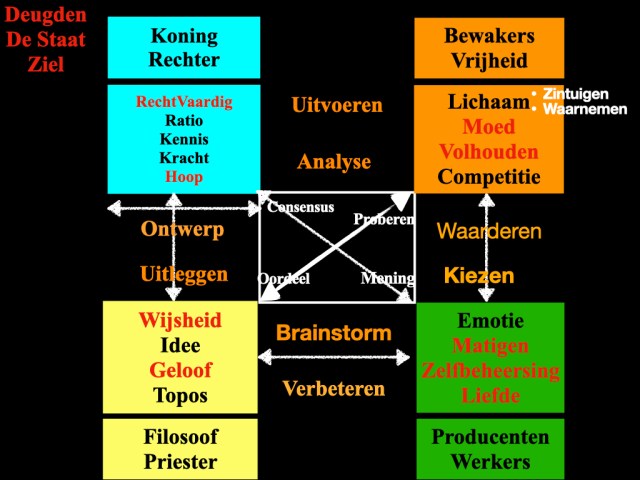
Spinoza is the Christ of philosophers and the greatest philosophers are hardly more than apostles who distance themselves from or draw near to this mystery“.

The great theories of the Ethics . . . cannot be treated apart from the three practical theses concerning consciousness, values and the sad passions

When we stop obeying God, the State, our parents, reason appears and persuades us to continue being docile because it says to us: it is you who are giving the orders. Reason represents our slavery and our subjection as something superior, which makes us reasonable beings“.

That identity not be first, that it exist as a principle but as a second principle, as a principle become; that it revolve around the Different: such would be the nature of a Copernican revolution which opens up the possibility of difference having its own concept, rather than being maintained under the domination of a concept in general already understood as identical“.

History progresses not by negation and the negation of negation, but by deciding problems and affirming differences. It is no less bloody and cruel as a result. Only the shadows of history live by negation“.

This world does not exist in itself; it exists only in the individual notions that express this world“.

We are points of view on the world.

It is not the subject that explains the point of view;

it is the point of view that explains the subject“.

The Idea that Identity is Difference can be easily proved by the fact that if Identity is One Every Thing would be the Same.

The Identity who is Difference is an always-differentiating process always folding, unfolding, and refolding. Deleuze calls this Identity The Fold (Le Pli).

An Identity is the Sum of many Differences which are or were Identities of their own until someone started to “fight” the Identity.

Fighting Identity is the task of the Philosopher. He (or she) has to break the Unity by creating a new Concept.

A philosopher creates a concept and the artists create new qualitative combinations of sensation and feeling. They give Life to the concept because Life is Emotions and Sensations. In the last phase science creates quantitative theories based on fixed points of reference.

They will never find the Unifying Central Point of Reference. This Point moves when the Creative Power opens up new Points of View of the Fold.

The world is a Body of infinite folds and surfaces that twist and weave through compressed time and space (The Chronotope).

Humans are the Observers and the Creators of the Fold.

An Independent Thinking Consciousness is an Illusion. We think that our thoughts are the cause of our Actions but they are the Effects of our own Actions and the Actions of Others.

We are experiencing beings and our experience generates novelty (difference).

Novelty is the seed of an idea.

Good and Evil are the illusions of a moralistic worldview that does nothing but reduce our power to act and encourages the experience of the sad passions.

We are In the World and not Alone in the Universe.

Our engagement with others determinates our power to Act and our ability to experience Joy.

To live well is to fully express one’s power, to go to the limits of one’s potential“.

LINKS

A Short Introduction to the Work of Deleuze

About Points of View