J. Konstapel Leiden 22-8-2025 All Rights Reserved.
Our reality is twisted many times to connect all polarities you can imagine. The result is a Klein Bottle. Here on the head of a friendly gnome.

Created with the help of Claude and GPT5.
This blog is a follow-up of The Geometry of Human Design.
Questions or interested to participate in my project use the contact form.
Introduction: The Limits of Hierarchical Models
For centuries, Western thought has been dominated by linear, hierarchical models of understanding. We organize knowledge into disciplines, governments into top-down structures, and consciousness itself into neat categories. Yet this approach increasingly fails to capture the dynamic, interconnected nature of reality. What if there exists a more fundamental organizing principle—one that reveals the deep patterns underlying everything from individual psychology to collective decision-making?
This exploration introduces a radical alternative: viewing reality through the lens of fractal mathematics, non-orientable topology, and cyclical processes. Rather than imposing artificial hierarchies, this approach recognizes that the same fundamental patterns repeat across all scales of existence, from the quantum to the cosmic, from the personal to the political.
The Mathematical Foundation: Fractals and Self-Reference
The Discovery of Self-Similarity
The mathematical concept of fractals—shapes that exhibit self-similarity at every scale—offers a profound metaphor for understanding reality. Unlike Euclidean geometry’s clean lines and perfect circles, fractals reveal the recursive nature of natural systems. A coastline viewed from space shows the same jagged patterns as when examined under a microscope. This isn’t mere coincidence; it reflects a deeper principle of how complex systems organize themselves.
The key insight is that complexity emerges not from complicated rules imposed from above, but from simple patterns repeating at multiple scales. The mathematician Benoit Mandelbrot showed us that infinite complexity can arise from equations as simple as z² + c. This suggests that reality itself might be fundamentally fractal—organized by recursive patterns rather than linear hierarchies.
Beyond Three Dimensions: Octonion Mathematics
While most people are familiar with real numbers and even complex numbers, few encounter the higher-dimensional number systems that reveal reality’s deeper structure. Quaternions, discovered by William Rowan Hamilton, describe rotations in three-dimensional space and form the mathematical foundation of modern physics. But there’s an even more exotic system: octonions.
Octonions exist in eight dimensions and possess a crucial property: they are non-associative. This means that (a × b) × c doesn’t necessarily equal a × (b × c). While this might seem like a mathematical curiosity, it reflects something profound about reality: not all relationships are transitive or symmetrical. In human experience, for instance, the relationship between self, other, and context cannot be reduced to simple linear equations.
Recent work in theoretical physics suggests that octonions might be fundamental to the structure of spacetime itself. If consciousness and physical reality share mathematical foundations, then eight-dimensional mathematics might describe not just particle physics, but the deep structure of experience itself.
Non-Orientable Spaces: The Klein Bottle as Metaphor
Traditional thinking assumes clear boundaries between inside and outside, self and other, subject and object. But topology—the mathematics of space and form—reveals more complex possibilities. Consider the Klein bottle: a four-dimensional surface that has no distinct inside or outside. Every point is simultaneously interior and exterior.
This topological impossibility in three dimensions becomes a powerful metaphor for consciousness and social organization. Rather than existing as separate individuals in a shared space, we might better understand ourselves as nodes in a Klein bottle-like reality where boundaries are fluid and contextual.
The implications are profound: if social systems operate on Klein bottle principles, then traditional concepts of hierarchy, control, and separation become obsolete. Instead, we find continuous surfaces where transformation is possible without crossing fixed boundaries.
Cyclical Time and the GEPL Process
Beyond Linear Progression
Western culture’s obsession with linear progress—the idea that time moves in a straight line from past to future—blinds us to reality’s fundamentally cyclical nature. Natural systems operate in cycles: seasons, circadian rhythms, ecological succession. Even human creativity follows cyclical patterns of inspiration, development, expression, and integration.
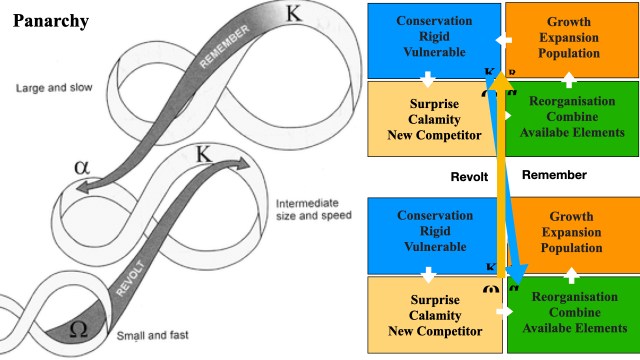
The GEPL cycle (Growth-Expansion-Peak-Learning) offers a mathematical description of how complex systems naturally evolve:
Growth (Geel): A system detects tension or potential energy. Something new wants to emerge.
Expansion: The detected pattern spreads through the system’s network, gaining energy and coherence.
Peak: Maximum intensity and expression. The pattern reaches its fullest manifestation.
Learning: Integration and wisdom extraction. The system incorporates lessons and prepares for the next cycle.
This isn’t merely descriptive—it’s predictive. Systems that honor their natural GEPL rhythms remain healthy and adaptive. Those that force linear progression or skip phases become rigid and eventually collapse.
Temporal Democracy and Natural Rhythms
If we take cyclical time seriously, it transforms our understanding of decision-making and governance. Rather than imposing artificial deadlines or forcing consensus, we can align collective processes with natural rhythms. Some decisions require immediate response (crisis cycles), while others need seasons or years to mature properly.
This suggests a temporal democracy where timing becomes as important as content. The question isn’t just “what should we decide?” but “when is this decision ready to be made?” Systems operating on cyclical principles develop what we might call temporal intelligence—the ability to sense when transformation is ripe and when patience is needed.
Human Design as Applied Fractal Psychology
The Energetic Blueprint
One of the most sophisticated applications of fractal thinking to human psychology comes through the Human Design system. Rather than categorizing people into fixed personality types, Human Design reveals the energetic blueprint underlying individual consciousness—a fractal pattern that repeats from the cellular to the cosmic level.
The system recognizes four fundamental energetic types, each with distinct strategies for engaging with reality:
Manifestors initiate new cycles, creating discontinuities that allow fresh patterns to emerge. They operate like quantum events—spontaneous and catalytic.
Generators respond to what life brings them, building sustainable energy through engagement. They form the stable foundation that allows complex systems to develop.
Projectors see the larger patterns and guide energy efficiently. They function as system optimizers, recognizing how different elements can work together.
Reflectors mirror the health of their environment, providing crucial feedback about systemic balance.
Fractal Decision-Making
What makes Human Design fractal is that these patterns repeat at every scale. An individual Manifestor operates according to the same principles as a Manifestor community or even a Manifestor civilization. The mathematics are scalable—what works for personal decision-making also applies to collective governance.
This suggests that effective social organization requires honoring the different energetic types and their distinct decision-making processes. Rather than imposing uniform procedures, fractal systems adapt their processes to match the energetic signature of what wants to emerge.
Practical Applications: From Theory to Implementation
Organizational Fractals
Consider how these principles might transform organizational design. Instead of rigid hierarchies, imagine structures that self-organize according to fractal principles. Each level of the organization mirrors the same basic pattern, but with appropriate scaling.
A fractal organization might have:
- Local autonomy that mirrors the organization’s overall purpose
- Cyclical processes that honor natural rhythms rather than artificial quarters
- Energetic diversity that includes all four Human Design types at every level
- Non-orientable boundaries that allow for fluid collaboration across traditional silos
Such organizations would be simultaneously more stable and more adaptive than traditional structures. They could respond quickly to crisis while maintaining long-term coherence.
Educational Implications
Fractal thinking revolutionizes education by recognizing that learning follows natural patterns rather than linear curricula. Each student’s energetic type suggests different optimal learning strategies, while the fractal principle means that deep understanding in any domain can illuminate patterns in all others.
Rather than fragmenting knowledge into separate subjects, fractal education might organize around recurring patterns that appear in mathematics, biology, psychology, and social organization. Students would develop pattern recognition abilities that serve them regardless of their specific field of study.
Therapeutic and Healing Applications
Individual healing becomes a fractal process when we recognize that patterns present in one area of life reflect systemic principles. Physical symptoms, emotional patterns, relationship dynamics, and creative expression all mirror the same underlying fractal structure.
Effective therapy might focus less on symptom management and more on supporting the person’s natural GEPL cycles. What wants to emerge? Where is energy expanding? What patterns have reached their peak and need integration? How can learning be extracted and incorporated?
Collective Intelligence and Emergence
Beyond Individual Consciousness
One of the most revolutionary implications of fractal thinking involves consciousness itself. If individual awareness operates according to fractal principles, then collective consciousness—the shared intelligence of groups—follows the same mathematical laws.
This means that groups of people can literally think together in ways that transcend individual cognition. Not through consensus or compromise, but through fractal resonance where individual intelligence amplifies collective wisdom.
Such collective intelligence requires:
- Energetic diversity: All four Human Design types participating
- Cyclical processes: Honoring natural rhythms of emergence
- Topological fluidity: Klein bottle-like boundaries that allow for continuous transformation
- Fractal scaling: Patterns that work at every level from pairs to nations
Technological Fractals
Digital technology, when designed according to fractal principles, could support rather than undermine human consciousness. Instead of addictive interfaces that fragment attention, fractal technologies would adapt to individual energetic signatures while facilitating collective intelligence.
Imagine software that morphs its interface based on your Human Design type and current cyclical phase. Or social networks organized as Klein bottles where information flows continuously without creating echo chambers or filter bubbles.
Such technologies would feel less like tools we use and more like extensions of natural intelligence—supporting the fractal patterns that already organize reality rather than imposing artificial structures.
Implications for Global Challenges
Climate and Systemic Crisis
The global challenges facing humanity—climate change, social inequality, technological disruption—resist linear solutions precisely because they are fractal in nature. Climate patterns, economic systems, and social dynamics all operate according to the same underlying mathematical principles.
Effective responses require fractal strategies that address root patterns rather than surface symptoms. This means:
- Cyclical thinking that works with natural rhythms rather than against them
- Energetic diversity in leadership and decision-making
- Topological fluidity that allows for transformation without violent revolution
- Fractal scaling from individual behavior change to global coordination
Democratic Innovation
Current democratic systems, based on linear representation and majority rule, fail to capture the complex intelligence present in human communities. Fractal democracy might operate through:
- Cyclical representation where leadership rotates according to natural rhythms
- Energetic governance that includes all four Human Design types in decision-making
- Topological participation where boundaries between citizen and representative become fluid
- Fractal scaling from neighborhood councils to global coordination
Such systems would be simultaneously more responsive to immediate needs and more capable of long-term planning.
Conclusion: A New Paradigm Emerging
The transition from linear to fractal thinking represents more than intellectual curiosity—it may be an evolutionary necessity. As global systems become increasingly complex and interconnected, our conceptual frameworks must become sophisticated enough to match reality’s inherent sophistication.
This doesn’t require abandoning rational thought or scientific method. Instead, it means expanding our mathematical and philosophical toolkit to include the insights emerging from chaos theory, topology, and systems science. The goal isn’t to replace logic with intuition, but to develop forms of intelligence that honor both analytical precision and pattern recognition.
The fractal approach offers hope precisely because it reveals order within apparent chaos. The same patterns that organize galaxies also organize consciousness, relationships, and social systems. By learning to recognize and work with these patterns, we can navigate complexity without being overwhelmed by it.
Perhaps most importantly, fractal thinking suggests that transformation is always possible. In a Klein bottle reality, there are no fixed boundaries preventing change. In cyclical time, every ending becomes a new beginning. In fractal space, individual actions can scale up to transform entire systems.
The question isn’t whether these principles are “true” in some absolute sense, but whether they offer a more useful way of engaging with reality’s inherent complexity. As we face challenges that require both individual wisdom and collective intelligence, fractal approaches may provide the mathematical and philosophical foundation for the next stage of human development.
The future doesn’t have to be a linear extrapolation of current trends. By understanding the fractal patterns that underlie all complex systems, we can participate consciously in the emergence of new possibilities—individually and collectively.
References and Further Reading
Foundational Mathematics and Physics
Mandelbrot, B. B. (1982). The Fractal Geometry of Nature. W. H. Freeman and Company.
- Seminal work establishing fractal mathematics as a tool for understanding natural complexity.
Baez, J. C. (2002). “The Octonions.” Bulletin of the American Mathematical Society, 39(2), 145-205.
- Comprehensive mathematical treatment of octonion algebra and its applications in physics.
Conway, J. H., & Smith, D. A. (2003). On Quaternions and Octonions: Their Geometry, Arithmetic, and Symmetry. A K Peters/CRC Press.
- Advanced exploration of higher-dimensional number systems and their geometric implications.
Penrose, R. (2004). The Road to Reality: A Complete Guide to the Laws of the Universe. Jonathan Cape.
- Mathematical physics foundations including discussion of exotic algebras and topological spaces.
Rowlands, P. (2007). Zero to Infinity: The Foundations of Physics. World Scientific Publishing.
- Exploration of how octonion mathematics might underlie fundamental physics.
Topology and Spatial Mathematics
Barr, S. (1964). Experiments in Topology. Thomas Y. Crowell Company.
- Accessible introduction to non-orientable surfaces including Klein bottles and Möbius strips.
Weeks, J. R. (2002). The Shape of Space. Marcel Dekker.
- Comprehensive exploration of topological spaces and their implications for understanding reality.
Francis, G. K. (1987). A Topological Picturebook. Springer-Verlag.
- Visual exploration of complex topological concepts including Klein bottles and projective spaces.
Systems Theory and Complexity Science
Capra, F. (1996). The Web of Life: A New Scientific Understanding of Living Systems. Anchor Books.
- Integration of systems thinking with ecological and consciousness studies.
Gell-Mann, M. (1994). The Quark and the Jaguar: Adventures in the Simple and the Complex. W. H. Freeman.
- Nobel laureate’s exploration of complexity theory and emergent systems.
Holland, J. H. (1995). Hidden Order: How Adaptation Builds Complexity. Addison-Wesley.
- Foundational work on complex adaptive systems and emergence.
Kauffman, S. A. (1995). At Home in the Universe: The Search for Laws of Self-Organization and Complexity. Oxford University Press.
- Theoretical biology and self-organization principles in complex systems.
Prigogine, I., & Stengers, I. (1984). Order Out of Chaos: Man’s New Dialogue with Nature. Bantam Books.
- Nobel Prize-winning work on dissipative structures and temporal organization.
Varela, F. J., Thompson, E., & Rosch, E. (1991). The Embodied Mind: Cognitive Science and Human Experience. MIT Press.
- Enactive approach to cognition and consciousness studies.
Cyclical Time and Temporal Philosophy
Eliade, M. (1954). The Myth of the Eternal Return. Princeton University Press.
- Classical exploration of cyclical versus linear time consciousness.
Whitehead, A. N. (1929). Process and Reality. Macmillan.
- Process philosophy and the temporal nature of reality.
Bergson, H. (1896/2004). Matter and Memory. Zone Books.
- Philosophical investigation of time, duration, and consciousness.
Thelen, E., & Smith, L. B. (1994). A Dynamic Systems Approach to the Development of Cognition and Action. MIT Press.
- Dynamic systems theory applied to human development and cognition.
Human Design and Energetic Typology
Ra Uru Hu (1992). The Human Design System. Ra Uru Hu.
- Original source material for Human Design system and energetic typology.
Parkyn, C. (2009). Human Design: Discover the Person You Were Born to Be. New World Library.
- Accessible introduction to Human Design principles and applications.
Bunnel, L. (2011). The Definitive Book of Human Design: The Science of Differentiation. HDC Publishing.
- Comprehensive technical manual for Human Design system.
Consciousness and Collective Intelligence
Sheldrake, R. (1981). A New Science of Life: The Hypothesis of Morphic Resonance. Blond & Briggs.
- Theoretical framework for understanding collective consciousness and morphogenetic fields.
Wilber, K. (2000). A Theory of Everything: An Integral Vision for Business, Politics, Science, and Spirituality. Shambhala Publications.
- Integral theory and multi-level consciousness models.
Laszlo, E. (2004). Science and the Akashic Field: An Integral Theory of Everything. Inner Traditions.
- Systems philosophy and consciousness field theory.
Maturana, H. R., & Varela, F. J. (1980). Autopoiesis and Cognition: The Realization of the Living. D. Reidel Publishing.
- Foundational work on autopoietic systems and biological cognition.
Democratic Theory and Governance Innovation
Ostrom, E. (1990). Governing the Commons: The Evolution of Institutions for Collective Action. Cambridge University Press.
- Nobel Prize-winning research on collective governance and institutional design.
Fishkin, J. S. (2009). When the People Speak: Deliberative Democracy and Public Consultation. Oxford University Press.
- Empirical research on deliberative democracy and citizen participation.
Brown, P. (2005). Right Relationship: Building a Whole Earth Economy. Berrett-Koehler Publishers.
- Alternative economic models based on ecological and systems principles.
Korten, D. C. (2006). The Great Turning: From Empire to Earth Community. Berrett-Koehler Publishers.
- Systemic analysis of democratic and economic transformation.
Organizational Design and Management Theory
Laloux, F. (2014). Reinventing Organizations: A Guide to Creating Organizations Inspired by the Next Stage of Human Consciousness. Nelson Parker.
- Evolutionary organizational models and self-management principles.
Wheatley, M. J. (2006). Leadership and the New Science: Discovering Order in a Chaotic World. Berrett-Koehler Publishers.
- Application of complexity science to organizational leadership and design.
Senge, P. M. (1990). The Fifth Discipline: The Art and Practice of the Learning Organization. Doubleday.
- Systems thinking applied to organizational learning and development.
Climate Science and Systemic Approaches
Lovelock, J. (1979). Gaia: A New Look at Life on Earth. Oxford University Press.
- Systems approach to understanding Earth as a self-regulating organism.
Capra, F., & Luisi, P. L. (2014). The Systems View of Life: A Unifying Vision. Cambridge University Press.
- Integration of systems thinking with ecological and sustainability science.
Meadows, D. H. (2008). Thinking in Systems: A Primer. Chelsea Green Publishing.
- Practical introduction to systems thinking and leverage points for change.
Philosophy of Mathematics and Reality
Lakoff, G., & Núñez, R. E. (2000). Where Mathematics Comes From: How the Embodied Mind Brings Mathematics into Being. Basic Books.
- Cognitive science approach to mathematical understanding and its relationship to reality.
Tegmark, M. (2014). Our Mathematical Universe: My Quest for the Ultimate Nature of Reality. Knopf.
- Exploration of mathematics as the fundamental structure of reality.
Rosen, R. (1991). Life Itself: A Comprehensive Inquiry into the Nature, Origin, and Fabrication of Life. Columbia University Press.
- Mathematical biology and the relationship between mathematics and living systems.
Historical and Cultural Context
Bakhtin, M. M. (1981). The Dialogic Imagination. University of Texas Press.
- Literary theory with implications for understanding context and meaning-making.
Merleau-Ponty, M. (1945/2012). Phenomenology of Perception. Routledge.
- Embodied phenomenology and the relationship between consciousness and world.
Jung, C. G. (1959). The Archetypes and the Collective Unconscious. Princeton University Press.
- Analytical psychology and collective patterns of consciousness.
Interdisciplinary Syntheses
Bateson, G. (1972). Steps to an Ecology of Mind. Ballantine Books.
- Cybernetics, systems theory, and patterns of connection across disciplines.
Bohm, D. (1980). Wholeness and the Implicate Order. Routledge.
- Quantum physics and consciousness, holographic models of reality.
Jantsch, E. (1980). The Self-Organizing Universe. Pergamon Press.
- Evolutionary systems theory and cosmic self-organization.
Note on Sources: This bibliography includes both mainstream academic sources and works that push the boundaries of conventional thinking. Readers are encouraged to approach all sources critically while remaining open to paradigm-shifting insights that may emerge from interdisciplinary synthesis.