

0 Introduction
go to the Summary
This blog ends with a new concept Magma.
Magma is the undifferentiated, pre-logical reality that exists before our minds impose order and meaning through language and logic.
Unlike sets with clearly defined elements, magma is a fluid, ever-changing multiplicity of meanings and potentialities.
Magna looks like the Ether.also called the Vacuum.
It lies in the middle between the Universum of the Sun and the Universum of the Moon
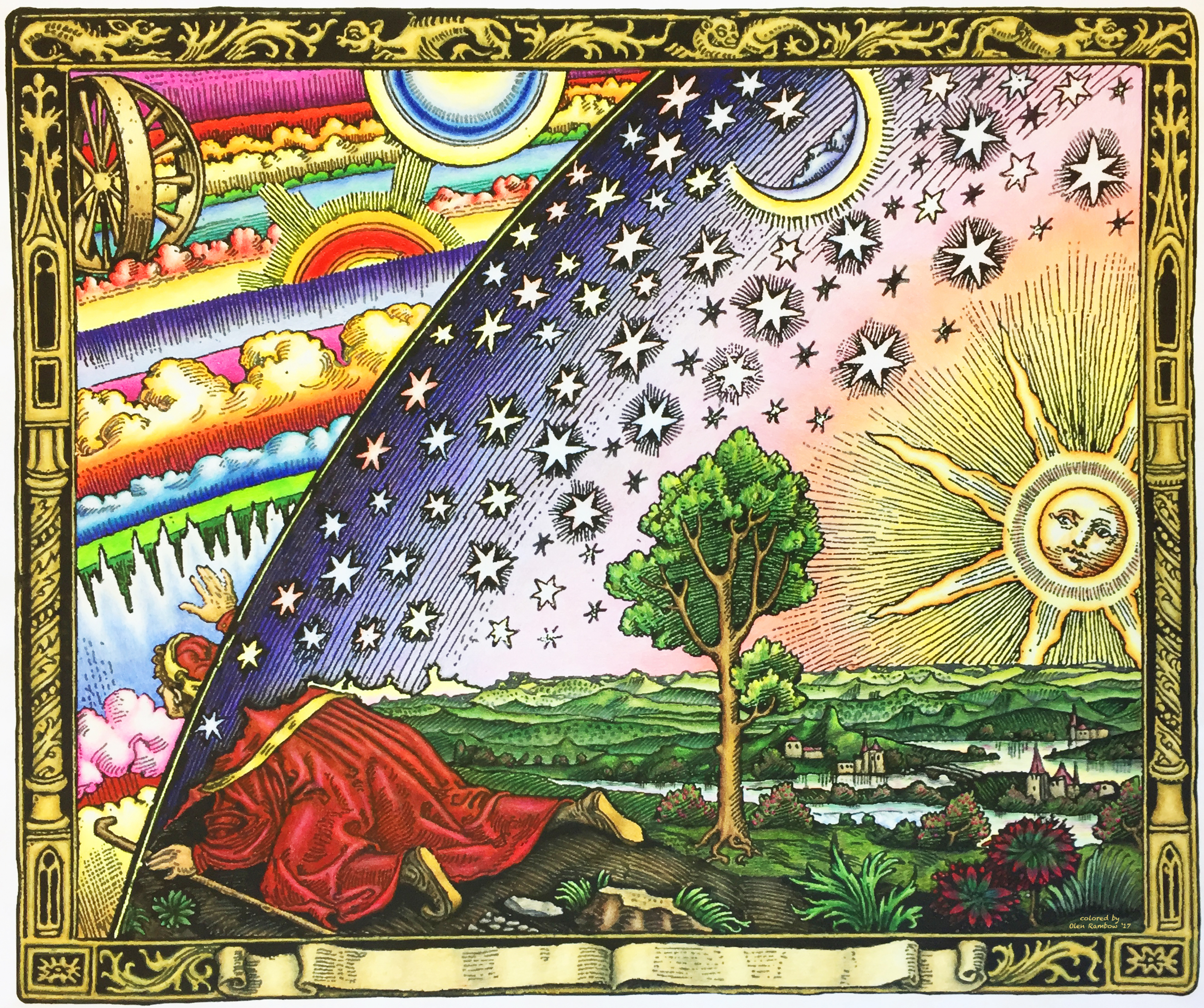
Looking for the Primordial Idea, the ? of the ?
The ? started as a . in ”Greece and became a ¿in Rome.
Magna lies behind ?, ¿,. but it is not a singularity.
This blog was about the role of Meta Systems in design especially in Software-systems until I stopped searching for a new pattern that was not a pattern or an Idea.
A metasystem is a governing structure that provides coordination and
integration of multiple systems,
It can also be used to understand the systems it contains.
Meta Systems contain Systems or other Meta-Systems.
A System is a Composition of components.
Components are really Waves that Resonate


Boundary and Enclosure
Containing can be defined in various ways, but most definitions emphasize the idea of enclosure.
- Simple enclosure: An object A contains object B if B is located within the boundaries of A. For example: “A box contains a ball.”
- Part of a whole: A contains B if B is a component of A. For example: “A car contains an engine.”
- Abstract enclosure: A contains B if B is a concept or idea that falls within A. For example: “Mathematics contains geometry.”
Inside Outside
The Object can be inside, outside or Be the Boundary

The Introduction contains links to Blogs I wrote about E8.
Skip this Introduction push here.
Part 1 is about Software Architectures.
Part2 is about Meta-systems.
The appendix contains many PDF’s about Software Architectures and Meta-systems.
Go to the Conclusion.
Part 3 Meta-Cycles
This blog is about Meta-systems and Meta-Cycles.
It is also About a strange pattern in Meta symmetries called Bott Periodicity.
This pattern shows why 8 is a Boundary in symmetries: 8=> <->4. 4 is a Square.
The Square is related to the Quaternio of Carl Jung.
Mirror
It is a model of the Human Personality and therefore of the Universe
We see ourselves in the Mirror we see.
Symmetry
Therefore the Universe is a highly symmetric structure.
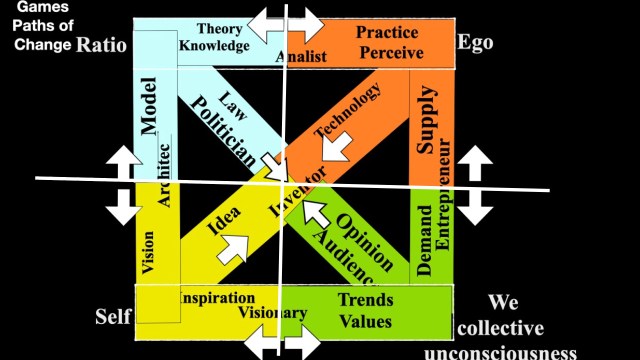
Meta-systems contain other systems and other meta-systems.
That’s why a Meta-system is a Fractal.
Meta cycles are Rotations (Quaternions)
Clerk Maxwell discovered in 1840 that the Universe, the ultimate Meta-system, can be described by the Quaternions that represent a Rotation in 4D-space.
When we look at Maxwell’s theory we can see that the universe is expanding in a spiralling pattern that according to Peter Rowlands is copied.

This spiral pattern creates two parallel 4D Mirror-Universes with a total dimension of 8 which is the maximum dimension defined by . Bott Periodicity.
Octonions
The pattern of 8 is called the Octonions.
It is represented by a Sphere rolling on a Sphere.
The Super Symmetry of E8.

How to Describe a Context
The blog below is about the Context of Mikhael Bakthin.
It is already a summary of many summaries.
Names
If you use the right, fractal, compression method and the subject is a fractal no essence is lost only the Names that classify a new expansion.
Meta = Up & Down
The meta-proces turns everything into a Map
Medieval Art is without Perspective

A map is a projection of a Sphere on a Plane.
Projective Geometry

A projection is called a Projective Geometry.
It was invented in the Renaissance when painters discovered the Perspective because they started to look with their own Eyes and not with their opinion.
Euclidian Geometry
A plane is called a Euclidian Geometry. It was invented by the Greek.

the sum of the angles is <, > and = 180 degrees.
The map is not the territory:
We experience reality with the Senses and the Emotions related to the moving Body.
With the Imagination we make an image composed of familiar images we can point to and give a Name.
Thinking -> Thencon-> Seeing.
What is a Context?
To see the context we have to find the right Point of View.

(U & D) and Forward & Backwards -> Biofield
Interpersonal Theory was based by Harry Stack Sullivan on the Electro-Magnetic theory of Clerk Maxwell.


(U&D) & (F&B) -> Spiral

This blog was triggered by my recent blog about Vibrating Vibrators (Oscillators).
Synchronization
Oscillators always synchronize.
Part 1: The Future of Software Architecture
is a computer that acts as an Organism.
Humans are organisms that are chemical (not semantic) beings.
Chemical means Biophysical, means ElectroMagnetic Resonators.

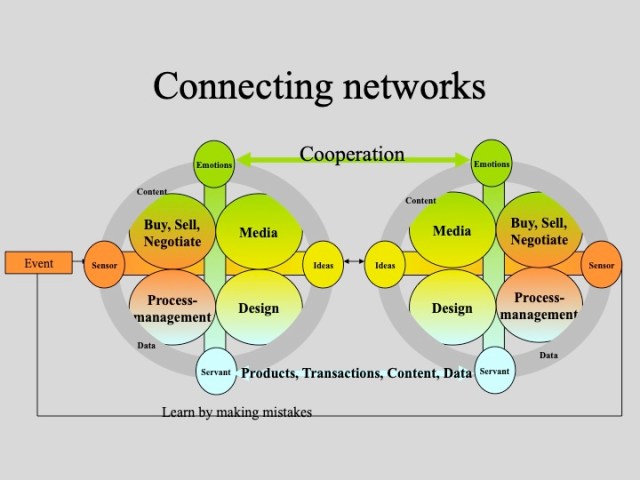


This is now a repository of intresting PDF’s about Meta-\modelling until I finished a text to explain them.
This blog is a follow-up on an earlier blog about the same subject called How to solve Wicked Problems with Meta Modelling
It is also a follow-up on Matter is a Vibrating Vibration and
Resilience & Anti-Fragility: How to Benefit from Disorder
The ulimate Meta-Model
is a Cycle of Geometries based on the Archetypes of Jung that come from Alchemy, the art of personal transmutation into a God.
In my last blog I discussed the fractal model of Light (Yellow) which is a rotation of nothing “=” being pure love.


A System looks like an Organism

the bodyplan of the bacterium is the same as the bodyplan of the human. 1 cellular organisms are based on the same fractal principle as humans are.
Game and Play
Playing is a Game of the Imagination that creates new Games.

The Meta-view of the Ecology
Fractal Panarchy Pattern in 1D.

Panarchy Pattern in 4D

Panarchy Pattrrn in 2D
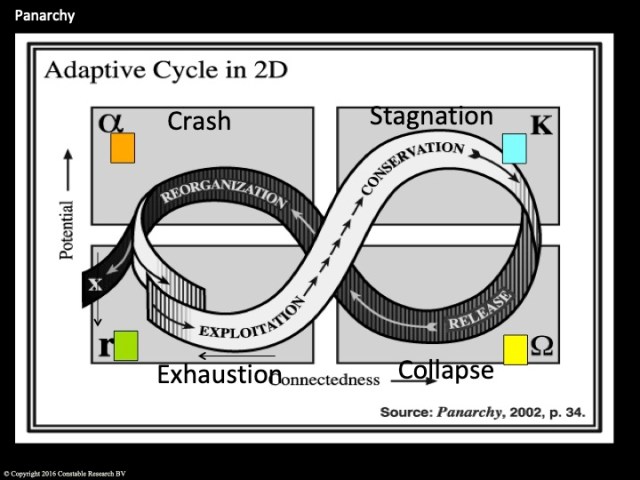
Panarchy Pattern projected on PoC and Alan Fiske.
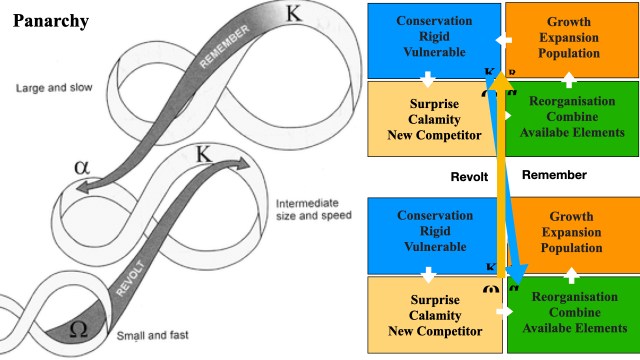
The Meta-view of History
was discoverd by Mikhhael Bahktin when he was put in the prison of the Goelag Archipel by Stalin.
We are now experiencing a return to the origin or a move into Space.


Part 2 About Meta Systems:
Meta-Physics
was seen as the most fundamental part of philosophy until it was attacked as a language-game and a subjective construction-proces. It is now focused on the pragmatic aspects of language and knowledge and on the role of social interaction in the construction of meaning.
The most advanced philosophy moved to Cybernetics, Complexity Theory and Heuristics.
Emergence: The End of Causality
Emergence is the phenomenon where new properties and behaviors arise in complex systems that cannot be reduced to the individual components of the system. These properties emerge from the interaction between the parts, but do not exist on their own.
Key concepts to understand emergence:
- Self-organization: Complex systems can spontaneously order and form patterns without external control.
- Nonlinearity: Small changes in initial conditions can lead to large changes in the outcome.
- Feedback loops: Amplify or dampen the behavior of a complex system, leading to complex patterns of behavior.
Maps in Mathematics
Maps turned into functions and functors and the “numbers” became theories. Category Theory tries to find out what functions are behind functions.
Non-Russell Set
?the basic unit of Mathematics is the Paradox
Category Theory: the Art of Composition
Abstraction
is the art of throwing away without destoying the essence being the altimate paradox between he static and the dynamic.,
Scales and Meta-systems

The four Scales above impose four different relations on a Meta-System where
(1): the Ordinal scale is related to Order and Rank , It converges to a Unity (Point) at the top.
Affine geometry studies geometric properties that are preserved by affine transformations, which include translations, rotations, scalings, and reflections. It is related to ordinal scales, which only measure the order of objects, not the absolute distances between them. Examples of affine geometry in practice include city maps, thermometer scales, and rankings of teams in a competition
(2) The Ratio scale is linked to Measuring related to a Unity, Money, the Euclidian Geometry (a Frame) and Cause and Effect which is a dominant concept because it is related to Capitalism.
Many Causes Converge sometimes in one effect.
(3) The Nominal scale lis inked to being Unique and Different and Liberalism which is a product of the French and American Revolution and Alan Fiske’s Equality Matching (EM).
EM is euivalent to to Trading without money involved.. See Anti-fragility and Panarchy.
(4) Set: Socialism and Communal Shring is related to Projective Geometry which is connecting lines (Pure Relation) where crosses of lines become Points.Point-Line-Duality : which means that points and lines can be exchanged. It also means rhat persons and their relations can be exchanged. See Interpersonal Theory.
Duality
Duality in mathematics refers to the symmetry or correspondence between different mathematical concepts or structures, such as objects and morphisms in category theory, or points and lines in projective geometry.
It often involves the interchange or reversal of certain elements while preserving important relationships or properties.
(5) The Cross being the Heart = “=“.
Meta-Levels-> Meta-Rules
Abstract concepts (games, systems, languages) are understood through meta-levels of rules and constraints.
- Ontological analysis focuses on these meta-levels (essence and rules) rather than just the entities themselves (ontic perspective).
- Higher meta-levels define broader constraints that determine the essence of lower levels.
- Different “kinds of Being” can be understood through this hierarchical structure of meta-levels.
- Applying meta-levels to phenomena (like learning) reveals their core essence and limitations.
This approach allows for a deeper understanding of a domain by progressively uncovering its underlying complexity and the constraints that shape it, even if those higher levels become more abstract and less directly controllable.
Why do higher meta-levels always involve rules?
Higher meta-levels always involve rules because they represent a level of abstraction above the concrete instances within a domain. At this higher level, the principles and structures that govern the functioning of the lower levels become visible.
These meta-rules can take various forms, such as:
- Grammar in language: Grammatical rules dictate how words can be combined to form sentences.
- Game rules in games: Game rules define how players can behave within the game and how the game can be won.
- Laws in physics: The laws of physics dictate how nature works and how different elements interact with each other.
In all these cases, the meta-rules are more abstract than the concrete instances they govern.
Grammatical rules are more abstract than the words they combine, game rules are more abstract than the actions of the players, and the laws of physics are more abstract than the concrete phenomena they describe.
This abstraction is crucial because it allows us to understand the workings of complex systems without getting bogged down in the details.
By examining the meta-rules, we can recognize the underlying principles and structures that govern the system’s behavior.
The End = E8?
Currently E8 is the most effective meta-rule ever found.
How to Compress Experience of many Observers during the History of Mankind
This method only works when there are many Observers that communicate and understand each other and share the new levels from zero 0 -to-six i6 in history.
It explains why science is highly diverse and is certainly not the “truth” about our reality.
A bottum-up-top-down forward-and backward proces could help.

From Down to Up: Experience -> E/M-field->E8
Rules, Theorems, and Categories (Meta-level 1): Derived from observations and experiences (level 0). As we identify repeated patterns, we establish rules and categories to organize and describe them.
Properties, Axioms, and Spectra (Meta-level 2): Based on the rules and categories of the first meta-level. After establishing rules and categories, we examine the properties of objects and phenomena within these categories, as well as the fundamental assumptions (axioms) guiding our understanding.
Exceptions, Anomalies, and Singularities (Meta-level 3): Emerges from understanding properties and axioms. As our understanding deepens, we become aware of exceptions and anomalies that do not fit within existing rules and patterns, leading to the discovery of new concepts or ‘singularities’.
Categorization of Content, Quality Spectra, and Singularities (Meta-level 4): Arises from identifying exceptions and anomalies. In response to these discoveries, we further categorize and explore content, focusing on qualitative aspects and variability within categories.
Isolation, Transition, and Mutation (Meta-level 5): Result of understanding categorization and quality spectra. Delving deeper into variability within categories, we isolate individual elements and examine their transitions and mutations, leading to a better understanding of fundamental building blocks of phenomena.
Monads, Facets, and Wild Being (Meta-level 6): Derived from understanding isolation, transition, and mutation. At this highest level, we focus on the ultimate reduction of phenomena (monads), while acknowledging aspects of reality that cannot be fully reduced and fall beyond our comprehension (Wild Being). Facets serve as a way to understand and categorize these irreducible aspects
Appendix
Many PDF’s about Meta-Systems
Kent Palmer about Meta Systems
This PDF was used to test the theories I developed.
It is advised to read it!
https://slideplayer.com/slide/4545224
Conclusion
An Idea is a Beginning and an End.

Winter is the endstate of Autumn and Summer is the endstate of Spring.
Spring is the beginning and the end..
Cornelius Castoriadis
tried to solve the problem of the Ontology by trying to find a pattern that is Unique by itself.
Magma
Plato called it an Idea.
Cornelius called it Magma.
Magma is the undifferentiated, pre-logical reality that exists before our minds impose order and meaning through the frames of language and logic.
Unlike sets with clearly defined elements, magma is a fluid, ever-changing multiplicity of meanings and potentialities.
The concept of “magma,” as introduced by Cornelius Castoriadis, refers to a mode of being or existence that differs from traditional categories such as sets and classes.
A magma is characterized by the property that its elements are not fully determined or distinguishable.
In other words, the structure of a magma cannot be unequivocally established, and its elements are intertwined and dynamic.
In the context of Castoriadis’ philosophy, the concept of “magma” emphasizes the complexity, dynamism, and non-fully determined nature of systems, transcending traditional categorization and determinism. It suggests an openness to change and evolution, as well as a refusal of strict categorization.
In summary, a magma is a complex and dynamic entity whose elements are interconnected, and whose structure cannot be fully determined.
there is big overlap with the work of Mikhael Bahktin.
Summary
0 Introduction
This blog started as a search into meta-systems guided by the PDF of Kent Palmer in the Appendix.
As always the research got a life of tis own and ended with the pilosophy of Cornelius Castoriadis.
He tried to find what he called magna that has no parts and always resist being confined to sets.
Magna is always “new” but is also always there.
It is lies on the tip-of-the-tongue”.
To find magna you have to bstract which is throwing away what is trivial until you find the essence.
Meta Systems contain essence until you find a new meta-system.
To me E8 also called Supersymmetry was an essence and I was able to map many old essences into E8 until I found Magna.
Part 1 Software Architectures are defined by Meta-Models.
They describe the models that can be used to define software.
Software started to automate manual labor and meta-models started as data-models implemented in databases.
Later proces-models and content-models were added.
Currently Software is moving from the Body to the Mind forgetting the Soul.
Part 2 Meta Systems
It started with the Meta-fysics of Aristoteles that was found in an Arabic Library in Constantinopel
It was translated in Greek and than Latin.
It started the Renaissance.
Russell and Witgenstein reconstructed Mathematics that was abstracted away into a Map of Theories that became symmetries until Duality was discovered again.
Now Methematics is almost automated but Philosophy is not because Humans keep looking for Magna.
Part 3 Meta-cycles
are procesmodels that represent cycles with many different cycletimes.
The shortest cycletime is related to Light that is the foundation of Matter.
We are made out of Flickering Contradictions.
go back to the Introduction